Osmosis and water potential
Water potential
A measure of the tendency of water molecules to move, higher in a dilute solution and lower in a concentrated solution.
- Water potential is a measure of the tendency of water molecules to move.
- A dilute solution has a higher water potential; a concentrated solution has a lower water potential.
- In these terms, osmosis is the net movement of water molecules from a higher water potential to a lower water potential, through a partially permeable membrane.
- Water moves down a water potential gradient until the two water potentials are equal.
This is the same process as before, now described using water potential instead of 'dilute' and 'concentrated'. It is Extended-only (Supplement) content.
Turgid cells and turgor pressure
Turgid
Describes a plant cell that is firm because it is full of water, pushing the cell membrane against the cell wall.
- In a solution of higher water potential than its contents, a plant cell gains water by osmosis.
- The contents swell and push outwards against the cell wall, so the cell becomes turgid (firm).
- The outward pressure of the contents on the cell wall is called turgor pressure.
- The strong cell wall resists this pressure, so a turgid cell does not burst.
Turgor pressure keeps plant cells firm, and together turgid cells support the whole plant.
Flaccid and plasmolysed cells
Plasmolysis
The pulling away of the cell membrane from the cell wall when a plant cell loses so much water that its contents shrink.
- In a solution of the same water potential as its contents, a cell has no net water movement and becomes flaccid (soft).
- In a solution of lower water potential, the cell loses water by osmosis and its contents shrink.
- When the contents shrink so far that the cell membrane pulls away from the cell wall, the cell is plasmolysed.
- If many cells become flaccid or plasmolysed, the plant loses its support and wilts.
In a plasmolysed cell the membrane pulls away from the wall; the rigid cell wall itself does not move.
Water potential and water uptake
Water potential
A measure of the tendency of water molecules to move, higher in a dilute solution and lower in a concentrated solution.
- Water moves into or out of cells depending on the water potential of their surroundings.
- Root hair cells take in water from the soil, because the soil solution has a higher water potential than the cell contents.
- Water then passes from cell to cell across the root by osmosis, moving down a water potential gradient.
- If the surroundings have a lower water potential, such as very salty soil, water leaves the cells and the plant loses water.
Controlling water potential lets organisms take up water where they need it and limits water loss in dry or salty surroundings.
- State osmosis in terms of water potential.
- Does a concentrated solution have a high or a low water potential?
- What is turgor pressure?
- What happens to a plant cell in a solution of lower water potential than its contents?
- Why does water enter a root hair cell from the soil?
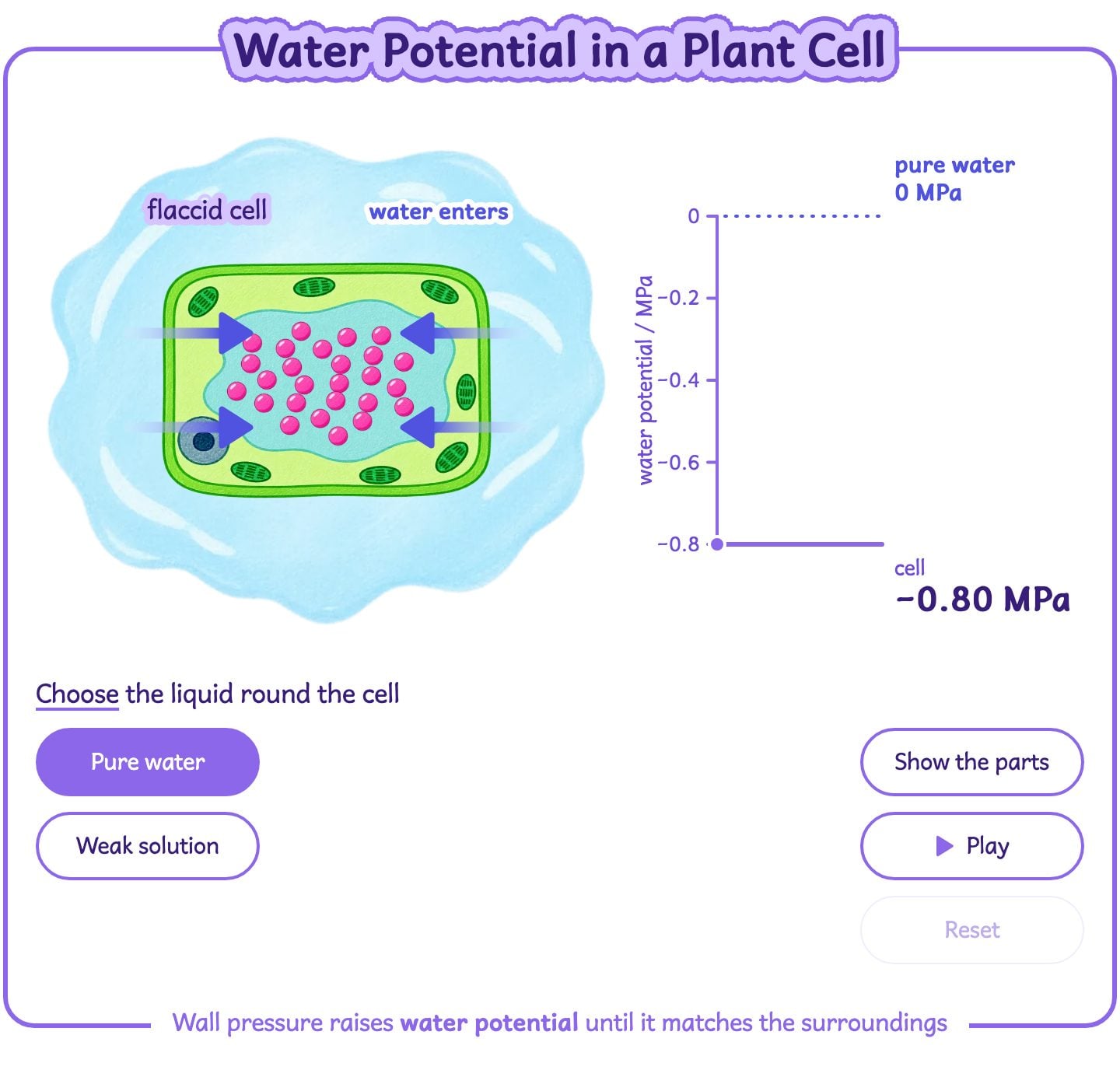
Change the surrounding solution and watch the cell go from flaccid to turgid as water enters.