Modelling osmosis with tubing
Definition
Partially permeable membrane
A membrane that lets some molecules through, such as water, but not others, such as larger solute molecules.
- Dialysis (Visking) tubing is an artificial partially permeable membrane.
- It lets water molecules through but not larger sugar molecules, just like a cell membrane.
- Placing sugar solution inside the tubing and water outside lets you follow osmosis by measuring mass.
Practical
- Soak a length of dialysis tubing in water until it softens, then tie a tight knot in one end.
- Fill the tubing with a concentrated sugar solution and tie the other end, leaving no air inside.
- Rinse the outside with water to wash off any spilt sugar, then blot it dry.
- Record the starting mass on a balance, then place the tubing in a beaker of distilled water.
- After a set time, remove the tubing, blot it dry in the same way and record the final mass.
- The tubing gains mass as water enters it by osmosis, moving from the dilute water into the concentrated solution.
Note
Because the tubing is not alive, it shows that osmosis needs only a partially permeable membrane and a difference in concentration.
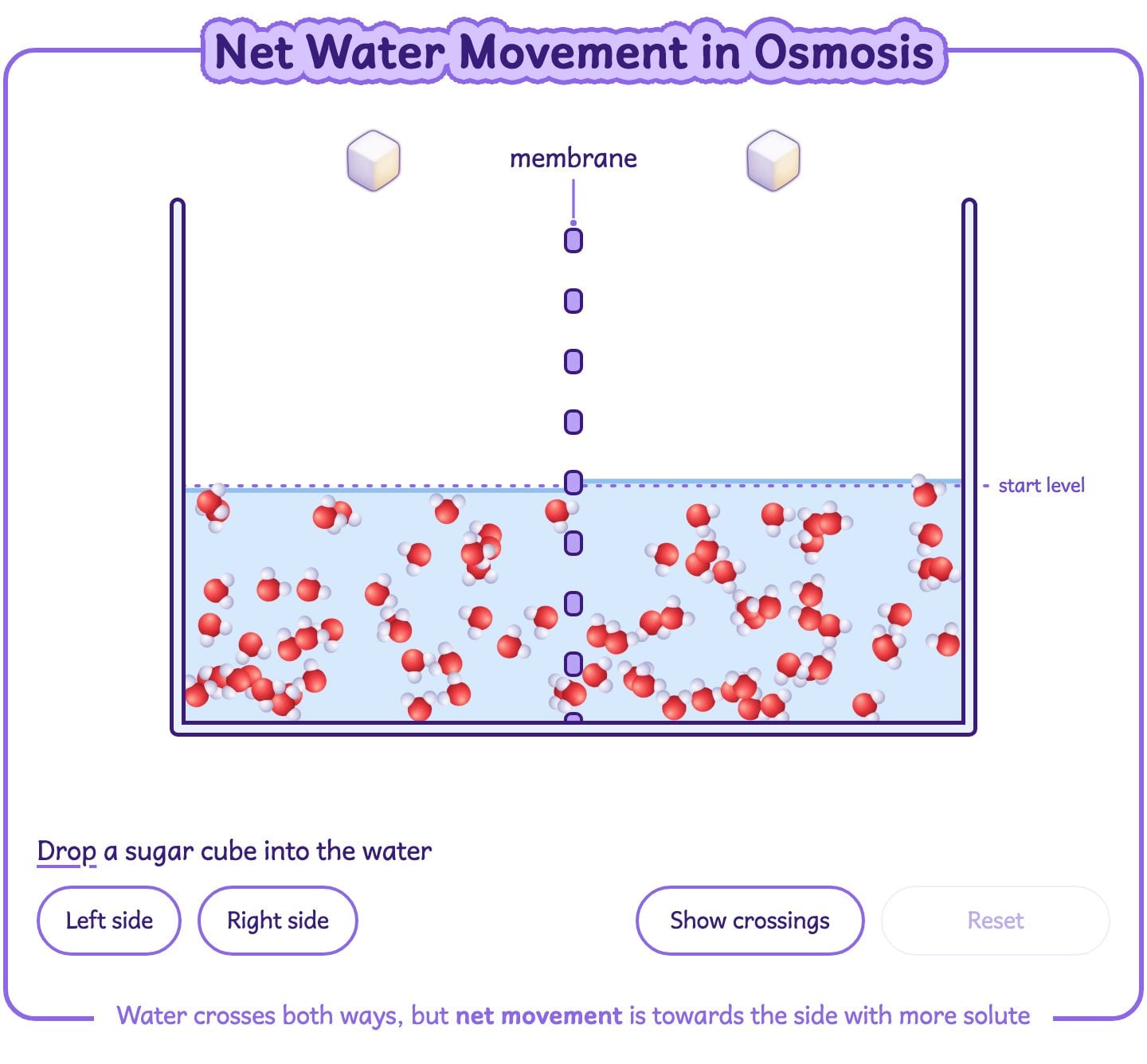
Change the solute concentration and watch water move across the membrane towards the more concentrated side.
Osmosis in plant tissue
- Osmosis also changes living plant tissue, which can be shown using cylinders of potato.
- A cylinder placed in a solution gains or loses water, changing its length and mass.
- Comparing cylinders across a range of solutions lets you find the concentration that matches the cell contents.
Practical
- Cut several potato cylinders of equal length using a cork borer and a ruler.
- Measure and record the length (or the mass) of each cylinder.
- Place each cylinder in a different sugar solution, ranging from distilled water to a concentrated solution.
- After a set time, remove each cylinder, blot it dry and measure its length (or mass) again.
- Work out the percentage change so cylinders of slightly different sizes can be compared, using % change=changestarting value×100\% \text{ change} = \dfrac{\text{change}}{\text{starting value}} \times 100% change=starting valuechange×100.
- Cylinders in dilute solutions gain water and become longer and firmer; those in concentrated solutions lose water and become shorter and softer.
Note
The solution that gives no change in length has the same concentration as the cell contents, so there is no net osmosis.
How water pressure supports plants
Definition
Cell wall
A rigid outer layer, made of cellulose in plant cells, that surrounds the cell membrane and supports and strengthens the cell.
- When plant cells take in water by osmosis, their contents press outwards against the cell wall.
- The strong cell wall resists this pressure, so the cell becomes firm without bursting.
- Firm cells press against each other and support soft plant parts such as leaves and young stems.
- If a plant loses more water than it takes in, its cells become soft and the plant wilts.
Note
The Extended article names these states using the terms turgid, turgor pressure, flaccid and plasmolysis.
Self review
- What does dialysis tubing model, and why does water move into it?
- Why is the tubing rinsed and blotted before weighing?
- Why is percentage change calculated for the potato cylinders rather than the raw change?
- What does it mean if a potato cylinder shows no change in length?
- How does water pressure inside cells support a plant?