Water as a solvent
Solvent
A liquid, such as water, in which a solute dissolves to form a solution.
- Water is the main solvent in living organisms, meaning many substances dissolve in it.
- A dissolved substance is a solute, and the mixture of solute and water is a solution.
- In digestion, digested food dissolves in water so that it can be absorbed and carried away.
- In transport, dissolved substances are carried around the body in watery blood plasma or plant sap.
- In excretion, waste products such as urea dissolve in water and are removed from the body in urine.
Because so many substances dissolve in it, water is the medium in which most reactions and transport take place.
Osmosis and membranes
Partially permeable membrane
A membrane that lets some molecules through, such as water, but not others, such as larger solute molecules.
- A partially permeable membrane lets small water molecules through but holds back larger solute molecules.
- Osmosis is the net movement of water molecules across a partially permeable membrane.
- Water moves from a more dilute solution, which has more water, to a more concentrated solution, which has less water.
- Osmosis is really a special case of diffusion in which only water moves.
Only water moves in osmosis; the dissolved solute molecules are too large to cross the membrane.
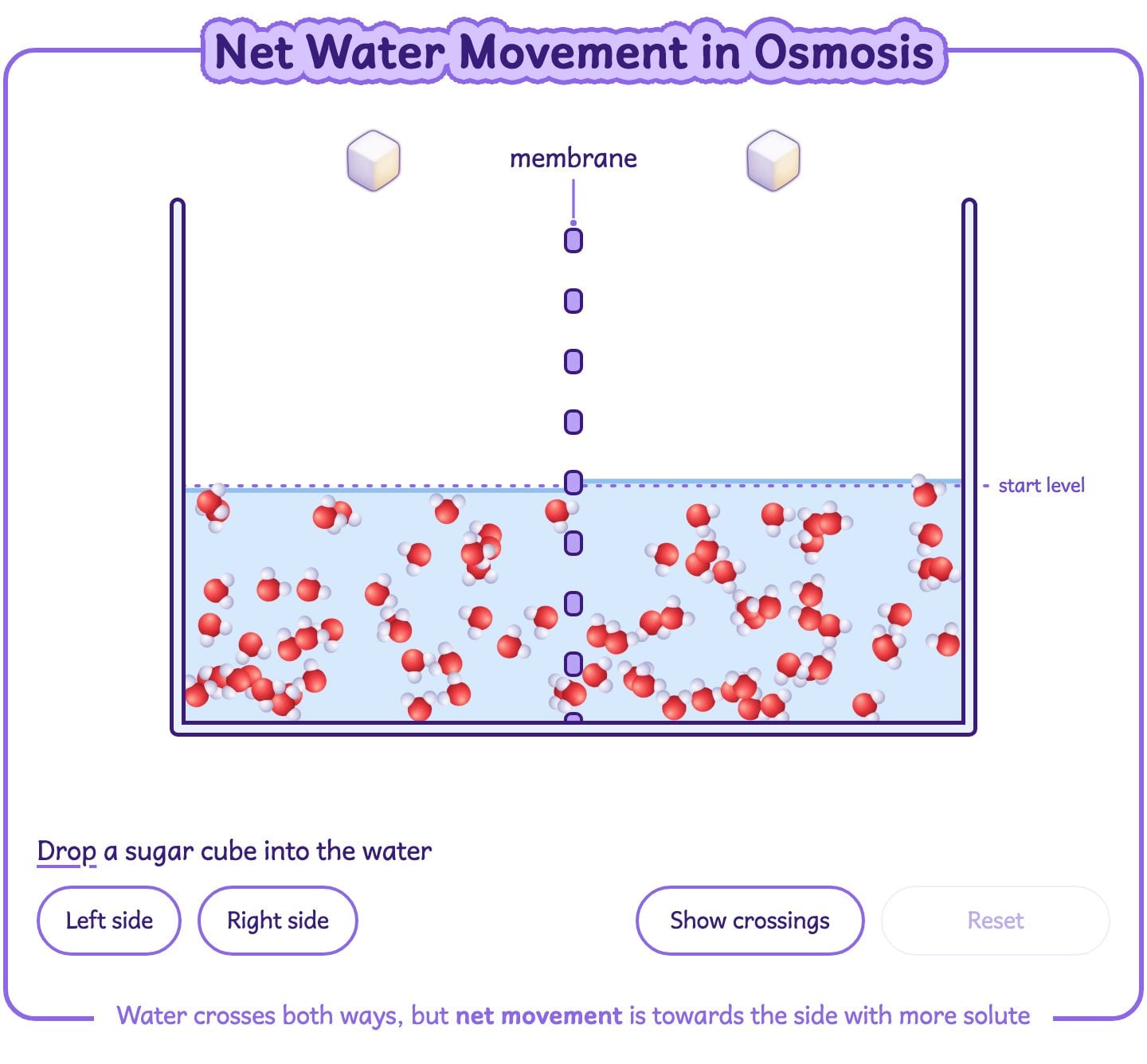
Change the solute concentration and watch water move across the membrane towards the more concentrated side.
Osmosis in cells
Osmosis
The net movement of water molecules from a more dilute solution to a more concentrated solution through a partially permeable membrane.
- The cell membrane is partially permeable, so water moves into and out of cells by osmosis.
- If a cell is surrounded by a more dilute solution than its contents, water moves into the cell.
- If a cell is surrounded by a more concentrated solution, water moves out of the cell.
- If the outside solution is the same concentration as the contents, there is no net movement of water.
A red blood cell placed in pure water gains water by osmosis and may swell until it bursts.
Hypotonic, isotonic and hypertonic
- These three words compare a surrounding solution with the inside of a cell.
- A hypotonic solution is more dilute than the cell, so water moves into the cell by osmosis.
- An isotonic solution has the same concentration as the cell, so there is no net movement of water.
- A hypertonic solution is more concentrated than the cell, so water moves out of the cell.
Cambridge questions usually say 'more dilute' or 'more concentrated', which mean the same as hypotonic and hypertonic.
- What is a solvent, and give one way water acts as a solvent in the body.
- What is osmosis, and what does a partially permeable membrane let through?
- Which way does water move if a cell sits in a hypertonic solution?
- What happens to a cell in a hypotonic solution?
- When is there no net movement of water into or out of a cell?