Why diffusion matters
Definition
Diffusion
The net movement of particles from a region of higher concentration to a region of lower concentration, down a concentration gradient.
- Living organisms rely on diffusion to exchange gases and to move dissolved substances (solutes).
- In the lungs, oxygen diffuses into the blood and carbon dioxide diffuses out of it.
- In a leaf, carbon dioxide diffuses in for photosynthesis and oxygen diffuses out.
- In the small intestine, digested food such as glucose and amino acids diffuses into the blood.
- Dissolved ions and waste products also move between cells and their surroundings by diffusion.
Note
Diffusion supplies cells with substances they need and removes waste, without using energy from respiration.
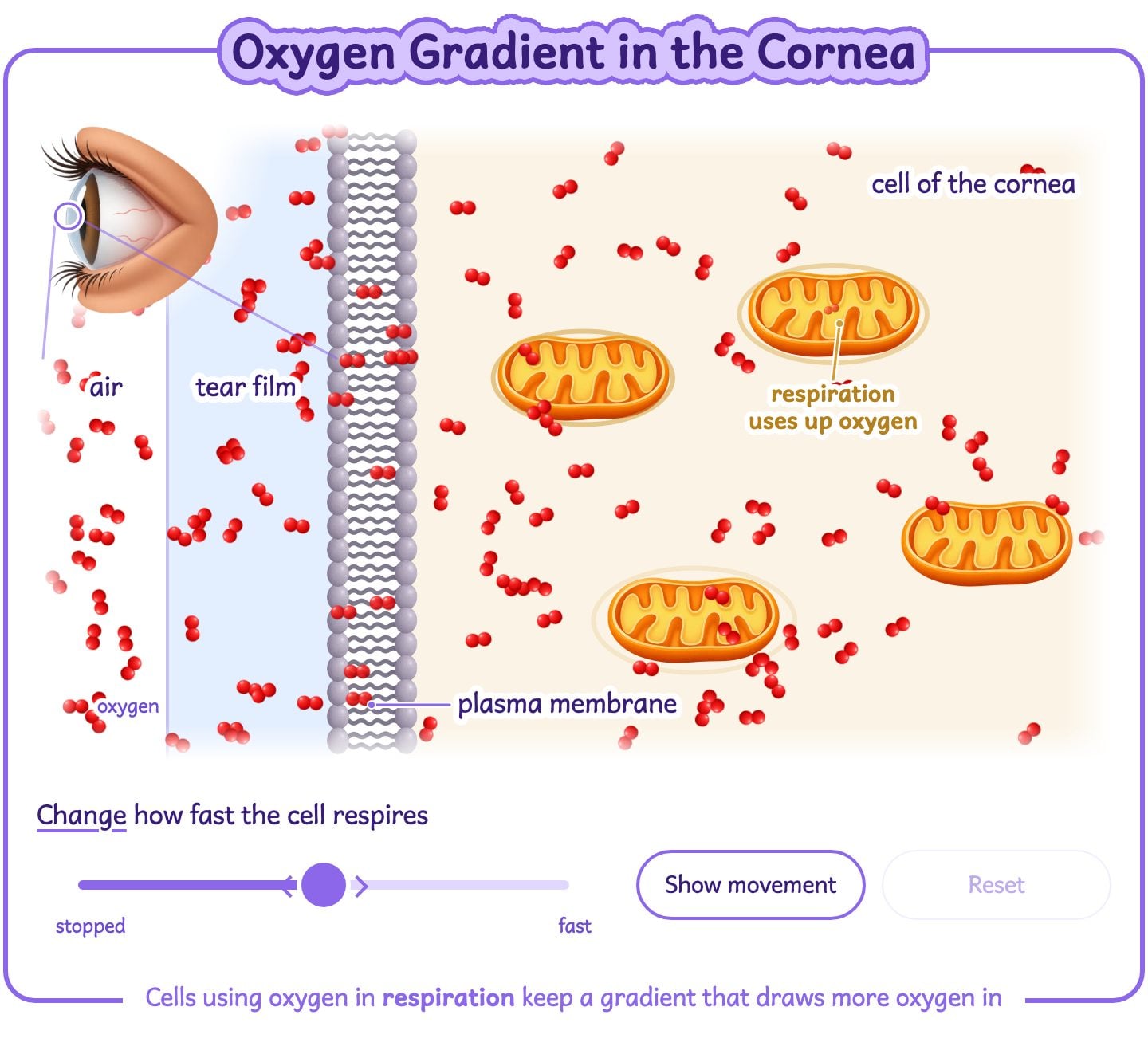
Watch oxygen diffuse in along the gradient created as cells use it up.
Factors affecting the rate
Definition
Concentration gradient
The difference in the concentration of a substance between a region of higher concentration and a region of lower concentration.
- A steeper concentration gradient speeds up diffusion, because the difference in concentration is greater.
- A higher temperature speeds up diffusion, because particles gain kinetic energy and move faster.
- A larger surface area speeds up diffusion, because more particles can cross at once.
- A shorter distance speeds up diffusion, because particles have less far to travel.
- The four factors you need are surface area, temperature, concentration gradient and distance.
- The effect of surface area on diffusion can be investigated using cubes of agar jelly.
Practical
- Set agar jelly containing a coloured indicator, such as cresol red, in a dish and let it cool.
- Cut the set agar into cubes of different sizes, for example 1 cm, 2 cm and 3 cm sides.
- Lower all the cubes into a beaker of dilute hydrochloric acid at the same moment.
- The acid diffuses in from the surface, changing the indicator's colour from the outside inwards.
- Time how long each cube takes to change colour right through to its centre.
- The smallest cube, which has the largest surface area to volume ratio, changes colour first.
- To test temperature, repeat with equal-sized cubes in acid kept at different temperatures.
Common Mistake
Change only one factor at a time and keep the others the same, so that the test is fair.
Self review
- Give one example of diffusion of a gas in the body.
- Name two digested foods absorbed by diffusion in the small intestine.
- Name the four factors that affect the rate of diffusion.
- Why does a larger surface area increase the rate of diffusion?
- In the agar cube experiment, which cube changes colour first, and why?