What diffusion is
Definition
Diffusion
The net movement of particles from a region of higher concentration to a region of lower concentration, down a concentration gradient.
- Diffusion is the net movement of particles from a region of their higher concentration to a region of their lower concentration.
- This overall movement is described as moving down a concentration gradient.
- Diffusion continues until the particles are evenly spread and the concentrations are equal.
Note
Net movement means the overall movement once the random movement in both directions is added together.
Why particles diffuse
Definition
Concentration gradient
The difference in the concentration of a substance between a region of higher concentration and a region of lower concentration.
- All particles in a liquid or a gas have kinetic energy and are constantly moving in random directions.
- They keep colliding with each other and bouncing off, so each particle follows an unpredictable, zig-zag path.
- Where particles are crowded together, more of them happen to move outwards into the emptier space than move back into the crowd.
- This is why the net movement is from the higher concentration to the lower concentration, even though every particle is moving at random.
- No energy from respiration is used to drive this movement, so diffusion is a passive process.
- The bigger the difference in concentration, the steeper the concentration gradient, and the faster the net movement.
Practical
- Half-fill a beaker with cold, still water and leave it to settle.
- Using forceps, drop a single crystal of potassium manganate(VII) into the centre.
- Do not stir the water; watch the purple colour spread outwards over several minutes.
- The dye moves from the crystal, where it is most concentrated, out into the clear water.
- In time the whole beaker turns an even, pale purple, showing that diffusion is complete.
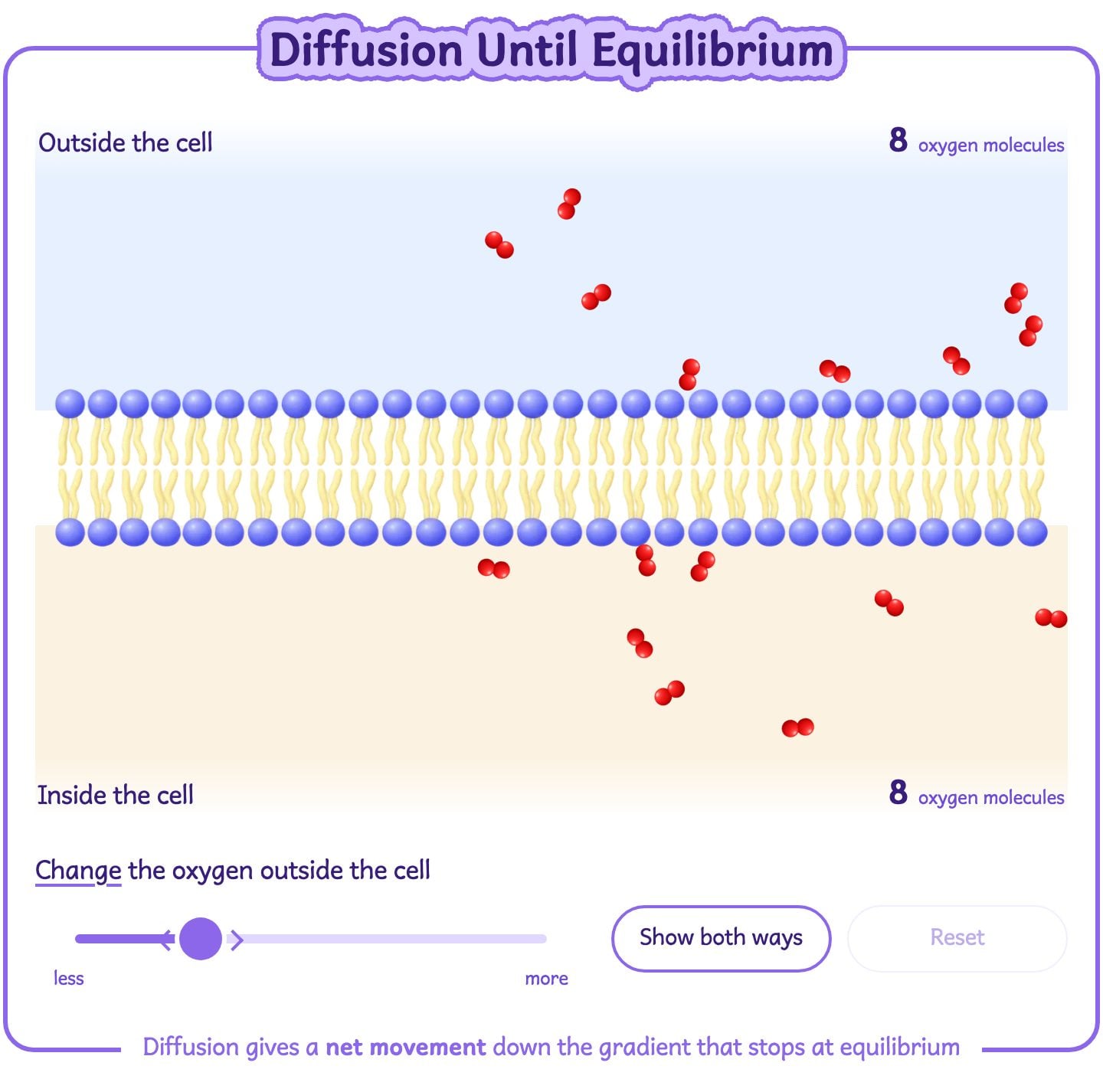
Watch the particles spread down the concentration gradient until there is no net movement.
Diffusion through the membrane
Definition
Cell membrane
The thin layer around a cell that controls which substances move into and out of the cell.
- Each cell is surrounded by a cell membrane that lets some substances pass through it.
- Small molecules such as oxygen, carbon dioxide and some nutrients can diffuse across the membrane.
- These substances diffuse down their concentration gradient, into or out of the cell.
- Oxygen diffuses into a respiring cell, because it is used up inside and so is less concentrated there.
- Carbon dioxide diffuses out of a respiring cell, because it is made inside and so is more concentrated there.
Note
The direction of diffusion depends only on where a substance is more concentrated and where it is less concentrated.
Self review
- Define diffusion.
- Explain why the random movement of particles gives a net movement down a concentration gradient.
- Does diffusion need energy from respiration?
- Why does oxygen diffuse into a respiring cell?
- Name two substances that cross the cell membrane by diffusion.