How selective breeding works
Definition
Selective breeding
The process in which humans choose organisms with desired features and breed them together over many generations so the offspring show those features.
- Selective breeding, also called artificial selection, is carried out by humans to increase a useful feature in a population.
- Select the individuals with the desirable features from the population.
- Cross these chosen individuals to produce the next generation.
- From the offspring, select those showing the desirable features and cross them again.
- Repeat this over many generations until the offspring reliably show the feature.
Note
The desirable feature must already exist as variation in the population, because selective breeding strengthens an existing feature rather than creating a new one.
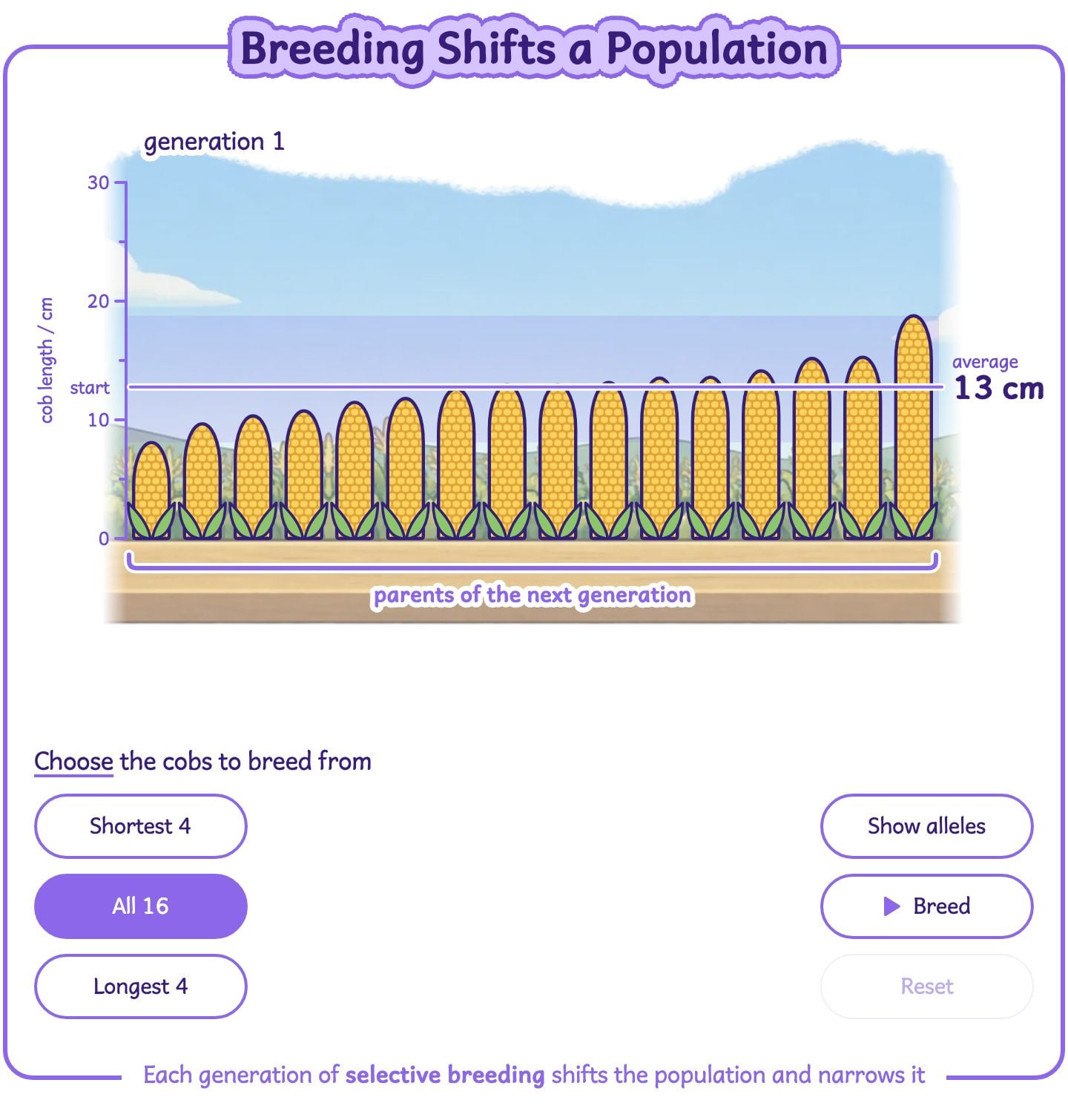
Choose the parents each generation and watch the population shift, while its variation narrows.
Selective breeding in crops and animals
- The same method is applied to improve both crop plants and domesticated animals.
- Crop plants
- Growers choose the plants with features such as higher yield, larger fruit or disease resistance, and sow the seeds of the best plants to grow the next generation.
- Domesticated animals
- Farmers breed the individuals with features such as higher milk yield or more meat, then breed again from their best offspring.
Example
Modern wheat was produced by choosing and re-sowing the highest-yielding plants over many generations, greatly increasing the grain each plant gives.
Benefits and the loss of variation
- Selective breeding produces organisms that are more useful to humans, such as higher-yield crops and higher-milk cattle.
- Repeatedly breeding closely related individuals reduces the genetic variation in the population.
- Low variation makes the population more vulnerable to a new disease or a change in conditions, because few individuals carry alleles that could cope.
Common Mistake
Do not confuse selective breeding with genetic engineering: selective breeding chooses which organisms mate, it does not move genes directly.
Self review
- Describe the repeating steps of selective breeding.
- Give one feature bred for in a crop plant and one in a farm animal.
- Why must the desirable feature already exist in the population?
- Why can selective breeding reduce genetic variation, and why is that a problem?