Adaptation as a process
Adaptation
The process, resulting from natural selection, by which a population becomes more suited to its environment over many generations.
- Adaptation is the process, resulting from natural selection, by which a population becomes more suited to its environment over many generations.
- In each generation, better-adapted individuals are more likely to survive and reproduce, so their advantageous alleles become more common.
- Generation after generation, the population becomes increasingly suited to the conditions it lives in.
- If the environment changes, different features become advantageous, and the population adapts in a new direction.
This whole article is Supplement content, examined only on the Extended papers (Paper 2 and Paper 4).
Antibiotic resistance evolves by natural selection
Antibiotic resistance
Antibiotic resistance is the ability of some bacteria to survive and continue to grow in the presence of an antibiotic that would normally kill them.
- A chance mutation in a bacterium can make it resistant to an antibiotic.
- When the antibiotic is used, it kills the non-resistant bacteria, but the resistant ones survive.
- The surviving resistant bacteria reproduce rapidly, passing on the resistance allele.
- Over time the whole population becomes resistant, producing a resistant strain such as MRSA.
MRSA is a strain of bacteria resistant to several common antibiotics, which makes its infections hard to treat in hospitals.
Do not say the antibiotic causes the mutation: the mutation arises by chance first, and the antibiotic then selects for it.
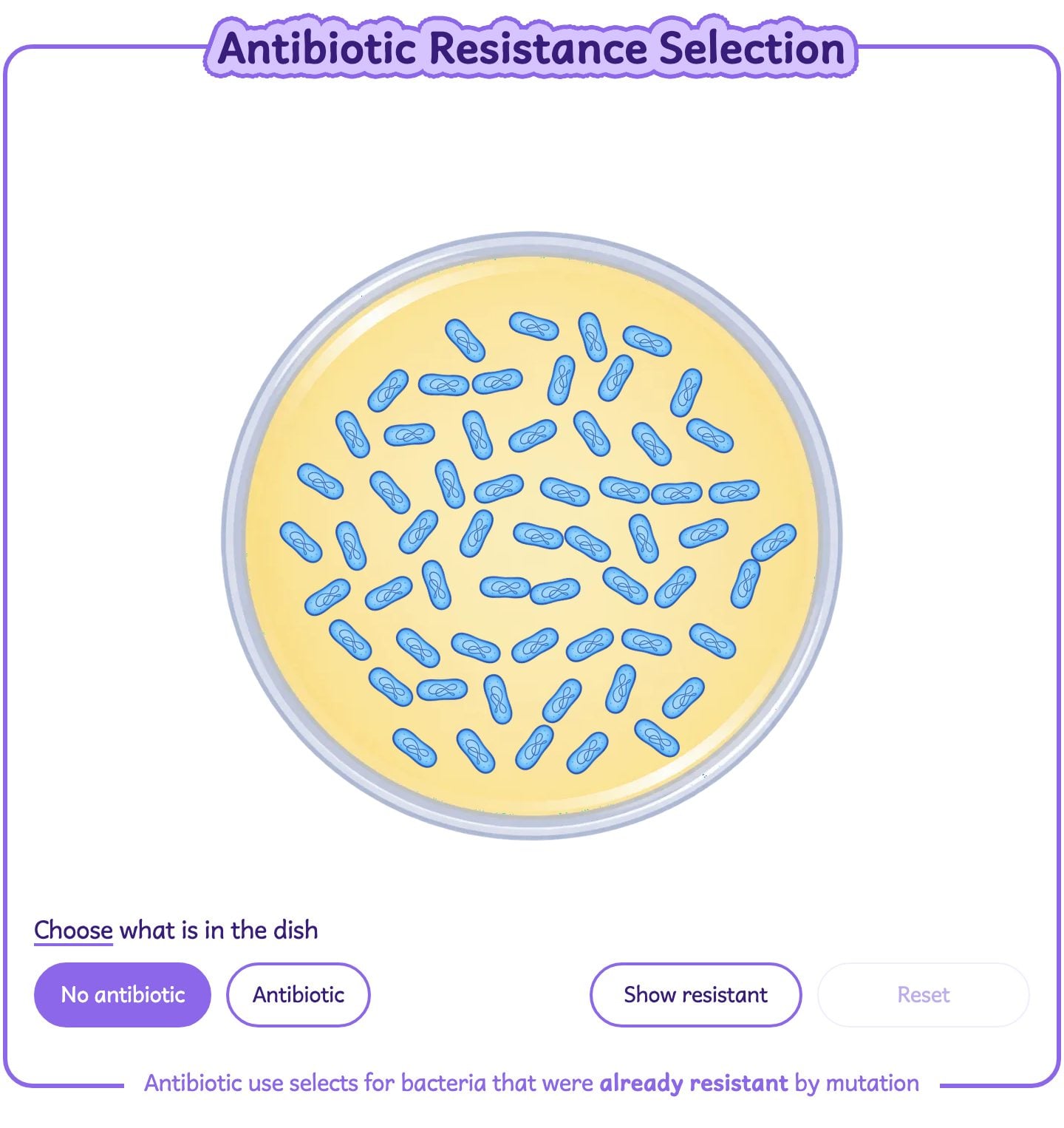
Apply the antibiotic and watch the already-resistant bacteria survive and become more common.
Natural versus artificial selection
Natural selection
Natural selection is the process by which organisms with characteristics best suited to their environment are more likely to survive, reproduce and pass on their alleles.
- Both processes act on existing variation and change how common alleles are over generations.
- In natural selection, the environment decides which individuals survive and reproduce.
- In artificial selection, also called selective breeding, humans decide which individuals breed.
- Natural selection favours features that help survival in the wild, while artificial selection favours features that are useful or desirable to humans.
The mechanism is the same, the selection of favourable alleles; the difference is whether the environment or a human does the selecting.
- Define adaptation as a process.
- Describe how a strain of antibiotic-resistant bacteria develops.
- Why is it wrong to say the antibiotic causes the resistance mutation?
- State two differences between natural and artificial selection.