How natural selection works
Definition
Natural selection
Natural selection is the process by which organisms with characteristics best suited to their environment are more likely to survive, reproduce and pass on their alleles.
- Within a population there is genetic variation: individuals carry different alleles, some suiting the environment better than others.
- Organisms produce more offspring than the environment can support.
- This leads to a struggle for survival, as individuals compete for limited resources such as food, water, space and mates.
- Individuals that are better adapted to the environment have a greater chance of surviving and reproducing than others.
- These survivors pass on their alleles to the next generation.
- Over many generations the advantageous alleles become more common, so the population becomes better suited to its environment.
Key Idea
Natural selection acts on individuals, but it is the population that changes as advantageous alleles become more common.
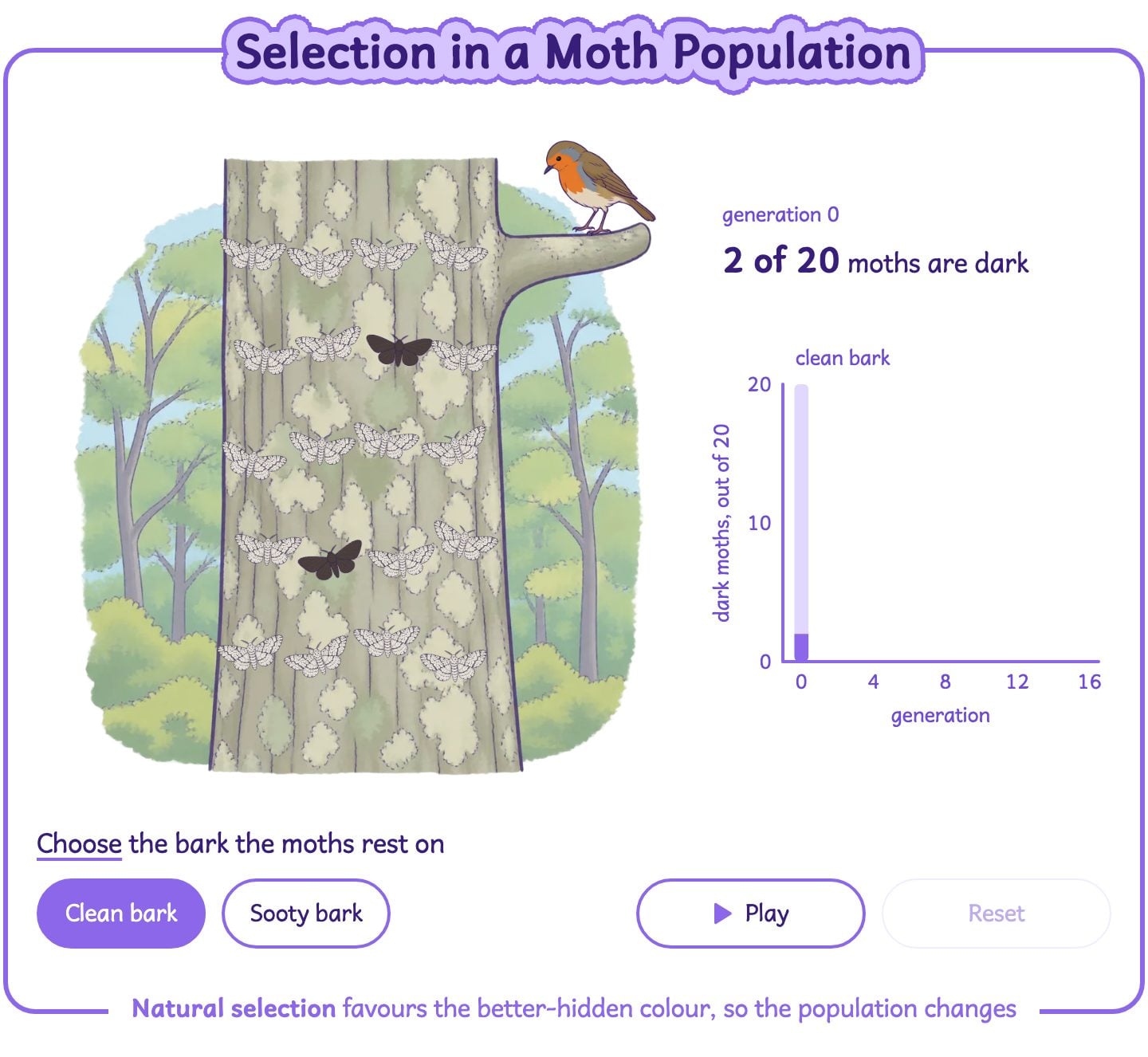
Run the generations and watch the better-hidden colour become more common in the population.
The population changes, not the individual
- An individual cannot change its own alleles to suit the environment; it either inherits helpful alleles or it does not.
- What changes over time is how common each allele is in the whole population.
- If the environment changes, different alleles become advantageous, so the direction of selection changes.
Example
When soot darkened tree bark, dark peppered moths were better camouflaged, survived predation and became more common, while pale moths declined.
Common Mistake
Do not say organisms change their bodies on purpose to suit the environment: the useful alleles are already present by chance, and selection simply favours them.
Self review
- List the five steps of natural selection in order.
- Why do organisms in a population compete?
- Why are better-adapted individuals more likely to pass on their alleles?
- Why is it wrong to say an animal changes its body to suit its environment?