What Homeostasis Is
Homeostasis
The maintenance of a stable internal environment, keeping conditions such as temperature, blood glucose and water content within narrow limits around a set point.
- Homeostasis is the maintenance of a constant internal environment.
- It keeps conditions such as temperature, blood glucose and water content within narrow limits.
- A stable internal environment lets enzymes and cells work efficiently.
The definition of homeostasis is Core; the negative feedback and set point ideas below are Supplement (Extended).
Control Systems in the Body
Receptor
A cell or sense organ that detects a stimulus (a change in the environment) and produces an electrical impulse.
- A control system has receptors that detect a change in a condition.
- A coordinator, usually the brain, receives the information and decides on a response.
- Effectors then carry out the response that corrects the change.
Set Points and Negative Feedback
Set point
The normal level, or norm, that a control system tries to keep a condition at; the actual level fluctuates gently above and below it.
Negative feedback
A control mechanism in which a change in a condition triggers a response that brings the condition back to normal.
- Each condition is kept close to a set point, which is its normal level.
- If the condition rises above or falls below the set point, receptors detect the change.
- Negative feedback then triggers a response that brings the condition back towards the set point.
- Because the response reverses the change, the condition stays close to the set point.
In negative feedback, the response always opposes the original change, rather than adding to it.
- Define homeostasis.
- Name three conditions kept constant by homeostasis.
- What is a set point?
- What does negative feedback do when a condition rises above its set point?
- Which part of the body usually acts as the coordinator?
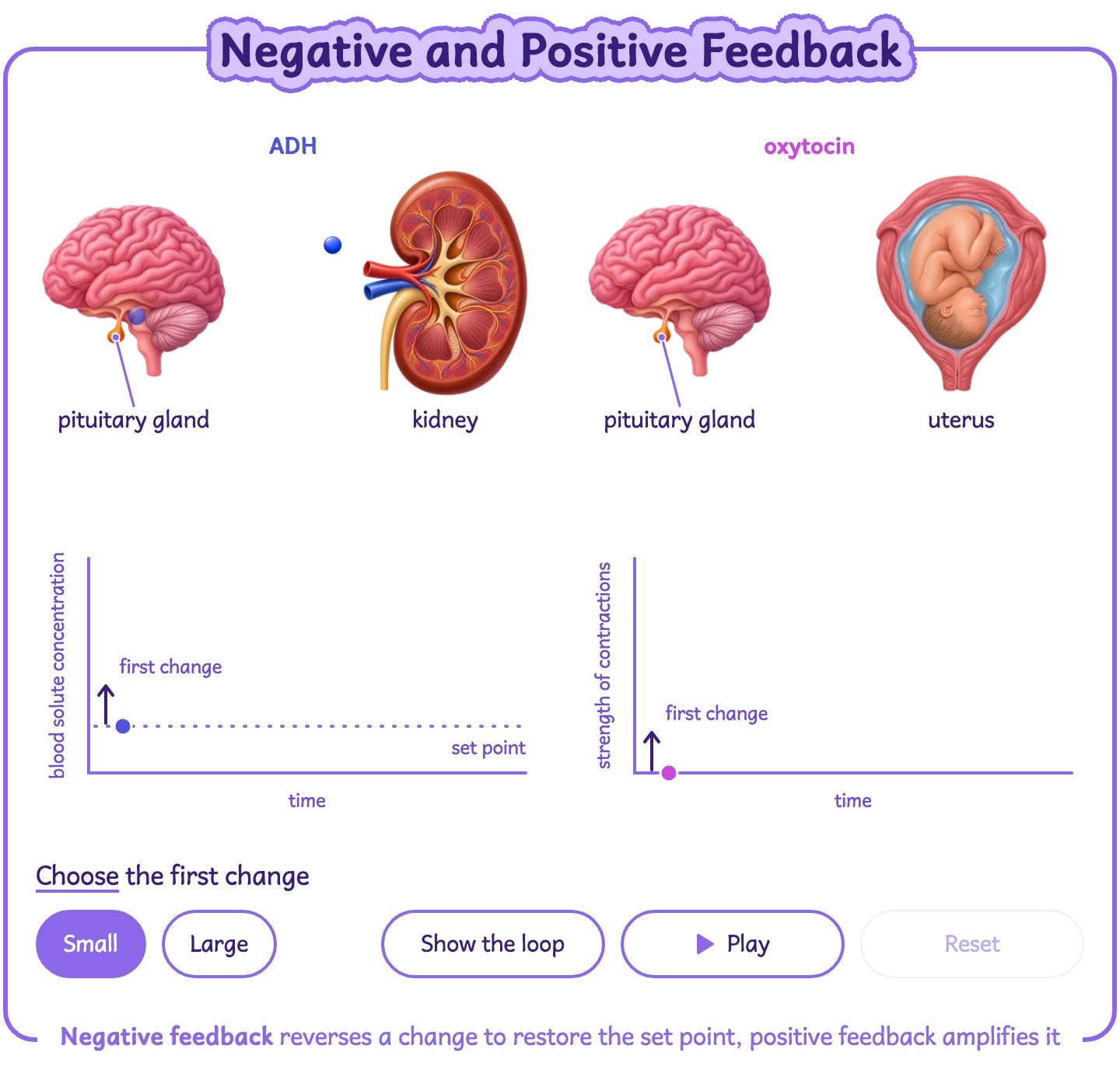
Watch a change get reversed by negative feedback so the body returns to its set point.