

What you'll learn
- What DNA is, including why it is called a polymer and a double helix.
- How DNA links to proteins, including enzymes.
- How enzymes work using the lock and key model.
- How to investigate enzyme-controlled reactions and calculate reaction rates.
The big picture: cells are chemical systems
Cells are not just tiny “bags of liquid”. They are busy places where lots of chemical reactions happen all the time. These reactions let cells grow, respire, make new substances, break substances down, and respond to changes.
The instructions for making many important cell molecules are stored in DNA. Some of the most important molecules made using these instructions are proteins, including enzymes.
Metabolism
Metabolism means the total of all the chemical reactions happening in a cell or organism. Enzymes control many of these reactions so they happen fast enough for life.
DNA: the instruction molecule
DNA stands for deoxyribonucleic acid. You do not need to memorise that full name, but you do need to understand what DNA is like.
A polymer is a large molecule made from many repeating smaller units joined together. DNA is a polymer because it is made from repeating units called nucleotides. Each nucleotide contains a sugar, a phosphate group, and a base.
DNA as a polymer
DNA is a polymer made from many repeating nucleotides. It is not a protein: proteins are made from amino acids, while DNA is made from nucleotides.
DNA is made of two strands twisted around each other to form a double helix. “Double” means two strands, and “helix” means a spiral shape. The bases on the two strands pair up in the middle, helping hold the structure together.
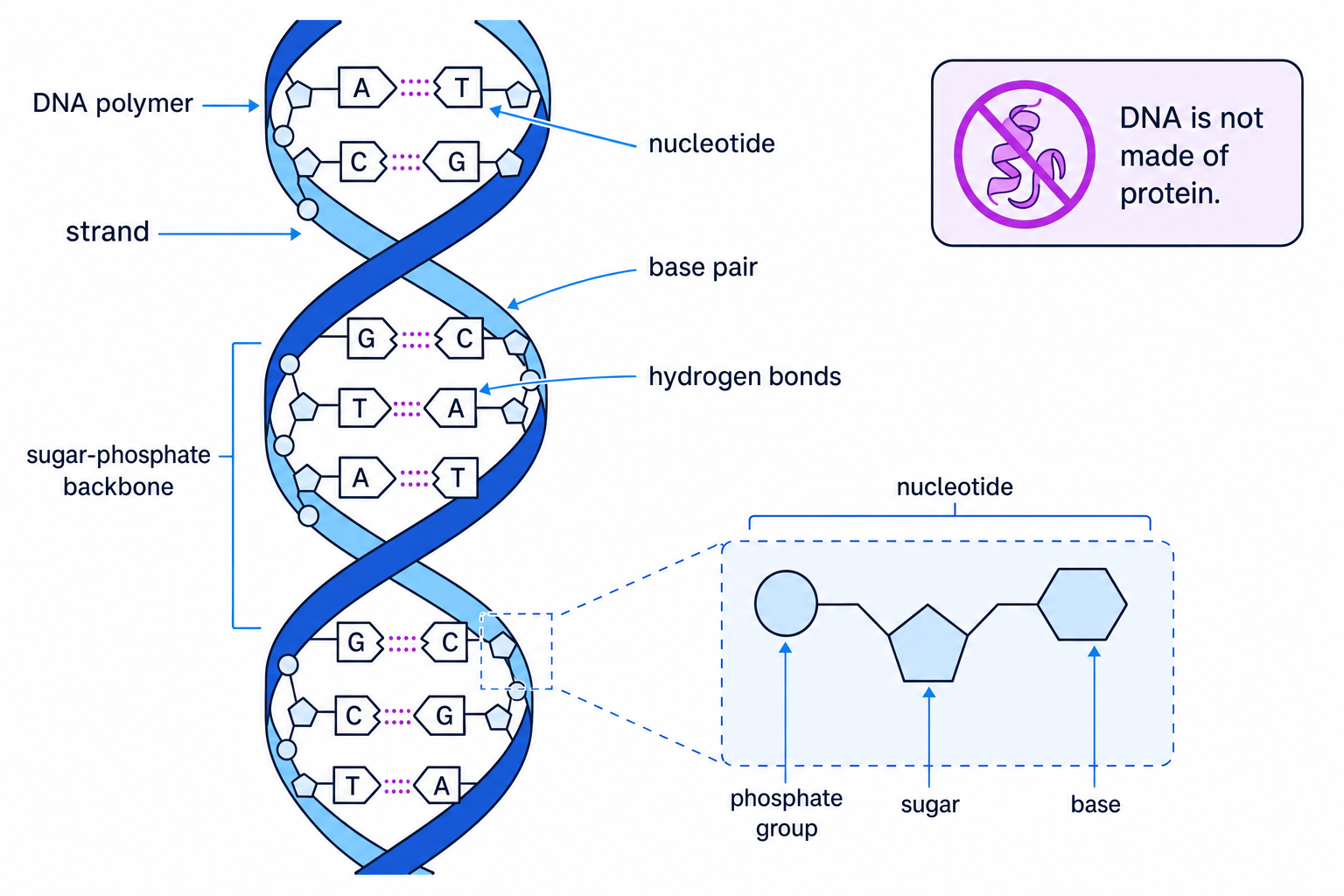
The order of bases in DNA acts like a code. A gene is a section of DNA that contains instructions for making a protein. The shape of a protein affects what it does, so the information in DNA is linked to cell function.
DNA is not made of protein
DNA and proteins are different biological molecules. DNA contains the code for making proteins, but DNA itself is made from nucleotides, not amino acids.
Proteins and enzymes
A protein is a biological molecule made from smaller units called amino acids. Proteins have many jobs in cells. For example, some form structures, some act as hormones, and many act as enzymes.
An enzyme is a protein that acts as a biological catalyst. A catalyst speeds up a chemical reaction without being used up in the reaction. This means the same enzyme molecule can be used again and again.
Enzyme
An enzyme is a protein that speeds up a biological reaction without being used up. The substance it acts on is called the substrate.
Enzymes are needed because many cell reactions would be far too slow at normal cell temperatures without them.
How enzymes work: the lock and key model
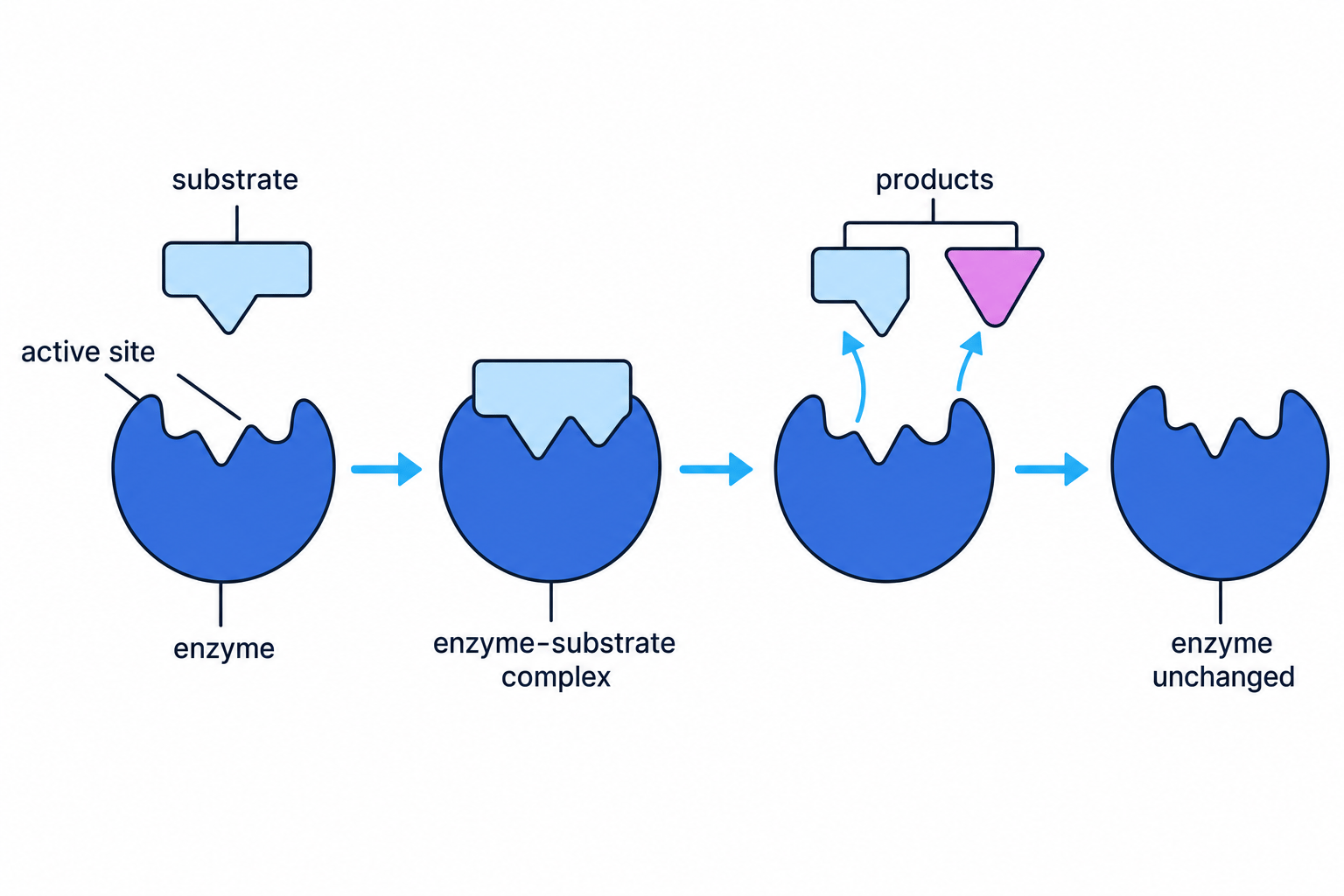
Each enzyme has a specially shaped part called the active site. The substrate fits into the active site because their shapes are complementary. Complementary means the shapes match each other.
When the substrate binds to the active site, an enzyme-substrate complex forms. The reaction happens, products are released, and the enzyme is left unchanged.
This is called the lock and key hypothesis because the substrate fits the active site like a key fits a lock.
Enzyme specificity
Enzymes are specific: usually only one substrate, or a small group of similar substrates, fits the active site well enough for the reaction to happen.
Predicting enzyme specificity
An enzyme has an active site with a deep square-shaped pocket. Substrate A has a matching square-shaped part. Substrate B has a rounded part.
- Compare each substrate shape with the active site shape: substrate A matches the square pocket, while substrate B does not.
- Use the lock and key model: only the substrate with a complementary shape can form an enzyme-substrate complex.
- Predict the reaction: substrate A is more likely to react with this enzyme, while substrate B is unlikely to fit the active site.
Factors affecting enzyme-controlled reactions
The rate of an enzyme-controlled reaction depends on how often enzyme and substrate particles collide successfully. Anything that changes the active site shape, or changes how often enzyme-substrate complexes form, can affect the rate.
Temperature
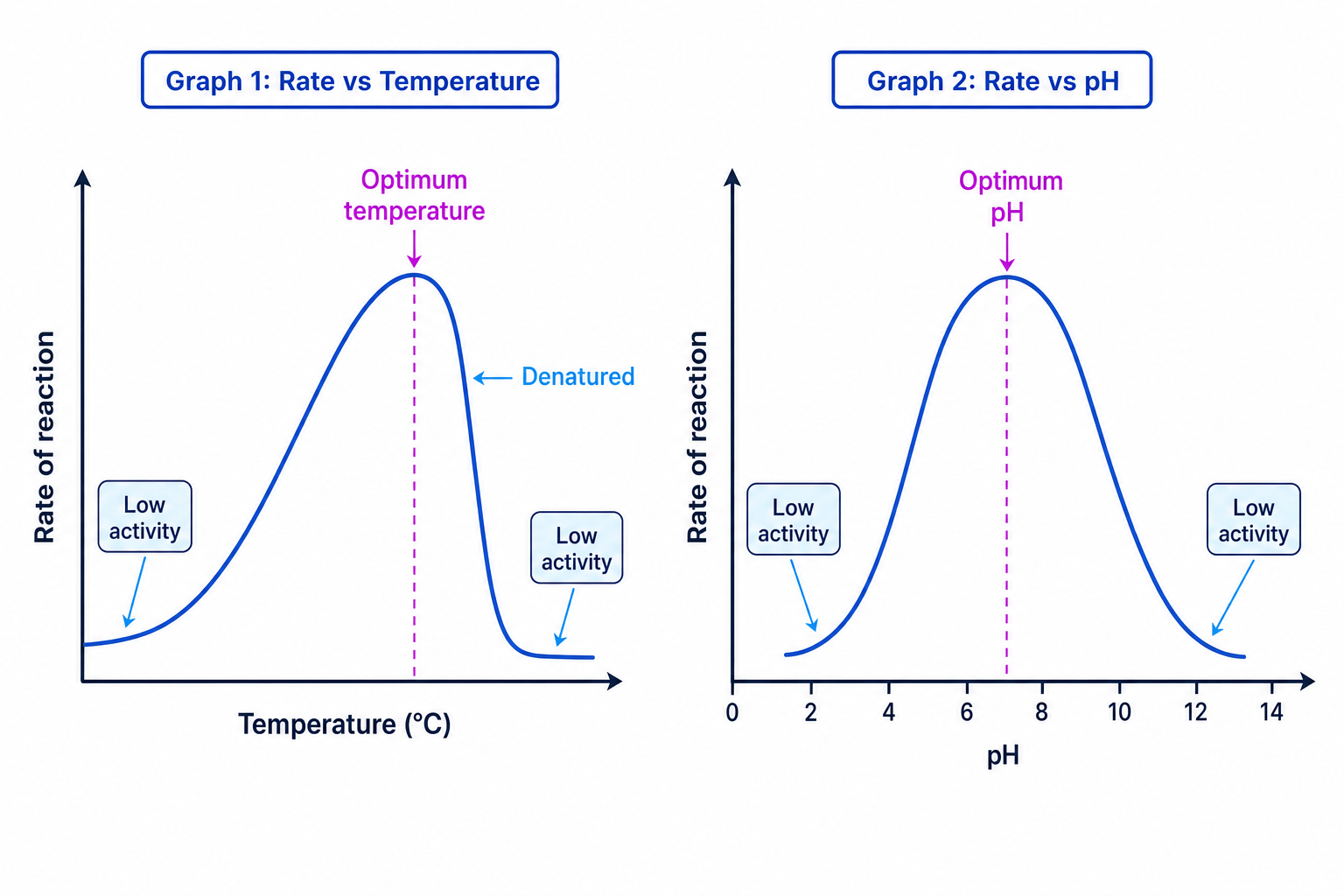
At low temperatures, particles have less kinetic energy, so enzyme and substrate molecules move slowly. There are fewer successful collisions, so the reaction is slow.
As temperature rises, particles move faster, causing more frequent successful collisions. The rate increases up to the optimum temperature, which is the temperature where the enzyme works fastest.
Above the optimum temperature, the enzyme may denature. This means the active site changes shape so the substrate no longer fits properly. The reaction rate then falls sharply.
pH
pH measures how acidic or alkaline a solution is. Each enzyme has an optimum pH where it works fastest. If the pH is too high or too low, the active site may change shape and the enzyme may denature.
Different enzymes can have different optimum pH values. For example, some enzymes in the stomach work best in acidic conditions, while others work best closer to neutral pH.
Not every enzyme works best at 37°C
Many human enzymes work best near 37°C, but this is not true for all enzymes. Enzymes from other organisms, or from different parts of the body, can have different optimum temperatures.
Substrate concentration
If substrate concentration increases, there are more substrate particles available to collide with enzyme active sites. At first, this increases the reaction rate.
Eventually, all the enzyme active sites are occupied most of the time. The enzymes are working as fast as they can, so adding more substrate no longer increases the rate. The enzyme concentration has become the limiting factor.
Enzyme concentration
If there is plenty of substrate, increasing enzyme concentration increases the rate because there are more active sites available.
But if there is not enough substrate, adding more enzyme will not help much. The substrate has become the limiting factor.
Identifying the limiting factor
A student increases substrate concentration, but the reaction rate stops rising. Then they add more enzyme, and the rate increases again.
- The rate stopping when more substrate is added suggests the enzyme active sites were already fully occupied.
- Adding more enzyme provides more active sites, so more enzyme-substrate complexes can form each second.
- Therefore, before extra enzyme was added, enzyme concentration was the limiting factor.
Investigating enzyme reactions
You can investigate enzyme activity by changing one variable and measuring how the reaction rate changes.
The variable you deliberately change is the independent variable. The variable you measure is the dependent variable. Variables you keep the same are control variables.
For enzyme experiments, common independent variables include temperature, pH, substrate concentration, and enzyme concentration.
Amylase and starch
Amylase is an enzyme that breaks down starch into sugars. A common experiment uses iodine solution to test for starch. Iodine turns blue-black if starch is present and stays orange-brown if starch has been broken down.
A typical method is:
- Mix amylase with starch solution.
- Keep the mixture at a chosen temperature using a water bath.
- Use a buffer solution to keep the pH constant.
- Take samples at regular time intervals and add them to iodine solution.
- Record the time taken for starch to disappear.
A buffer solution is a solution that resists changes in pH.
Catalase and hydrogen peroxide
Catalase is an enzyme found in many living tissues, such as potato or liver. It breaks down hydrogen peroxide into water and oxygen. You can measure the oxygen produced using a gas syringe, or measure foam height in a simpler setup.
This type of investigation is useful because the volume of oxygen gives numerical data, so you can calculate a rate and plot a graph.
Planning enzyme practicals
Only change one independent variable at a time. Keep important control variables the same, such as pH, temperature, enzyme volume, substrate volume, and concentration where appropriate.
Calculating reaction rate
The rate of reaction tells you how quickly a reaction happens. In enzyme experiments, rate might be measured using volume of gas produced per second, or using how quickly a substrate disappears.
A common formula is:
rate=amount of product formedtime taken\text{rate} = \frac{\text{amount of product formed}}{\text{time taken}}rate=time takenamount of product formedIf the experiment measures the time for something to disappear, such as starch, you can estimate a relative rate using:
relative rate=1time taken\text{relative rate} = \frac{1}{\text{time taken}}relative rate=time taken1The shorter the time, the faster the reaction.
Calculating reaction rate
In an amylase experiment, starch disappears after 40 s at one temperature and after 25 s at another temperature. Calculate the relative rate for each.
- Use the relative rate equation because the experiment measures the time for starch to disappear: relative rate=1time taken\text{relative rate} = \frac{1}{\text{time taken}}relative rate=time taken1.
- For 40 s: 140 s=0.025 s−1\frac{1}{40\ \text{s}} = 0.025\ \text{s}^{-1}40 s1=0.025 s−1.
- For 25 s: 125 s=0.040 s−1\frac{1}{25\ \text{s}} = 0.040\ \text{s}^{-1}25 s1=0.040 s−1.
- Compare the values: 0.040 s⁻¹ is greater than 0.025 s⁻¹, so the reaction was faster when starch disappeared after 25 s.
Graphs and reliability
In enzyme investigations, the independent variable normally goes on the x-axis, and the dependent variable goes on the y-axis. For example, if you investigate temperature, temperature goes on the x-axis and rate of reaction goes on the y-axis.
To improve reliability, repeat each measurement and calculate a mean, ignoring any clear anomalies if you have a good reason. A good graph should have labelled axes, units, sensible scales, and plotted points shown clearly.
In the exam
- When explaining enzyme action, use the key terms active site, substrate, enzyme-substrate complex, and products.
- For temperature questions, separate the low-temperature explanation from the high-temperature denaturation explanation.
- In practical questions, identify the independent variable, dependent variable, and at least two control variables.
Check yourself
- Why is DNA described as both a polymer and a double helix?
- What happens to an enzyme’s active site when it denatures?
- How would you calculate relative rate if starch disappeared after 50 s?
