

What you'll learn
- What cellular respiration is, and why all living cells need it.
- Why respiration is an exothermic, enzyme-controlled process that supplies ATP.
- How aerobic and anaerobic respiration compare in animals, plants and fungi.
- How carbohydrates, proteins and lipids are built up and broken down.
Starting point: cells need usable energy
Every living cell carries out chemical reactions all the time. Together, all the chemical reactions in a cell are called metabolism.
These reactions include building new molecules, moving substances across membranes, contracting muscle cells, repairing damage and keeping cells alive. Cells need a usable way to transfer energy to these processes.
ATP
ATP, or adenosine triphosphate, is a small molecule that transfers energy inside cells. Respiration supplies ATP so cells can do useful work, such as muscle contraction, active transport and making larger molecules.
Cellular respiration
Cellular respiration is a chemical process in living cells that breaks down organic molecules, such as glucose, to transfer energy into ATP.
An organic molecule is a carbon-containing molecule made by living things, such as glucose, fats and proteins. These molecules act as fuels for respiration.
Respiration is not breathing
In everyday speech, people sometimes use “respiration” to mean breathing. In GCSE biology, be more precise.
Ventilation means moving air into and out of the lungs. This helps with gas exchange: oxygen enters the blood and carbon dioxide leaves the blood.
Cellular respiration happens inside cells. It uses fuel molecules to supply ATP.
Ventilation is not respiration
Breathing moves gases around the body. Cellular respiration is the chemical process inside cells that supplies ATP. They are linked, but they are not the same thing.
Respiration happens in all living cells
Respiration is described as universal because it occurs in all living cells: animal cells, plant cells, fungal cells and microorganisms.
It is also continuous. Cells need ATP all the time, so respiration must keep happening. In cells with mitochondria, aerobic respiration mainly happens in the mitochondria, which are sub-cellular structures adapted for respiration.
Do plants respire?
Yes. Plants respire in their living cells during the day and at night. In the light, photosynthesis may also happen, but it does not replace respiration.
Respiration is controlled by enzymes
Respiration is not just one simple reaction. It is a series of enzyme-controlled reactions.
An enzyme is a biological catalyst: it speeds up a chemical reaction without being used up. This is why factors such as temperature can affect how quickly cells respire.
The big idea
Respiration breaks down fuel molecules in cells so that energy can be transferred to ATP for life processes.
Respiration is exothermic
An exothermic reaction is a reaction that transfers energy to the surroundings. Respiration is exothermic because breaking down fuel molecules transfers energy. Cells capture some of this energy in ATP, and some may be transferred as heat.
You may see evidence for this using living seeds or microorganisms: if they are respiring, the temperature can rise.
Using temperature change to show respiration is exothermic
A tube of germinating seeds rises from 20 °C to 27 °C in 30 minutes. A tube of boiled seeds stays at 20 °C.
- Calculate the temperature change for each tube: the germinating seeds increase by 7 °C, while the boiled seeds increase by 0 °C.
- Compare the tubes: germinating seeds contain living cells that are respiring, while boiled seeds act as a control because their cells are dead.
- Link the observation to the idea: the temperature rise shows energy was transferred from respiration to the surroundings, so respiration is exothermic.
Aerobic respiration
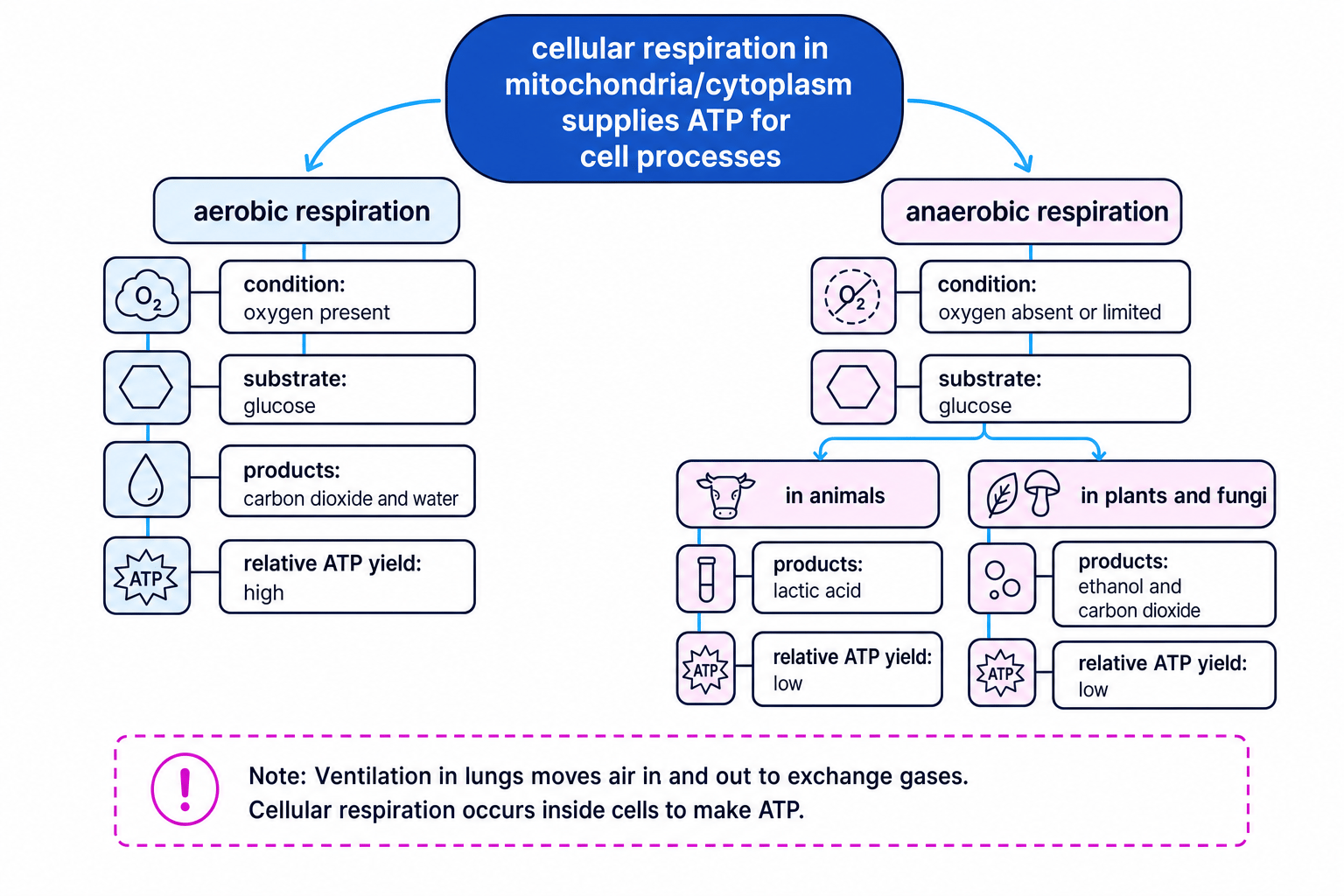
Aerobic respiration is respiration that uses oxygen. It breaks down glucose completely, so it transfers a relatively large amount of energy to ATP.
The word equation is:
glucose + oxygen → carbon dioxide + water
A balanced chemical equation, if needed, is:
C6H12O6(aq)+6O2(g)→6CO2(g)+6H2O(l)\text{C}_6\text{H}_{12}\text{O}_6\text{(aq)} + 6\text{O}_2\text{(g)} \to 6\text{CO}_2\text{(g)} + 6\text{H}_2\text{O(l)}C6H12O6(aq)+6O2(g)→6CO2(g)+6H2O(l)The key points are:
- condition: oxygen is present
- substrate: glucose
- products: carbon dioxide and water
- ATP yield: high compared with anaerobic respiration
A substrate is a reactant that is acted on in a reaction. In respiration, the main substrate you need to know is glucose.
Anaerobic respiration
Anaerobic respiration is respiration without oxygen, or when oxygen is in limited supply. Glucose is only partly broken down, so much less ATP is supplied than in aerobic respiration.
The products depend on the type of organism.
| Type of cell | Condition | Substrate | Products | Relative ATP yield |
|---|---|---|---|---|
| Animal cells | Oxygen absent or limited | Glucose | Lactic acid | Low |
| Plant and fungal cells, including yeast | Oxygen absent or limited | Glucose | Ethanol and carbon dioxide | Low |
In animals, the word equation is:
glucose → lactic acid
In plants and fungi, including yeast, the word equation is:
glucose → ethanol + carbon dioxide
Not all anaerobic respiration makes lactic acid
Animal cells make lactic acid during anaerobic respiration. Plants and fungi, including yeast, make ethanol and carbon dioxide.
Choosing the respiration pathway
A sprinter’s muscle cells are short of oxygen near the end of a race. Yeast cells are respiring in a sealed dough mixture.
- For the sprinter, the cells are animal cells and oxygen is limited, so the pathway is anaerobic respiration in animals.
- Match the animal products: glucose is broken down incompletely to lactic acid, with a low ATP yield.
- For the yeast, the organism is a fungus and the sealed dough has little oxygen, so the pathway is anaerobic respiration in fungi.
- Match the fungal products: glucose is broken down to ethanol and carbon dioxide, again with a low ATP yield compared with aerobic respiration.
Comparing aerobic and anaerobic respiration
The most important comparison is the amount of ATP supplied.
Aerobic respiration uses oxygen and breaks glucose down more completely, so it supplies much more ATP. Anaerobic respiration does not use oxygen, so glucose is only partly broken down and less ATP is supplied.
Aerobic vs anaerobic
Aerobic respiration needs oxygen and gives a high ATP yield. Anaerobic respiration happens without oxygen and gives a low ATP yield, with different products in animals compared with plants and fungi.
Building up and breaking down biological molecules
Respiration is closely linked to the molecules in food. Cells can build large molecules for growth and storage, then break them down when smaller molecules are needed.
Synthesis and breakdown
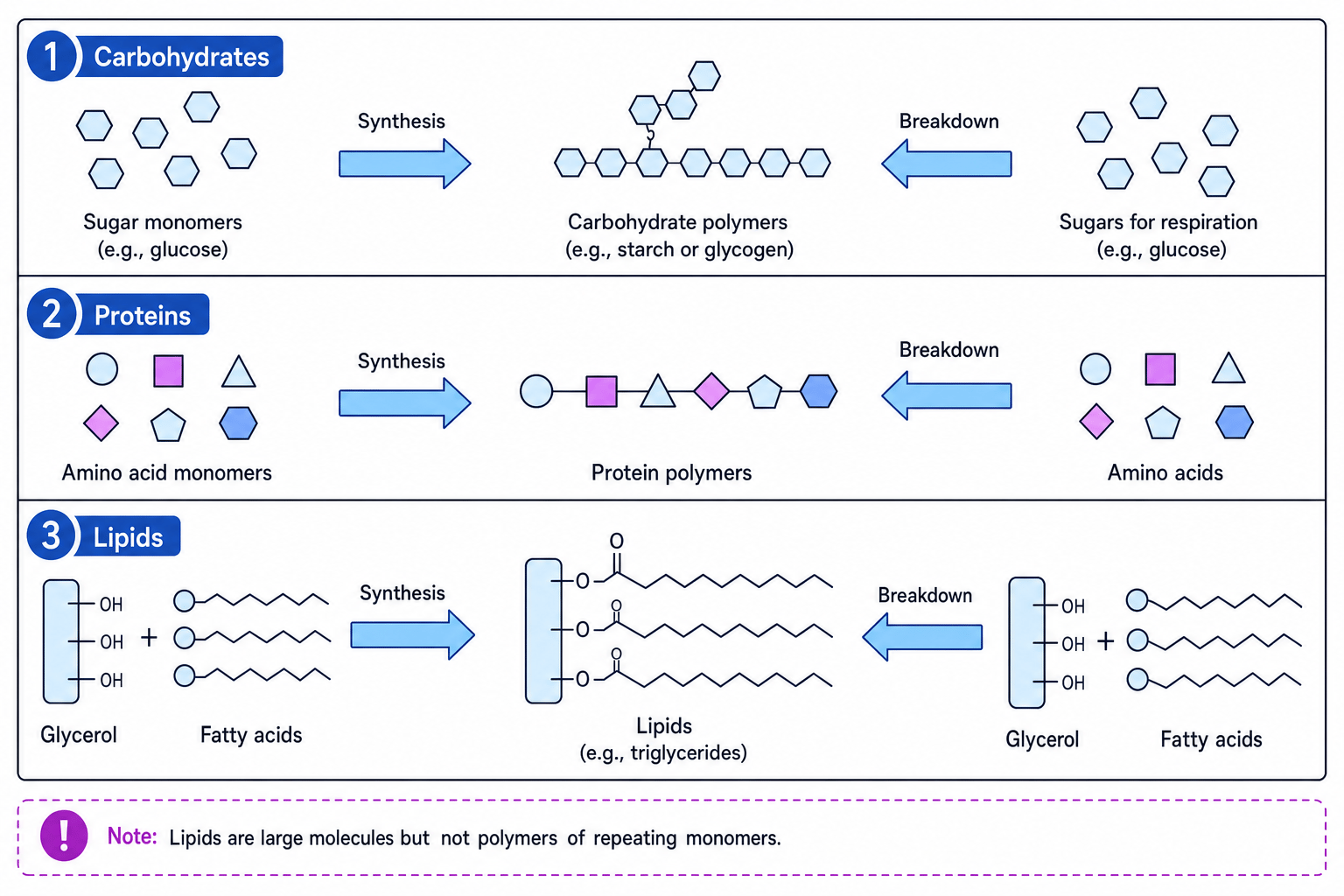
Synthesis means building larger molecules from smaller molecules. Breakdown means chemically splitting larger molecules into smaller molecules.
Monomer and polymer
A monomer is a small building-block molecule. A polymer is a large molecule made from many repeating monomers joined together.
Breakdown, not breakup
In biology, “breakdown” means chemical reactions split larger molecules into smaller molecules. It does not mean the molecule or cell is simply smashed apart.
Carbohydrates and sugars
Carbohydrates include sugars and larger carbohydrate polymers.
Small sugar monomers, such as glucose, can be joined together to make carbohydrate polymers such as starch in plants and glycogen in animals. This is useful for storage.
When cells need glucose for respiration, these carbohydrate polymers can be broken down into sugars.
So sugars are important because they are:
- monomers used to synthesise carbohydrate polymers
- products of carbohydrate breakdown
- substrates for respiration, especially glucose
Proteins and amino acids
Proteins are polymers made from amino acid monomers.
An amino acid is a small molecule that can join with other amino acids to form a protein. Proteins are needed for growth, repair, cell structures and enzymes.
Protein synthesis builds proteins from amino acids. Protein breakdown produces amino acids again, which can be used to make new proteins.
This links back to respiration because enzymes controlling respiration are proteins.
Lipids, fatty acids and glycerol
Lipids are large biological molecules used for long-term energy storage, insulation and cell membranes.
Lipids are made from fatty acids and glycerol. Unlike carbohydrates and proteins, lipids are not usually described as polymers of repeating monomers.
Lipid synthesis joins fatty acids and glycerol to make lipids. Lipid breakdown produces fatty acids and glycerol again. These smaller molecules can be used by cells, including as fuel after being converted into suitable respiration substrates.
Linking starch breakdown to ATP supply
A plant stores glucose as starch in a root. Later, the root cells need more ATP.
- Identify the storage molecule: starch is a carbohydrate polymer made from many sugar monomers.
- Work out the breakdown product: starch can be broken down into glucose molecules.
- Link to respiration: glucose can be used as a substrate in respiration, transferring energy to ATP for cell processes.
In the exam
- Keep the words separate: ventilation is air movement, but respiration is a chemical process inside cells.
- For anaerobic respiration, check the organism: animals produce lactic acid; plants and fungi produce ethanol and carbon dioxide.
- When comparing ATP yield, say aerobic respiration gives a higher yield because glucose is broken down more completely using oxygen.
Check yourself
- What is the difference between aerobic and anaerobic respiration?
- Why do plant cells need to respire even when they can photosynthesise?
- Which smaller molecules are used to build carbohydrates, proteins and lipids?
