

What you'll learn
- How waves transfer energy without carrying matter along overall.
- What amplitude, wavelength, frequency, period and wave speed mean.
- How to use the wave equation v=fλv=f\lambdav=fλ.
- How transverse waves differ from longitudinal waves, using water ripples and sound as examples.
Waves: the big idea
A wave is a travelling disturbance that transfers energy from one place to another. Some waves need a material to travel through, such as water or air. Others, such as light, can travel through a vacuum.
For this section, the key examples are water ripples and sound waves in air.
Wave basics
- A medium is the material a wave travels through, such as air, water or a solid.
- A vibration or oscillation is a repeated movement about a rest position.
- The equilibrium position is the undisturbed rest position.
- Displacement is the distance and direction of a point from its equilibrium position.
Energy moves, not matter overall
In a mechanical wave, the particles of the medium vibrate about their equilibrium positions. The wave transfers energy through the medium, but the particles are not carried along with the wave overall.
Describing a wave
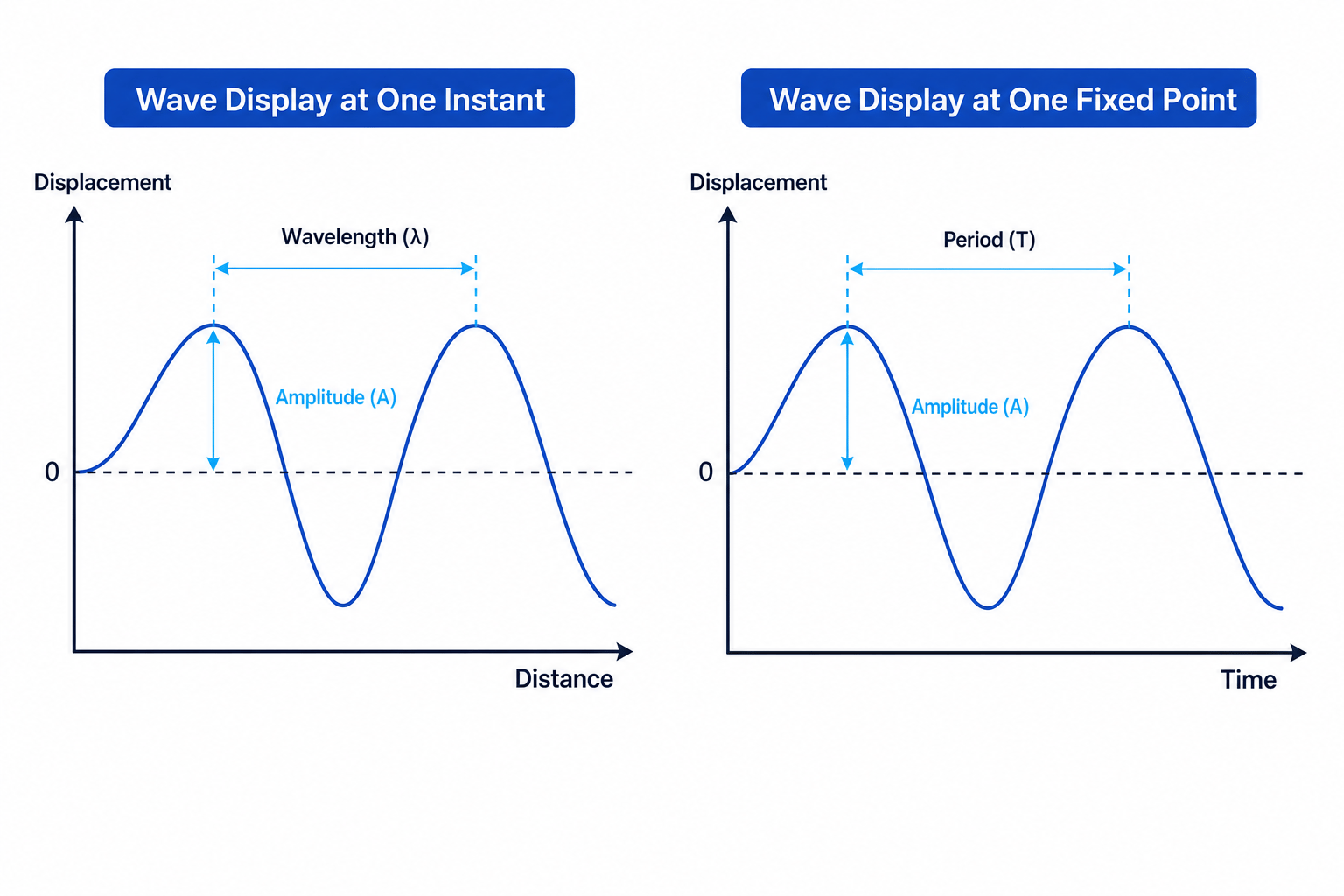
You need to be comfortable with the standard wave quantities. These can be shown on a wave diagram or read from a graph.
Wave measurements
- Amplitude, symbol AAA, is the maximum displacement from the equilibrium position. It is measured in metres (m).
- Wavelength, symbol λ\lambdaλ, is the distance from one point on a wave to the same point on the next wave, such as crest to crest. It is measured in metres (m).
- Frequency, symbol fff, is the number of complete waves passing a point each second. It is measured in hertz (Hz).
- Period, symbol TTT, is the time taken for one complete wave to pass a point. It is measured in seconds (s).
- Wave speed or wave velocity, symbol vvv, is how fast the wave travels. It is measured in metres per second (m/s).
Frequency and period are linked because a high frequency means each wave takes less time:
f=1Tf=\frac{1}{T}f=T1and
T=1fT=\frac{1}{f}T=f1The same wave can be displayed in two different ways: as a shape in space at one instant, or as a trace showing how one point moves over time.
Mixing up wavelength and period
If the horizontal axis is distance, crest-to-crest gives wavelength. If the horizontal axis is time, crest-to-crest gives period.
Reading wave measurements from graphs
A displacement-distance graph has crests at 0.20 m and 0.70 m. A displacement-time graph for the same wave has crests at 0.10 s and 0.35 s. The amplitude is 0.040 m.
- On the displacement-distance graph, the horizontal separation between matching points gives wavelength: λ=0.70 m−0.20 m=0.50 m\lambda=0.70\ \text{m}-0.20\ \text{m}=0.50\ \text{m}λ=0.70 m−0.20 m=0.50 m.
- On the displacement-time graph, the horizontal separation between matching points gives period: T=0.35 s−0.10 s=0.25 sT=0.35\ \text{s}-0.10\ \text{s}=0.25\ \text{s}T=0.35 s−0.10 s=0.25 s.
- Use the period to calculate frequency: f=1T=10.25 s=4.0 Hzf=\frac{1}{T}=\frac{1}{0.25\ \text{s}}=4.0\ \text{Hz}f=T1=0.25 s1=4.0 Hz.
- The amplitude is 0.040 m because amplitude is measured from the centre line to a crest, not from crest to trough.
Doubling the amplitude
The distance from crest to trough is twice the amplitude. Amplitude is measured from the equilibrium line to a crest or trough.
The wave equation
For OCR Gateway Combined Science, you need to recall and apply the relationship between wave speed, frequency and wavelength:
v=fλv=f\lambdav=fλwhere:
- vvv is wave speed in metres per second (m/s)
- fff is frequency in hertz (Hz)
- λ\lambdaλ is wavelength in metres (m)
You may also need to rearrange it:
f=vλf=\frac{v}{\lambda}f=λvand
λ=vf\lambda=\frac{v}{f}λ=fvUnit check
Before using v=fλv=f\lambdav=fλ, convert wavelength into metres and frequency into hertz. For example, 3.0 cm becomes 0.030 m.
Finding frequency from ripple measurements
In a ripple tank, the distance from the first crest to the sixth crest is 0.15 m. A wavefront travels 0.60 m in 2.0 s. Calculate the frequency.
- From the first crest to the sixth crest there are five wavelength gaps, so λ=0.15 m5=0.030 m\lambda=\frac{0.15\ \text{m}}{5}=0.030\ \text{m}λ=50.15 m=0.030 m.
- Calculate the wave speed from the timed distance: v=0.60 m2.0 s=0.30 m/sv=\frac{0.60\ \text{m}}{2.0\ \text{s}}=0.30\ \text{m/s}v=2.0 s0.60 m=0.30 m/s.
- Rearrange the wave equation to find frequency: f=vλ=0.30 m/s0.030 m=10 Hzf=\frac{v}{\lambda}=\frac{0.30\ \text{m/s}}{0.030\ \text{m}}=10\ \text{Hz}f=λv=0.030 m0.30 m/s=10 Hz.
Changing medium
Use speed and wavelength values for the same medium. If a wave enters a different medium, its speed may change; the frequency is set by the source, so the wavelength may change too.
Transverse and longitudinal waves
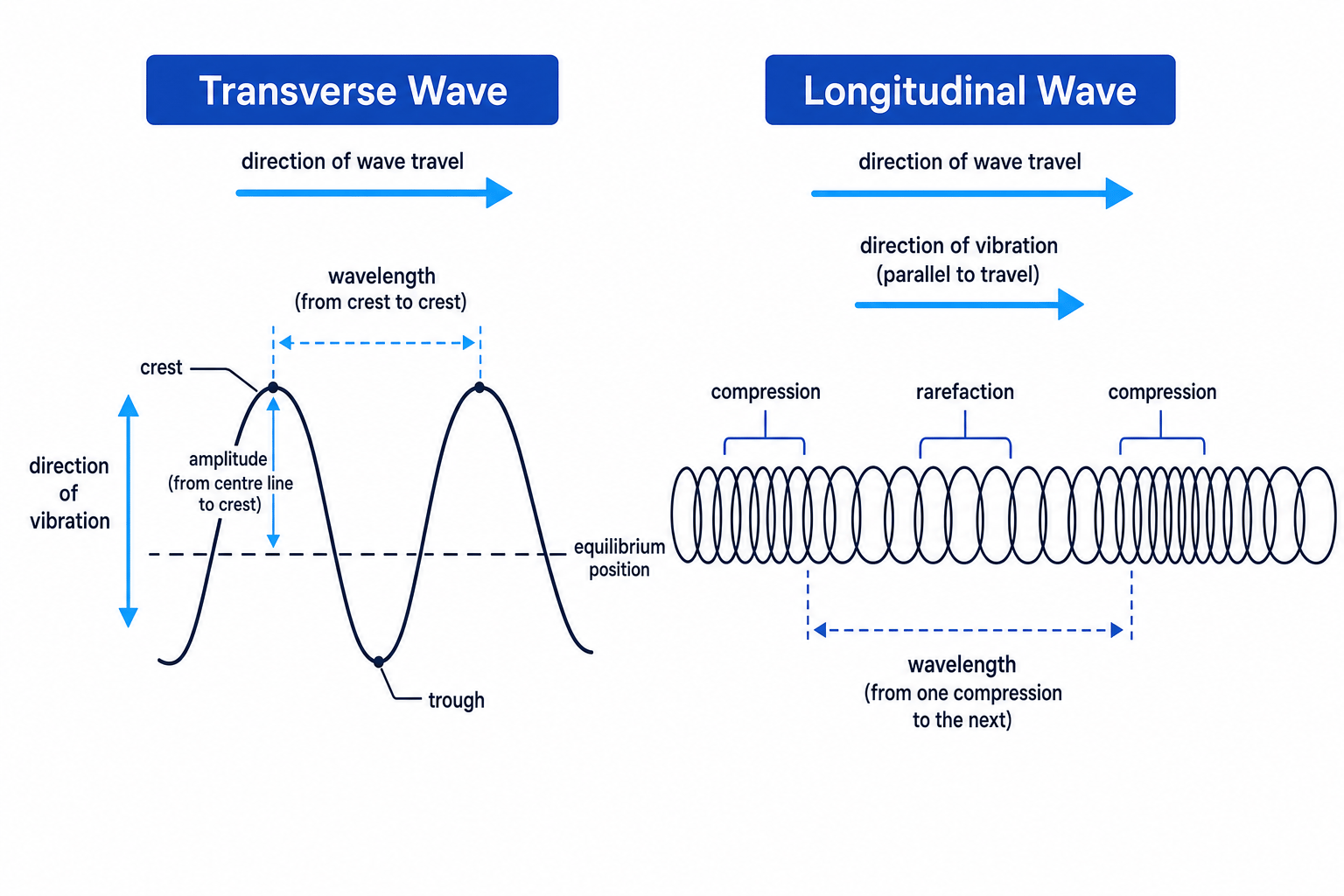
Waves are classified by comparing the direction of vibration with the direction the wave travels.
Transverse and longitudinal waves
- In a transverse wave, the vibrations are perpendicular to the direction of wave travel.
- In a longitudinal wave, the vibrations are parallel to the direction of wave travel.
- A compression is a region in a longitudinal wave where particles are closer together.
- A rarefaction is a region in a longitudinal wave where particles are further apart.
Water ripples are used as a model of transverse waves: the ripple travels across the surface while points on the surface move up and down. Sound waves in air are longitudinal waves: air molecules vibrate backwards and forwards, creating compressions and rarefactions.
Treating the graph as the particle path
A sine-shaped sound trace is not showing air molecules moving up and down. In sound, air molecules vibrate backwards and forwards along the direction the sound travels.
Measuring wave speed
In a ripple tank, a vibrating dipper creates water waves. You can measure the wavelength by measuring across several crests and dividing by the number of wavelength gaps. The frequency can come from the wave generator. Then use v=fλv=f\lambdav=fλ.
In PAG P4-style ripple tank work, the lamp and screen make the wavefronts easier to see, so you can investigate reflection or refraction and still use the same wave measurements.
For sound, a microphone changes pressure variations into an electrical signal. An oscilloscope displays how that signal changes with time. From the trace, you can measure the period and calculate frequency.
To measure the speed of sound, you can place two microphones a known distance apart and use an oscilloscope to measure the time delay between the signals. The speed is the distance between microphones divided by the time delay.
Evidence that the medium does not travel along
For water ripples, a floating cork bobs up and down as ripples pass, but it does not steadily move across the tank with the wave. This shows the wave travels across the surface, while the water mainly oscillates about its position.
For sound waves, the air is not blown all the way from the speaker to your ear. Instead, air molecules vibrate back and forth, passing energy through compressions and rarefactions.
The most important comparison
In transverse waves, vibrations are at 90° to the direction of travel. In longitudinal waves, vibrations are along the same line as the direction of travel.
In the exam
- Check the horizontal axis: distance means wavelength, but time means period.
- Convert units before using v=fλv=f\lambdav=fλ, especially centimetres to metres and kilohertz to hertz.
- For wave type questions, compare the direction of vibration with the direction of wave travel, then state that energy is transferred but particles only oscillate.
Check yourself
- What is the difference between amplitude and wavelength?
- A wave has a speed of 12 m/s and a wavelength of 0.40 m. How would you calculate its frequency?
- What evidence shows that water or air particles are not carried along overall by a wave?
