Magnets and magnetic fields
What you'll learn
- How magnetic poles attract and repel, and how to draw magnetic field patterns.
- The difference between permanent magnets and induced magnets.
- Why a compass gives evidence that the Earth has a magnetic field.
- How electric currents make magnetic fields, and — on Higher Tier — how this links to motors.
Magnetic poles and forces
A magnet is an object that produces a magnetic field. A pole is one end of a magnet where the magnetic effect is strongest. Bar magnets have a north pole and a south pole.
- Like poles are the same type: north–north or south–south. They repel.
- Unlike poles are different types: north–south. They attract.
Pole rule
Like poles repel. Unlike poles attract. The force can act without the magnets touching because each magnet has a magnetic field around it.
Bigger does not always mean stronger
A larger magnet is not automatically stronger than a smaller magnet. Strength depends on the material, how strongly it is magnetised, and how far away you are from it.
Permanent and induced magnets
Permanent and induced magnets
A permanent magnet produces its own magnetic field all the time. An induced magnet is a magnetic material that becomes a magnet when it is placed in a magnetic field.
Magnetic materials include iron, steel, nickel and cobalt. If a piece of iron is attracted to a permanent magnet, the iron becomes an induced magnet while it is near the magnet. The end nearest the permanent magnet becomes the opposite pole, so the force is attractive.
Induced magnetism is often temporary. For example, soft iron loses most of its magnetism when the magnetic field is removed.
Magnetic fields and field lines
Magnetic field
A magnetic field is the region around a magnet, magnetic material or current-carrying conductor where a magnetic force can be felt.
A magnetic field line is a model used to show the field. The arrow on a field line shows the direction a north pole would be pushed. Around a bar magnet, field lines outside the magnet go from north to south.
The strength of the field changes from place to place. Field lines that are closer together mean a stronger magnetic field. The field is strongest near the poles of a magnet.
These diagrams show the patterns around one bar magnet, attracting unlike poles, and repelling like poles.
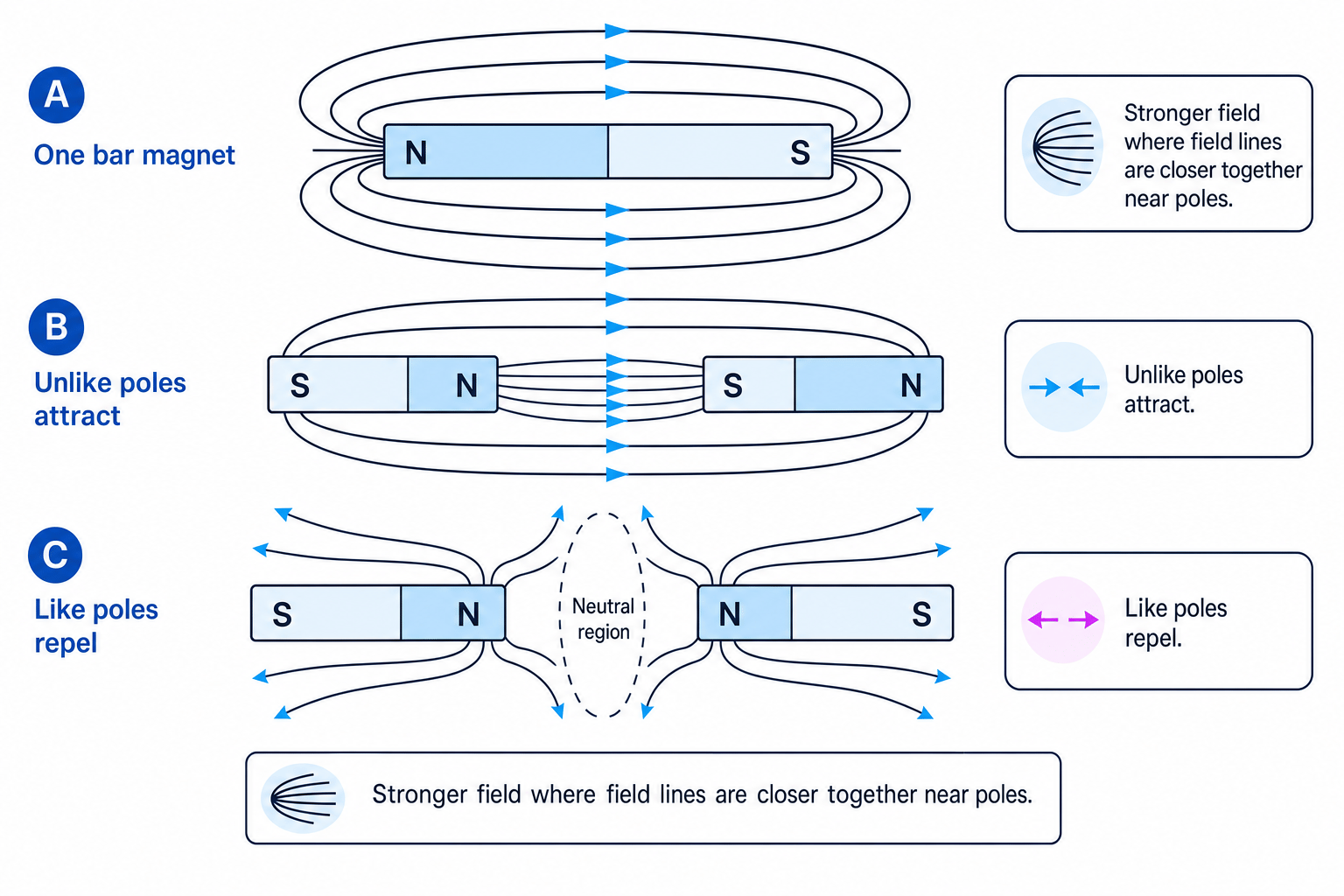
Comparing magnetic field strength
A diagram shows point A near the pole of a bar magnet and point B further away. The field lines are much closer together at A.
- Use the arrows on the field lines to decide the field direction. A compass north-seeking end would point along the arrow direction at that point.
- Compare the spacing of the field lines. Closer field lines mean a stronger magnetic field.
- Conclude that the field is stronger at A than at B because A has greater field line density, not just because it is “near a magnet”.
Investigating magnetic fields
You can investigate a magnetic field using plotting compasses. A plotting compass is a small compass that lines up with the magnetic field at its position.
To map a field, place the compass near the magnet, mark the direction the north end points, move the compass along, and join the marks into smooth field lines. Iron filings can show the shape of the field, but plotting compasses show the direction more clearly.
The Earth as a magnet
A normal compass points roughly north because the Earth has a magnetic field. The compass needle lines up with this field.
A geographic pole is based on the Earth’s rotation axis. A magnetic pole is based on the Earth’s magnetic field. These are not in exactly the same place.
A dipping compass can tilt up and down as well as rotate horizontally. Its behaviour gives evidence that the Earth’s core produces a magnetic field, because the field has a direction through the Earth as well as around it.
North is not quite that simple
The north-seeking end of a compass points roughly towards geographic north, but the Earth’s geographic poles and magnetic poles are not the same place.
Magnetic field around a current-carrying wire
A current is the rate of flow of electric charge, measured in amperes (A). A conductor is a material that allows charge to flow through it easily, such as copper.
When a current flows through a straight wire, it creates a magnetic field around the wire. The field lines are circles centred on the wire.
The direction is found using the right-hand grip rule:
- Point your right thumb in the direction of the conventional current.
- Your curled fingers show the direction of the magnetic field.
If you reverse the current, the magnetic field direction reverses. The field is stronger when the current is larger, and weaker further away from the wire.
The same idea applies to a coil of wire called a solenoid.
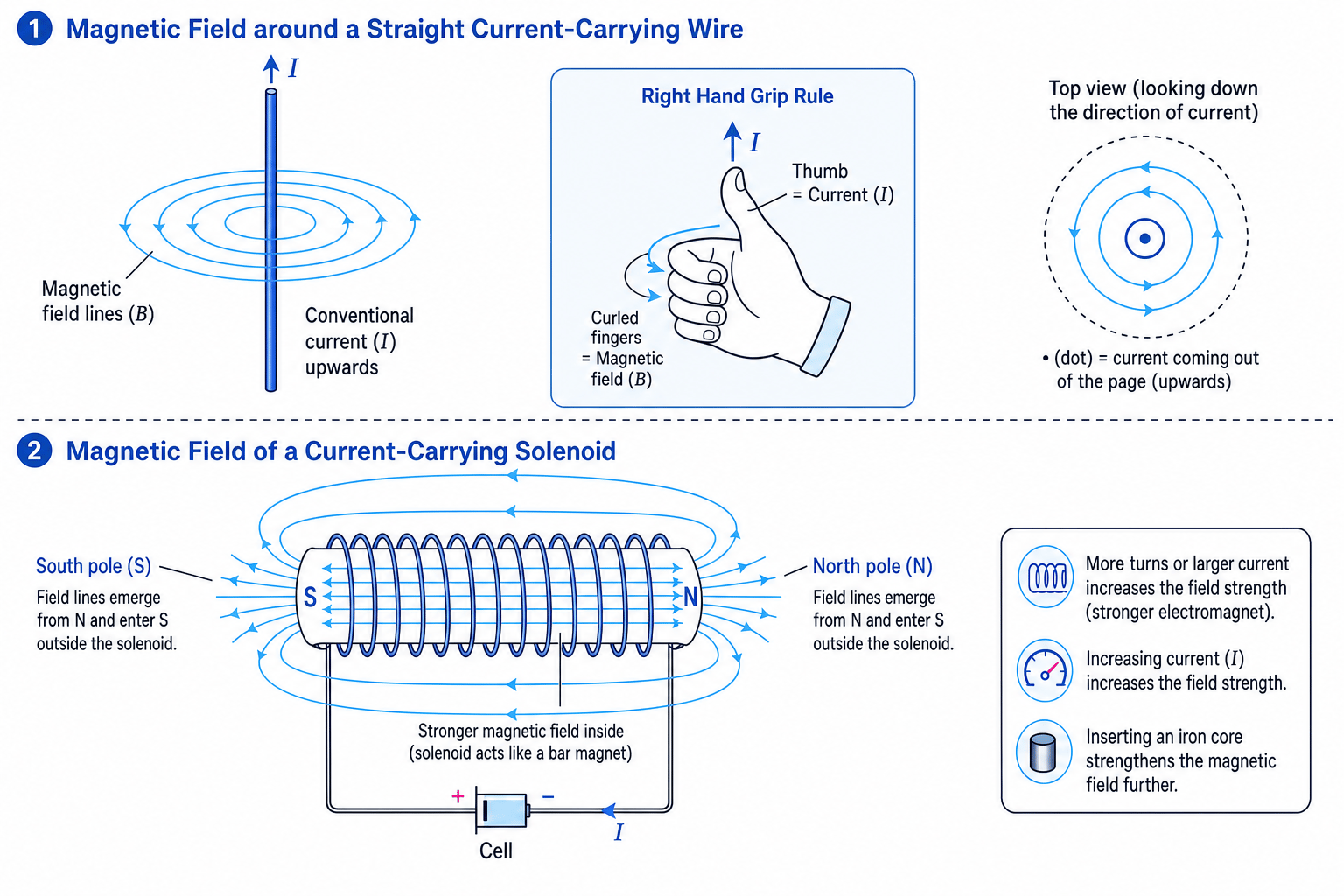
Using the right-hand grip rule
A wire carries conventional current out of the page towards you. Find the direction of the magnetic field around it.
- Represent current out of the page with a dot, like the tip of an arrow coming towards you.
- Point your right thumb towards you, in the direction of the conventional current.
- Your fingers curl anticlockwise, so the magnetic field goes anticlockwise around the wire.
Dot and cross notation
A dot means “out of the page” because you see the arrow tip. A cross means “into the page” because you see the arrow tail feathers.
Solenoids and electromagnets
A solenoid is a coil of wire with many turns. When current flows through it, the magnetic fields from the turns add together. This makes a stronger, more useful magnetic field, especially inside the coil.
An electromagnet is a magnet made using an electric current. It can be switched on and off. You can strengthen an electromagnet by:
- increasing the current;
- increasing the number of turns of wire;
- adding an iron core inside the solenoid.
Why solenoids are stronger
A solenoid enhances the magnetic effect because each turn of wire produces a magnetic field, and the fields combine to make a strong field like the field of a bar magnet.
Higher Tier: the motor effect
On Higher Tier, you also need to describe the motor effect. This is when a current-carrying conductor experiences a force because it is in a magnetic field.
The force happens because the magnetic field around the current-carrying conductor interacts with the magnetic field from the magnet. The magnet and the conductor exert forces on each other. In a “jumping wire” demonstration, the wire jumps when the current is switched on.
The force is at right angles to both:
- the current in the conductor;
- the magnetic field.
If you reverse the current, the force reverses. If you reverse the magnetic field, the force also reverses.
Higher Tier: Fleming’s left-hand rule
Fleming’s left-hand rule is used to find the direction of the force in the motor effect.
Use your left hand:
- Thumb = force or motion.
- First finger = magnetic field, from north to south.
- Second finger = conventional current.
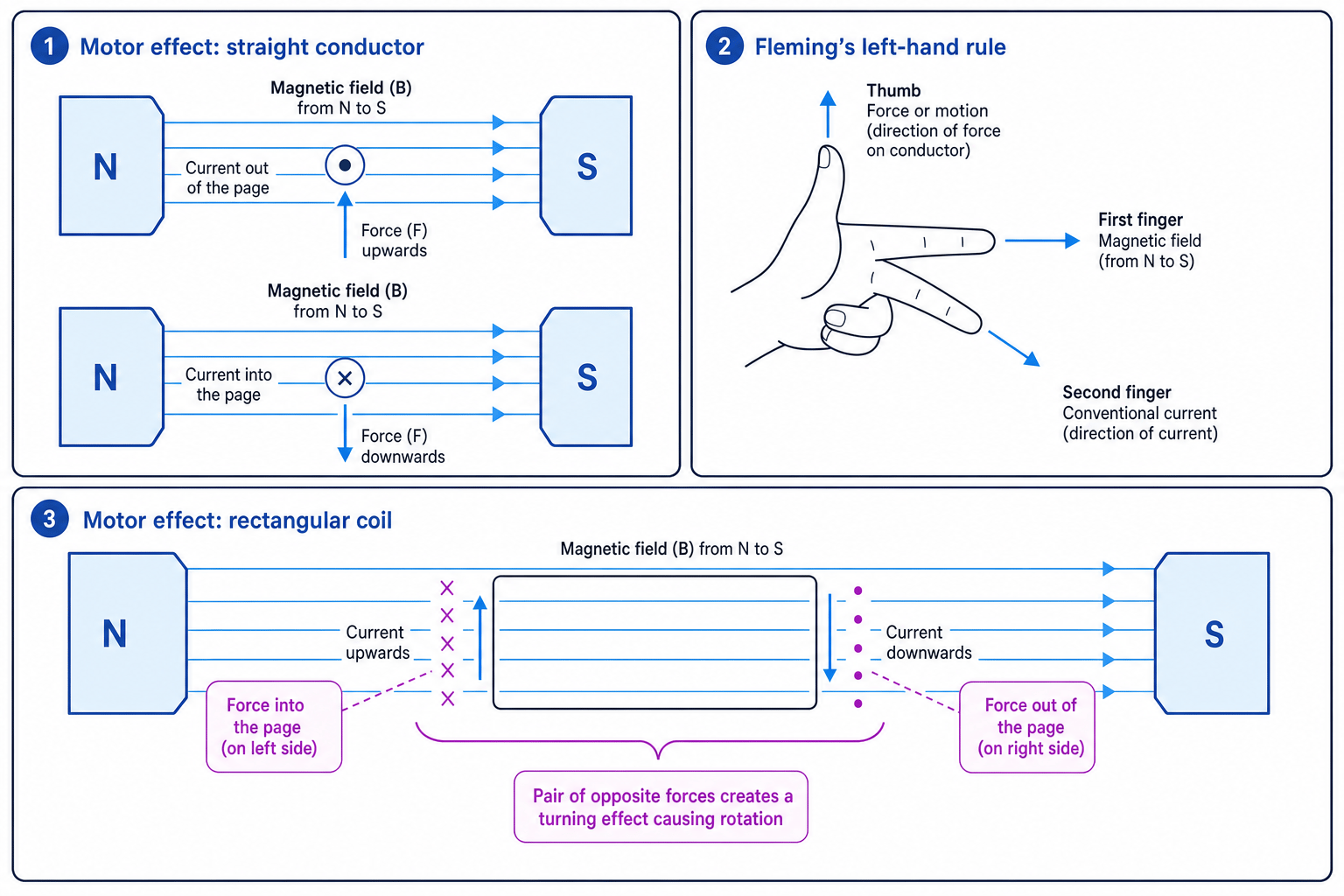
Left hand versus right hand
Use the right-hand grip rule for the magnetic field around a wire. Use Fleming’s left-hand rule for the force on a current-carrying wire in a magnetic field.
Higher Tier: calculating the force on a conductor
For Higher Tier, you need to apply the equation for the force on a current-carrying conductor at right angles to a magnetic field. OCR’s focus here is applying the relationship correctly, so make sure you can choose it and use SI units.
Magnetic flux density
Magnetic flux density, symbol BBB, is a measure of magnetic field strength. It is measured in tesla (T).
where:
- FFF is force in newtons (N);
- BBB is magnetic flux density in tesla (T);
- III is current in amperes (A);
- lll is the length of conductor in the magnetic field in metres (m).
Right angles only
At GCSE, use F=BIlF = B I lF=BIl when the conductor is at right angles to the magnetic field. If the current is parallel to the magnetic field, there is no motor-effect force.
Calculating force on a wire
A wire of length 0.25 m carries a current of 3.0 A at right angles to a magnetic field of magnetic flux density 0.40 T. Calculate the force on the wire.
- Identify the values: B=0.40 TB = 0.40 \text{ T}B=0.40 T, I=3.0 AI = 3.0 \text{ A}I=3.0 A and l=0.25 ml = 0.25 \text{ m}l=0.25 m.
- Substitute into the equation:
- Calculate the result:
- If the current were reversed, the size of the force would still be 0.30 N, but the direction of the force would reverse.
Higher Tier: how electric motors rotate
An electric motor transfers electrical energy into kinetic energy using the motor effect.
In a simple coil between magnetic poles, current flows up one side of the coil and down the other side. Because the currents are in opposite directions, the forces on the two sides are also in opposite directions. This pair of forces creates a turning effect, so the coil rotates.
You do not need detailed motor structure for this Gateway Combined Science point, but you should understand the basic cause of rotation: opposite forces on opposite sides of a current-carrying coil.
In the exam
- For field diagrams, always use arrows: outside a bar magnet they go from north to south, and closer lines mean a stronger field.
- For current questions, choose the correct rule: right-hand grip for the field around a wire; Fleming’s left hand for the motor-effect force.
- For Higher Tier calculations, check the conductor is at right angles, use F=BIlF = B I lF=BIl, and keep units in T, A and m.
Check yourself
- Why do unlike magnetic poles attract, but like poles repel?
- How would increasing the current in a wire affect the magnetic field around it?
- In a motor, why do the two sides of the coil experience forces in opposite directions?