What you'll learn
- Why all electromagnetic waves are transverse waves that can travel through space.
- How wavelength and frequency change across the electromagnetic spectrum.
- The order of the main regions: radio to gamma.
- How different electromagnetic waves are used, and why some can be hazardous.
Starting point: waves and energy
You already know that a wave transfers energy from one place to another without transferring matter overall.
A source is the object or process that produces the wave. An absorber is the material that takes in the wave’s energy.
For example, the Sun is a source of visible light and infrared radiation. Your skin can absorb some of that energy, which is why sunlight can warm you.
Electromagnetic wave
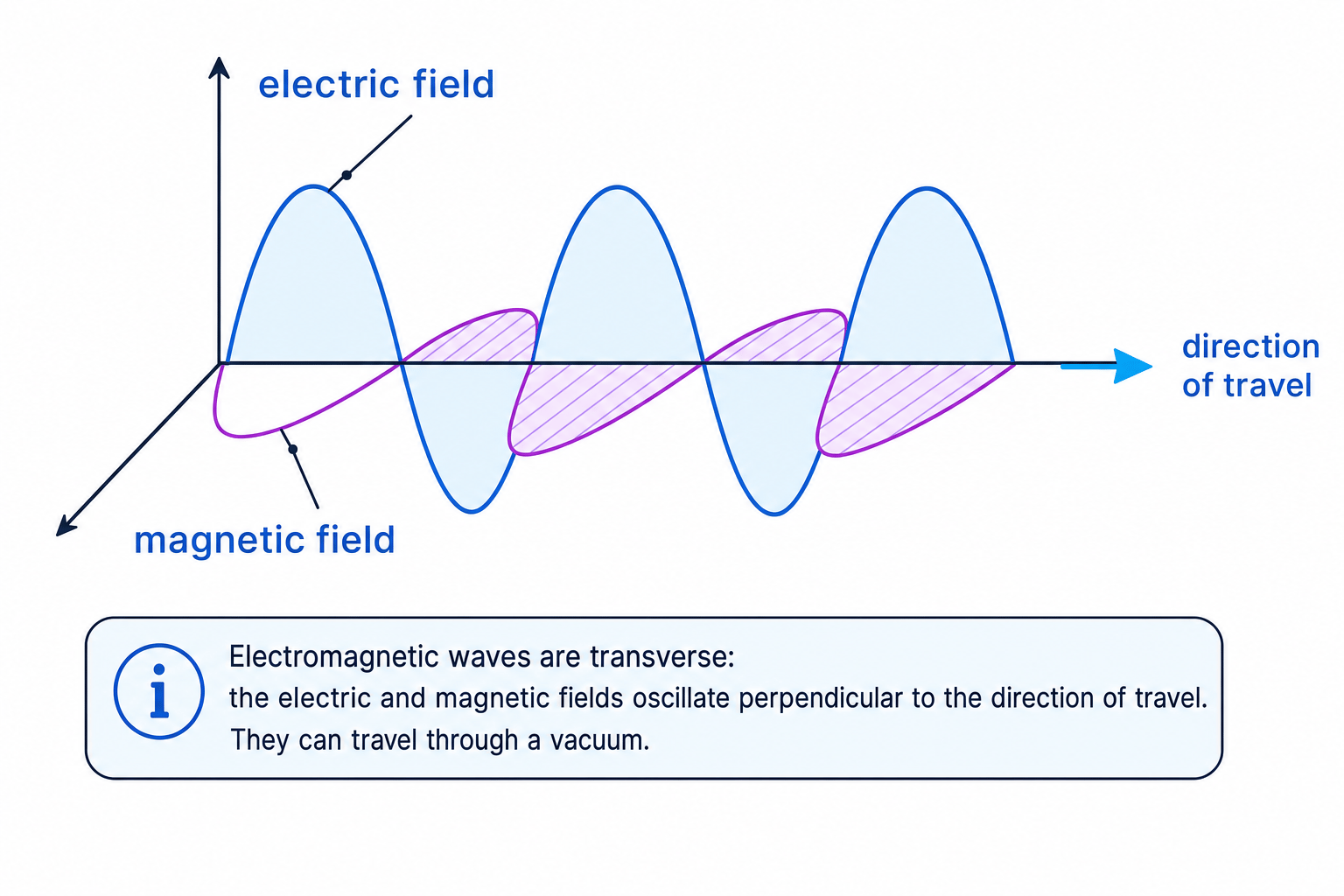
An electromagnetic wave is a wave made from oscillating electric and magnetic fields. It can travel through a vacuum, so it does not need particles of matter to carry it.
Electromagnetic waves transfer energy from a source to an absorber. That energy might become thermal energy, an electrical signal, or cause a chemical change.
Tracing energy transfer from a TV remote
- The remote contains an infrared LED, so the LED is the source of infrared electromagnetic waves.
- The infrared waves travel through the air to the TV sensor, transferring energy without needing a material medium.
- The TV sensor absorbs some infrared energy, which is changed into an electrical signal in the circuit.
Electromagnetic waves are transverse
A transverse wave is a wave where the vibrations are at right angles to the direction the wave travels.
All electromagnetic waves are transverse. This includes radio waves, microwaves, infrared, visible light, ultraviolet, X-rays and gamma rays.
Same type of wave
The different parts of the electromagnetic spectrum are not completely separate “things”. They are all electromagnetic waves; they just have different wavelengths and frequencies.
Speed through space
Electromagnetic waves can be transmitted through space. In a vacuum, they all travel at the same speed:
v=3.0×10⁸ m/sv = 3.0 \times 10^8\ \text{m/s}v=3.0×108 m/sThis value is often called the speed of light, but it applies to all electromagnetic waves in a vacuum, not just visible light.
In air, the speed is very close to this value, so GCSE questions often treat it as the same unless told otherwise.
Frequency and wavelength
Wavelength and frequency
Wavelength, symbol λ\lambdaλ, is the distance from one point on a wave to the same point on the next wave, measured in metres (m). Frequency, symbol fff, is the number of waves passing a point each second, measured in hertz (Hz).
The wave equation links wave speed, frequency and wavelength:
v=fλv = f\lambdav=fλFor electromagnetic waves in a vacuum, vvv is the same for all parts of the spectrum. So if the wavelength is shorter, the frequency must be higher.
Calculating a microwave wavelength
A microwave oven uses waves with frequency 2.45×10⁹ Hz2.45 \times 10^9\ \text{Hz}2.45×10⁹ Hz. Estimate the wavelength in air.
- Use the electromagnetic wave speed in air as v=3.0×10⁸ m/sv = 3.0 \times 10^8\ \text{m/s}v=3.0×108 m/s and the relationship v=fλv=f\lambdav=fλ.
- Rearrange for wavelength: λ=vf\lambda=\frac{v}{f}λ=fv.
- Substitute the values: λ=3.0×10⁸ m/s2.45×109 Hz=0.122 m\lambda=\frac{3.0 \times 10^8\ \text{m/s}}{2.45 \times 10^9\ \text{Hz}}=0.122\ \text{m}λ=2.45×10⁹ Hz3.0×108 m/s=0.122 m.
- The wavelength is about 0.12 m0.12\ \text{m}0.12 m, which is sensible for a microwave.
The electromagnetic spectrum
The electromagnetic spectrum is the full range of electromagnetic waves, arranged by wavelength or frequency.
From longest wavelength and lowest frequency to shortest wavelength and highest frequency, the order is:
- Radio waves
- Microwaves
- Infrared
- Visible light
- Ultraviolet
- X-rays
- Gamma rays
Visible light itself goes from red to violet. Red light has the longer wavelength and lower frequency; violet light has the shorter wavelength and higher frequency.

Remembering the order
A useful order phrase is: Raging Martians Invaded Venus Using X-ray Guns — radio, microwave, infrared, visible, ultraviolet, X-rays, gamma.
Not separate boxes
The named regions have approximate boundaries. The spectrum is continuous, so radio waves gradually become microwaves as wavelength decreases; there is not a sudden physical wall between them.
Comparing ultraviolet and infrared
- Infrared is to the left of visible light, while ultraviolet is to the right.
- Moving right across the spectrum means wavelength decreases and frequency increases.
- So ultraviolet has a shorter wavelength and a higher frequency than infrared.
Your eyes only detect visible light
Your eyes can only detect a limited range of the electromagnetic spectrum: visible light.
That does not mean the other waves are not there. Special detectors can detect them, such as:
- infrared cameras for thermal imaging
- radio aerials for radio waves
- X-ray detectors for medical imaging
So, visible light is just one small region of the electromagnetic spectrum.
Practical uses of electromagnetic waves
Different regions of the spectrum are useful because they interact with materials in different ways.
Radio waves
Radio waves are used for radio and TV broadcasting, and some forms of communication.
Radio waves can be produced by oscillations in electrical circuits. An oscillation is a repeated back-and-forth change. In a transmitter aerial, electrons oscillate and produce radio waves.
Radio waves can also induce oscillations in a receiving circuit. This means the incoming radio wave causes electrons in the aerial to oscillate, producing a tiny electrical signal.
Microwaves
Microwaves are used for:
- cooking food, because water and fat molecules absorb microwave energy and heat up
- satellite communication
- mobile phone and Wi-Fi communication
Infrared
Infrared radiation is used for:
- remote controls
- thermal imaging cameras
- heaters
- some fibre-optic communication systems
Your body emits infrared radiation, which is why thermal cameras can detect people in the dark.
Visible light
Visible light is used for:
- seeing
- cameras
- optical fibres
- microscopes and telescopes
Ultraviolet
Ultraviolet radiation is used for:
- security marking
- fluorescent lamps
- sterilising surfaces and equipment
But ultraviolet can also damage skin and eyes.
X-rays
X-rays are used for:
- medical imaging, especially bones
- airport security scanners
They can pass through soft tissue more easily than bone, which creates contrast in an X-ray image.
Gamma rays
Gamma rays are used for:
- sterilising medical equipment
- killing cancer cells in radiotherapy
- some medical tracers
Gamma rays are very penetrating and can be dangerous, so their use must be carefully controlled.
Choosing radiation for imaging a broken bone
- The radiation must pass through soft tissue but be absorbed more by bone, so the detector receives different amounts from different parts of the arm.
- X-rays are suitable because bone absorbs X-rays more strongly than soft tissue.
- The exposure should be kept as low as possible because X-rays can damage living tissue.
Hazards of ultraviolet, X-rays and gamma rays
Ultraviolet, X-rays and gamma rays can have hazardous effects on human body tissues.
Ultraviolet can cause:
- sunburn
- skin ageing
- eye damage
- increased risk of skin cancer
X-rays and gamma rays are ionising radiation. This means they can remove electrons from atoms and molecules. In living cells, this can damage DNA, which may lead to mutations or cancer.
Ionising radiation
Ionising radiation is radiation with enough energy to remove electrons from atoms or molecules, producing charged particles called ions.
Benefit does not mean harmless
X-rays and gamma rays are useful in medicine because they can pass through the body or kill cells, but that same ability can make them hazardous. Medical uses involve balancing benefit against risk.
Absorbing, transmitting, reflecting and refracting
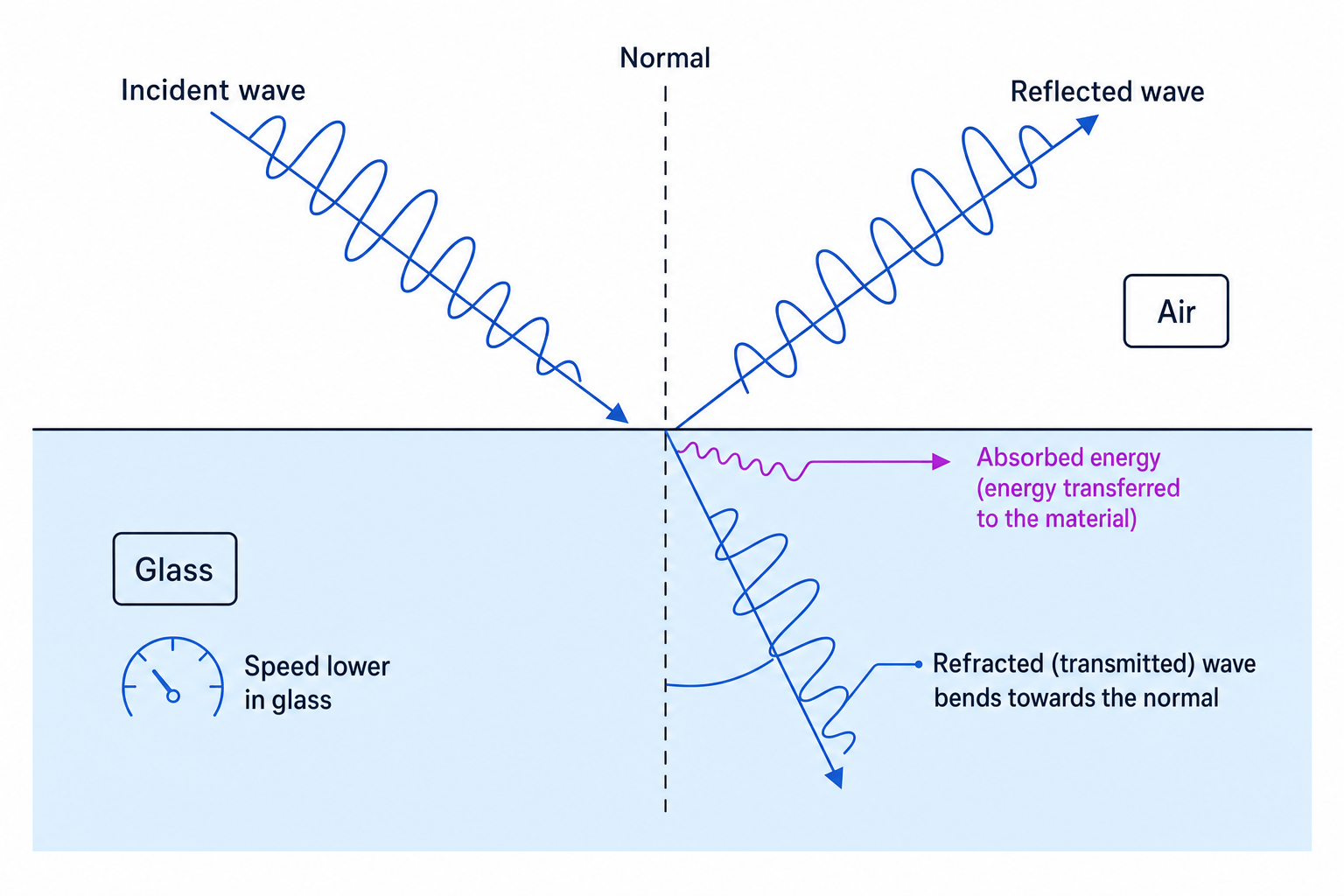
When an electromagnetic wave meets a material, several things may happen.
- Absorption: the wave’s energy is transferred to the material.
- Transmission: the wave passes through the material.
- Reflection: the wave bounces off the surface.
- Refraction: the wave changes direction when it enters a different material because its speed changes.
Different substances interact with different wavelengths in different ways. For example, glass transmits visible light well, but it may absorb some ultraviolet. A black surface absorbs visible and infrared radiation strongly, while a shiny surface reflects more.
When an electromagnetic wave enters a different substance, its speed can change. If it enters at an angle, this speed change can make the wave bend. The normal is an imaginary line drawn at 90° to the surface.
Predicting refraction in glass
- The wave travels from air into glass, where its speed is lower.
- The frequency stays controlled by the source, so using v=fλv=f\lambdav=fλ, a lower speed means the wavelength becomes shorter in the glass.
- If the wave enters at an angle, one side slows before the other side, so the wave bends towards the normal.
If a wave enters exactly along the normal, its speed can still change, but it does not change direction.
In the exam
- Learn the spectrum order both ways: radio has the longest wavelength and lowest frequency; gamma has the shortest wavelength and highest frequency.
- When comparing two regions, link wavelength and frequency using v=fλv=f\lambdav=fλ and remember that electromagnetic waves have the same speed in a vacuum.
- For uses and hazards, explain the property that makes the wave suitable, then mention the risk if the wave can damage tissue.
Check yourself
- Which region of the electromagnetic spectrum has a higher frequency: microwaves or ultraviolet?
- Why can radio waves be received by an aerial connected to a circuit?
- What can happen to light when it enters glass from air at an angle?