What you'll learn
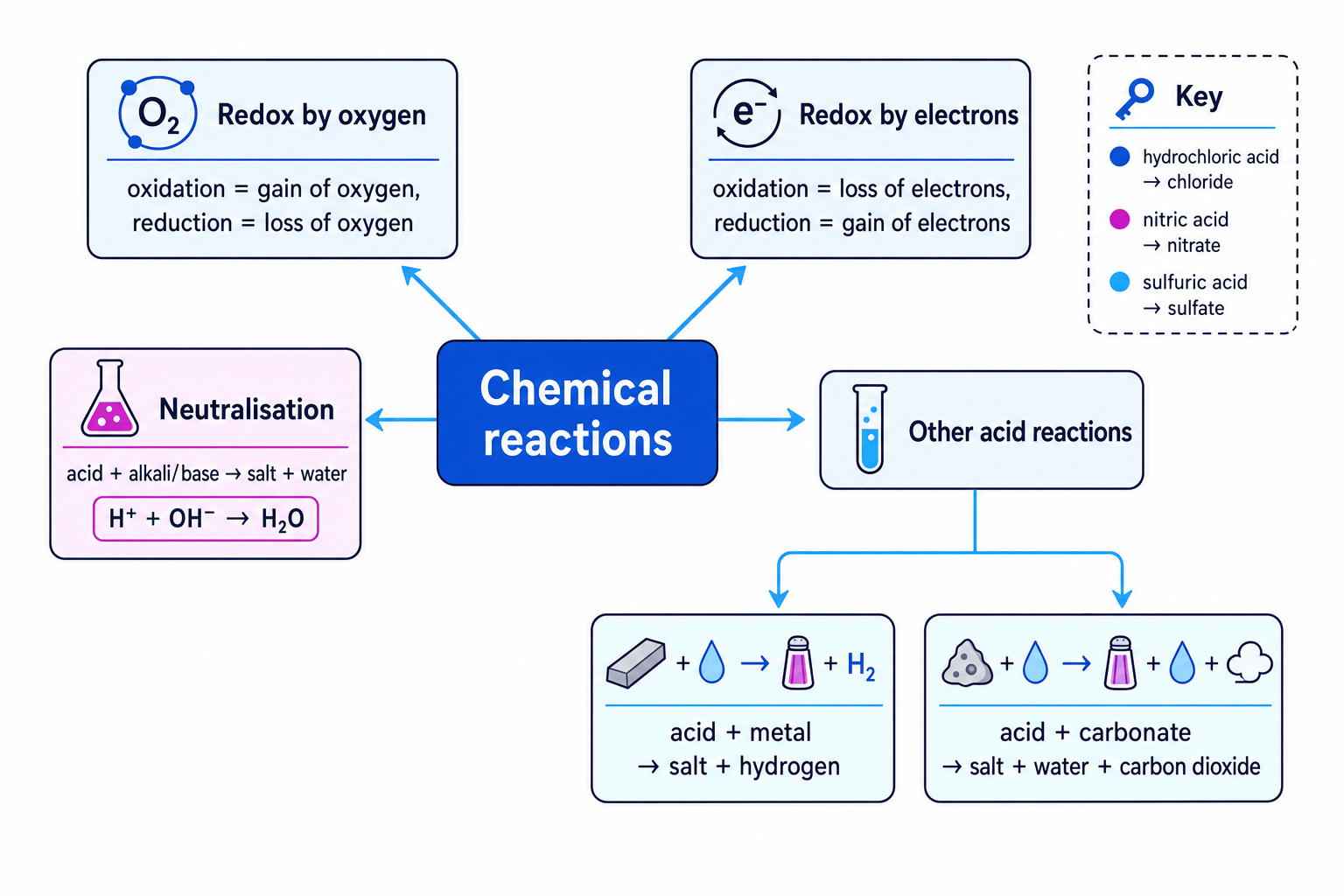
- How to classify reactions as oxidation, reduction and neutralisation.
- How acids, alkalis and bases react, including how to predict products.
- How pH links to hydrogen ions and hydroxide ions.
- For Higher Tier, how electron transfer, acid strength and tenfold pH changes work.
The big idea: reactions can be grouped by what changes
A chemical reaction rearranges atoms to make new substances. In this topic, you classify reactions by looking at changes in:
- oxygen atoms
- electrons
- hydrogen ions and hydroxide ions
- pH
State symbols show the physical state of substances in equations: (s) solid, (l) liquid, (g) gas, and (aq) aqueous, meaning dissolved in water.
Species
A species is any particle or substance involved in a reaction, such as an atom, ion, molecule or compound.
Oxidation and reduction using oxygen
You may already know some reaction types, such as combustion, thermal decomposition and displacement. Many of these can also be described as redox reactions.
Oxidation and reduction by oxygen
- Oxidation is the gain of oxygen.
- Reduction is the loss of oxygen.
- A redox reaction is a reaction where oxidation and reduction happen at the same time.
For example:
CuO(s) + H₂(g) → Cu(s) + H₂O(l)
Copper(II) oxide loses oxygen, so it is reduced. Hydrogen gains oxygen, so it is oxidised.
An oxidising agent causes another substance to be oxidised. In oxygen-transfer reactions, it gives oxygen to another substance and is itself reduced.
A reducing agent causes another substance to be reduced. In oxygen-transfer reactions, it removes oxygen from another substance and is itself oxidised.
Identifying oxidation and reduction by oxygen transfer
Consider this reaction:
Mg(s) + CuO(s) → MgO(s) + Cu(s)
-
Compare magnesium before and after the reaction: Mg(s) has no oxygen, but MgO(s) contains oxygen. Magnesium has gained oxygen, so magnesium is oxidised.
-
Compare copper(II) oxide before and after the reaction: CuO(s) contains oxygen, but Cu(s) does not. Copper(II) oxide has lost oxygen, so copper(II) oxide is reduced.
-
Decide the agents: CuO supplies oxygen to magnesium, so CuO is the oxidising agent. Magnesium removes oxygen from CuO, so magnesium is the reducing agent.
Oxidation and reduction using electrons
If you are taking Higher Tier, you also need to describe redox in terms of electron transfer. An electron is a negatively charged particle.
Oxidation and reduction by electrons
- Oxidation is the loss of electrons.
- Reduction is the gain of electrons.
OIL RIG
Use OIL RIG: Oxidation Is Loss, Reduction Is Gain — of electrons.
For example:
Zn(s) + Cu²⁺(aq) → Zn²⁺(aq) + Cu(s)
Zinc atoms become zinc ions, so they lose electrons. Copper ions become copper atoms, so they gain electrons.
Identifying oxidation and reduction by electron transfer
Use the reaction:
Zn(s) + Cu²⁺(aq) → Zn²⁺(aq) + Cu(s)
-
Track zinc: Zn(s) has no charge, while Zn²⁺(aq) has a 2+ charge. Zinc has lost two electrons, so zinc is oxidised.
-
Track copper: Cu²⁺(aq) has a 2+ charge, while Cu(s) has no charge. Copper ions have gained two electrons, so copper ions are reduced.
-
Decide the agents: zinc donates electrons, so zinc is the reducing agent. Copper ions accept electrons, so Cu²⁺(aq) is the oxidising agent.
Oxidation is not always about oxygen
At GCSE, oxidation can mean gain of oxygen or loss of electrons, depending on the reaction. The electron definition is more general.
Acids, alkalis and bases
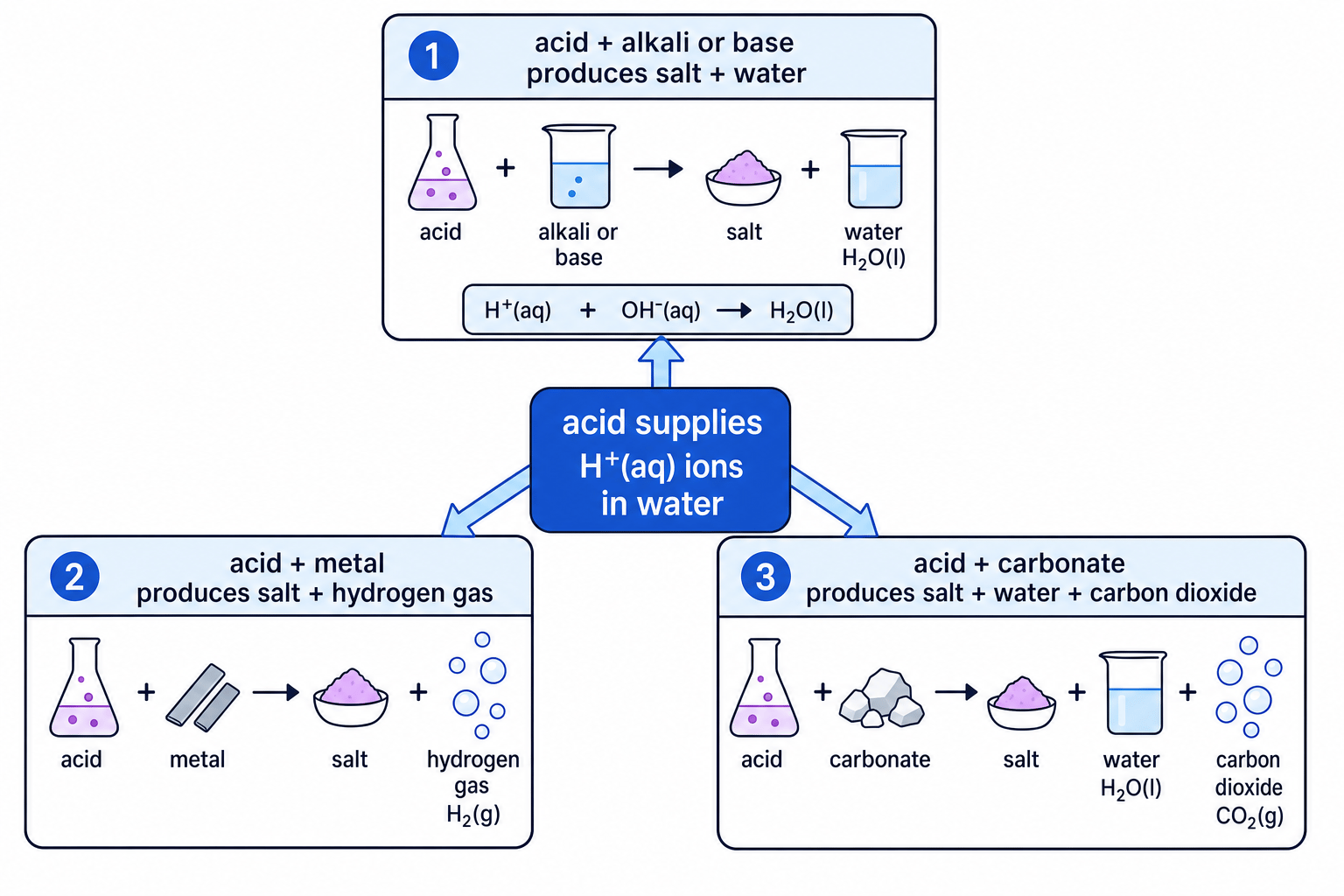
An acid forms hydrogen ions, H⁺(aq), when it dissolves in water.
An alkali is a soluble base. Solutions of alkalis contain hydroxide ions, OH⁻(aq).
A base is a substance that can neutralise an acid. Some bases dissolve in water, making alkalis, but some bases are insoluble solids, such as copper(II) oxide.
Hydrogen ions are free in solution
In GCSE chemistry, acids are described as producing free H⁺(aq) ions in water. Do not treat the hydrogen ions as still being attached to the original acid molecule.
Neutralisation reactions
Neutralisation happens when an acid reacts with an alkali or a base to form a salt and water.
Salt
A salt is an ionic compound formed when the hydrogen ion from an acid is replaced by a metal ion or ammonium ion.
The key ionic equation for aqueous neutralisation is:
H⁺(aq) + OH⁻(aq) → H₂O(l)
This means hydrogen ions from the acid react with hydroxide ions from the alkali to make water.
Common acid endings help you name salts:
- hydrochloric acid makes chloride salts
- sulfuric acid makes sulfate salts
- nitric acid makes nitrate salts
For example:
HCl(aq) + NaOH(aq) → NaCl(aq) + H₂O(l)
Predicting products in neutralisation
Write the balanced equation for sulfuric acid reacting with potassium hydroxide.
-
Identify the salt: sulfuric acid makes a sulfate, and potassium hydroxide provides potassium ions, so the salt is potassium sulfate, K₂SO₄(aq).
-
Write the products using the neutralisation pattern: acid + alkali → salt + water, so the products are K₂SO₄(aq) and H₂O(l).
-
Balance the equation: sulfuric acid has two acidic hydrogens, so it needs two potassium hydroxide particles.
H₂SO₄(aq) + 2KOH(aq) → K₂SO₄(aq) + 2H₂O(l)
Making a pure dry salt
For an insoluble base reacting with an acid:
- Add the insoluble base in excess so all the acid reacts.
- Filter off the unreacted solid.
- Evaporate some water from the filtrate and leave crystals to dry.
Acids with metals and carbonates
Acids also react with some metals and with carbonates.
For metals:
acid + metal → salt + hydrogen
Example:
Mg(s) + 2HCl(aq) → MgCl₂(aq) + H₂(g)
For carbonates:
acid + carbonate → salt + water + carbon dioxide
Example:
CaCO₃(s) + 2HNO₃(aq) → Ca(NO₃)₂(aq) + H₂O(l) + CO₂(g)
Not every metal reacts with dilute acids
Metals less reactive than hydrogen, such as copper, do not usually react with dilute acids to produce hydrogen gas.
Predicting products from an acid and a carbonate
Write the balanced equation for zinc carbonate reacting with hydrochloric acid.
-
Identify the salt: hydrochloric acid makes chloride salts, and the metal ion is zinc, so the salt is zinc chloride, ZnCl₂(aq).
-
Use the carbonate reaction pattern: acid + carbonate → salt + water + carbon dioxide, so the products are ZnCl₂(aq), H₂O(l) and CO₂(g).
-
Balance the equation: ZnCl₂ contains two chloride ions, so use 2HCl.
ZnCO₃(s) + 2HCl(aq) → ZnCl₂(aq) + H₂O(l) + CO₂(g)
pH and measuring acidity
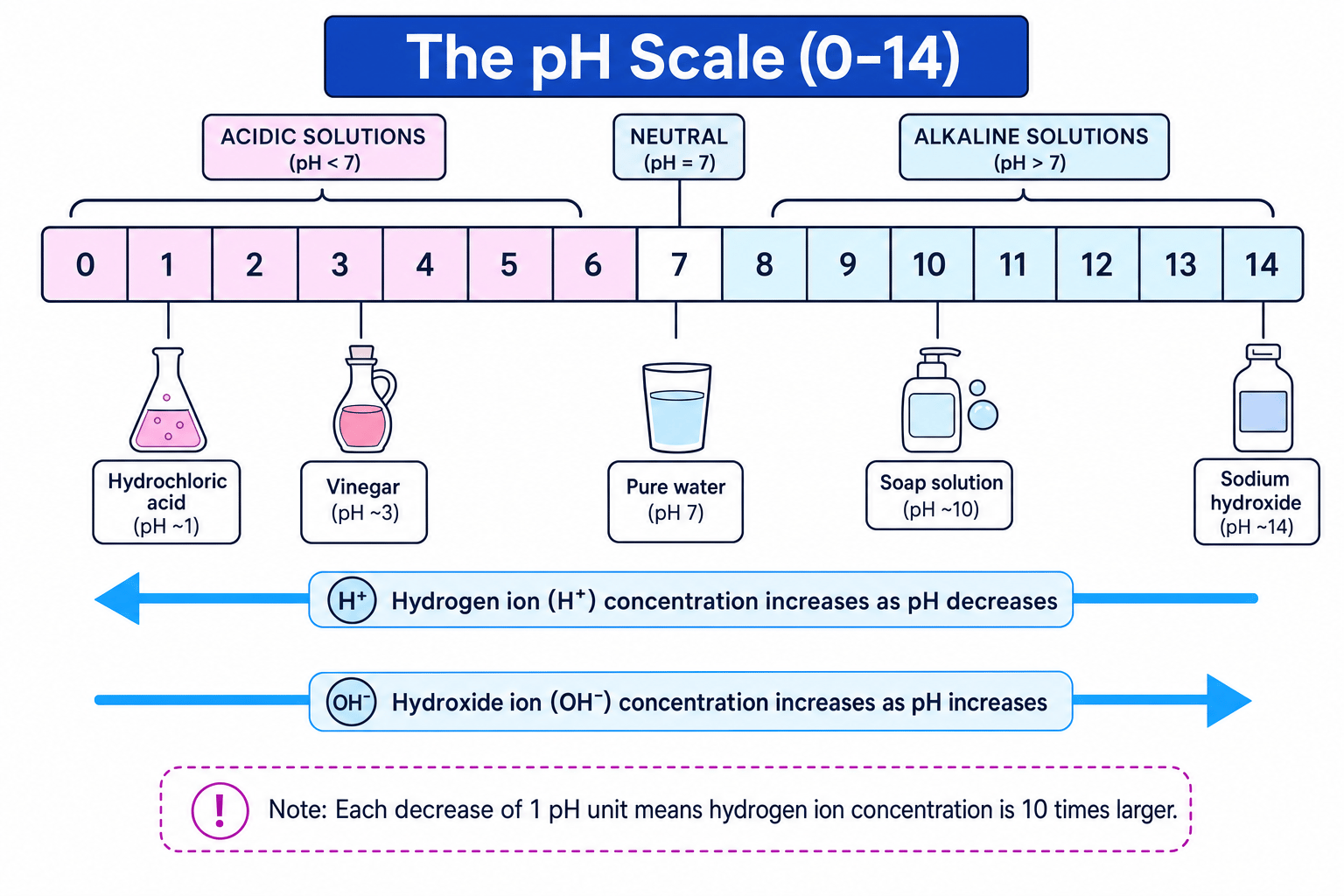
pH measures relative acidity and alkalinity. The usual GCSE pH scale runs from 0 to 14:
- pH below 7 is acidic
- pH 7 is neutral
- pH above 7 is alkaline
You can measure pH using:
- universal indicator, which changes colour and gives an approximate pH
- a pH meter or pH probe, which gives a more precise numerical value
Alkalis can be dangerous too
Do not assume alkalis are “safe” just because they are not acids. Strong alkalis can be very corrosive.
Concentrated, dilute, strong and weak acids
For Higher Tier, you need to separate two different ideas.
Concentration is about how much acid substance is dissolved in a certain volume of solution. A concentrated acid has a large amount of acid per volume. A dilute acid has a smaller amount of acid per volume.
You may use:
c=nVc = \frac{n}{V}c=Vn
where ccc is concentration in mol/dm³, nnn is amount of substance in moles, and VVV is volume in dm³.
Strength is about the degree of ionisation. Ionisation means forming ions in solution.
- A strong acid is completely ionised in water.
- A weak acid is only partly ionised in water.
Strong is not the same as concentrated
A strong acid can be dilute if lots of water is added. A weak acid can be concentrated if there is a large amount of acid per volume, even though only some particles ionise.
Comparing acid concentration
Solution A contains 0.10 mol of acid in 1.0 dm³. Solution B contains 0.10 mol of acid in 0.20 dm³. Which is more concentrated?
-
Use c=nVc = \frac{n}{V}c=Vn, making sure the volume is in dm³.
-
Calculate each concentration: for A, c=0.101.0=0.10c = \frac{0.10}{1.0} = 0.10c=1.00.10=0.10 mol/dm³. For B, c=0.100.20=0.50c = \frac{0.10}{0.20} = 0.50c=0.200.10=0.50 mol/dm³.
-
Compare the values: 0.50÷0.10=50.50 \div 0.10 = 50.50÷0.10=5, so solution B is five times more concentrated. This does not tell you whether the acid is strong or weak.
pH and hydrogen ion concentration
For Higher Tier, pH links to hydrogen ion concentration. The higher the concentration of H⁺(aq), the lower the pH.
For whole-number pH values, each decrease of 1 pH unit means the hydrogen ion concentration increases by a factor of 10.
Comparing hydrogen ion concentration from pH
Compare a solution at pH 3 with a solution at pH 6.
-
Find the pH difference: pH 6 to pH 3 is a decrease of 3 pH units.
-
Use the direction: lower pH means higher hydrogen ion concentration, so the pH 3 solution has more H⁺(aq).
-
Apply the tenfold rule: 103=100010^3 = 1000103=1000, so the pH 3 solution has 1000 times the hydrogen ion concentration of the pH 6 solution.
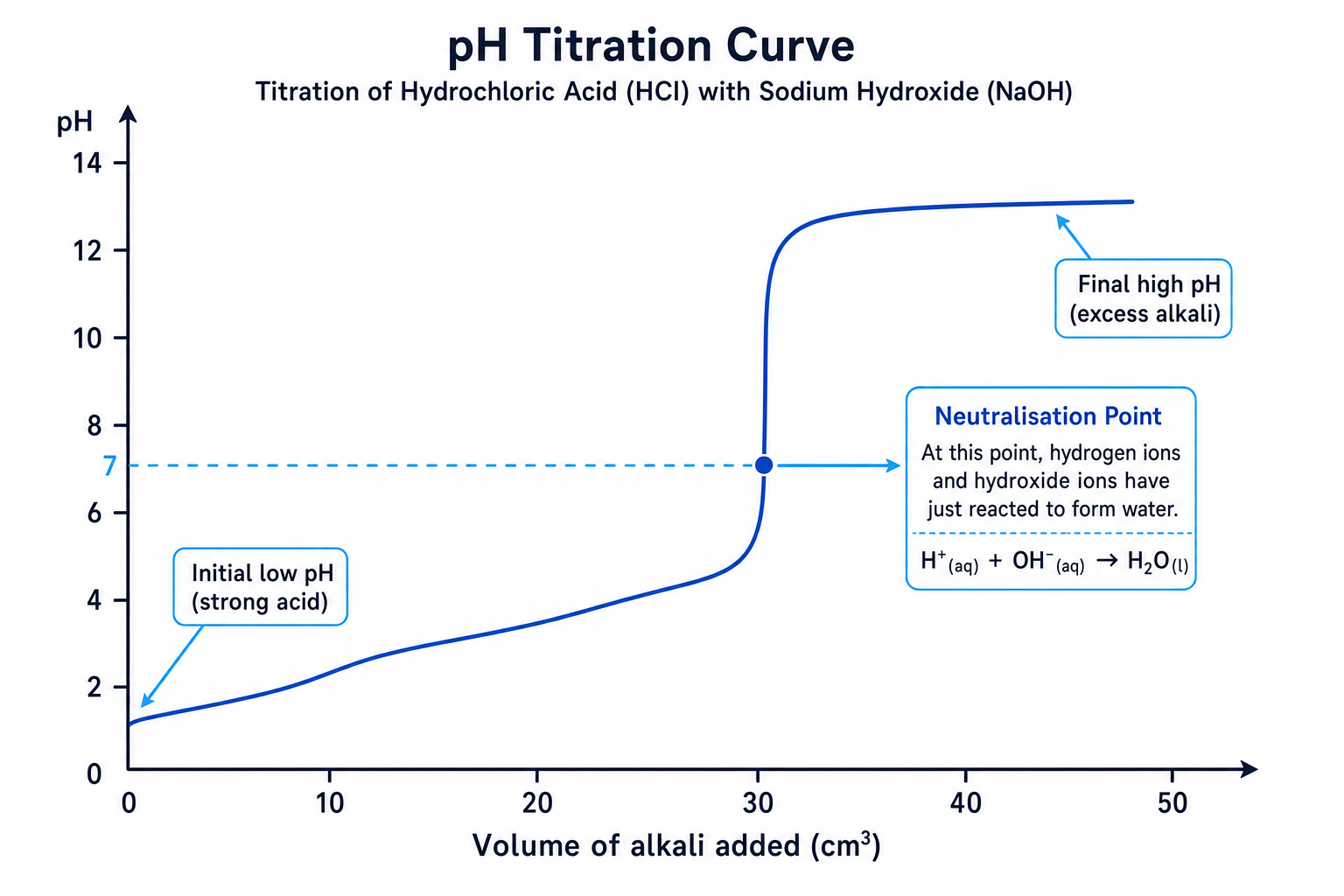
A titration is an experiment where one solution is added carefully to another to find the volume needed for neutralisation. On a pH titration curve, the steep part shows where a small volume causes a large pH change. For a strong acid reacting with a strong alkali, the neutralisation point is around pH 7.
In the exam
-
For redox, state exactly what is gained or lost: oxygen for the simpler definition, electrons for the Higher Tier definition.
-
For acid equations, first choose the reaction pattern, then name the salt from the acid and metal ion, then balance the equation with state symbols.
-
For pH questions, remember that lower pH means more H⁺(aq), and on Higher Tier each pH step is a factor of 10.
Check yourself
- In Mg(s) + CuO(s) → MgO(s) + Cu(s), which substance is oxidised and which is reduced?
- Why can dilute hydrochloric acid still be described as a strong acid?
- What products form when calcium carbonate reacts with hydrochloric acid?