

What you'll learn
- How to tell whether a reaction is exothermic or endothermic from a temperature change.
- How to draw and label reaction profile diagrams.
- What activation energy means and why reactions often need a “start”.
- For Higher Tier, how to calculate energy changes using bond energies.
The big idea: reactions transfer energy
A chemical reaction rearranges atoms. The starting substances are called reactants, and the substances formed are called products.
In many reactions, energy is transferred between the reacting chemicals and their surroundings. The surroundings are everything around the reacting chemicals, such as the solution, the test tube, the air, or your thermometer.
Energy transfer
Energy is never “used up” or “lost” in a reaction. It is transferred between chemical energy stores and the surroundings, often causing a temperature change.
Exothermic and endothermic reactions
You can classify many reactions by measuring the temperature change of the surroundings.
Exothermic and endothermic reactions
- An exothermic reaction transfers energy to the surroundings, so the temperature of the surroundings increases.
- An endothermic reaction takes in energy from the surroundings, so the temperature of the surroundings decreases.
Common exothermic reactions include combustion, neutralisation and many oxidation reactions. For example:
HCl(aq) + NaOH(aq) → NaCl(aq) + H₂O(l)
Common endothermic processes include some thermal decompositions and reactions used in cold packs.
Use the surroundings
If the surroundings get warmer, the reaction is exothermic. If the surroundings get colder, the reaction is endothermic.
Measuring a temperature change
In a school practical, you might mix two reactants in a polystyrene cup, use a thermometer or temperature probe, and record the highest or lowest temperature reached. This is the idea behind the temperature-change practical work in PAG C5.
Classifying a reaction from temperature change
A student mixes hydrochloric acid and sodium hydroxide solution. The temperature changes from 21.0 °C to 28.5 °C.
-
Calculate the temperature change: ΔT=28.5 ∘C−21.0 ∘C=+7.5 ∘C\Delta T = 28.5\,^\circ\text{C} - 21.0\,^\circ\text{C} = +7.5\,^\circ\text{C}ΔT=28.5∘C−21.0∘C=+7.5∘C.
-
Decide what happened to the surroundings: the measured temperature increased, so energy was transferred to the surroundings.
-
Classify the reaction: the reaction is exothermic.
Heat needed to start does not mean endothermic
A reaction can need a spark or flame to start but still be exothermic overall. For example, methane combustion needs ignition but releases energy once it is going: CH₄(g) + 2O₂(g) → CO₂(g) + 2H₂O(l).
Reaction profile diagrams
A reaction profile is a graph showing how the energy changes as a reaction happens.
The vertical axis is energy. The horizontal axis is progress of reaction — it is not usually time. The curve rises first because energy is needed to start breaking bonds, then falls or rises to the final energy level of the products.
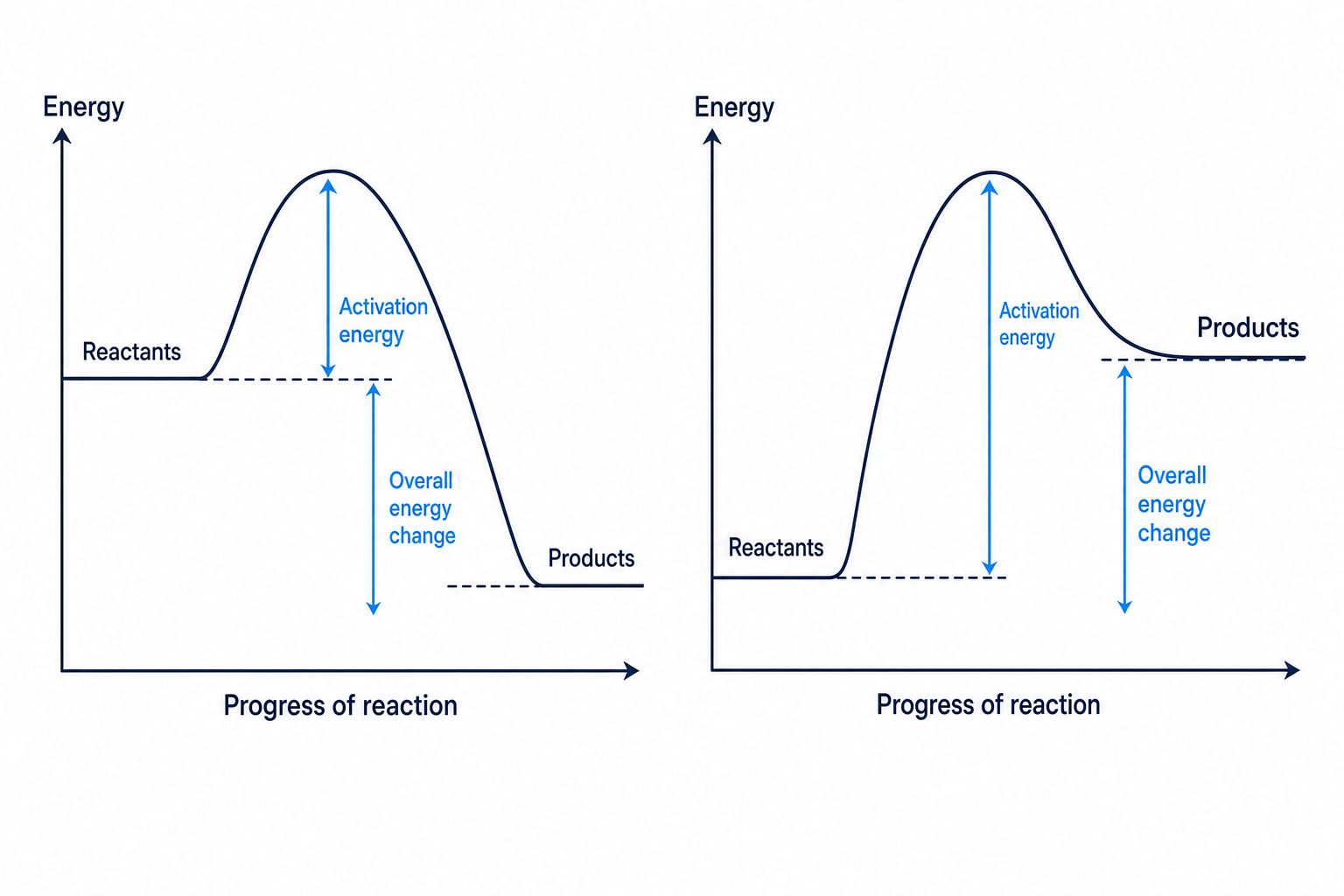
Exothermic reaction profiles
In an exothermic reaction:
- the products are at a lower energy than the reactants
- the overall energy change is shown by a downward arrow
- energy has been transferred to the surroundings
Endothermic reaction profiles
In an endothermic reaction:
- the products are at a higher energy than the reactants
- the overall energy change is shown by an upward arrow
- energy has been taken in from the surroundings
Reading a reaction profile
A reaction profile shows reactants at 120 kJ/mol, the peak at 190 kJ/mol, and products at 40 kJ/mol.
-
Compare reactants and products: the products are lower than the reactants, so the reaction is exothermic.
-
Calculate the activation energy from the reactants to the peak: Ea=190 kJ/mol−120 kJ/mol=70 kJ/molE_a = 190\,\text{kJ/mol} - 120\,\text{kJ/mol} = 70\,\text{kJ/mol}Ea=190kJ/mol−120kJ/mol=70kJ/mol.
-
Calculate the overall energy change: ΔH=40 kJ/mol−120 kJ/mol=−80 kJ/mol\Delta H = 40\,\text{kJ/mol} - 120\,\text{kJ/mol} = -80\,\text{kJ/mol}ΔH=40kJ/mol−120kJ/mol=−80kJ/mol.
-
Interpret the sign: the negative value confirms that energy is transferred to the surroundings.
Activation energy
Activation energy
Activation energy, often written as EaE_aEa, is the minimum energy particles need for a reaction to occur.
Particles must collide with enough energy to start breaking the original bonds. If they do not have enough energy, they may bounce apart without reacting.
On a reaction profile, the activation energy is the vertical energy gap from the reactants up to the highest point of the curve.
Where to draw activation energy
Draw the activation energy arrow from the reactants’ energy level to the top of the curve, not from the x-axis.
Bond breaking and bond making
During a reaction, bonds in the reactants are broken and new bonds in the products are made.
This is the key bond-energy model:
- Breaking bonds requires energy.
- Making bonds releases energy.
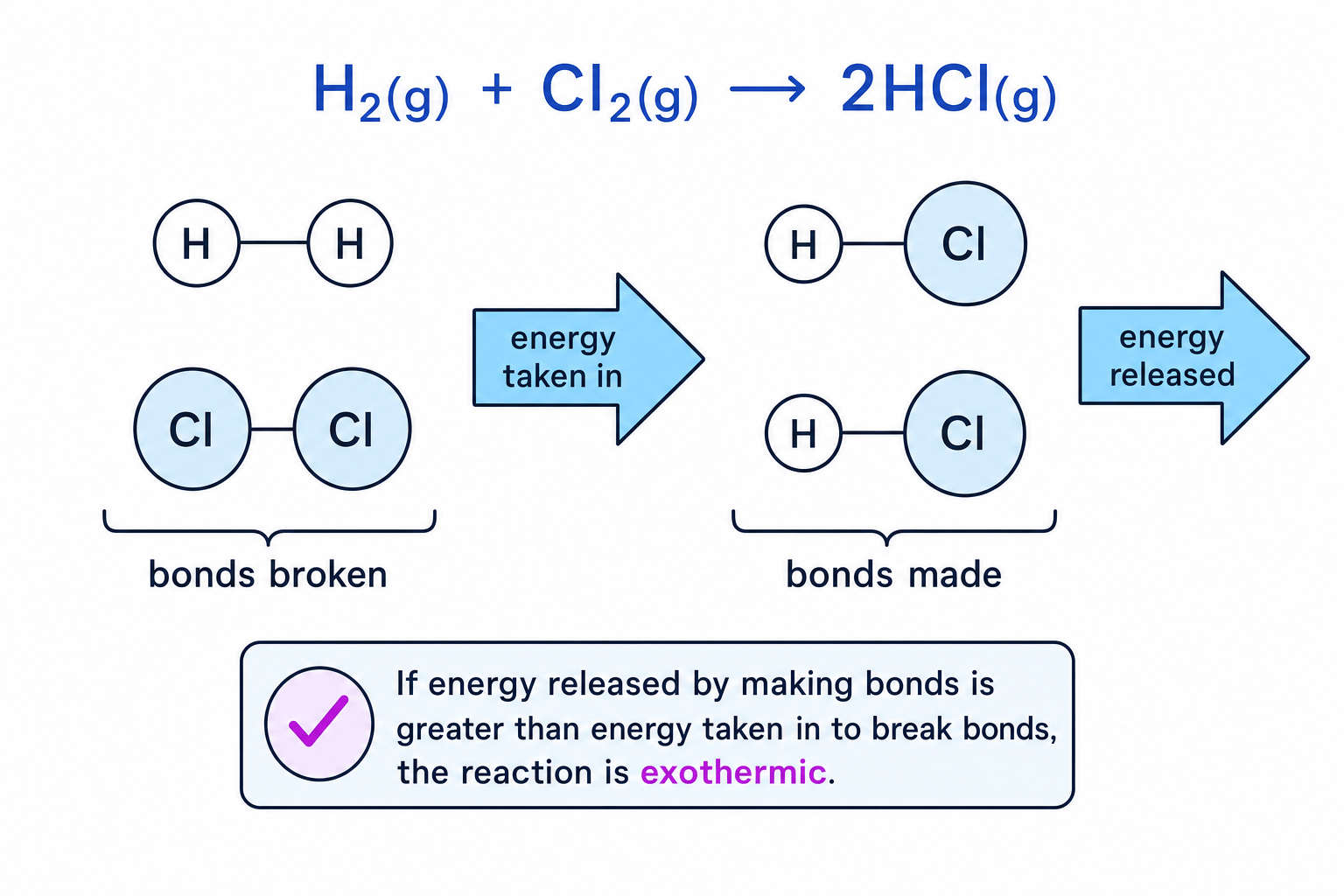
Bonds breaking do not release energy
A very common mistake is to say that breaking bonds releases energy. In this GCSE model, breaking bonds always takes in energy; making bonds releases energy.
Higher Tier: calculating energy changes from bond energies
At Higher Tier, you may be asked to calculate the energy change in a reaction using bond energies.
Bond energy
A bond energy is the energy needed to break one mole of a particular type of covalent bond, measured in kilojoules per mole (kJ/mol).
The method is:
ΔH=∑Ebonds broken−∑Ebonds made\Delta H = \sum E_\text{bonds broken} - \sum E_\text{bonds made}ΔH=∑Ebonds broken−∑Ebonds madeSo:
- a negative value means the reaction is exothermic
- a positive value means the reaction is endothermic
The calculation rule
Add up the energy needed to break bonds, add up the energy released when bonds are made, then do: broken minus made.
Calculating an energy change from bond energies
Hydrogen reacts with chlorine:
H₂(g) + Cl₂(g) → 2HCl(g)
Bond energies: H–H = 436 kJ/mol, Cl–Cl = 243 kJ/mol, H–Cl = 432 kJ/mol.
-
Work out the energy needed to break bonds in the reactants: one H–H bond and one Cl–Cl bond are broken, so 436 kJ/mol+243 kJ/mol=679 kJ/mol436\,\text{kJ/mol} + 243\,\text{kJ/mol} = 679\,\text{kJ/mol}436kJ/mol+243kJ/mol=679kJ/mol.
-
Work out the energy released when bonds are made in the products: two H–Cl bonds are made, so 2×432 kJ/mol=864 kJ/mol2 \times 432\,\text{kJ/mol} = 864\,\text{kJ/mol}2×432kJ/mol=864kJ/mol.
-
Substitute into the formula: ΔH=679 kJ/mol−864 kJ/mol=−185 kJ/mol\Delta H = 679\,\text{kJ/mol} - 864\,\text{kJ/mol} = -185\,\text{kJ/mol}ΔH=679kJ/mol−864kJ/mol=−185kJ/mol.
-
Interpret the answer: the value is negative, so the reaction is exothermic.
Count bonds carefully
Use the balanced equation to count bonds. If the product is 2HCl(g), there are two H–Cl bonds being made.
In the exam
-
For temperature-change questions, link your answer to the surroundings: temperature rises means exothermic; temperature falls means endothermic.
-
For reaction profiles, always label the axes, reactants, products, activation energy and overall energy change.
-
For Higher Tier bond-energy calculations, use bonds broken minus bonds made, then include the sign and units in kJ/mol.
Check yourself
- If a reaction mixture cools from 24 °C to 18 °C, is the reaction exothermic or endothermic?
- On a reaction profile, where should the activation energy arrow start and finish?
- Why is “breaking bonds releases energy” the wrong way round?
