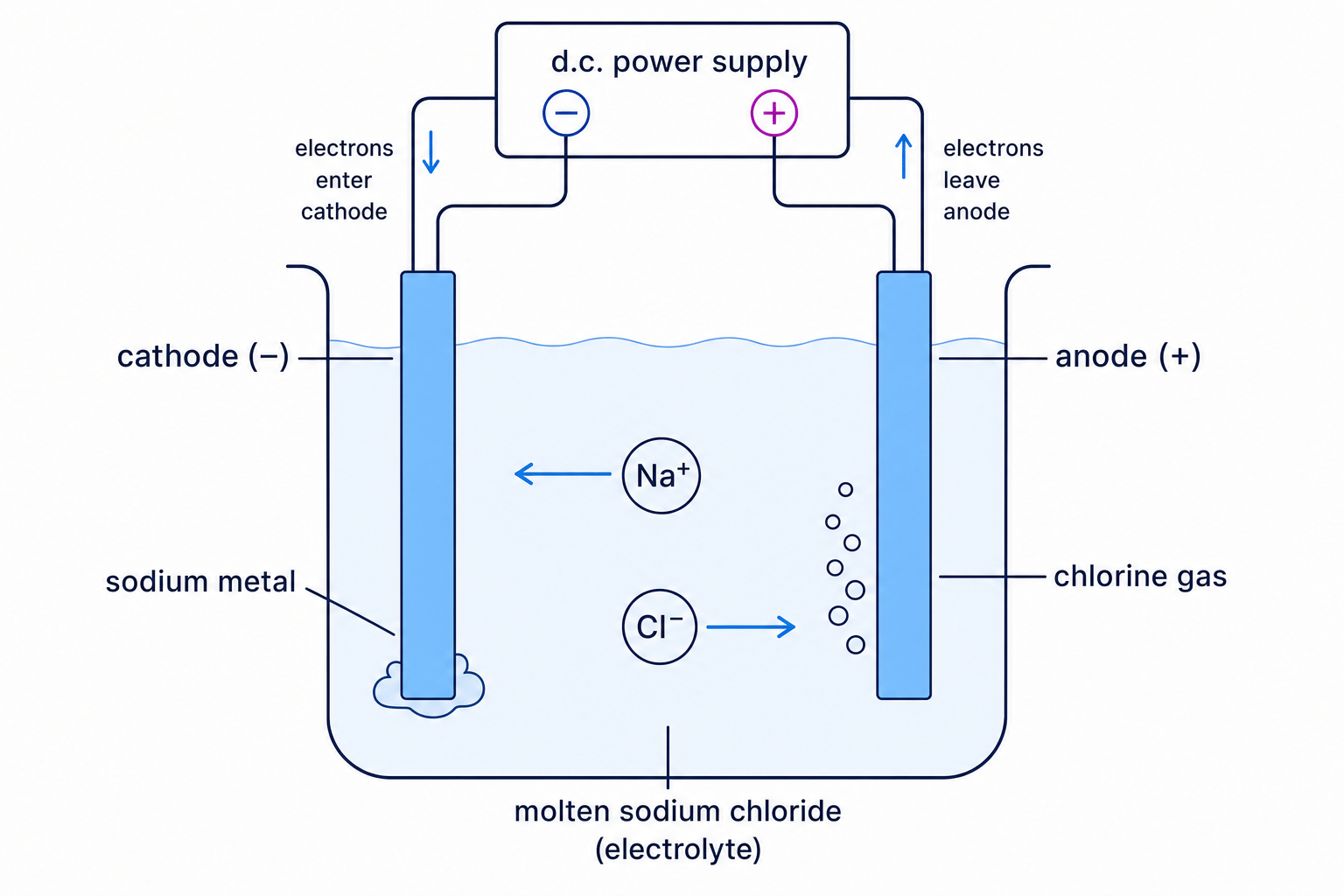
What you'll learn
- Why ionic substances conduct only when molten or dissolved in water.
- How ions move to the cathode and anode during electrolysis.
- How to predict products from molten ionic compounds and aqueous solutions.
- How inert and non-inert electrodes can change what happens.
The starting point: ions must be able to move
An ion is an atom or group of atoms with an electrical charge. A cation is a positive ion, and an anion is a negative ion.
An ionic compound is made from oppositely charged ions arranged in a giant ionic lattice. In a solid ionic compound, the ions are held in fixed positions, so they cannot move around.
If the ionic compound is molten — melted into a liquid — or aqueous — dissolved in water — its ions can move. A liquid that conducts electricity because it contains moving ions is called an electrolyte.
What carries the charge?
Ionic solutions conduct because ions move through the liquid. Electrons move through the metal wires and electrodes, not through the electrolyte. Solid ionic compounds do not conduct because their ions are fixed in place.
What is electrolysis?
Electrolysis
Electrolysis is the decomposition, or breaking down, of a molten ionic compound or aqueous ionic solution by passing a direct electric current through it.
Electrolysis uses two electrodes, which are conductors placed in the electrolyte. The cathode is the negative electrode in electrolysis, and the anode is the positive electrode. The power supply must be d.c. because the electrodes need to keep their fixed positive and negative roles.
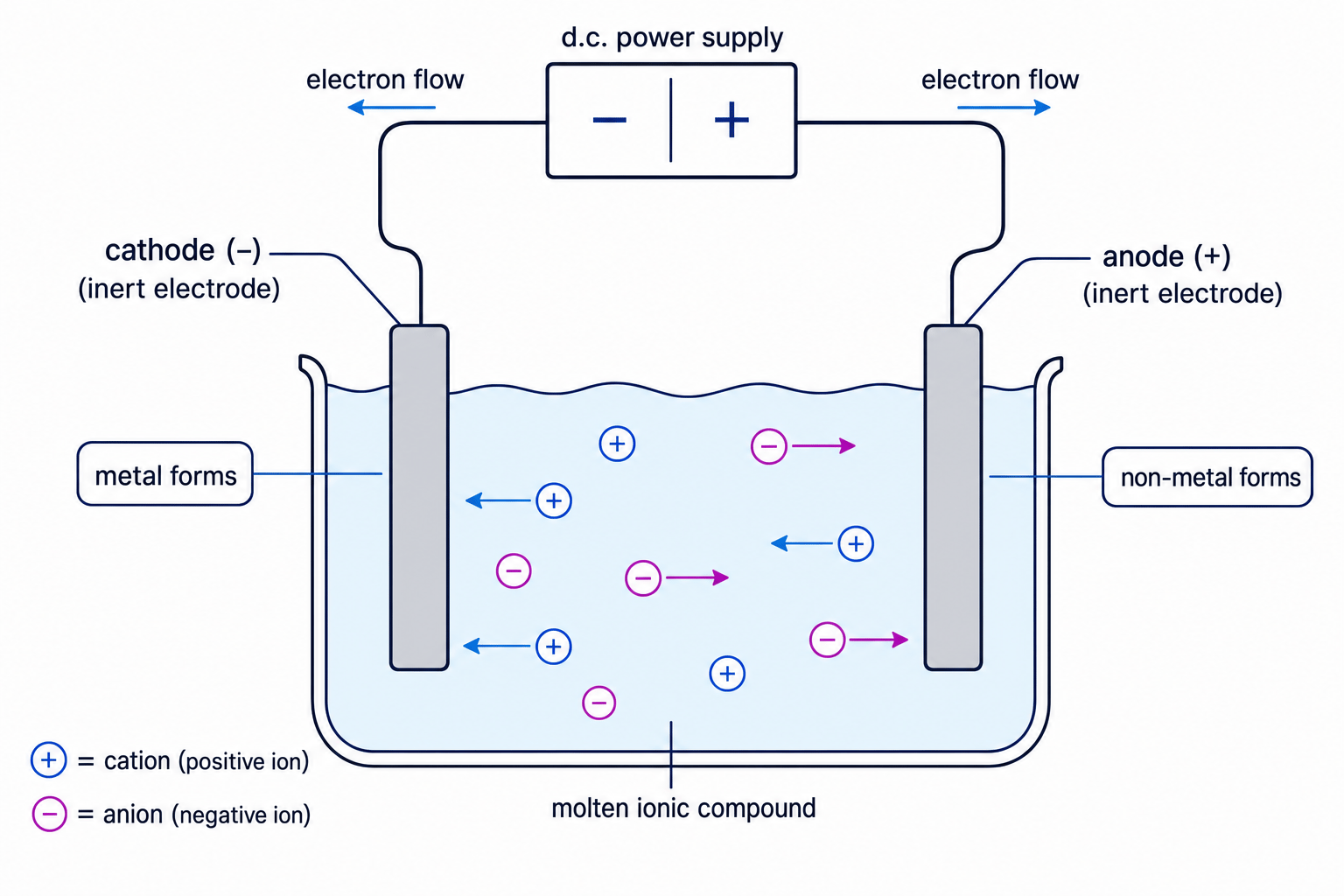
The power supply pushes electrons onto the cathode and pulls electrons away from the anode. Positive ions are attracted to the negative cathode. Negative ions are attracted to the positive anode.
The electrode rule
Using inert electrodes, metals or hydrogen form at the cathode, and non-metals form at the anode.
An inert electrode does not react during electrolysis; it just provides a conducting surface. Graphite and platinum are common inert electrodes.
What happens at the electrodes?
When an ion reaches an electrode, it may be discharged. This means it gains or loses electrons and becomes a neutral substance.
Oxidation and reduction
Reduction is gain of electrons. Oxidation is loss of electrons. In electrolysis, cations are reduced at the cathode and anions are oxidised at the anode.
At the cathode, positive ions gain electrons. For example:
Cu2+(aq) + 2e− → Cu(s)
At the anode, negative ions lose electrons. For example:
2Cl−(aq) → Cl2(g) + 2e−
OIL RIG
Oxidation Is Loss of electrons; Reduction Is Gain of electrons. Also remember: cations go to the cathode.
Electrolysis of molten binary ionic compounds
A binary ionic compound contains ions of only two elements, usually a metal and a non-metal. Examples include sodium chloride, NaCl, and lead(II) bromide, PbBr2.
In the molten state, there is no water present, so the only ions available are the ions from the compound itself. This makes the products fairly straightforward:
- The metal ion goes to the cathode and forms the metal.
- The non-metal ion goes to the anode and forms the non-metal.
Predicting products from molten lead(II) bromide
-
Molten lead(II) bromide contains Pb2+(l) ions and Br−(l) ions. There are no water ions competing.
-
Pb2+ ions move to the cathode because they are positive. They gain electrons: Pb2+(l) + 2e− → Pb(l).
-
Br− ions move to the anode because they are negative. They lose electrons and pair up to form bromine: 2Br−(l) → Br2(g) + 2e−.
-
The overall reaction is: PbBr2(l) → Pb(l) + Br2(g).
For molten aluminium oxide, Al2O3(l), aluminium forms at the cathode and oxygen forms at the anode. The balanced overall equation is:
2Al2O3(l) → 4Al(l) + 3O2(g)
Forgetting molecules
Hydrogen, oxygen and halogens usually form molecules: H2, O2, Cl2, Br2 and I2. Do not write just H, O or Cl as the product.
Electrolysis of aqueous solutions
An aqueous solution contains ions from the dissolved compound, but it also contains H+(aq) and OH−(aq) ions from water. This creates competing reactions, because more than one ion may be attracted to each electrode.
The flowchart shows the GCSE product rules for aqueous solutions using inert electrodes.
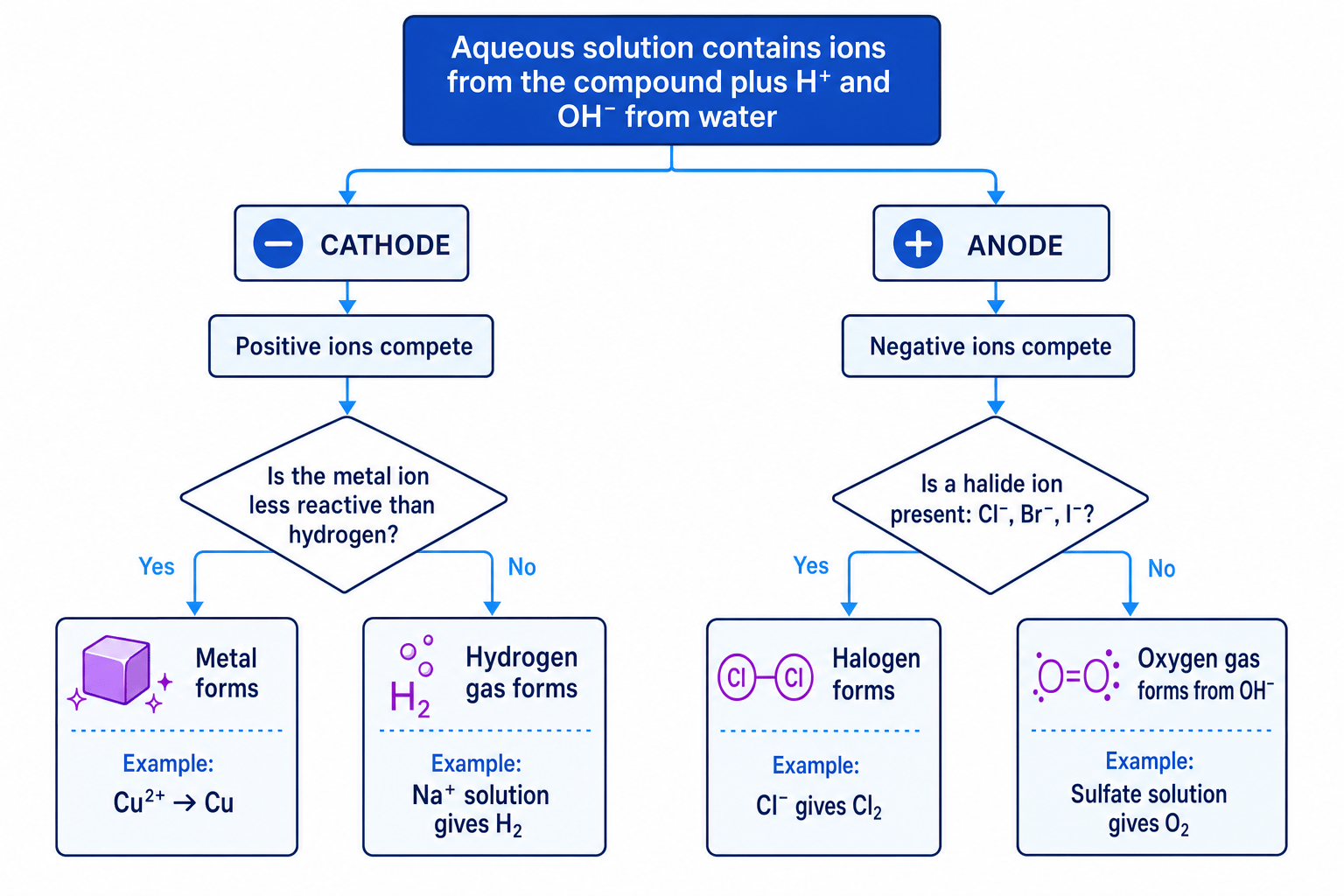
At the cathode, positive ions compete:
- If the metal is less reactive than hydrogen, the metal forms.
- If the metal is more reactive than hydrogen, hydrogen gas forms.
At the anode, negative ions compete:
- If a halide ion is present — Cl−, Br− or I− — the halogen forms.
- If no halide ion is present, oxygen forms from OH− ions.
Predicting products from copper sulfate solution
-
Copper sulfate solution contains Cu2+(aq), SO42−(aq), H+(aq) and OH−(aq) ions.
-
At the cathode, Cu2+ competes with H+. Copper is less reactive than hydrogen, so copper forms: Cu2+(aq) + 2e− → Cu(s).
-
At the anode, sulfate ions and hydroxide ions compete. Sulfate is not a halide, so oxygen forms from hydroxide ions: 4OH−(aq) → O2(g) + 2H2O(l) + 4e−.
-
You would observe a copper coating on the cathode and bubbles of oxygen at the anode.
For sodium chloride solution, Na+(aq), Cl−(aq), H+(aq) and OH−(aq) are present. Sodium is more reactive than hydrogen, so hydrogen forms at the cathode. Chloride is a halide, so chlorine forms at the anode.
2NaCl(aq) + 2H2O(l) → H2(g) + Cl2(g) + 2NaOH(aq)
Inert and non-inert electrodes
A non-inert electrode does react during electrolysis. This can change the products because the electrode itself may lose atoms into the solution.
A useful comparison is copper sulfate solution:
Comparing graphite and copper electrodes
-
With inert graphite electrodes in CuSO4(aq), Cu2+ ions form copper at the cathode, while oxygen forms at the anode.
-
If the anode is copper, copper atoms lose electrons instead: Cu(s) → Cu2+(aq) + 2e−. The copper anode gets smaller.
-
The cathode still gains copper: Cu2+(aq) + 2e− → Cu(s). Overall, copper is transferred from the anode to the cathode.
In practical work, gas bubbles show a gas is forming, while a coloured coating may show a metal is being deposited. Hydrogen gives a squeaky pop with a lit splint, oxygen relights a glowing splint, and chlorine bleaches damp litmus paper.
In the exam
-
First decide whether the electrolyte is molten or aqueous. Molten means only the compound’s ions are present; aqueous means water ions also compete.
-
Label the electrodes carefully: cathode is negative, anode is positive in electrolysis.
-
Use the product rules for inert electrodes, but check whether the question says the electrodes are non-inert.
-
When writing equations, balance atoms and charges, and include state symbols such as (s), (l), (g) and (aq).
Check yourself
- Why does solid sodium chloride not conduct electricity, but molten sodium chloride does?
- What products form when molten magnesium chloride is electrolysed using inert electrodes?
- How does copper sulfate electrolysis change when copper electrodes are used instead of graphite electrodes?