What you'll learn
- Why large multicellular organisms need exchange surfaces and transport systems.
- How to calculate surface area to volume ratio and link it to diffusion.
- How the heart, blood vessels, red blood cells and plasma are adapted for transport.
- How plants move water, mineral ions and sugars, and how potometers measure water uptake.
Why size creates a problem
All cells need substances such as oxygen, water and dissolved food molecules. They also need to remove waste substances such as carbon dioxide and urea.
Small organisms can often exchange enough substances directly through their outer surface. Larger multicellular organisms cannot rely on this alone.
Diffusion
Diffusion is the net movement of particles from an area of higher concentration to an area of lower concentration.
As an organism gets bigger, two important things change:
- its volume increases a lot, so it has more cells needing supplies
- its surface area does not increase as quickly, so there is less exchange surface for each unit of volume
Surface area to volume ratio
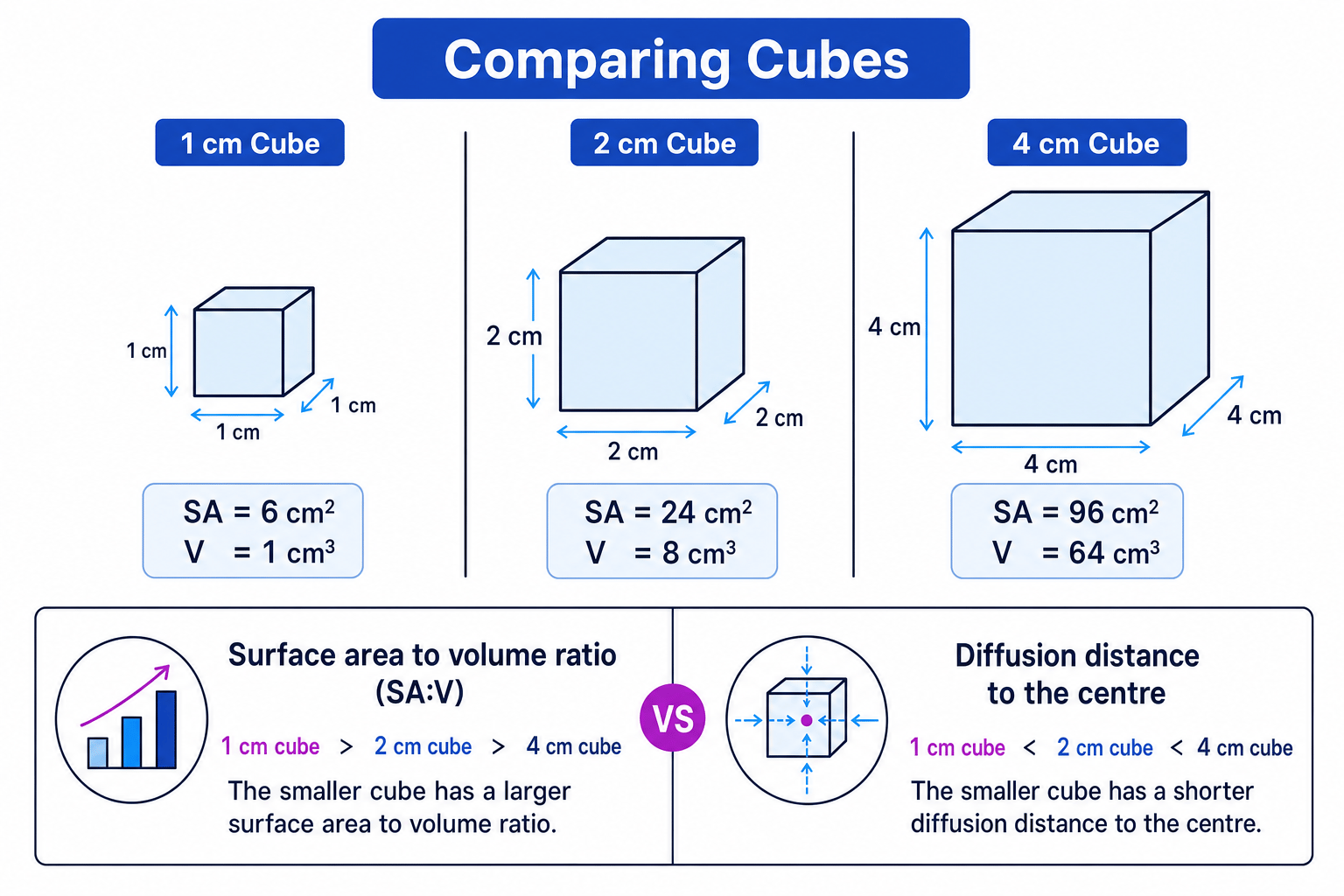
Surface area to volume ratio, often written as SA:V, compares the outside area available for exchange with the internal volume that needs supplying.
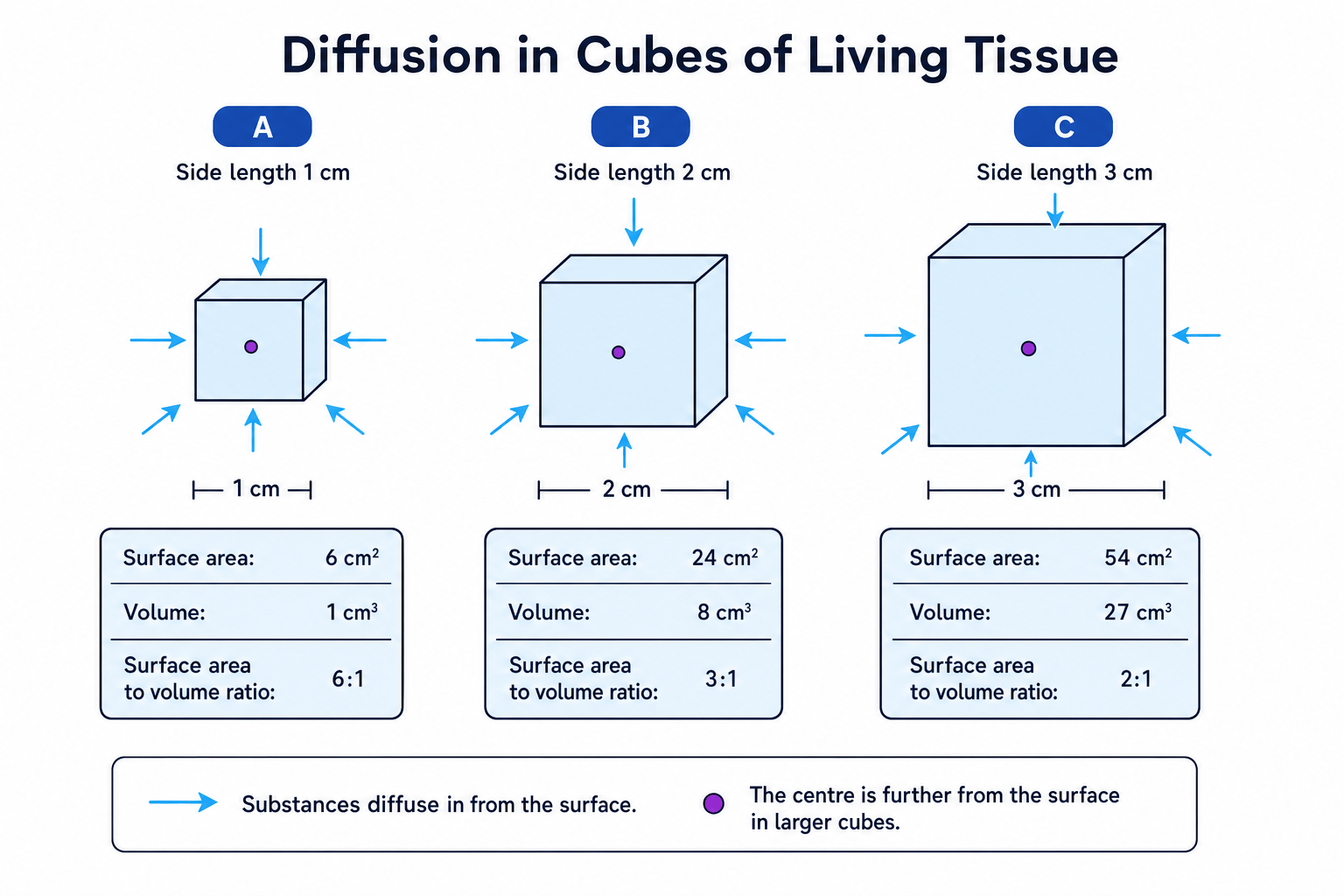
For a cube with side length lll:
SA=6l2V=l3SA:V=SAV\begin{aligned} SA &= 6l^2 \\ V &= l^3 \\ \text{SA:V} &= \frac{SA}{V} \end{aligned}SAVSA:V=6l2=l3=VSACalculating surface area to volume ratio
A cube-shaped organism has sides of 4 cm. Find its surface area to volume ratio.
- Calculate the surface area using SA=6l2SA = 6l^2SA=6l2:
SA=6×42=6×16=96 cm2SA = 6 \times 4^2 = 6 \times 16 = 96\ \text{cm}^2SA=6×42=6×16=96 cm2. - Calculate the volume using V=l3V = l^3V=l3:
V=43=64 cm3V = 4^3 = 64\ \text{cm}^3V=43=64 cm3. - Compare surface area with volume:
96:6496:6496:64 simplifies to 1.5:11.5:11.5:1. - Interpret the result: for every 1 cm³ of volume, there is only 1.5 cm² of surface for exchange, so diffusion alone would be too slow for a large active organism.
Exchange surfaces and transport systems
Exchange surface
An exchange surface is a specialised surface where substances move into or out of an organism, usually by diffusion, osmosis or active transport.
Good exchange surfaces usually have:
- a large surface area
- a short diffusion distance, meaning particles do not have far to travel
- a good supply of the substance being exchanged
- a way of carrying substances away to maintain a concentration gradient
In mammals, the alveoli in the lungs are gas exchange surfaces. In plants, root hair cells absorb water and mineral ions, while leaves exchange gases through stomata.
Why large organisms need transport systems
Large multicellular organisms have a lower SA:V and longer diffusion distances, so they need specialised exchange surfaces and transport systems to move substances quickly enough.
Gel cube practical
In acid-and-indicator cube experiments, smaller cubes change colour throughout more quickly because they have a higher SA:V and a shorter distance for acid to diffuse to the centre.
What substances need transporting?
Different organisms transport different substances depending on what they need.
Animals transport:
- oxygen from lungs to cells for aerobic respiration
- carbon dioxide from cells to lungs
- dissolved food molecules such as glucose and amino acids from the small intestine
- urea from the liver to the kidneys
- water and mineral ions around the body
Plants transport:
- water from roots to leaves
- mineral ions from soil to growing tissues
- dissolved sugars from leaves to other parts of the plant
The human double circulatory system
Circulatory system
The circulatory system is the organ system that transports blood around the body using the heart and blood vessels.
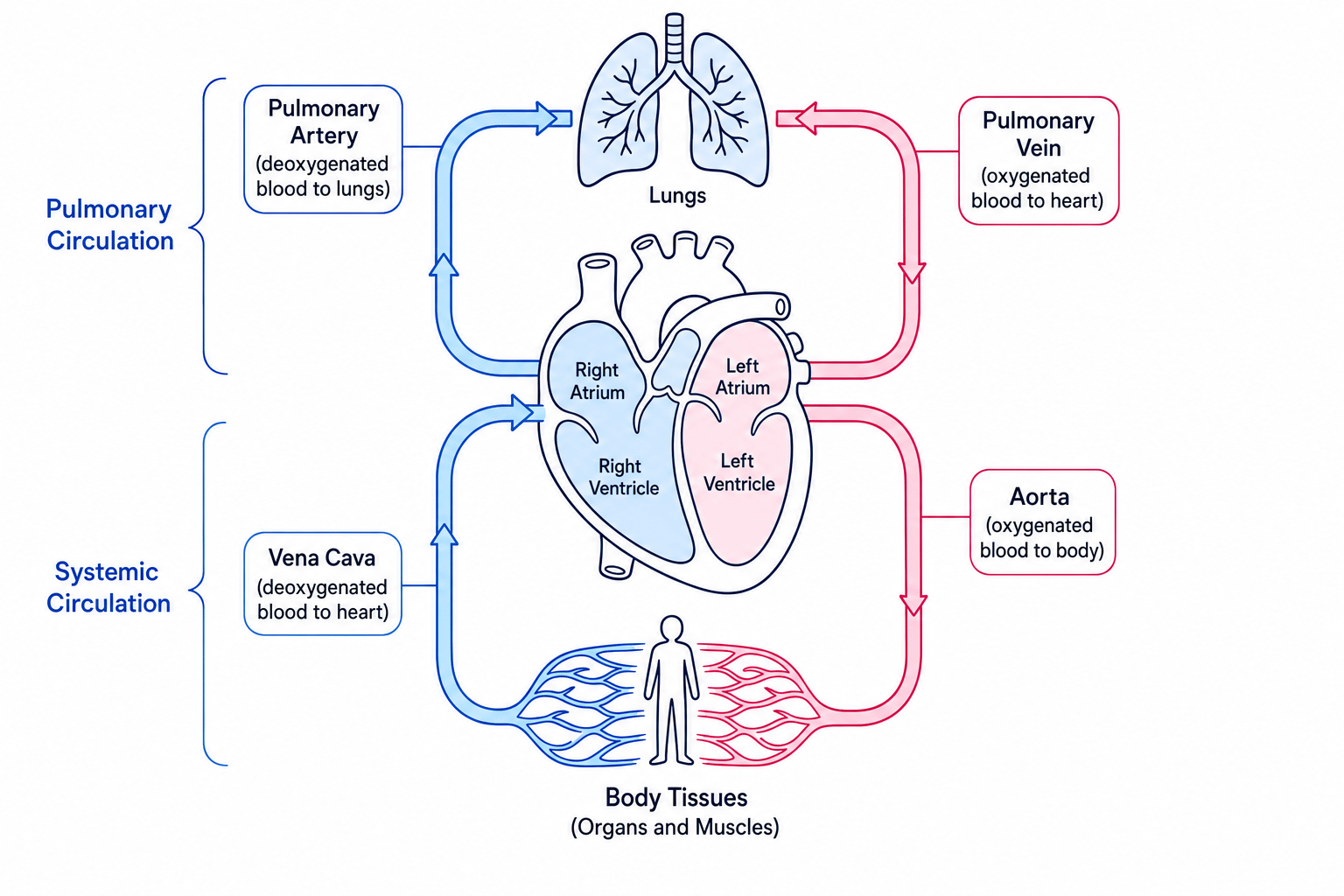
Mammals have a double circulatory system. This means blood passes through the heart twice for each full circuit of the body:
- pulmonary circulation: heart to lungs and back
- systemic circulation: heart to body tissues and back
This is useful because blood can be pumped at lower pressure to the delicate lungs, then returned to the heart and pumped at higher pressure around the whole body.
Tracing blood through the double circulation
A red blood cell starts in the vena cava and eventually reaches a muscle cell. Describe its route.
- It enters the right atrium, then moves into the right ventricle.
- The right ventricle pumps it through the pulmonary artery to the lungs, where it loads oxygen and releases carbon dioxide.
- It returns to the heart through the pulmonary vein, entering the left atrium and then the left ventricle.
- The left ventricle pumps it through the aorta to the body, where oxygen diffuses from the blood into the muscle cell.
Pulmonary vessels are the odd ones
The pulmonary artery carries deoxygenated blood, and the pulmonary vein carries oxygenated blood. This is the opposite of what many students expect.
The heart: structure and function
The heart is made of cardiac muscle, a specialised muscle that contracts rhythmically without tiring easily.
It has four chambers:
- right atrium and left atrium: receive blood
- right ventricle and left ventricle: pump blood out
The left ventricle has the thickest muscular wall because it pumps blood around the whole body at high pressure.
A valve is a structure that stops blood flowing backwards. Important heart valves include:
- tricuspid valve between the right atrium and right ventricle
- bicuspid valve, also called the mitral valve, between the left atrium and left ventricle
- semilunar valves at the exits to the pulmonary artery and aorta
Blood vessels
A lumen is the hollow space inside a blood vessel where blood flows.
Arteries carry blood away from the heart. They have thick muscular and elastic walls to withstand high pressure, and a relatively narrow lumen.
Veins carry blood towards the heart. They have thinner walls, a wider lumen and valves to prevent backflow because the blood is at lower pressure.
Capillaries are tiny vessels where exchange happens. Their walls are one cell thick, giving a very short diffusion distance between the blood and body cells.
Why blood is slow in capillaries
Blood flow in capillaries is slow mainly because the total cross-sectional area of all the capillaries is huge, not simply because each capillary is narrow. Slow flow gives more time for diffusion.
Identifying a blood vessel from its structure
A vessel has a thick elastic wall, a small lumen and no valves. Identify it.
- A thick elastic wall suggests the vessel must cope with high pressure.
- A small lumen is typical of vessels carrying blood rapidly away from the heart.
- No valves are needed because high pressure keeps blood moving forwards, so the vessel is an artery.
Blood as a transport medium
Red blood cells are adapted to carry oxygen. They contain haemoglobin, which binds to oxygen in the lungs and releases it in respiring tissues. They also have a biconcave shape for a large surface area, no nucleus to make more space for haemoglobin, and flexibility to squeeze through capillaries.
Plasma
Plasma is the liquid part of blood. It transports dissolved substances around the body.
Plasma carries carbon dioxide, urea, glucose, amino acids, hormones, antibodies, water and heat.
Plant transport: roots, xylem and phloem
Plants also face the challenge of size. A tall plant cannot rely on diffusion alone to move water from roots to leaves or sugars from leaves to roots.
Root hair cells
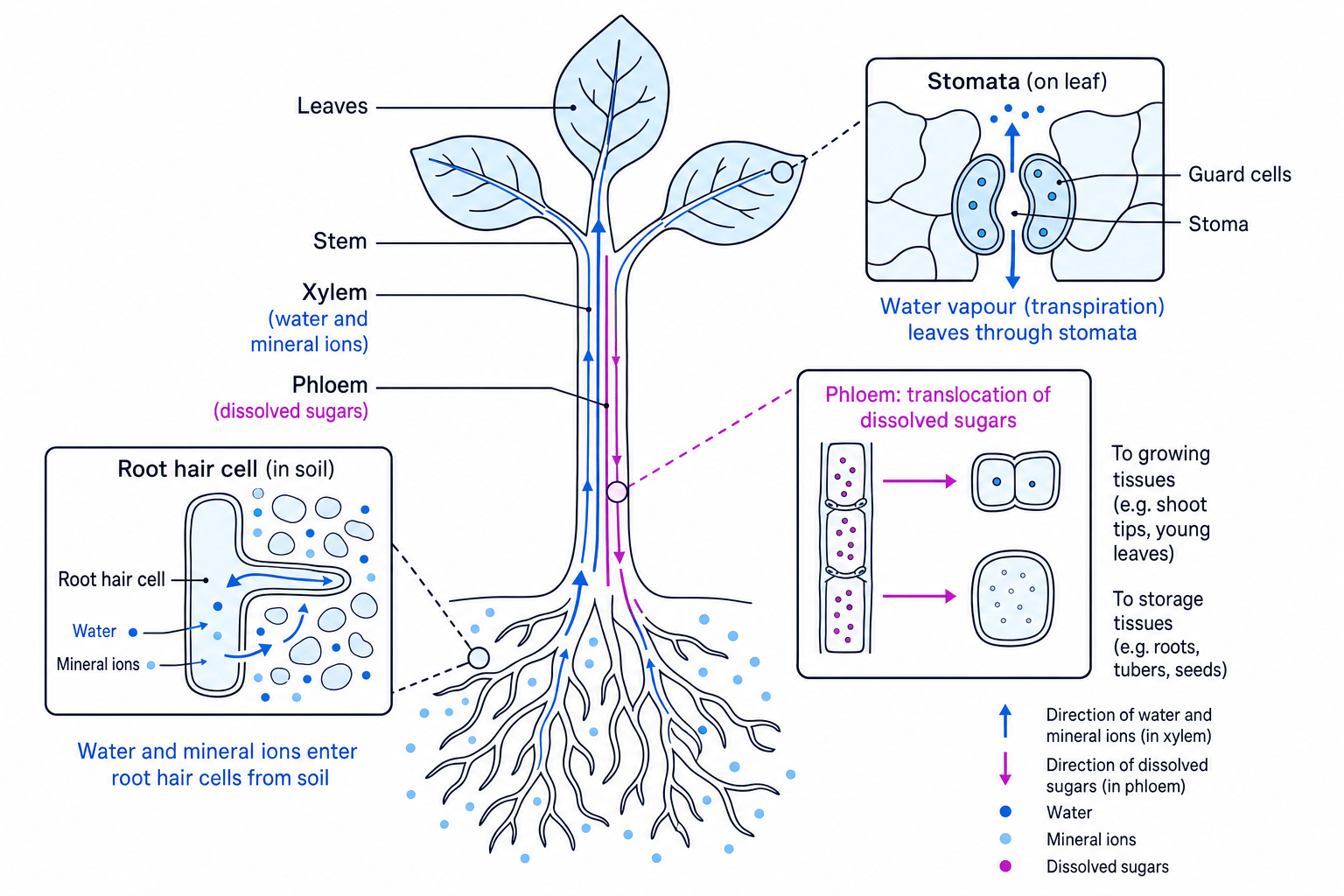
Root hair cells absorb water and mineral ions from the soil. Their long hair-like projection gives a large surface area.
Water enters root hair cells by osmosis.
Osmosis
Osmosis is the movement of water molecules through a partially permeable membrane from a dilute solution to a more concentrated solution.
Mineral ions can be taken up by active transport, which is movement against a concentration gradient using energy from respiration. Root hair cells contain mitochondria to release this energy.
Xylem
Xylem transports water and mineral ions from roots to leaves. Xylem vessels are made from dead cells joined end to end, forming hollow tubes. Their walls are strengthened with lignin, which helps support the plant and stops the tubes collapsing.
Phloem
Phloem transports dissolved sugars, mainly sucrose, from leaves to growing or storage tissues. This movement is called translocation. Phloem is living tissue and has sieve plates and companion cells to help move sugars.
Transpiration and stomata
Transpiration
Transpiration is the loss of water vapour from the leaves of a plant, mainly through the stomata.
A stoma is a pore in the leaf surface. Guard cells open and close the stomata. When stomata are open, carbon dioxide can enter for photosynthesis, but water vapour can also diffuse out.
The water lost from leaves helps pull more water up the xylem from the roots. This flow is called the transpiration stream.
Environmental factors affect the rate of water uptake:
- higher light intensity usually opens stomata, increasing transpiration
- more air movement removes water vapour from around the leaf, increasing the diffusion gradient
- higher temperature increases evaporation and diffusion, increasing transpiration
Very hot conditions
If conditions are too hot or dry, stomata may close to reduce water loss, so the simple “higher temperature means faster transpiration” pattern may stop applying.
Using a potometer
A potometer is apparatus used to estimate the rate of water uptake by a plant shoot. It does not measure transpiration directly, because a small amount of water may be used in photosynthesis or to keep cells turgid.
In a simple potometer:
- a leafy shoot is connected to a water-filled tube
- the apparatus must be airtight
- an air bubble is introduced into a capillary tube
- the distance the bubble moves in a set time is measured
You can calculate rate using:
rate of water uptake=volume of water taken uptime\text{rate of water uptake} = \frac{\text{volume of water taken up}}{\text{time}}rate of water uptake=timevolume of water taken upIf the capillary tube has a known cross-sectional area:
volume=cross-sectional area×distance moved\text{volume} = \text{cross-sectional area} \times \text{distance moved}volume=cross-sectional area×distance movedCalculating potometer rate and percentage mass loss
A potometer capillary tube has cross-sectional area 0.50 mm². The air bubble moves 80 mm in 600 s. A plant’s mass decreases from 125.0 g to 122.5 g.
- Calculate the volume of water taken up:
volume=0.50×80=40 mm3\text{volume} = 0.50 \times 80 = 40\ \text{mm}^3volume=0.50×80=40 mm3. - Calculate the rate of water uptake:
rate=40600=0.067 mm3/s\text{rate} = \frac{40}{600} = 0.067\ \text{mm}^3/\text{s}rate=60040=0.067 mm3/s. - Find the change in mass:
125.0−122.5=2.5 g125.0 - 122.5 = 2.5\ \text{g}125.0−122.5=2.5 g. - Calculate the percentage loss:
percentage loss=2.5125.0×100=2.0%\text{percentage loss} = \frac{2.5}{125.0} \times 100 = 2.0\%percentage loss=125.02.5×100=2.0%.
In the exam
- For SA:V questions, calculate surface area and volume separately, then compare them as a ratio and link your answer to diffusion distance.
- For heart questions, always follow the direction of blood flow: vena cava, right heart, lungs, left heart, aorta, body.
- For potometer or transpiration graphs, put the independent variable on the x-axis, rate on the y-axis, include units, and explain trends using diffusion gradients.
Check yourself
- Why does a large multicellular organism need both exchange surfaces and a transport system?
- How are arteries, veins and capillaries each adapted to their functions?
- How would increasing air movement around a plant shoot affect water uptake in a potometer?