What you'll learn
- How the nervous system is organised, from receptors to the central nervous system.
- What sensory, relay and motor neurones do.
- How synapses and effectors help produce coordinated responses.
- Why reflex arcs are fast, automatic and protective.
The big idea: communication inside the body
Your body needs to respond to changes around you and inside you. For example, you may need to pull your hand away from something hot, turn towards a sound, or blink when dust comes near your eye.
A multicellular organism is organised in levels: cells make up tissues, tissues make up organs, organs work together in organ systems, and all the systems together make the organism. The nervous system is one of these organ systems.
Nervous system
The nervous system is the organ system that detects changes, sends information as nerve impulses, and coordinates fast responses.
The nervous system is especially important for fast responses. Hormones also coordinate the body, but hormonal responses are usually slower and longer-lasting.
Stimuli, receptors and responses
Stimulus and response
A stimulus is a change in the environment that can be detected. A response is the action taken by the body after detecting a stimulus.
Examples of stimuli include light, sound, temperature, pressure, pain, and chemicals such as smells or tastes.
A sensory receptor is a cell or group of cells that detects a specific type of stimulus. For example:
- receptors in the skin detect temperature, pressure and pain
- receptors in the eye detect light
- receptors in the nose detect chemicals in the air
Eyes do not send out a force
You see because light enters the eye and is detected by receptors. Your brain then interprets the nerve impulses. Nothing comes out of your eye to “touch” the object.
The central nervous system
Central nervous system
The central nervous system, or CNS, is made up of the brain and spinal cord.
The CNS coordinates responses. This means it receives information from receptors, processes it, and sends instructions to parts of the body that will respond.
The nerves outside the CNS form the peripheral nervous system, or PNS. These nerves link the CNS to the rest of the body.
Coordination
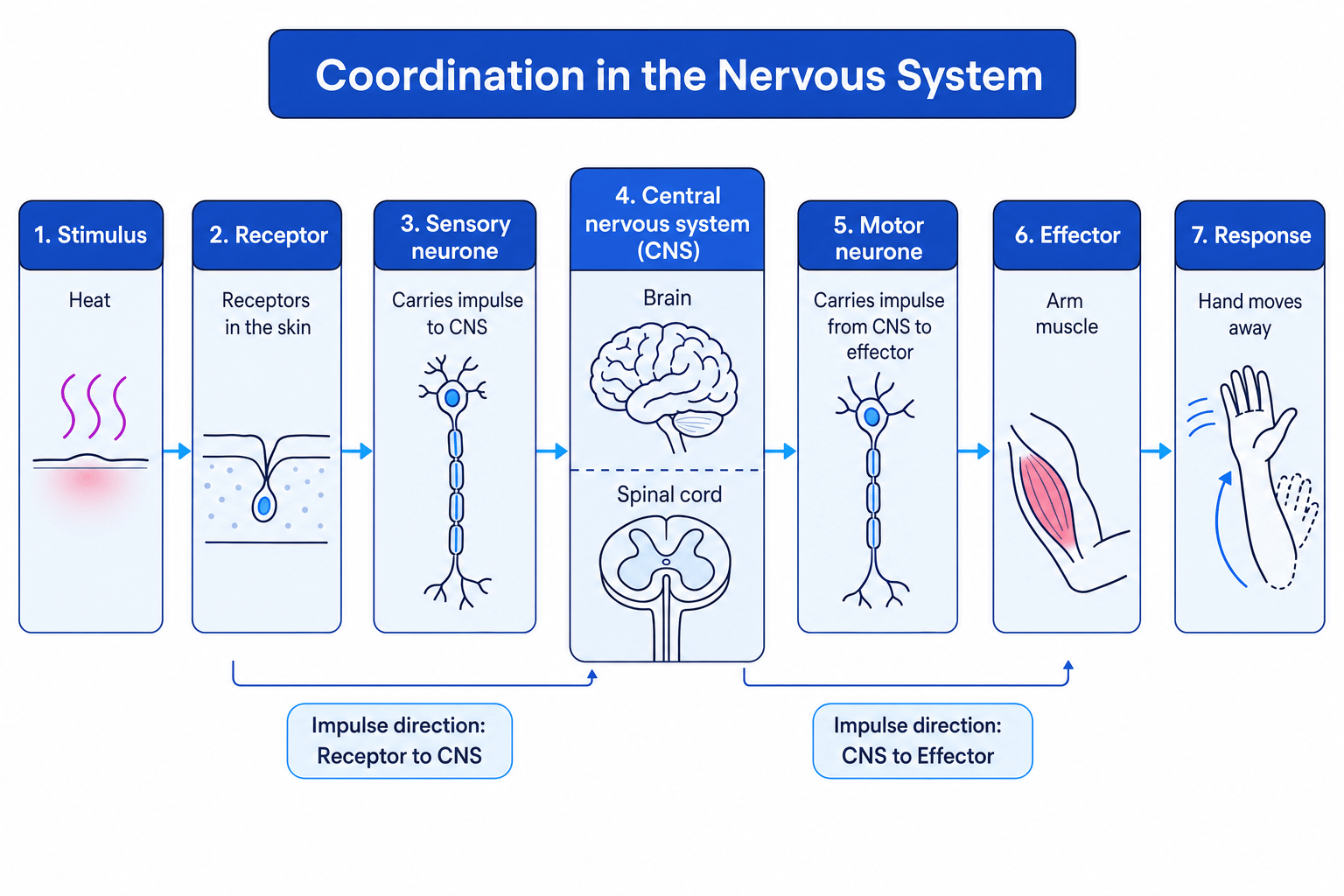
A coordinated response usually follows this pathway: stimulus → receptor → sensory neurone → CNS → motor neurone → effector → response.
Neurones: nerve cells that carry impulses
Neurone
A neurone is a specialised nerve cell that carries electrical signals called nerve impulses.
Neurones are adapted to carry impulses quickly over long distances. They have long fibres and branched endings so they can connect with other cells.
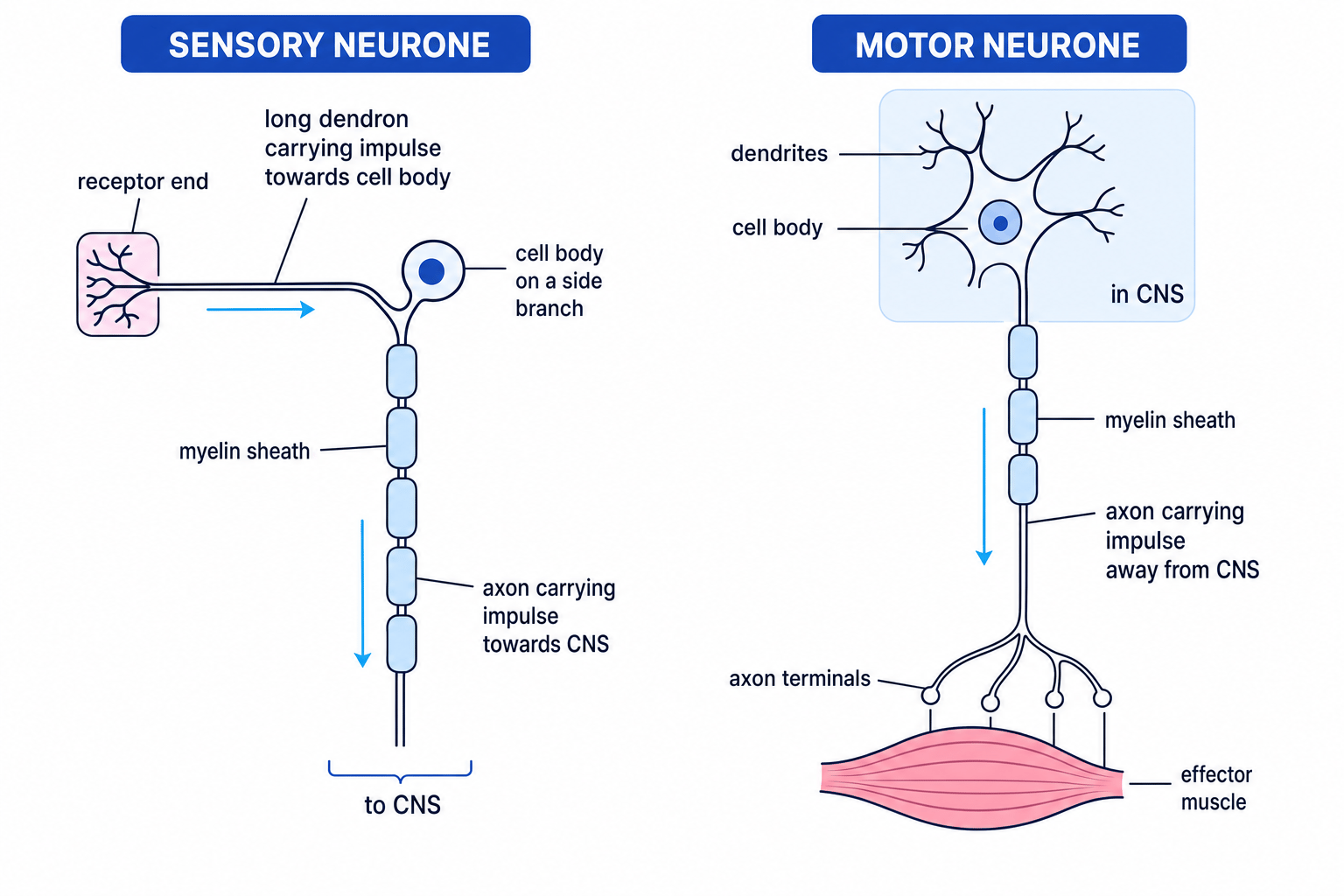
Important neurone structures include:
- cell body: contains the nucleus and controls the cell
- dendrites: short branches that receive impulses
- dendron: a long fibre carrying impulses towards the cell body in a sensory neurone
- axon: a long fibre carrying impulses away from the cell body
- myelin sheath: an insulating layer around some neurones that helps impulses travel faster
- axon terminals: branches at the end of a neurone that pass signals to another cell
The diagram compares the structure and direction of impulses in sensory and motor neurones.
Types of neurone
Sensory neurones
A sensory neurone carries impulses from receptors towards the CNS.
For example, if your skin detects heat, a sensory neurone carries that information to your spinal cord or brain.
Relay neurones
A relay neurone is found in the CNS. It connects sensory neurones to motor neurones.
Relay neurones help the CNS process information and coordinate the correct response.
Motor neurones
A motor neurone carries impulses from the CNS to an effector.
Effector
An effector is a muscle or gland that brings about a response. Muscles contract; glands secrete substances.
For example, a muscle may contract to move your arm, or a gland may release saliva.
Synapses: gaps between neurones
Synapse
A synapse is a tiny gap between two neurones, or between a neurone and an effector.
An impulse cannot simply jump across the gap. When an impulse reaches the end of one neurone, chemicals are released. These chemicals diffuse across the synapse and trigger a new impulse in the next neurone.
Synapses are important because they allow neurones to connect in networks. This helps the nervous system link many parts of the body and produce coordinated responses.
Direction of travel
In GCSE pathway questions, keep the direction clear: sensory neurones go to the CNS; motor neurones go from the CNS to effectors.
Producing a coordinated response
The nervous system can coordinate responses because:
- it reaches all parts of the body
- it has many links between neurones
- it has different receptors for different stimuli
- the CNS can process information and send instructions
- effectors can carry out the response
A response can be conscious, such as deciding to pick up a cup, or automatic, such as blinking.
Tracing a response pathway
A student touches a sharp pin and quickly moves their finger away. Trace the pathway involved.
- The sharp pin is the stimulus, and pain receptors in the skin detect it.
- A sensory neurone carries impulses from the skin receptor towards the CNS.
- The CNS coordinates the response by passing impulses through neurones in the spinal cord.
- A motor neurone carries impulses from the CNS to an effector muscle in the arm or hand.
- The muscle contracts, producing the response: the finger moves away.
Reflex actions
Reflex action
A reflex action is a fast, automatic response to a stimulus that does not require conscious thought before the response happens.
Reflex actions protect the body from damage. For example, you blink when something moves towards your eye, and you pull your hand away from something hot.
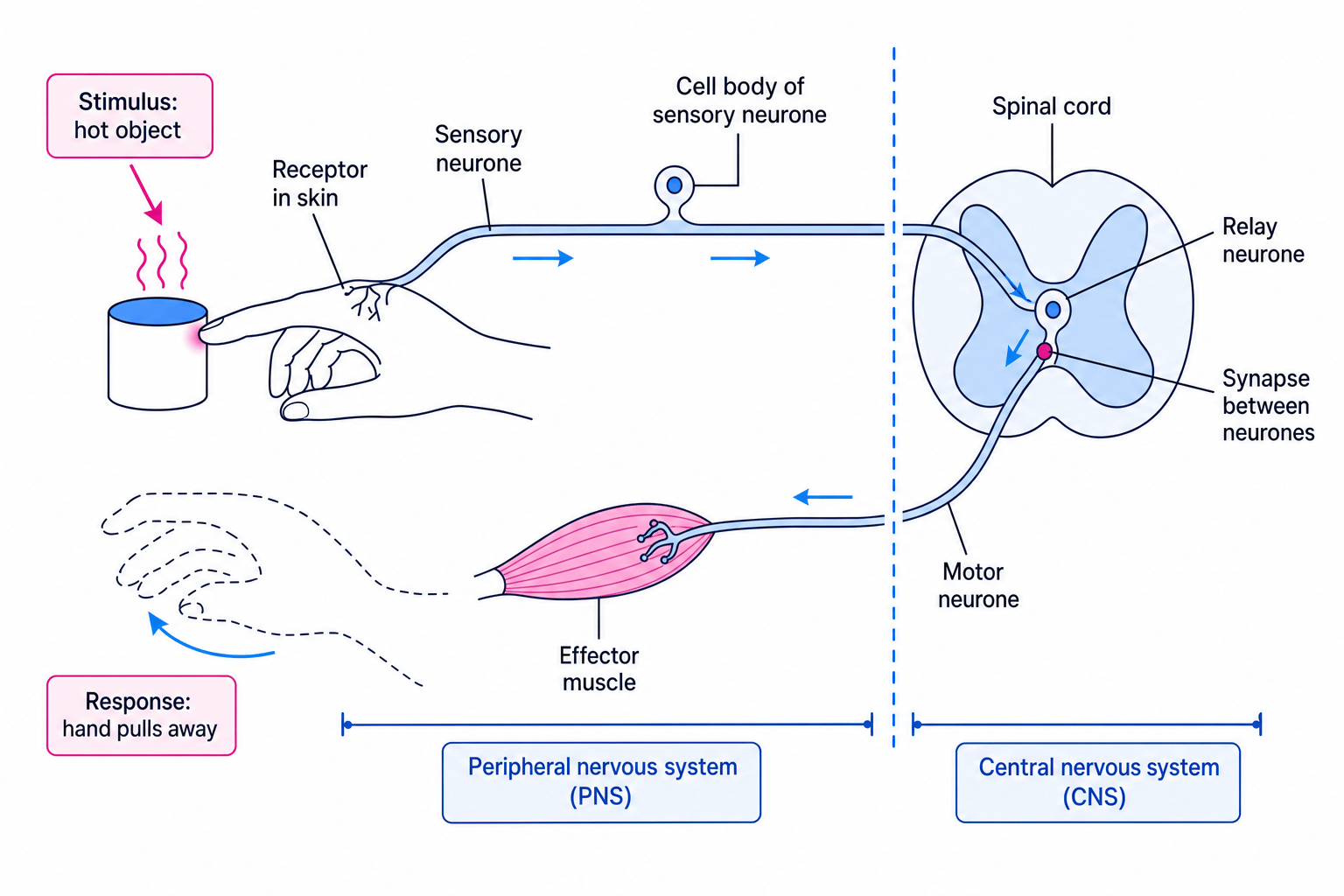
A reflex happens through a reflex arc, which is the pathway followed by nerve impulses during a reflex.
Structure of a reflex arc
A typical reflex arc includes:
- Stimulus — for example, heat from a hot object.
- Receptor — detects the stimulus, such as temperature or pain receptors in the skin.
- Sensory neurone — carries impulses to the spinal cord.
- Relay neurone — passes impulses through the CNS.
- Synapse — transfers the signal between neurones using chemicals.
- Motor neurone — carries impulses from the CNS to the effector.
- Effector — a muscle or gland that carries out the response.
- Response — for example, a muscle contracts to pull the hand away.
Why reflexes are fast
In a reflex arc, the response is coordinated through the spinal cord before conscious processing by the brain is needed. This makes the response rapid and protective.
The brain may receive information about what happened, so you become aware of pain, but the protective movement can begin before you consciously decide to move.
The brain is not completely ignored
Do not say “the brain is not involved at all”. It is better to say the response does not require conscious processing by the brain before the action happens.
Explaining a withdrawal reflex
Explain why pulling your hand away from a hot object is fast and protective.
- Heat and pain receptors in the skin detect the hot object and produce nerve impulses.
- The impulses travel along a sensory neurone into the spinal cord, where they pass through synapses to a relay neurone and then a motor neurone.
- The motor neurone carries impulses to an arm muscle, which contracts and pulls the hand away before conscious thought is needed.
- This reduces the time the skin is touching the hot object, so it helps prevent injury.
Investigating reaction time
A common way to investigate reaction time is the ruler drop test.
One person holds a ruler above another person’s open fingers. The ruler is dropped without warning, and the other person catches it as quickly as possible. The distance the ruler falls can be used to compare reaction times: a greater distance means a longer reaction time.
To make the test more reliable:
- repeat the test several times
- calculate a mean
- keep the starting position the same
- use the same hand each time
- avoid giving clues about when the ruler will be dropped
Calculating a mean reaction time
A student records reaction times of 0.19 s, 0.20 s, 0.67 s, 0.18 s and 0.21 s. The 0.67 s result happened because the student was distracted. Calculate the mean reaction time without the anomalous result.
-
Exclude 0.67 s because there is a clear reason it is anomalous: the student was distracted.
-
Add the reliable readings:
total=0.19 s+0.20 s+0.18 s+0.21 s=0.78 s\text{total} = 0.19\ \text{s} + 0.20\ \text{s} + 0.18\ \text{s} + 0.21\ \text{s} = 0.78\ \text{s}total=0.19 s+0.20 s+0.18 s+0.21 s=0.78 s -
Divide by the number of reliable readings:
mean=0.78 s4=0.195 s\text{mean} = \frac{0.78\ \text{s}}{4} = 0.195\ \text{s}mean=40.78 s=0.195 s -
Round suitably: the mean reaction time is about 0.20 s.
Do not throw away results too easily
Only ignore an anomalous result if there is a good reason, such as a clear mistake, distraction, or the question tells you to exclude it.
In the exam
- For pathway questions, write the sequence in order: receptor → sensory neurone → CNS/relay neurone → motor neurone → effector.
- When explaining reflexes, mention that they are fast, automatic and protective, and that conscious thought is not needed before the response.
- Use precise terms: receptors detect stimuli, neurones carry impulses, and effectors produce responses.
Check yourself
- What is the difference between a sensory neurone, a relay neurone and a motor neurone?
- Why does a reflex arc help protect the body?
- In a ruler drop investigation, why is it important to repeat the test and calculate a mean?