

What you'll learn
- How substances move into and out of cells by diffusion, osmosis and active transport.
- How to calculate percentage change in mass in an osmosis practical.
- How the cell cycle and mitosis make new body cells for growth.
- Why differentiation and stem cells are important in animals and plants.
Why cells need a good supply
Every cell needs useful substances, such as oxygen, glucose, water and mineral ions. Cells also need to remove waste substances, such as carbon dioxide.
The cell membrane controls what enters and leaves the cell. It is not just a bag: it is a boundary that helps maintain the cell’s internal conditions.
Partially permeable membrane
A partially permeable membrane lets some particles pass through but prevents others from passing through, depending on factors such as particle size.
Surface area to volume ratio
The surface area of a cell is the amount of membrane available for exchange. The volume is the amount of cell material that needs supplying.
Surface area to volume ratio
The surface area to volume ratio, often shortened to SA:V, compares the exchange surface available with the amount of cell or organism that must be supplied.
As cells or organisms get bigger, their volume increases faster than their surface area. This means larger organisms have a smaller surface area to volume ratio, even though they have a larger total surface area.
Comparing surface area to volume ratio
- For a cube with side length s=1 mms = 1\,\text{mm}s=1mm, the surface area is 6s2=6 mm26s^2 = 6\,\text{mm}^26s2=6mm2 and the volume is s3=1 mm3s^3 = 1\,\text{mm}^3s3=1mm3, so the SA:V is 6 : 1.
- For a cube with side length s=2 mms = 2\,\text{mm}s=2mm, the surface area is 6s2=24 mm26s^2 = 24\,\text{mm}^26s2=24mm2 and the volume is s3=8 mm3s^3 = 8\,\text{mm}^3s3=8mm3, so the SA:V is 3 : 1.
- The larger cube has a lower SA:V, so each cubic millimetre has less surface available for exchange. This is why larger organisms need specialised exchange and transport systems.
Bigger does not mean a bigger ratio
A large animal has more total surface area than a small animal, but it has much more volume as well. The ratio of surface area to volume is lower in larger animals.
Movement across cell membranes
Particles are always moving. If there is a difference in concentration between two places, there is a concentration gradient.
Concentration gradient
A concentration gradient is a difference in concentration between two regions. “Down” a concentration gradient means from higher concentration to lower concentration.
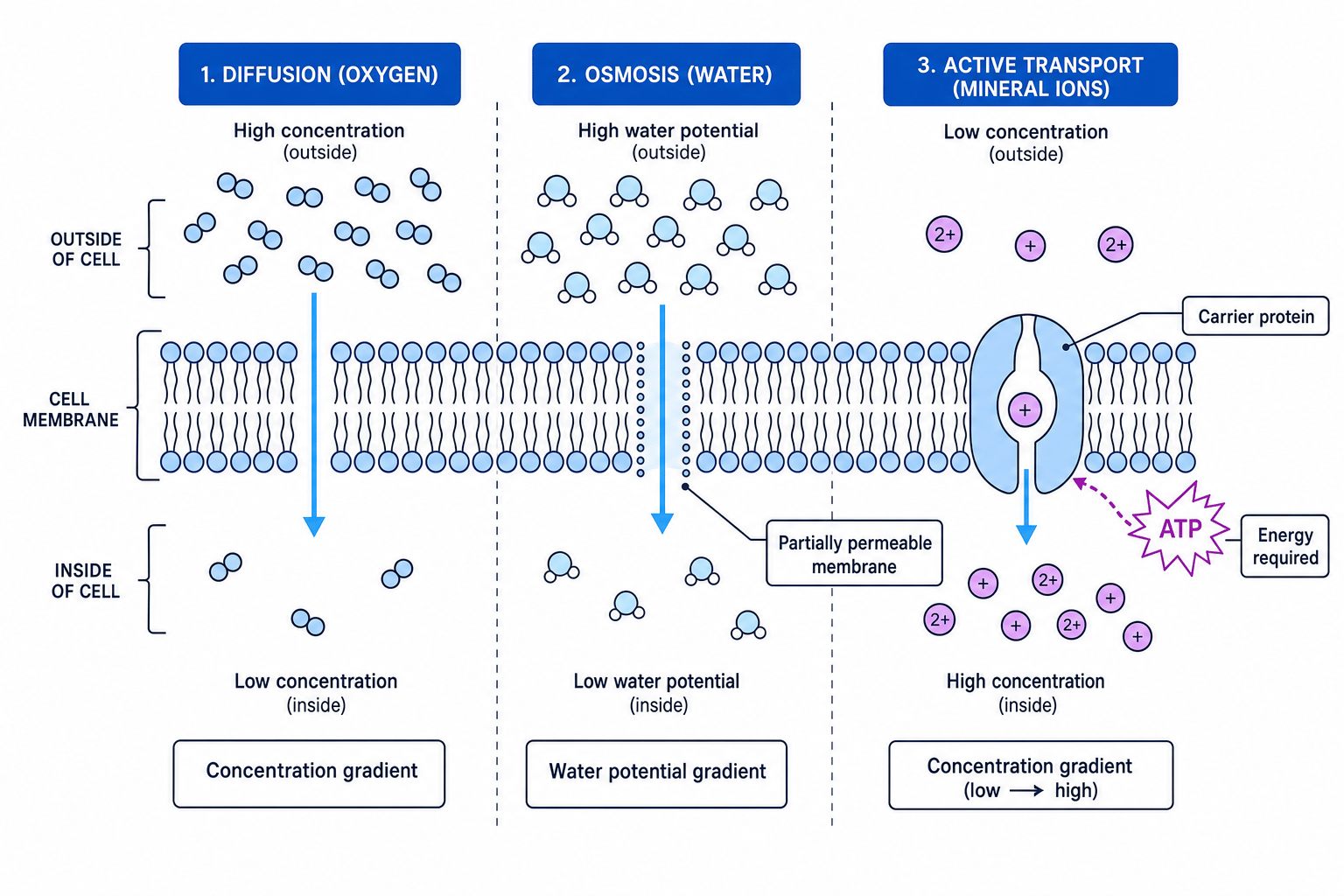
The diagram below compares the three transport processes you need: diffusion, osmosis and active transport.
Diffusion
Diffusion
Diffusion is the net movement of particles from a region of higher concentration to a region of lower concentration, down a concentration gradient.
Net movement means the overall movement after lots of random particle movement has been considered. Individual particles move in all directions, but more move from high concentration to low concentration overall.
Diffusion does not require energy from respiration. Examples include:
- oxygen diffusing into cells for aerobic respiration
- carbon dioxide diffusing out of cells as a waste product
- dissolved substances moving between cells and body fluids
Diffusion direction
Diffusion is passive: particles move down their concentration gradient, from higher concentration to lower concentration.
Osmosis
Osmosis
Osmosis is the net movement of water molecules through a partially permeable membrane from a region of higher water potential to a region of lower water potential.
Water potential describes the tendency of water molecules to move. Pure water has a high water potential. Adding solute, such as sugar or salt, lowers the water potential.
So, in osmosis, water moves:
- from a more dilute solution to a more concentrated solution
- through a partially permeable membrane
- down a water potential gradient
In plant cells, water entering by osmosis can make the cell firm, or turgid. Water leaving a plant cell can make the cell contents shrink away from the cell wall. In animal cells, too much water entering can cause swelling because animal cells do not have a cell wall.
A common practical is to place vegetable chips, such as potato, into different sugar or salt solutions and measure the change in mass.
Calculating percentage change in mass
A potato chip has an initial mass of 2.50 g. After being placed in a sugar solution, its final mass is 2.20 g.
- Calculate the change in mass: final mass−initial mass=2.20 g−2.50 g=−0.30 g\text{final mass} - \text{initial mass} = 2.20\,\text{g} - 2.50\,\text{g} = -0.30\,\text{g}final mass−initial mass=2.20g−2.50g=−0.30g.
- Divide by the initial mass and multiply by 100: −0.30 g2.50 g×100=−12%\frac{-0.30\,\text{g}}{2.50\,\text{g}} \times 100 = -12\%2.50g−0.30g×100=−12%.
- The negative percentage shows a loss of mass, so water moved out of the potato cells by osmosis. The sugar solution had a lower water potential than the potato cells.
Using the wrong starting mass
For percentage change, always divide by the initial mass, not the final mass: change in massinitial mass×100\frac{\text{change in mass}}{\text{initial mass}} \times 100initial masschange in mass×100.
Active transport
Active transport
Active transport is the movement of substances from a region of lower concentration to a region of higher concentration, against a concentration gradient, using energy from respiration.
Active transport needs carrier proteins in the cell membrane. The cell uses energy, often described as energy from respiration, to move particles against their concentration gradient.
Examples include:
- mineral ions, such as nitrate ions, moving from soil into root hair cells
- glucose being absorbed in the small intestine when its concentration is lower in the gut than in the blood
Identifying active transport
A root hair cell takes in nitrate ions from the soil. The nitrate ion concentration is lower in the soil than inside the root hair cell.
- Compare the concentrations: nitrate ions move from a lower concentration in the soil to a higher concentration inside the cell.
- This movement is against the concentration gradient, so it cannot be simple diffusion.
- Because the movement is against the gradient and requires energy from respiration, the process is active transport.
Choosing the transport process
If it is water moving through a partially permeable membrane, think osmosis. If particles move down a concentration gradient, think diffusion. If particles move against a concentration gradient using energy, think active transport.
| Process | Substance moved | Direction | Energy from respiration? |
|---|---|---|---|
| Diffusion | Particles such as oxygen or carbon dioxide | Higher concentration to lower concentration | No |
| Osmosis | Water only | Higher water potential to lower water potential | No |
| Active transport | Substances such as mineral ions or glucose | Lower concentration to higher concentration | Yes |
The cell cycle and mitosis
Cells do not just split randomly. They go through a controlled sequence called the cell cycle.
Chromosome
A chromosome is a long molecule of DNA found in the nucleus. Chromosomes carry genetic information in the form of genes.
Mitosis
Mitosis is cell division that produces two genetically identical daughter cells for growth and repair.
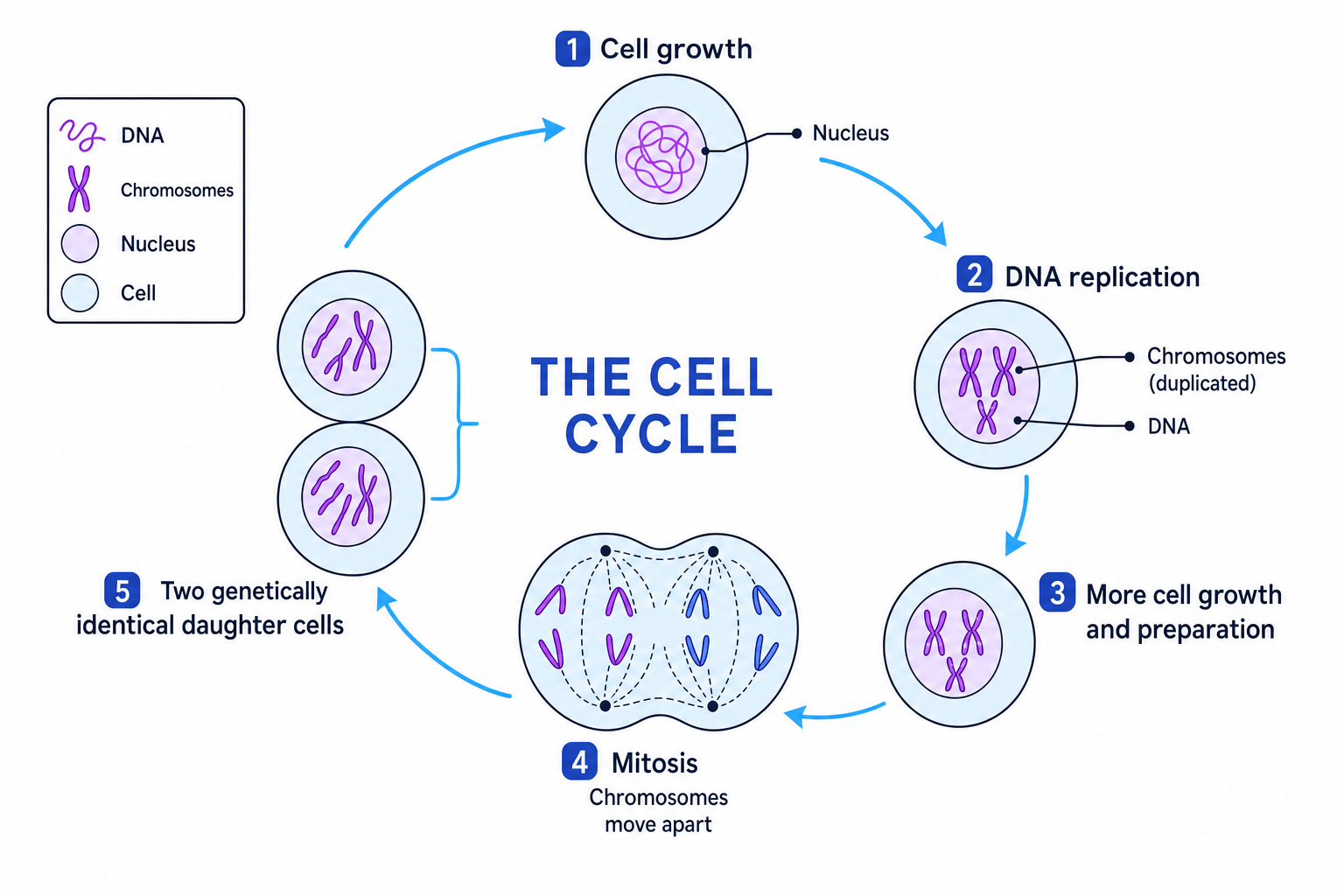
The cell cycle includes:
- Cell growth — the cell increases in size and makes more sub-cellular structures.
- DNA replication — the DNA is copied so each chromosome is duplicated.
- More cell growth and preparation — the cell checks it is ready to divide.
- Mitosis — the chromosomes move apart to opposite ends of the cell.
- Cell division — the cytoplasm and cell membrane divide, forming two genetically identical daughter cells.
The diagram shows how DNA is copied before mitosis, so each new cell receives the same genetic information.
Working out chromosome number after mitosis
A human body cell has 46 chromosomes before the cell cycle begins.
- During DNA replication, each chromosome is copied, so the cell has duplicated chromosomes ready to separate.
- During mitosis, the duplicated chromosomes move apart so each new nucleus gets one copy of each chromosome.
- The result is two genetically identical daughter cells, each with 46 chromosomes.
Mitosis is not meiosis
Mitosis makes genetically identical body cells and keeps the chromosome number the same. Meiosis makes gametes, such as sperm and egg cells, and is different.
Differentiation and specialised cells
Differentiation
Differentiation is the process by which a cell becomes specialised for a particular function.
Specialised cells make multicellular organisms more efficient because different cells can do different jobs. These specialised cells can form tissues, organs and organ systems.
Examples include:
- root hair cells, which absorb water and mineral ions
- red blood cells, which transport oxygen
- nerve cells, which carry electrical impulses
- muscle cells, which contract to cause movement
- xylem cells, which transport water in plants
Linking cell structure to function
A root hair cell is specialised for absorbing substances from soil.
- Its long hair-like extension gives it a large surface area, increasing the rate at which water can enter by osmosis.
- Mineral ions may be at a lower concentration in the soil than inside the cell, so they are absorbed by active transport.
- Root hair cells contain many mitochondria to release energy by respiration for active transport.
Stem cells
Stem cell
A stem cell is an unspecialised cell that can divide and can differentiate into specialised cell types.
Stem cells are important because they provide new cells for development, growth and repair.
Animal stem cells are found in:
- embryos, where they can become a wide range of specialised cell types
- adult tissues, such as bone marrow, where they usually produce a more limited range of cells for repair and replacement
In plants, stem cells are found in meristems. Meristems are growing regions, such as the tips of roots and shoots, where cells keep dividing and can differentiate into plant tissues.
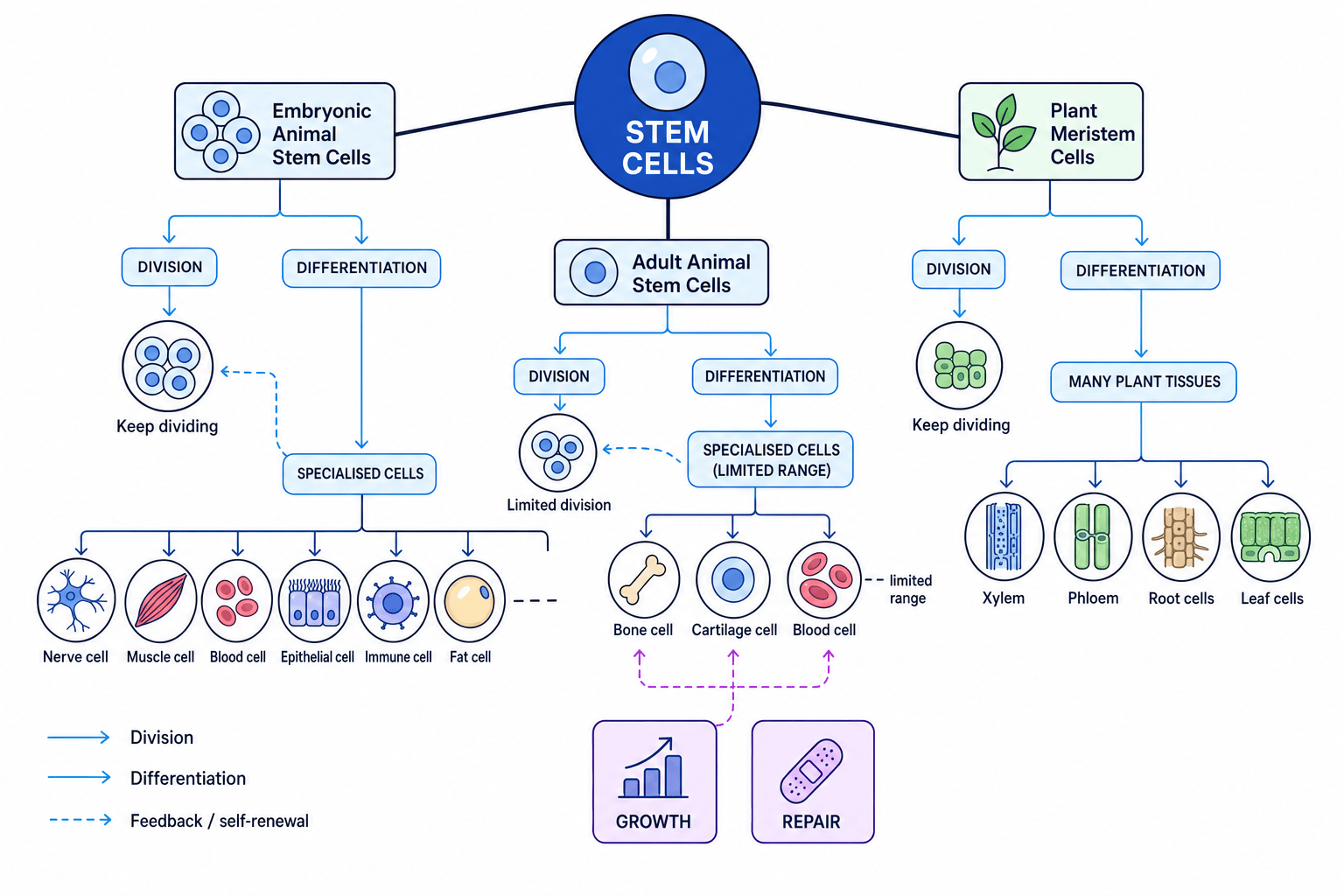
The diagram below summarises how different stem cells can divide and differentiate.
Embryonic animal stem cells
Embryonic stem cells are found in early animal embryos. They can differentiate into many different specialised cell types, which is essential for development of the whole organism.
Adult animal stem cells
Adult stem cells are found in body tissues after the embryo stage. They are mainly used for growth, repair and replacement of damaged or worn-out cells. They usually differentiate into a limited range of cell types.
Plant meristems
Meristem cells in plants can keep dividing throughout the plant’s life. This allows plants to grow new roots, shoots, leaves and flowers, and to repair damage.
Comparing stem cell sources
A scientist wants cells that could form many different tissues. A doctor wants cells to replace damaged blood cells.
- For many different tissues, embryonic animal stem cells are more suitable because they can differentiate into a much wider range of specialised cells.
- For replacing blood cells, adult stem cells from bone marrow may be suitable because they naturally produce blood cells for growth and repair.
- For producing new plant tissues, meristem cells are suitable because they keep dividing and can differentiate into different plant cell types.
Adult stem cells are not only in adults
“Adult stem cell” means a stem cell found in body tissues after the embryo stage. Children have adult stem cells too.
In the exam
- For transport questions, always state the substance, the direction of movement, and whether energy from respiration is needed.
- For osmosis calculations, use percentage change from the initial mass and explain the sign: positive means gain, negative means loss.
- For mitosis and stem cells, use precise outcomes: mitosis makes two genetically identical daughter cells; stem cells divide and differentiate for development, growth and repair.
Check yourself
- A potato chip increases in mass in pure water. What moved, in which direction, and why?
- Why do larger organisms have a lower surface area to volume ratio than smaller organisms?
- How are embryonic animal stem cells different from adult animal stem cells?
