What you'll learn
- What photosynthesis is, where it happens, and why it supports life on Earth.
- The word equation and balanced chemical equation for photosynthesis.
- How to investigate photosynthesis using starch tests, pondweed, or algae.
- How light intensity, carbon dioxide concentration and temperature affect the rate of photosynthesis.
Why photosynthesis matters
Green plants and algae are photosynthetic organisms. They make their own food using light energy, so they are the main producers of food for life on Earth.
Producer
A producer is an organism that makes its own food, usually by photosynthesis. Producers make biomass, which is the mass of living material in an organism or group of organisms.
When a plant makes glucose, it can use that glucose to build larger molecules. This becomes plant biomass. Animals then gain biomass by eating plants, or by eating other animals that ate plants.
Food chains start with photosynthesis
Most food chains depend on photosynthesis because it transfers energy into glucose and biomass at the producer stage.
What photosynthesis is
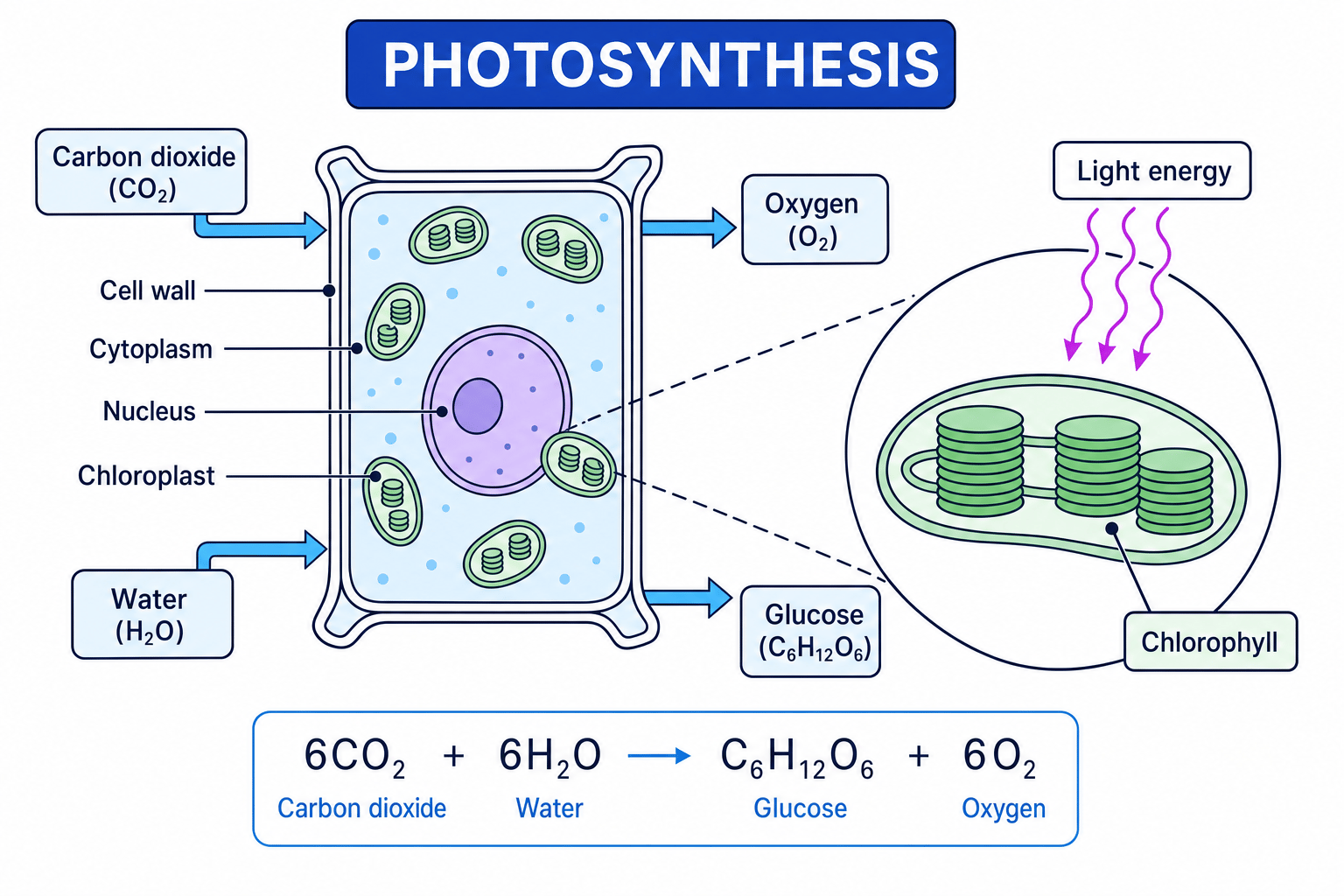
Photosynthesis happens in chloroplasts, which are tiny structures found in many plant and algal cells. Chloroplasts contain chlorophyll, a green pigment that absorbs light energy.
Photosynthesis
Photosynthesis is the process where green plants and algae use light energy to react carbon dioxide with water to make glucose and oxygen.
The word equation is:
carbon dioxide + water → glucose + oxygen
The balanced chemical equation is:
6CO₂(g) + 6H₂O(l) → C₆H₁₂O₆(aq) + 6O₂(g)
Light energy is needed, but it is not a reactant in the equation because it is energy, not a substance.
The two-stage process
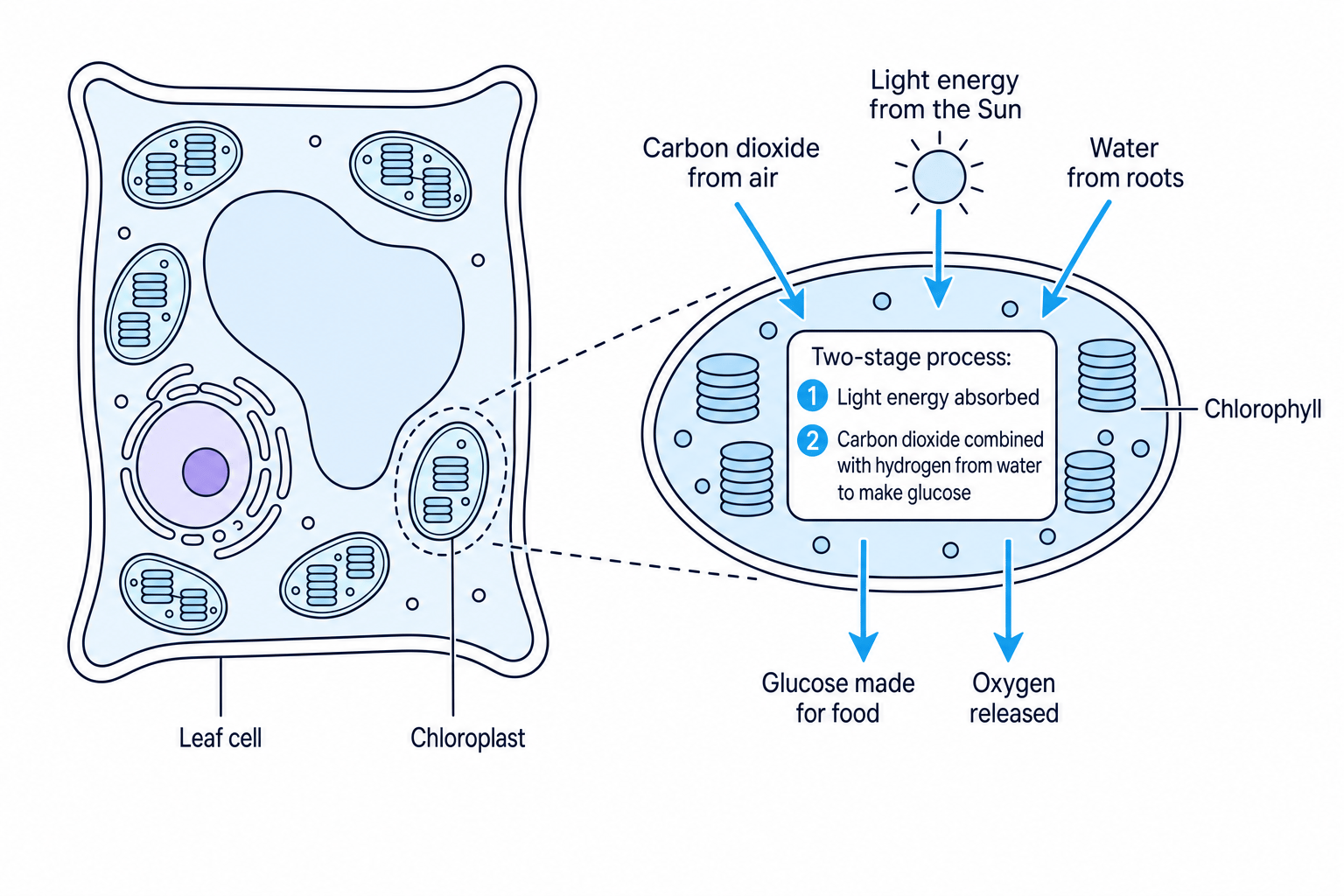
For GCSE Combined Science, you should understand photosynthesis as a two-stage process:
- Light energy is absorbed by chlorophyll in chloroplasts.
- This energy is used to combine carbon dioxide with hydrogen from water, making glucose. Oxygen is released as a product.
Plants can use glucose in several ways. They can use it in respiration, store it as starch, or convert it into other useful substances such as cellulose for cell walls.
Plants respire too
Plants photosynthesise in the light, but they also respire all the time, including in darkness. Photosynthesis makes glucose; respiration releases energy from glucose.
Photosynthesis is endothermic
An endothermic reaction takes in energy from the surroundings. Photosynthesis is endothermic because light energy is absorbed and stored in glucose.
Endothermic reaction
An endothermic reaction is a reaction that takes in energy from its surroundings. In photosynthesis, energy is taken in as light.
This matters because photosynthesis does not just rearrange substances — it transfers energy from the Sun into chemical stores in glucose.
Investigating photosynthesis: testing a leaf for starch
One common experiment investigates whether light is needed for photosynthesis. It uses the fact that plants often store glucose as starch.
The basic method is:
- Leave the plant in darkness for about 24 hours to destarch it. This means existing starch is used up.
- Cover part of a leaf with opaque material, so that part cannot receive light.
- Put the plant in light for several hours.
- Test the leaf for starch using iodine solution.
To test the leaf:
- Place the leaf in boiling water to kill the cells and stop reactions.
- Warm the leaf in ethanol to remove chlorophyll, making colour changes easier to see.
- Rinse the leaf in warm water to soften it.
- Add iodine solution.
If starch is present, iodine changes from orange-brown to blue-black.
Ethanol safety
Ethanol is flammable, so it should be heated using a hot water bath rather than directly with a flame.
Interpreting a starch test
A leaf is partly covered with foil, then left in bright light. After testing with iodine, only the uncovered part turns blue-black.
- The uncovered part received light, so it could photosynthesise and make glucose.
- Some glucose was stored as starch, so iodine turned blue-black in that region.
- The covered part did not receive light, so it could not make starch by photosynthesis.
- This supports the conclusion that light is needed for photosynthesis.
Investigating the rate of photosynthesis
The rate of photosynthesis means how quickly photosynthesis is happening. Since oxygen is a product, you can estimate the rate by measuring oxygen produced per unit time.
For example, with pondweed such as Cabomba, you might count bubbles of oxygen released each minute. A better method is to collect the oxygen gas and measure its volume.
Rate
A rate tells you how much something changes per unit time. For photosynthesis, a rate might be measured in bubbles per minute or cubic centimetres of oxygen per minute.
A simple rate equation is:
rate=amount of oxygen producedtime taken\text{rate} = \frac{\text{amount of oxygen produced}}{\text{time taken}}rate=time takenamount of oxygen producedCalculating the rate of photosynthesis
A piece of pondweed produces 42 oxygen bubbles in 3 minutes. Calculate the rate in bubbles per minute.
-
Choose the rate equation:
rate=number of bubblestime\text{rate} = \frac{\text{number of bubbles}}{\text{time}}rate=timenumber of bubbles -
Substitute the values:
rate=42 bubbles3 min\text{rate} = \frac{42\ \text{bubbles}}{3\ \text{min}}rate=3 min42 bubbles -
Calculate the value with units:
rate=14 bubbles/min\text{rate} = 14\ \text{bubbles/min}rate=14 bubbles/min
Bubble counts are only estimates
Counting bubbles is easy, but bubbles may not all be the same size. Measuring the volume of oxygen collected is more reliable.
Variables in photosynthesis experiments
In an investigation, the independent variable is the factor you change. The dependent variable is the factor you measure. Control variables are kept the same to make the test fair.
For example, if you investigate light intensity using a lamp:
- Independent variable: distance of the lamp from the plant.
- Dependent variable: rate of photosynthesis.
- Control variables: temperature, carbon dioxide concentration, species of plant, length of pondweed, time counted.
Graph axes
Put the independent variable on the x-axis and the dependent variable on the y-axis. For photosynthesis experiments, the y-axis is often rate of photosynthesis.
Factors affecting the rate of photosynthesis
Photosynthesis is affected by three main factors:
- Light intensity
- Carbon dioxide concentration
- Temperature
The factor in shortest supply is called the limiting factor.
Limiting factor
A limiting factor is the factor that is stopping the rate of a process from increasing. If you increase the limiting factor, the rate can increase.
Light intensity
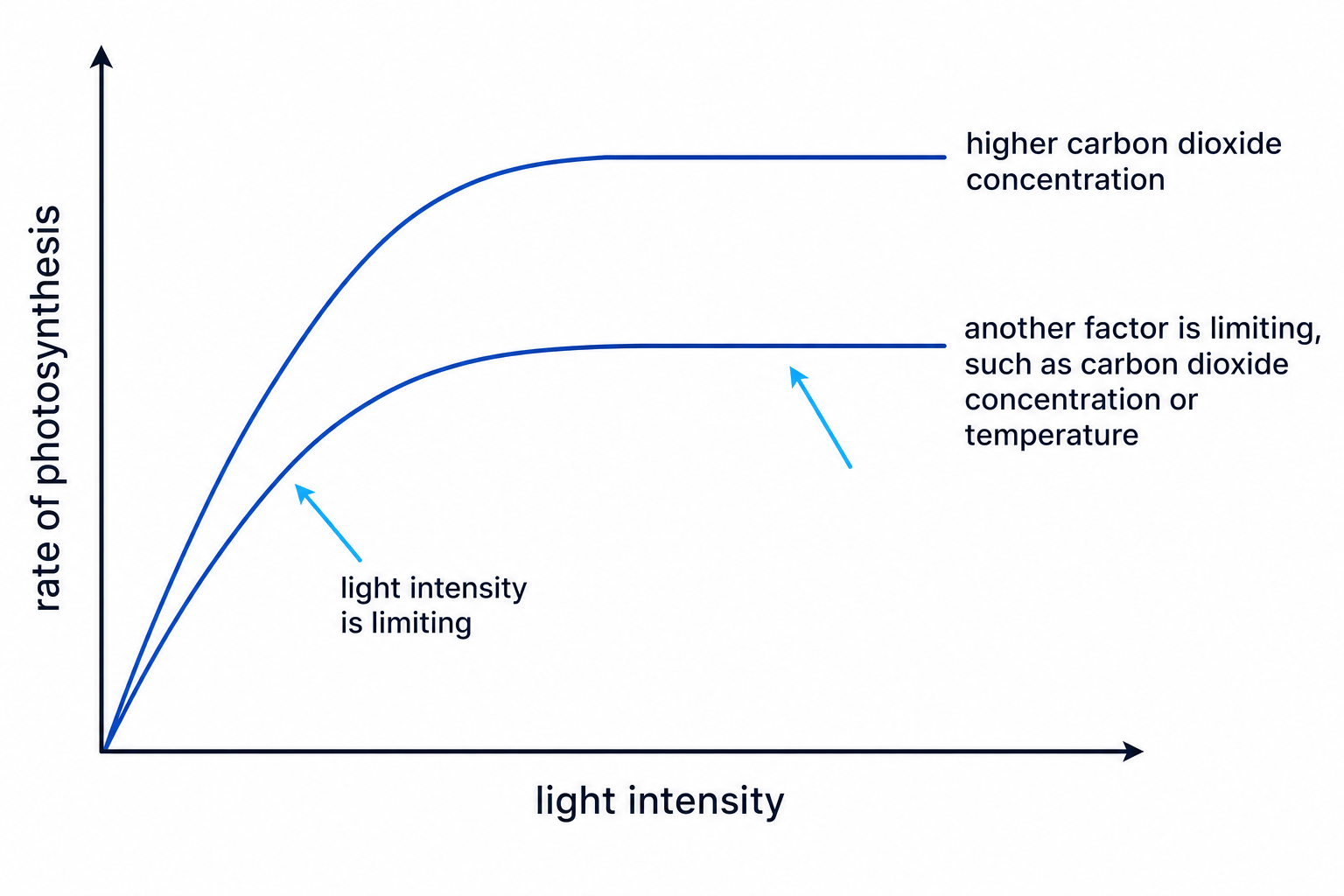
At low light intensity, increasing the light intensity increases the rate of photosynthesis. This is because more light energy is available for chlorophyll to absorb.
Eventually, the graph levels off. This means light is no longer the limiting factor. Something else, such as carbon dioxide concentration or temperature, is limiting the rate.
Carbon dioxide concentration
Carbon dioxide is a reactant in photosynthesis. If carbon dioxide concentration is low, increasing it can increase the rate.
Once there is enough carbon dioxide, another factor becomes limiting, so the rate stops increasing.
Temperature
Photosynthesis involves reactions controlled by enzymes, which are biological catalysts. A catalyst speeds up a reaction without being used up.
At low temperatures, enzymes and molecules have less kinetic energy, so reactions are slower. As temperature increases, the rate usually increases up to an optimum temperature. Above this, enzymes may denature, meaning their active sites change shape and they no longer work properly.
Temperature has an optimum
Light intensity and carbon dioxide concentration often produce a rising graph that levels off. Temperature usually produces a rise to an optimum, then a fall if enzymes denature.
How limiting factors interact
At Higher Tier, you need to explain how limiting factors interact using graphs. The key idea is that improving a non-limiting factor will not increase the rate.
For example, if a plant has plenty of light but very little carbon dioxide, giving it even more light will not help much. Carbon dioxide is limiting. If you increase carbon dioxide concentration, the rate may rise until another factor becomes limiting.
Identifying the limiting factor
A graph shows that increasing light intensity increases the rate at first, but then the line becomes horizontal. When the experiment is repeated with more carbon dioxide, the plateau is higher.
- On the rising part of the first curve, increasing light intensity increases the rate, so light intensity is limiting.
- At the plateau, increasing light intensity no longer increases the rate, so light is no longer limiting.
- The higher-carbon-dioxide curve reaches a higher rate, so carbon dioxide must have been limiting the first plateau.
- At the new higher plateau, another factor, such as temperature, is likely to be limiting.
Light intensity and distance from a lamp
In practical work, light intensity can be changed by moving a lamp closer to or further from a plant.
For Higher Tier, you may need to use the inverse square law: light intensity is inversely proportional to the square of the distance from the light source.
I∝1d2I \propto \frac{1}{d^2}I∝d21This means that if the distance is doubled, the light intensity becomes one quarter as large.
Using the inverse square law
A lamp is moved from 0.20 m to 0.40 m away from pondweed. Work out the new light intensity as a fraction of the original.
-
Compare the distances:
0.40 m0.20 m=2\frac{0.40\ \text{m}}{0.20\ \text{m}} = 20.20 m0.40 m=2 -
Apply the inverse square relationship: doubling the distance makes intensity 22=42^2 = 422=4 times smaller.
-
Write the new intensity as a fraction of the original:
new intensity=14 of the original\text{new intensity} = \frac{1}{4}\ \text{of the original}new intensity=41 of the original
More of one factor does not always mean faster photosynthesis
If the graph has levelled off, increasing the x-axis factor will not increase the rate unless that factor is still limiting.
In the exam
- For the photosynthesis equation, include both reactants and both products: carbon dioxide + water → glucose + oxygen.
- When explaining a graph, say which factor is limiting and use evidence from the shape of the graph.
- In practical questions, name the independent variable, dependent variable and at least two sensible control variables.
Check yourself
- Why are plants and algae described as producers?
- What colour change shows that starch is present in a leaf?
- Why does a photosynthesis rate graph level off when light intensity keeps increasing?