What you'll learn
- How nuclei are described using proton number, mass number and isotope notation.
- What alpha, beta, gamma and neutron emissions are, and how they change a nucleus.
- How to balance radioactive decay equations.
- How half-life, penetration, contamination and irradiation affect radioactive hazards.
1. The nucleus: the centre of the atom
An atom has a tiny central nucleus, with electrons arranged around it. Radioactivity is all about changes happening in the nucleus.
Nucleus and nuclear charge
The nucleus is the tiny, dense centre of an atom. It contains protons with relative charge +1 and neutrons with charge 0. The positive charge of the nucleus comes from its protons.
Each element has its own characteristic number of protons. For example, every carbon atom has 6 protons. If the number of protons changes, it is no longer carbon — it is a different element.
2. Isotopes and nuclear notation
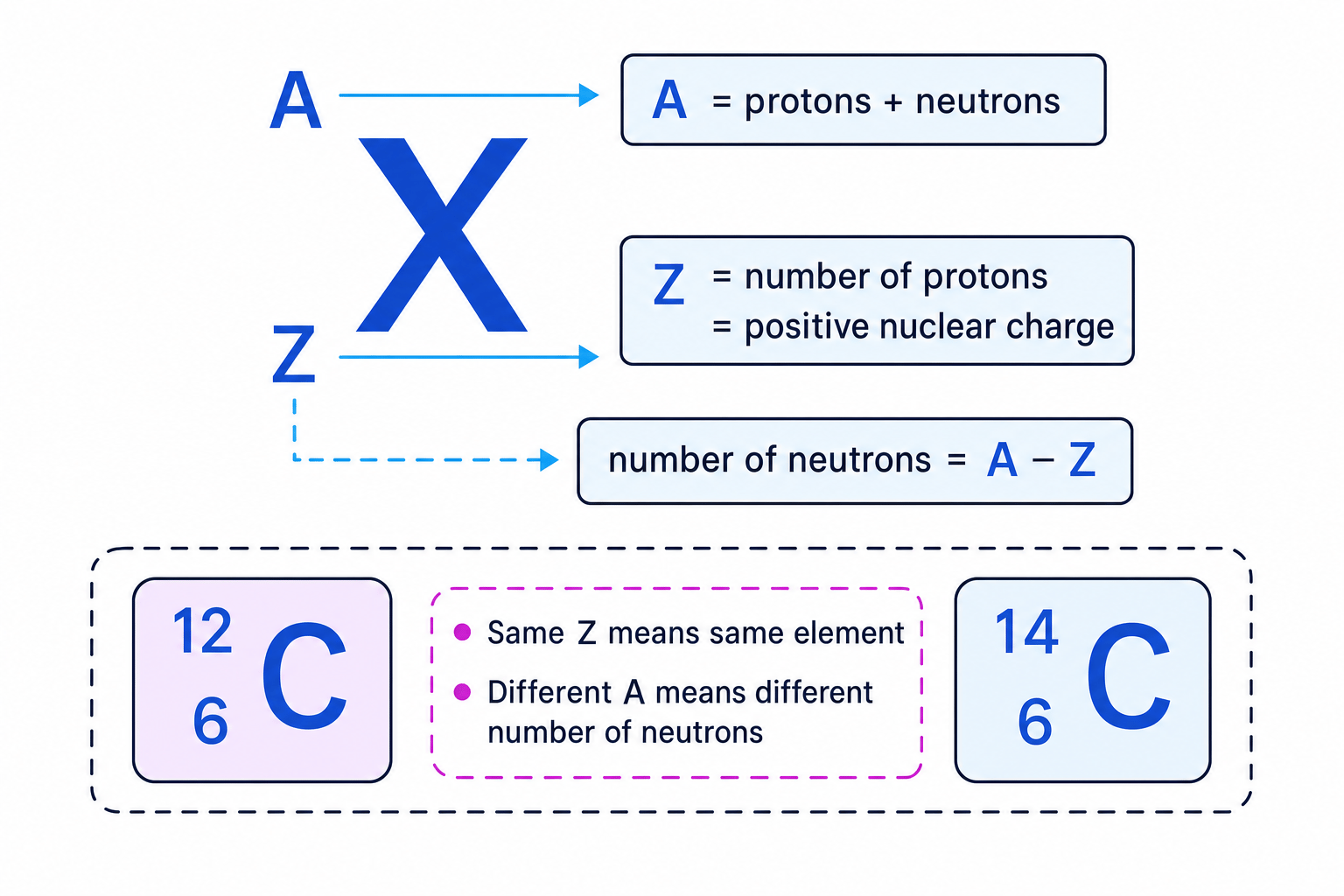
Atoms of the same element can have different numbers of neutrons. This means they have different nuclear masses, even though they are still the same element.
Isotope
Isotopes are atoms of the same element with the same number of protons but different numbers of neutrons.
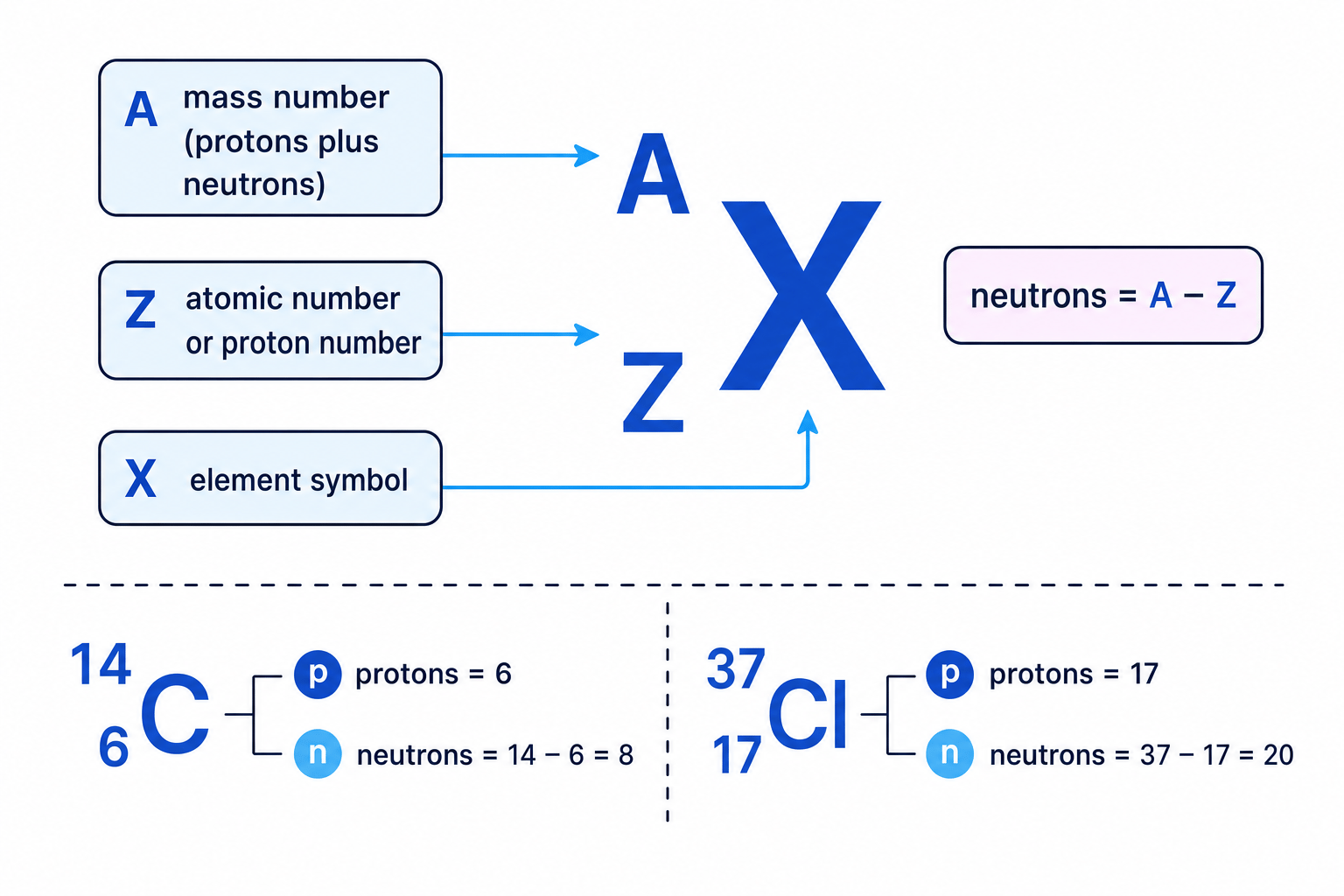
Nuclei are written using this conventional representation:
ZAX{}^{A}_{Z}\mathrm{X}ZAX- X\mathrm{X}X is the chemical symbol.
- AAA is the mass number: protons plus neutrons.
- ZZZ is the atomic number: number of protons.
- Number of neutrons is A−ZA - ZA−Z.
Interpreting isotope notation
A chlorine nucleus is written as 1737Cl{}^{37}_{17}\mathrm{Cl}1737Cl. Compare it with 1735Cl{}^{35}_{17}\mathrm{Cl}1735Cl.
- The lower number is Z=17Z = 17Z=17, so both nuclei have 17 protons. They are both chlorine.
- For 1737Cl{}^{37}_{17}\mathrm{Cl}1737Cl, the number of neutrons is 37−17=2037 - 17 = 2037−17=20.
- For 1735Cl{}^{35}_{17}\mathrm{Cl}1735Cl, the number of neutrons is 35−17=1835 - 17 = 1835−17=18. Same protons but different neutrons means they are isotopes.
3. Unstable nuclei and radioactive decay
Some nuclei are unstable. An unstable nucleus can become more stable by giving out radiation. This process is called radioactive decay.
Radioactive decay
Radioactive decay is the spontaneous change of an unstable nucleus, where it emits radiation such as an alpha particle, beta particle, neutron or gamma ray.
The original unstable nucleus is often called the parent nucleus. The nucleus left after decay is the daughter nucleus.
Radioactive decay is random. You cannot predict exactly when one particular nucleus will decay. However, if you have a very large number of unstable nuclei, the overall pattern is predictable.
4. Types of radioactive emission
The main emissions in this topic are:
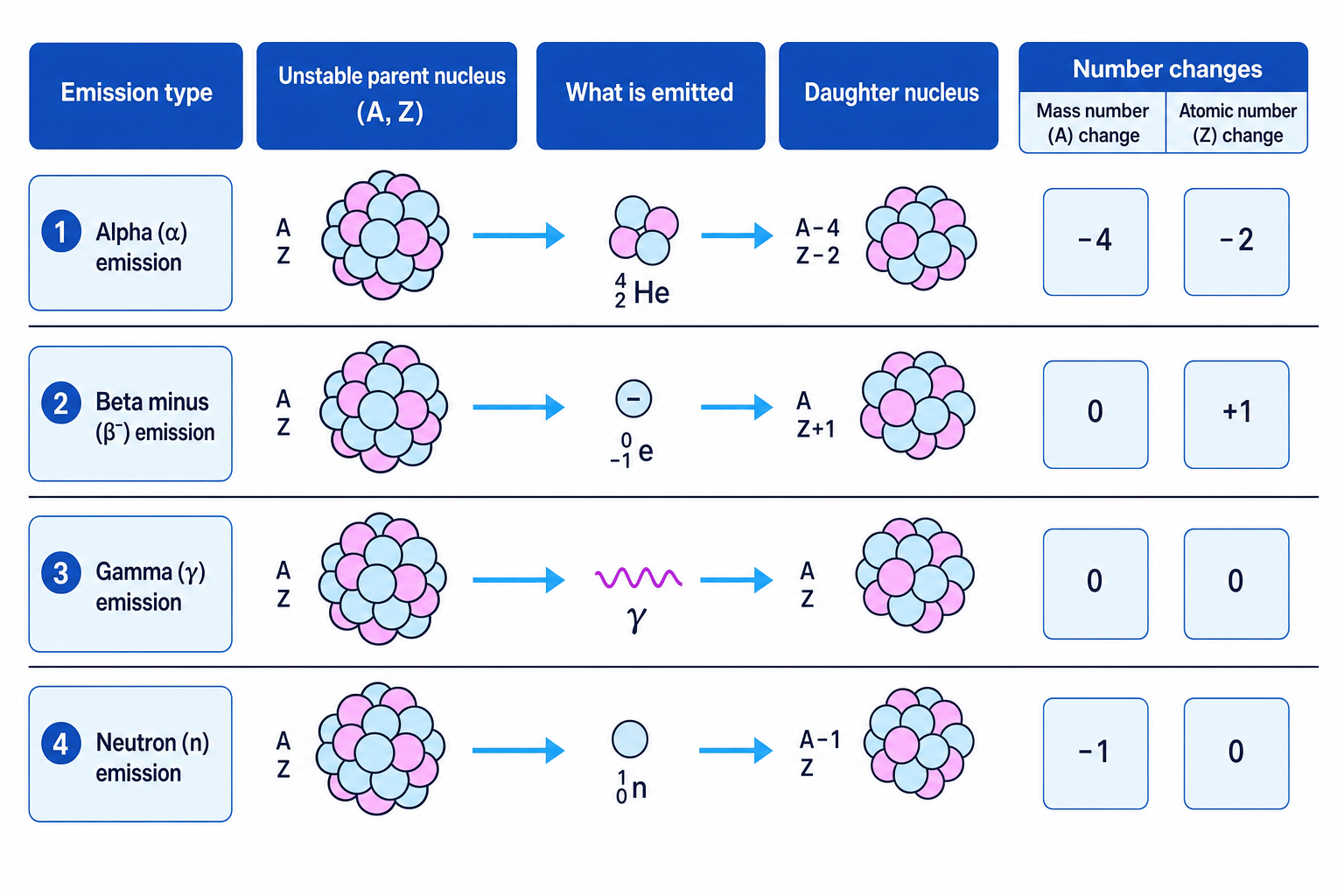
- Alpha particle, α\alphaα: a helium nucleus, 24He{}^{4}_{2}\mathrm{He}24He.
- Beta minus particle, β−\beta^{-}β−: a fast-moving electron, −10e{}^{0}_{-1}\mathrm{e}−10e.
- Gamma ray, γ\gammaγ: high-frequency electromagnetic radiation.
- Neutron, n\mathrm{n}n: an uncharged particle, 01n{}^{1}_{0}\mathrm{n}01n.
Electromagnetic radiation is energy travelling as waves, such as visible light, ultraviolet, X-rays and gamma rays.
What changes in decay
In nuclear equations, the top numbers show mass numbers and the bottom numbers show charge or proton number. The totals must balance on both sides.
For each emission:
- Alpha emission: mass number decreases by 4; atomic number decreases by 2.
- Beta minus emission: mass number stays the same; atomic number increases by 1.
- Gamma emission: mass number and atomic number do not change.
- Neutron emission: mass number decreases by 1; atomic number stays the same.
Beta particles are not shell electrons
A beta particle is not an electron that was already orbiting the atom. In beta minus decay, it is produced during a change inside the nucleus.
Balancing beta decay
Complete this nuclear equation:
614C→ZAX+−10e{}^{14}_{6}\mathrm{C} \to {}^{A}_{Z}\mathrm{X} + {}^{0}_{-1}\mathrm{e}614C→ZAX+−10e- Balance the mass numbers: carbon has mass number 14, and the beta particle has mass number 0, so the daughter nucleus must have A=14A = 14A=14.
- Balance the bottom numbers: the left side is 6. The beta particle contributes -1, so the daughter must have Z=7Z = 7Z=7 because 7+(−1)=67 + (-1) = 67+(−1)=6.
- Atomic number 7 is nitrogen, so the balanced equation is:
5. Electrons, excitation and ionisation
Electrons are arranged at different distances from the nucleus, often described as energy levels.
Excitation and ionisation
Excitation happens when an electron absorbs energy and moves to a higher energy level. Ionisation happens when an atom loses an electron and becomes a charged particle called an ion.
When an excited electron drops back down to a lower energy level, it emits electromagnetic radiation. This radiation can come from different parts of the electromagnetic spectrum.
A simple example is fluorescence: tonic water can absorb ultraviolet radiation from a black light and emit visible light. Nuclear changes can also emit radiation, including gamma rays.
6. Half-life
A Geiger-Müller tube can detect ionising radiation and give a count rate, usually measured in counts per second. Activity means the number of nuclear decays per second, measured in becquerels (Bq).
Half-life
The half-life of a radioactive isotope is the time taken for the activity, count rate, or number of undecayed nuclei to halve.
Half-life links random decay to a predictable pattern: individual nuclei decay randomly, but a large sample halves in a regular way.
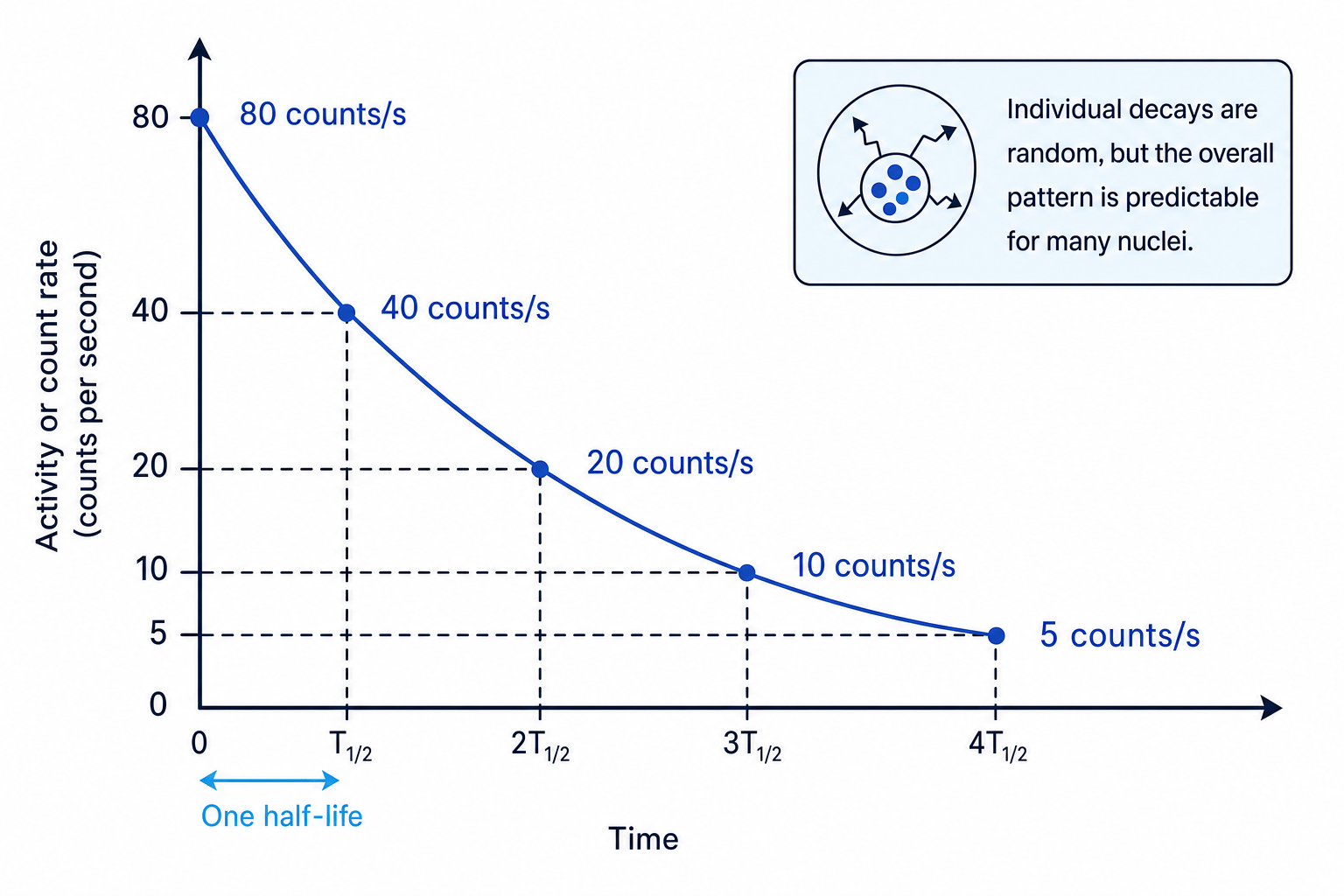
If you are on Higher Tier, you may be asked for the ratio after a whole number of half-lives:
remaining fraction=(12)n\text{remaining fraction} = \left(\frac{1}{2}\right)^nremaining fraction=(21)nAfter nnn half-lives, the final:initial ratio is 1:2n1:2^n1:2n.
Calculating activity after half-lives
A radioactive source has an activity of 1600 Bq. Its half-life is 5 days. Find the activity after 15 days and give the final:initial ratio.
- Work out the number of half-lives: 15÷5=315 \div 5 = 315÷5=3 half-lives.
- Halve the activity three times: 1600 Bq becomes 800 Bq, then 400 Bq, then 200 Bq.
- Three half-lives leaves (12)3=18\left(\frac{1}{2}\right)^3 = \frac{1}{8}(21)3=81 of the original, so the final:initial ratio is 1:8.
Half-life does not mean zero
After one half-life, half remains. After two half-lives, a quarter remains. The activity keeps decreasing, but it does not suddenly become zero.
7. Penetration and hazards
Different radiations have different penetrating powers:
- Alpha: stopped by paper, skin or a few centimetres of air. Low penetration, strongly ionising.
- Beta: stopped or reduced by thin aluminium. Medium penetration and medium ionising ability.
- Gamma: reduced by thick lead or concrete. High penetration, weakly ionising.
A school investigation may use a Geiger-Müller tube and different absorbers to compare count rate. If the count rate drops to background level with paper, the source is likely to be alpha. If aluminium reduces it strongly, it is likely to be beta. If thick shielding is needed, it is likely to be gamma.
Contamination and irradiation
- Contamination means radioactive material is unwantedly present on or inside an object or person.
- Irradiation means an object or person is exposed to radiation from a source outside them.
Irradiated does not mean radioactive
Irradiating an object with alpha, beta or gamma radiation does not normally make it radioactive. Once the source is removed, the irradiation stops.
Comparing contamination and irradiation
A worker stands near a sealed gamma source. Another worker gets alpha-emitting dust on their hand.
- The sealed gamma source is outside the first worker, so the worker is irradiated. When they move away, the exposure stops.
- The alpha-emitting dust is radioactive material on the second worker, so this is contamination. It keeps emitting radiation until it is removed or decays.
- Alpha radiation is not very penetrating from outside the body, but alpha contamination can be very dangerous because it releases energy close to living cells.
In the exam
- In nuclear equations, balance the top numbers and bottom numbers separately; remember beta has bottom number -1 and gamma changes neither number.
- For half-life, count how many halving intervals have passed, then halve repeatedly or use the ratio 1:2n1:2^n1:2n.
- For hazards, first decide whether radioactive material is present: present means contamination; exposure only means irradiation.
Check yourself
- How many protons and neutrons are in 94239Pu{}^{239}_{94}\mathrm{Pu}94239Pu?
- What happens to mass number and atomic number during alpha decay?
- Why can alpha radiation be more dangerous inside the body than outside it?