Work done
What you'll learn
- How to describe energy stores and transfers in a changing system.
- Why the total energy of a closed system stays the same.
- How work done by forces, heating, and electric currents transfer energy.
- How to calculate energy in moving objects, raised objects, stretched springs, and appliances.
Energy: stores, transfers, and systems
At GCSE, it is better to think in terms of energy stores and energy transfers, not just “types of energy”.
An object or group of objects you are studying is called a system. For example, the system might be a falling ball, a kettle and water, or a toy car and spring.
Energy store
Energy is a quantity measured in joules (J). An energy store is a way energy is accounted for in a system, such as a kinetic store, thermal store, chemical store, gravitational potential store, or elastic potential store.
Energy can be transferred between stores by processes such as:
- heating
- work done by forces
- work done when an electric current flows
- radiation, such as light or infrared waves
A closed system is one where no energy is transferred into or out of the system.
Conservation of energy
In a closed system, there is no net change to the total energy. Energy is not created or destroyed; it is redistributed between stores.
This means “wasted energy” is not destroyed. It usually means energy has been transferred to less useful thermal stores of the surroundings.
Following energy stores in a falling ball
A ball is dropped from a height. Describe the energy changes, including air resistance.
- Choose a system that includes the ball, the Earth, and the surroundings, so energy transferred to the air is still included in the system.
- As the ball falls, energy decreases in the gravitational potential store and increases in the ball’s kinetic store.
- Because of air resistance, some energy is transferred by work done against drag to thermal stores of the ball and surrounding air, but the total energy of the closed system stays the same.
Energy is not used up
Do not write “the energy is used up”. Say where it is transferred, for example “energy is transferred to the thermal store of the surroundings”.
Work done by a force
A force can transfer energy when it causes movement.
Work done
Work done is the energy transferred when a force moves an object through a distance in the direction of that force. Work done is measured in joules (J).
The key equation is:
W=FsW = F sW=Fswhere:
- WWW is work done, in joules (J)
- FFF is force, in newtons (N)
- sss is distance moved in the direction of the force, in metres (m)
OCR expects you to be able to recall or select the relevant equations in P5.1 and use them correctly. Even if an equation sheet is available, you still need to choose the correct equation and convert units.
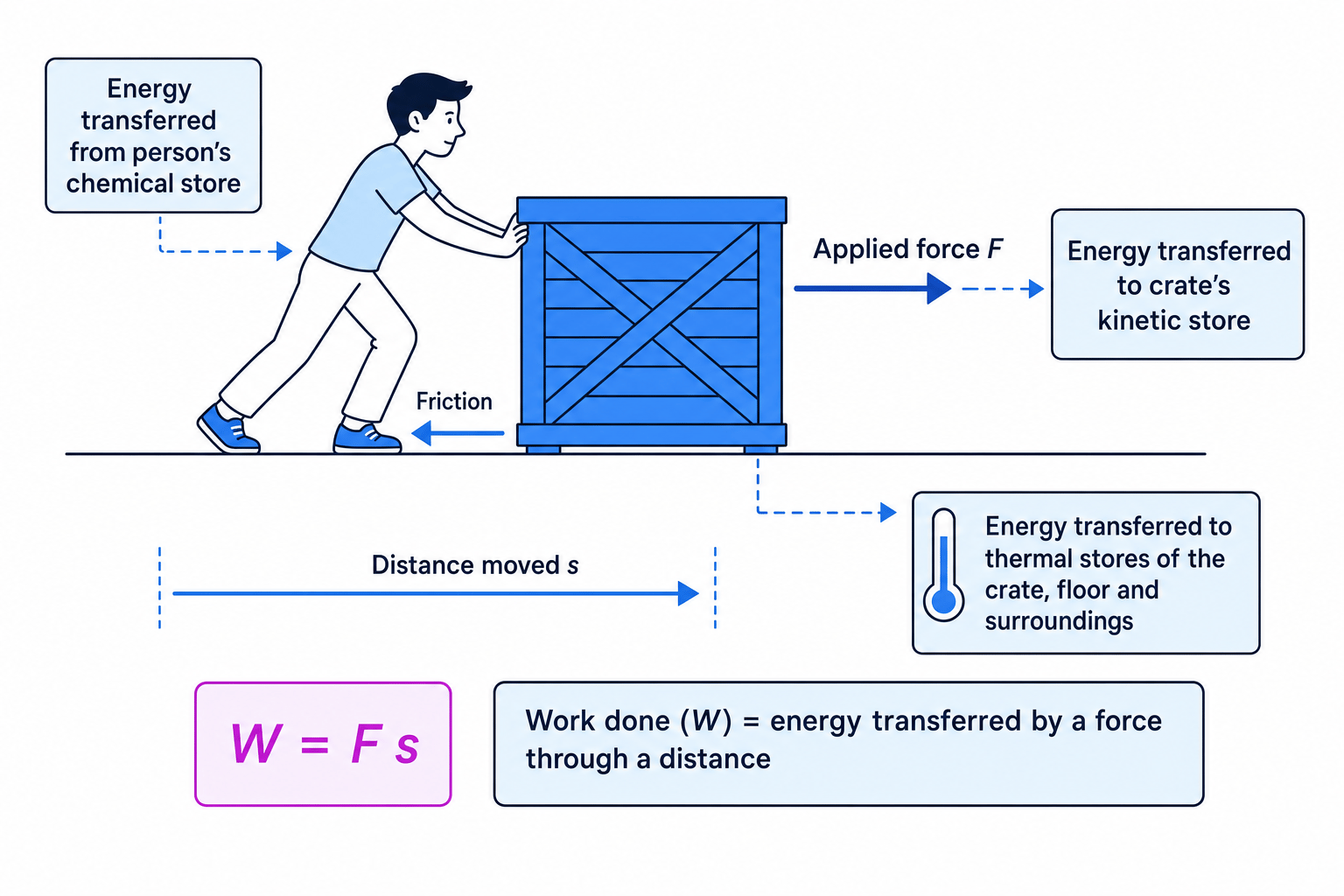
If a person pushes a box, energy is transferred from the person’s chemical store. Some may increase the box’s kinetic store, and some is transferred to thermal stores because of friction.
Calculating work done
A horizontal force of 60 N pushes a crate 2.5 m along the floor. Calculate the work done by the pushing force.
- The force acts in the same direction as the movement, so use W=FsW = F sW=Fs.
- Substitute the values: W=60 N×2.5 mW = 60 \text{ N} \times 2.5 \text{ m}W=60 N×2.5 m.
- Calculate the energy transferred: W=150 JW = 150 \text{ J}W=150 J.
Force is not energy
A force is a push or pull measured in newtons (N). Work done and energy transferred are measured in joules (J). A force with no movement does no work in this GCSE equation.
Energy changes by heating
Heating transfers energy to the thermal store of an object. The temperature rise depends on:
- the mass of the substance
- the material it is made from
- how much energy is transferred
Specific heat capacity
Specific heat capacity, symbol ccc, is the energy needed to raise the temperature of 1 kg of a substance by 1 °C, with no change of state.
The equation is:
E=mcΔTE = m c \Delta TE=mcΔTwhere:
- EEE is energy transferred, in joules (J)
- mmm is mass, in kilograms (kg)
- ccc is specific heat capacity, in J/kg °C
- ΔT\Delta TΔT is temperature change, in °C
Heating water
0.50 kg of water is heated from 20 °C to 80 °C. The specific heat capacity of water is 4200 J/kg °C. Calculate the energy transferred.
- Calculate the temperature change: 80−20=6080 - 20 = 6080−20=60, so ΔT=60 °C\Delta T = 60 \text{ °C}ΔT=60 °C.
- Use the heating equation: E=mcΔTE = m c \Delta TE=mcΔT.
- Substitute and calculate: E=0.50×4200×60=126000 JE = 0.50 \times 4200 \times 60 = 126000 \text{ J}E=0.50×4200×60=126000 J, which is 126 kJ.
Temperature is not the same as energy
Temperature tells you how hot something is. The energy in a thermal store also depends on the mass and the material.
Energy changes when a current flows
When an electric current flows through a component, work is done by the charges. Energy is transferred electrically to other stores, such as thermal stores in a heater or kinetic stores in a motor.
The useful equations are:
E=QVE = Q VE=QVand because:
Q=ItQ = I tQ=Ityou can also use:
E=VItE = V I tE=VItwhere:
- EEE is energy transferred, in joules (J)
- QQQ is charge, in coulombs (C)
- VVV is potential difference, in volts (V)
- III is current, in amperes (A)
- ttt is time, in seconds (s)
You may also use the power equation:
E=PtE = P tE=PtIf power is in watts and time is in seconds, energy is in joules. If power is in kilowatts and time is in hours, energy is in kilowatt-hours.
Kilowatt-hour
A kilowatt-hour (kWh) is the energy transferred by a 1 kW appliance working for 1 hour. It is a unit of energy, not power.
The conversion is:
1 kWh=3.6×10⁶ J1 \text{ kWh} = 3.6 \times 10^6 \text{ J}1 kWh=3.6×10⁶ JUsing kilowatt-hours
A 2.0 kW heater is switched on for 3.5 hours. Calculate the energy transferred in kWh and in joules.
- Use E=PtE = P tE=Pt with power in kW and time in hours: E=2.0×3.5E = 2.0 \times 3.5E=2.0×3.5.
- Calculate the energy in kilowatt-hours: E=7.0 kWhE = 7.0 \text{ kWh}E=7.0 kWh.
- Convert to joules: 7.0 kWh=7.0×3.6×106 J=2.52×10⁷ J7.0 \text{ kWh} = 7.0 \times 3.6 \times 10^6 \text{ J} = 2.52 \times 10^7 \text{ J}7.0 kWh=7.0×3.6×106 J=2.52×10⁷ J.
kWh is not kW per hour
Do not write kW/h for energy use. A kilowatt-hour, kWh, is already a complete unit of energy.
Energy in common stores
You need to calculate energy associated with a moving object, a raised object, and a stretched spring.
Kinetic energy
The kinetic store is the energy store of a moving object.
Ek=12mv2E_k = \frac{1}{2} m v^2Ek=21mv2where mmm is mass in kg and vvv is speed in m/s.
Gravitational potential energy
The gravitational potential store increases when an object is raised in a gravitational field.
Ep=mghE_p = m g hEp=mghwhere ggg is gravitational field strength in N/kg and hhh is height in m. On Earth, use the value given in the question, often 9.8 N/kg or 10 N/kg.
Elastic potential energy
The elastic potential store increases when an object such as a spring is stretched or compressed.
Ee=12ke2E_e = \frac{1}{2} k e^2Ee=21ke2where kkk is spring constant in N/m and eee is extension in m.
When the spring equation applies
Use Ee=12ke2E_e = \frac{1}{2} k e^2Ee=21ke2 only when the spring has not gone beyond its limit of proportionality, so it returns to its original shape.
Calculating energy in stores
Calculate the energy in each situation: a 0.20 kg trolley moving at 3.0 m/s, a 1.5 kg book raised by 2.0 m where g=9.8 N/kgg = 9.8 \text{ N/kg}g=9.8 N/kg, and a spring of spring constant 40 N/m stretched by 5.0 cm.
- For the moving trolley, use Ek=12mv2E_k = \frac{1}{2} m v^2Ek=21mv2: Ek=12×0.20×3.02=0.90 JE_k = \frac{1}{2} \times 0.20 \times 3.0^2 = 0.90 \text{ J}Ek=21×0.20×3.02=0.90 J.
- For the raised book, use Ep=mghE_p = mghEp=mgh: Ep=1.5×9.8×2.0=29.4 JE_p = 1.5 \times 9.8 \times 2.0 = 29.4 \text{ J}Ep=1.5×9.8×2.0=29.4 J.
- For the spring, first convert 5.0 cm to 0.050 m, then use Ee=12ke2E_e = \frac{1}{2} k e^2Ee=21ke2: Ee=12×40×0.0502=0.050 JE_e = \frac{1}{2} \times 40 \times 0.050^2 = 0.050 \text{ J}Ee=21×40×0.0502=0.050 J.
Choosing the right equation
Match the equation to the process
If a force moves something, think W=FsW = FsW=Fs. If something is heated, think E=mcΔTE = mc\Delta TE=mcΔT. If current flows, think E=VItE = VItE=VIt or E=PtE = PtE=Pt. If the question mentions speed, height, or extension, choose kinetic, gravitational potential, or elastic potential energy.
In practical work, a joulemeter can measure energy transferred to an electrical appliance directly. Light gates can measure speed so you can calculate kinetic energy of a trolley.
In the exam
- Identify the process first: force and distance, heating, current flow, motion, height, or extension.
- Convert units before substituting: use kg, m, s, m/s, and convert cm to m for spring extension.
- Track where the energy goes; if energy seems “missing”, it has usually been transferred to thermal stores of the surroundings.
Check yourself
- A 40 N force moves an object 6.0 m. What is the work done?
- When a ball is dropped, which energy stores change if air resistance is ignored?
- Why is a kilowatt-hour a unit of energy, not power?