

What you'll learn
- What “pure” means in chemistry, and how this differs from everyday use.
- How melting point data can show whether a substance is pure or impure.
- How to choose between filtration, crystallisation, distillation and chromatography.
- How to calculate relative formula mass, empirical formula and RfR_fRf values.
Pure substances and mixtures
In chemistry, we are very strict with the word pure. A “pure” substance is not just “natural”, “healthy” or “untampered with”. It means there is only one chemical substance present.
An element is a substance made from only one type of atom, such as copper or oxygen. A compound is made when atoms of different elements are chemically bonded together, such as water or carbon dioxide. A mixture contains two or more substances that are not chemically bonded together, such as air, seawater or ink.
Pure substance
A chemically pure substance is a single element or a single compound with nothing else mixed in. A mixture contains two or more substances that are physically mixed, not chemically bonded.
A clear solution can still be a mixture. For example, salt water looks like one substance, but it contains water and dissolved sodium chloride.
Everyday pure is not chemical pure
“Pure orange juice”, “pure air” or “pure spring water” are not chemically pure because they contain several substances. In GCSE chemistry, pure means one element or one compound only.
Using melting point to test purity
A melting point is the temperature at which a solid changes into a liquid. A pure substance has a sharp melting point: it melts at one temperature, or over a very small range.
An impure substance usually:
- melts over a wider temperature range
- has a melting point lower than the pure substance
This happens because the impurity disrupts the regular arrangement of particles in the solid.
Purity and melting point
A pure substance has a sharp melting point. An impure substance usually melts over a range of temperatures and often at a lower temperature.
Using melting point data
A pure compound is known to melt at 132 °C. Sample A melts from 131.5 °C to 132.0 °C. Sample B melts from 125 °C to 130 °C. Which sample is more likely to be pure?
- Compare the melting ranges: Sample A melts over only 0.5 °C, but Sample B melts over 5 °C, so Sample A has the sharper melting point.
- Compare the temperatures with the known value: Sample A is very close to 132 °C, while Sample B is lower than 132 °C.
- Conclude that Sample A is more likely to be pure, while Sample B is likely to contain impurities.
Relative formula mass
A relative atomic mass, ArA_rAr, is the mass of an atom compared with carbon-12. You find ArA_rAr values on the periodic table.
A relative formula mass, MrM_rMr, is found by adding together the ArA_rAr values of all the atoms in a formula. A species just means a particle or formula shown in a chemical equation, such as Mg, O₂ or MgO.
For example, the balanced equation for magnesium reacting with oxygen is:
2Mg(s) + O₂(g) → 2MgO(s)
Calculating relative formula masses in an equation
Use ArA_rAr values: Mg = 24.3 and O = 16.0.
- Calculate the formula mass of oxygen gas: Mr(O2)=2×16.0=32.0M_r(\text{O}_2) = 2 \times 16.0 = 32.0Mr(O2)=2×16.0=32.0.
- Calculate the formula mass of magnesium oxide: Mr(MgO)=24.3+16.0=40.3M_r(\text{MgO}) = 24.3 + 16.0 = 40.3Mr(MgO)=24.3+16.0=40.3.
- Use the balancing numbers to compare both sides: reactants have (2×24.3)+32.0=80.6(2 \times 24.3) + 32.0 = 80.6(2×24.3)+32.0=80.6, and products have 2×40.3=80.62 \times 40.3 = 80.62×40.3=80.6.
- The total relative mass is the same on both sides, as expected because atoms are conserved.
Empirical formula
The empirical formula is the simplest whole-number ratio of atoms of each element in a compound.
The molecular formula gives the actual number of atoms in a molecule. The molecular formula can be a multiple of the empirical formula.
For example, C₆H₁₂O₆ has the empirical formula CH₂O because the ratio 6 carbon to 12 hydrogen to 6 oxygen simplifies to 1 carbon to 2 hydrogen to 1 oxygen.
Finding an empirical formula from atom numbers
A model of a compound shows 4 nitrogen atoms and 8 oxygen atoms. Find the empirical formula.
- Write the atom numbers as a ratio: 4 nitrogen atoms to 8 oxygen atoms.
- Simplify the ratio by dividing both numbers by 4, giving 1 nitrogen atom to 2 oxygen atoms.
- Convert the simplest ratio into a formula: the empirical formula is NO₂.
Useful mixtures and formulations
Many useful materials are deliberately made as mixtures. A formulation is a mixture designed to have particular properties because its ingredients are present in carefully chosen amounts.
Examples include:
- medicines, where each ingredient has a purpose
- paints, which may contain pigments, solvents and binding substances
- fuels, which are mixtures of hydrocarbons
- alloys, such as steel or bronze
An alloy is a mixture of a metal with one or more other elements. Alloys are often harder or more useful than pure metals because the different-sized atoms distort the layers, making them harder to slide over each other.
Separating mixtures
Mixtures can often be separated because the substances in them have different physical properties, such as solubility, particle size or boiling point. Solubility means how well a substance dissolves in a solvent.
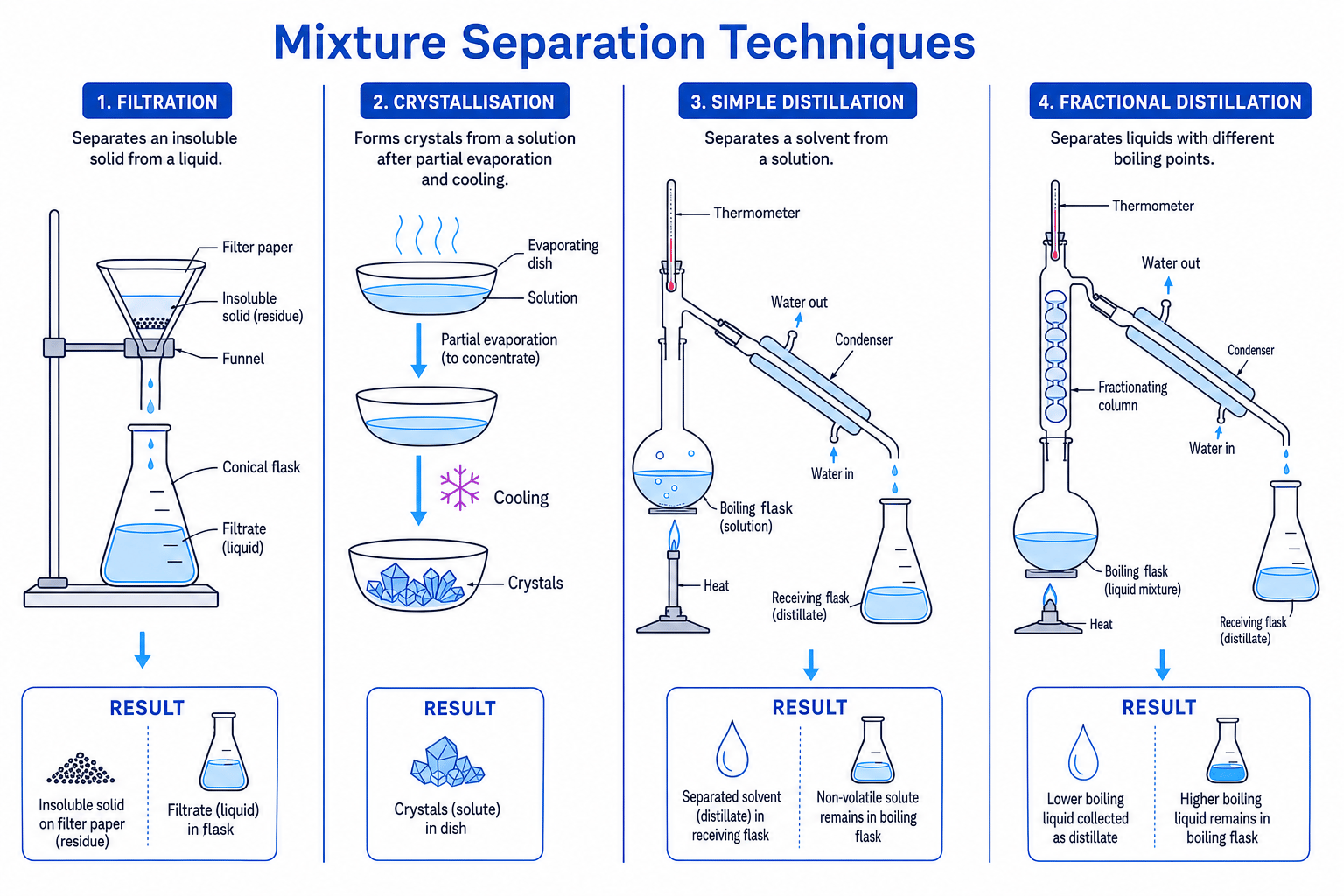
The diagram summarises the main separation methods you need for this topic.
Filtration
Filtration separates an insoluble solid from a liquid. The mixture is poured through filter paper.
- The insoluble solid left on the filter paper is the residue.
- The liquid that passes through is the filtrate.
Filtration works because the solid particles are too large to pass through the tiny holes in the filter paper.
Crystallisation
Crystallisation separates a dissolved solid from a solution.
A solution contains a solute dissolved in a solvent. For example, in salt water, sodium chloride is the solute and water is the solvent.
To crystallise a solid:
- Heat the solution to evaporate some solvent.
- Stop heating when the solution is concentrated, often close to being saturated. A saturated solution contains as much dissolved solute as possible at that temperature.
- Leave it to cool so crystals form.
- Filter and dry the crystals.
Simple distillation
Simple distillation separates a solvent from a solution, or separates liquids with very different boiling points.
The liquid with the lower boiling point evaporates first. Its vapour passes into a condenser, cools, and becomes liquid again. The collected liquid is called the distillate.
For example, simple distillation can be used to obtain pure water from salt water.
Fractional distillation
Fractional distillation separates two or more liquids that are mixed together and have different boiling points.
The fractionating column allows repeated evaporating and condensing. The liquid with the lower boiling point reaches the top of the column first and is collected first.
Filtration does not remove dissolved substances
You cannot remove dissolved salt from water by filtration because dissolved particles are small enough to pass through the filter paper. Use crystallisation to get the salt, or simple distillation to get the water.
Choosing a separation technique
A mixture contains sand, salt and water. You want to obtain dry sand and salt crystals.
- Separate the sand first using filtration, because sand is insoluble in water and will stay as the residue.
- Keep the filtrate, because it contains dissolved salt in water.
- Use crystallisation on the filtrate, because the salt is soluble and can form crystals when some water evaporates and the solution cools.
Chromatography
Chromatography separates substances in a mixture using two phases. A phase is a part of the system that substances can move through or stick to.
- The stationary phase stays still.
- The mobile phase moves.
In paper chromatography, the paper is the stationary phase and the solvent is the mobile phase. In thin layer chromatography, often called TLC, the stationary phase is a thin solid coating on a plate, and the solvent is the mobile phase.
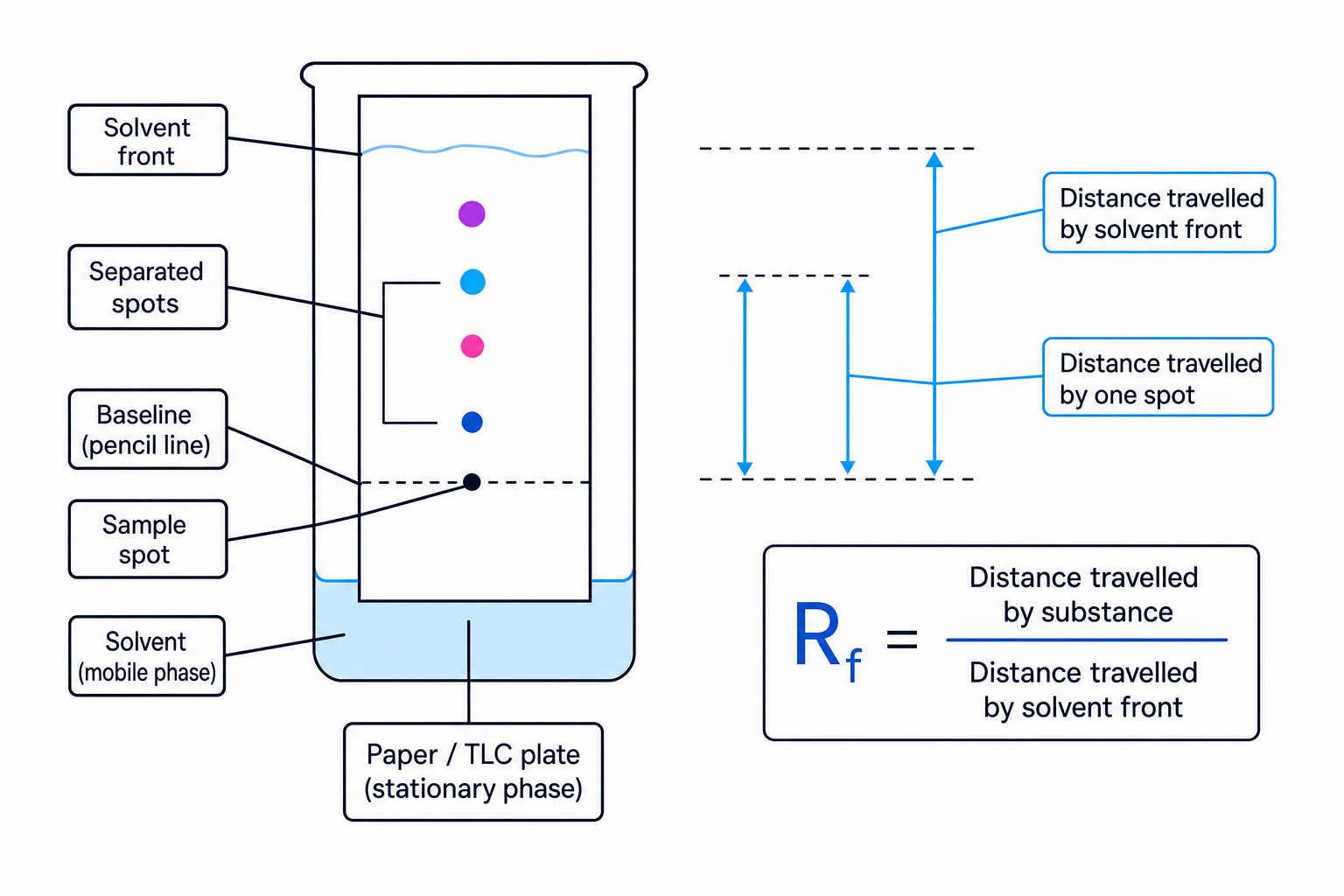
The diagram shows the key measurements used in chromatography.
Separation depends on how each substance is distributed between the two phases. A substance that dissolves well in the mobile phase travels further. A substance that is more strongly attracted to the stationary phase travels less far.
For paper chromatography or TLC:
- Draw a pencil baseline near the bottom.
- Place a small sample spot on the baseline.
- Put the plate or paper into a solvent, with the solvent below the baseline.
- Allow the solvent to rise and carry substances with it.
- Mark the solvent front before it dries.
An aqueous solvent is water-based. A non-aqueous solvent is not water-based, such as ethanol. Colourless substances may need a locating agent, such as iodine vapour, to make the spots visible.
Calculating and using RfR_fRf values
The RfR_fRf value compares how far a substance travels with how far the solvent front travels.
Rf=distance travelled by substancedistance travelled by solvent frontR_f = \frac{\text{distance travelled by substance}}{\text{distance travelled by solvent front}}Rf=distance travelled by solvent frontdistance travelled by substanceMeasure both distances from the baseline. For a spot, measure to the centre of the spot. RfR_fRf values have no units because the distance units cancel.
Calculating an Rf value
A spot travels 3.2 centimetres (cm) from the baseline. The solvent front travels 8.0 cm from the baseline. Calculate the RfR_fRf value.
- Substitute the measured distances into the formula: Rf=3.2 cm8.0 cmR_f = \frac{3.2\ \text{cm}}{8.0\ \text{cm}}Rf=8.0 cm3.2 cm.
- Divide the distances: Rf=3.2÷8.0=0.40R_f = 3.2 \div 8.0 = 0.40Rf=3.2÷8.0=0.40.
- The unit cancels, so the answer is Rf=0.40R_f = 0.40Rf=0.40.
Chromatography can help decide whether a substance is pure. A pure substance should give one spot in paper chromatography or TLC, using a particular solvent and stationary phase. A mixture gives more than one spot.
In gas chromatography, the mobile phase is a gas and substances separate as they travel through a column. A pure substance gives one peak; a mixture gives more than one peak.
One spot is not absolute proof
Two different substances can sometimes have the same RfR_fRf value in one solvent. To be more confident, compare with known substances and repeat using a different solvent or another method.
In the exam
- Link each separation method to the property it uses: insolubility for filtration, solubility for crystallisation, boiling point for distillation, and movement between phases for chromatography.
- For melting point questions, mention both the temperature and the range: pure substances melt sharply; impure substances usually melt lower and over a range.
- For chromatography calculations, measure from the baseline to the centre of the spot and to the solvent front, then give RfR_fRf with no units.
Check yourself
- Why is salt water a mixture, even if it looks clear?
- Which technique would you use to separate ethanol and water, and why?
- How do you use a chromatogram to decide whether a dye is pure or impure?
