Bonding
What you'll learn
- How electron arrangements link to the Periodic Table.
- Why atoms form ionic bonds, covalent bonds and metallic bonds.
- How to draw dot-and-cross diagrams for simple ionic and covalent substances.
- How to compare ionic compounds, simple molecules, giant covalent structures, polymers and metals.
Start from atoms
An atom is the smallest particle of an element that can still be recognised as that element. It has a tiny central nucleus, containing protons and neutrons, with electrons arranged in energy levels, often called shells, around it.
Electrons are the particles involved in bonding. The nucleus does not change when atoms bond.
Atomic number
The atomic number is the number of protons in the nucleus of an atom. In a neutral atom, the number of electrons is the same as the number of protons.
Atoms are extremely small: a typical atom is about 0.1 nanometres across, which is about 1×10⁻¹⁰ m1 \times 10^{-10}\,\text{m}1×10⁻¹⁰m.
Estimating atomic scale
How many atoms, each about 1×10⁻¹⁰ m1 \times 10^{-10}\,\text{m}1×10⁻¹⁰m wide, could fit across 1 mm?
- Convert 1 mm into metres: 1 mm is 1×10⁻³ m1 \times 10^{-3}\,\text{m}1×10⁻³m.
- Divide the total length by the width of one atom:
- So about 10 million atoms could fit across 1 mm.
Electron shells and the Periodic Table
The electron arrangement of an atom shows how its electrons are arranged in shells. For the first 20 elements, the simple GCSE model fills shells as 2, then 8, then 8, then the next shell begins.
For example, sodium has atomic number 11. A neutral sodium atom has 11 electrons, arranged as 2,8,1.
The Periodic Table is linked to electron arrangement:
- The period tells you how many occupied electron shells the atom has.
- The group tells you the number of outer-shell electrons for the main groups.
- Elements in the same group have similar chemical reactions because they have the same number of outer-shell electrons.
Outer electrons control bonding
The outer-shell electrons decide whether an atom tends to lose, gain or share electrons during chemical reactions.
Metals and non-metals
A metal is an element that usually conducts electricity and heat, is malleable, and forms positive ions. Metals are mostly found on the left and in the middle of the Periodic Table.
A non-metal is an element that usually does not conduct electricity, is often brittle if solid, and tends to gain or share electrons. Non-metals are mostly found on the right-hand side of the Periodic Table. Hydrogen is a non-metal even though it is placed on the left.
Metals usually have 1, 2 or 3 electrons in their outer shell, so they often react by losing electrons. Non-metals usually have 4, 5, 6 or 7 outer electrons, so they often react by gaining or sharing electrons.
Chemically, metal oxides are usually basic, while non-metal oxides are usually acidic.
Using atomic number to find electron arrangement
Chlorine has atomic number 17. Work out its electron arrangement and what this suggests about its bonding.
- A neutral chlorine atom has 17 electrons because it has 17 protons.
- Fill the shells using the simple model: 2 in the first shell, 8 in the second shell, leaving 7 in the third shell. So chlorine is 2,8,7.
- Chlorine has 7 outer electrons, so it usually gains 1 electron or shares 1 electron to get a full outer shell.
Why atoms bond
Atoms often become more stable when they have a full outer shell of electrons. Group 0 elements, the noble gases, already have full outer shells, so they are very unreactive.
A chemical bond is a force of attraction between particles. It is not a little stick or a piece of matter.
Electrostatic force
An electrostatic force is an attraction or repulsion between charged particles. Opposite charges attract; like charges repel.
Atoms can bond by transferring electrons or by sharing electrons.
The nucleus does not change
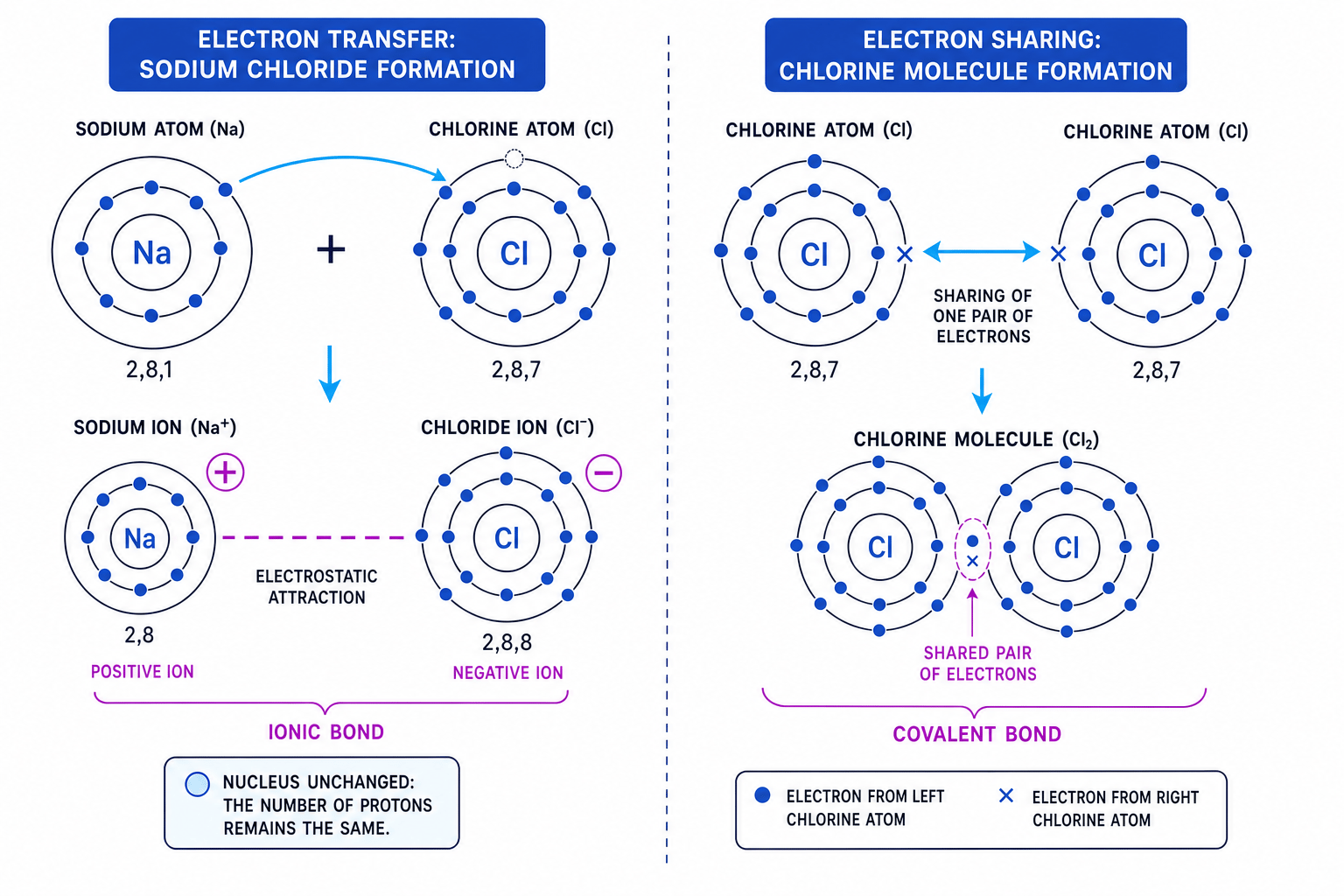
When an atom loses, gains or shares electrons, its nucleus is unchanged. The number of protons stays the same, so the element stays the same.
Ionic bonding: transfer of electrons
An ion is a charged particle formed when an atom or group of atoms loses or gains electrons.
- Losing electrons makes a positive ion.
- Gaining electrons makes a negative ion.
An ionic bond is the strong electrostatic attraction between oppositely charged ions. Ionic bonding usually happens between metals and non-metals.
For example, in sodium chloride, sodium transfers one electron to chlorine. Sodium becomes Na⁺ and chlorine becomes Cl⁻. The formula NaCl shows the simplest ratio of ions, not a separate molecule.
A binary ionic substance is an ionic compound made from two different elements, such as sodium chloride, magnesium oxide or calcium chloride.
Predicting the formula of magnesium chloride
Work out the formula formed from magnesium and chlorine.
- Magnesium is in Group 2, so it has 2 outer electrons and forms Mg²⁺ by losing both.
- Chlorine is in Group 7, so each chlorine atom gains 1 electron and forms Cl⁻.
- One Mg²⁺ ion needs two Cl⁻ ions to balance the charges: +2 and two lots of -1 make zero overall.
- The formula is MgCl₂.
Dot-and-cross diagrams for ionic compounds
A dot-and-cross diagram shows outer-shell electrons using dots for one atom and crosses for another. For ionic compounds:
- Show electrons being transferred from the metal atom to the non-metal atom.
- Draw the final ions in square brackets.
- Add the correct charges, such as Mg²⁺ or Cl⁻.
- Show full outer shells on the negative ions.
Ionic formula check
The total positive charge and total negative charge must cancel out. Ionic compounds are neutral overall.
Covalent bonding: sharing electrons
A covalent bond is a shared pair of electrons between non-metal atoms. The shared electrons are attracted to the nuclei of both atoms, holding the atoms together.
A molecule is a group of atoms held together by covalent bonds. Examples include H₂, Cl₂, H₂O and CO₂.
Drawing hydrogen chloride as a covalent molecule
Draw a dot-and-cross diagram for hydrogen chloride, HCl.
- Hydrogen has 1 outer electron and needs 1 more to fill its first shell.
- Chlorine has 7 outer electrons and needs 1 more to fill its outer shell.
- Place one hydrogen electron and one chlorine electron in the overlap between the atoms. This shared pair is one covalent bond.
- Hydrogen now counts 2 electrons in its shell, while chlorine counts 8 in its outer shell.
Comparing types of structure
Bonding is about forces between particles, but substances also have different structures, meaning different arrangements of atoms, ions or molecules.
Ionic compounds
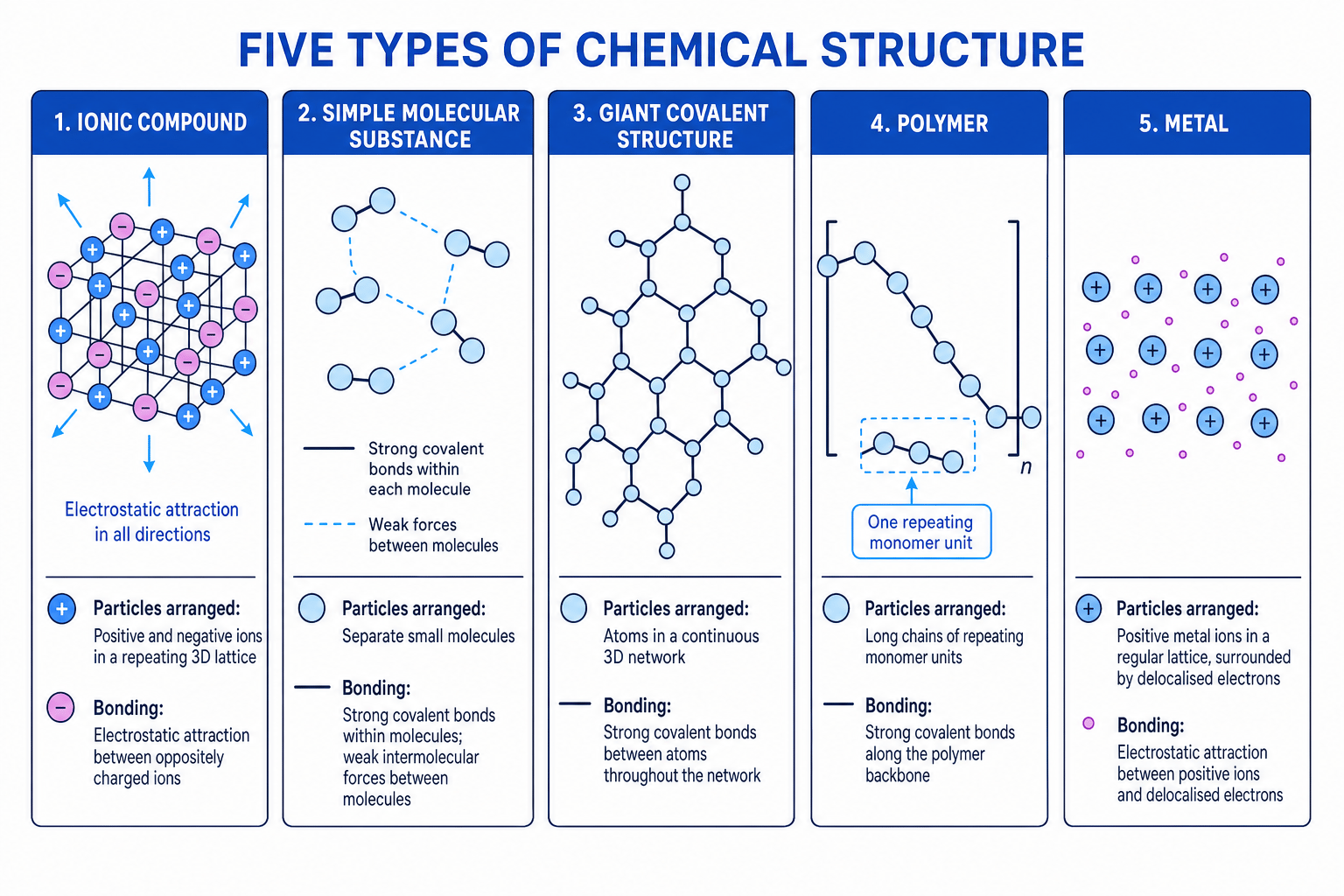
Ionic compounds form a giant 3D lattice of alternating positive and negative ions. The ionic bonds act in all directions through the lattice.
Simple molecular substances
A simple molecular substance contains small separate molecules. There are strong covalent bonds within each molecule, but much weaker forces between molecules.
Molecules versus ionic compounds
Na⁺ and Cl⁻ ions are not a molecule. Sodium chloride is a giant ionic lattice; NaCl is the simplest ratio of ions.
Giant covalent structures
A giant covalent structure is a huge network of atoms joined by covalent bonds. Examples include diamond, graphite and silicon dioxide. The covalent bonds continue throughout the structure.
Polymers
A polymer is a long-chain molecule made from many repeating units. The atoms in the chain are joined by covalent bonds. Polymer chains can be represented in 2D, but the real molecules are 3D and can be tangled or coiled.
Metals
In a metal, positive metal ions are arranged in a regular lattice. The outer electrons become delocalised, meaning they are free to move through the structure. A metallic bond is the electrostatic attraction between positive metal ions and delocalised electrons.
Different particles, different bonding
Ionic compounds contain ions, simple molecules contain separate covalent molecules, giant covalent structures contain continuous covalent networks, polymers contain long covalent chains, and metals contain positive ions with delocalised electrons.
Limits of bonding models
Models help you think, but every model leaves something out.
Dot-and-cross diagrams are useful because they show electron transfer or sharing clearly. However, they do not show the real size of atoms, the 3D shape of molecules, or the movement of electrons.
Ball-and-stick models are useful for showing which atoms are connected and the approximate shape. However, bonds are not physical sticks, and the atoms are not usually shown at their true relative sizes.
2D diagrams of giant structures are useful on paper, but real ionic lattices, covalent networks and metal lattices are 3D.
Mendeleev and the modern Periodic Table
Mendeleev arranged elements mainly by atomic mass, but he also used chemical properties. He left gaps for undiscovered elements and predicted their properties.
The modern Periodic Table is arranged by atomic number. This improved the table because atomic number links directly to proton number and, in neutral atoms, electron number. That means the modern table lines up with electron arrangements and repeating chemical properties.
As atomic number increases, the number of protons increases by one each time. In neutral atoms, the number of electrons also increases by one, so the electron arrangement changes in a regular pattern. This is why elements in the same group have similar reactions.
In the exam
- For bonding questions, start by deciding whether the elements are metals, non-metals, or both.
- Use outer-shell electrons to choose the bonding type: metal + non-metal usually means ionic; non-metal + non-metal usually means covalent.
- In dot-and-cross diagrams, always show the final charges for ions, and show shared pairs clearly for covalent bonds.
Check yourself
- Why does magnesium form Mg²⁺ but chlorine forms Cl⁻?
- How is an ionic lattice different from a simple molecule?
- What are two limitations of dot-and-cross diagrams?