What you'll learn
- How scientists’ ideas about atoms changed from Dalton to Bohr.
- What an atom is made from: protons, neutrons and electrons.
- How tiny atoms are, using powers of ten such as 10−10 m10^{-10}\text{ m}10−10 m.
- How to calculate the numbers of protons, neutrons and electrons in atoms and ions.
Starting point: what is an atom?
An element is a substance made from only one type of atom. For example, copper is made from copper atoms, and oxygen gas contains oxygen atoms.
Atom
An atom is the smallest part of an element that still has the chemical properties of that element.
Atoms are not solid little balls. The modern model says they are made from smaller particles called sub-atomic particles.
Sub-atomic particle
A sub-atomic particle is a particle smaller than an atom. The three you need here are protons, neutrons and electrons.
A molecule is different: it is made when two or more atoms are chemically bonded together. For example, oxygen gas, O₂, is a molecule made from two oxygen atoms.
Atom or molecule?
An atom is one single particle of an element. A molecule is two or more atoms joined together. Do not describe a molecule as “one atom”.
How the atomic model changed
A scientific model is a simplified idea or picture used to explain observations. Models can change when new evidence appears.
The atomic model changed because scientists carried out experiments and found results that older models could not explain.
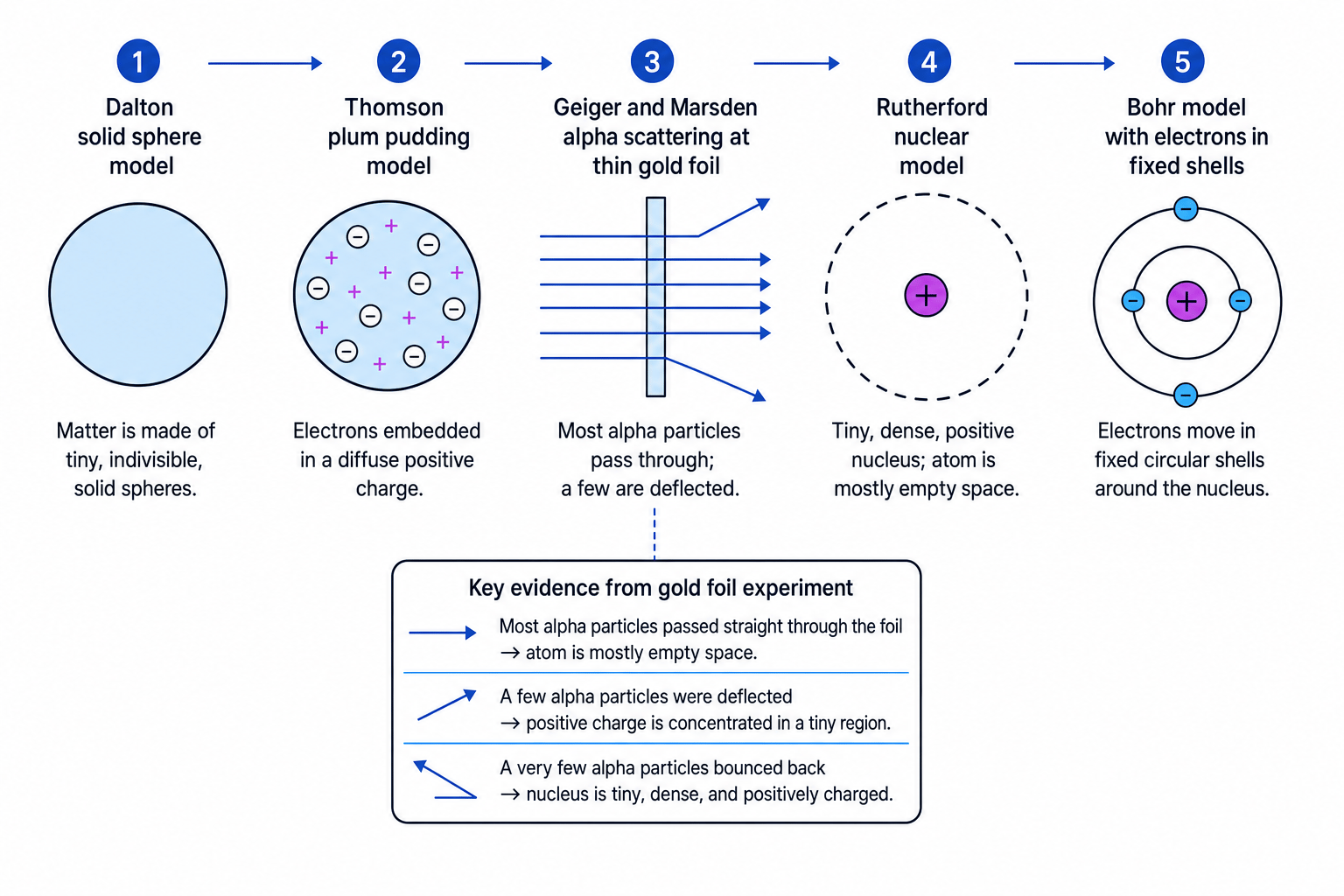
Dalton’s model: solid spheres
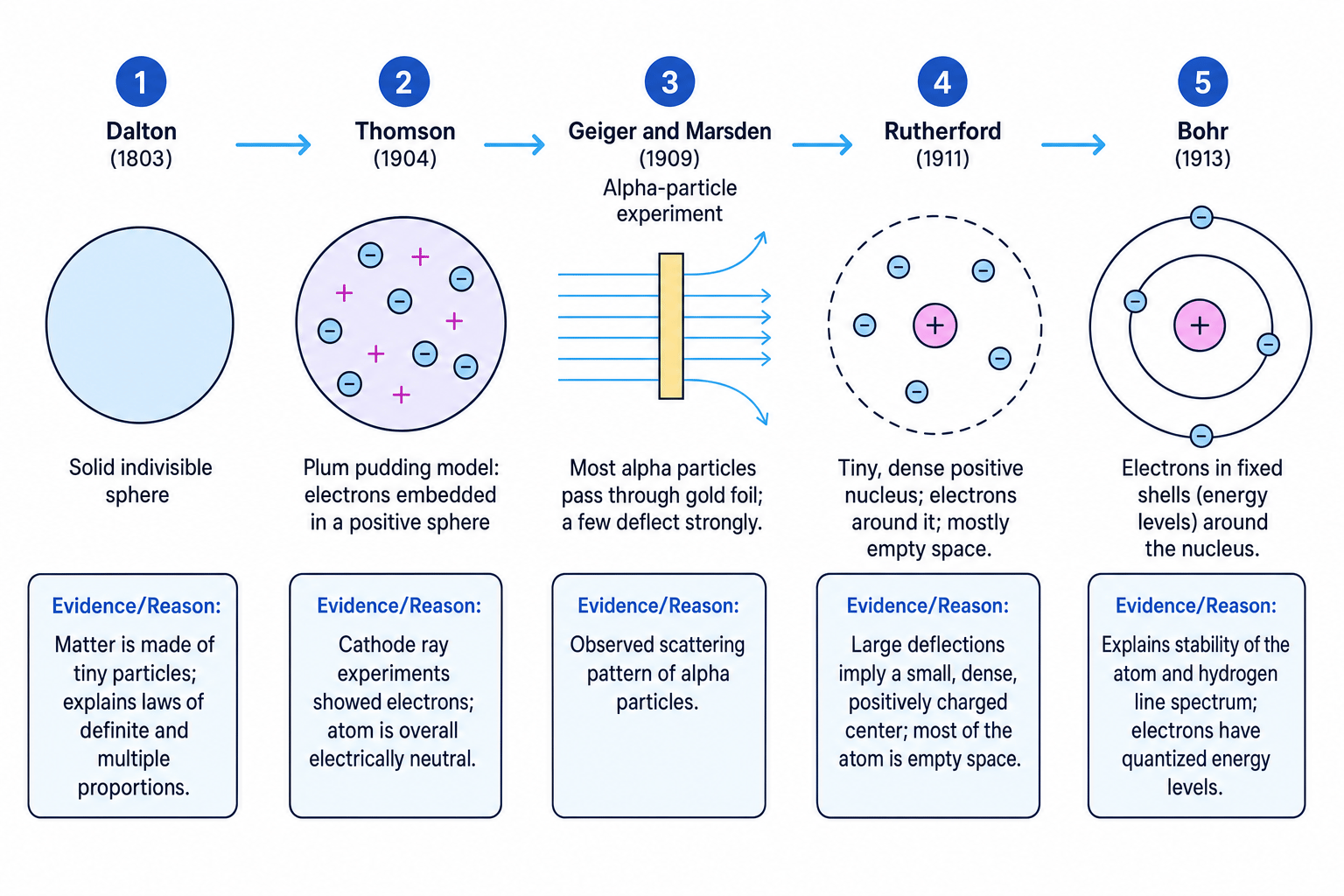
John Dalton described atoms as tiny, solid, indivisible spheres. This was useful because it explained why elements combine in fixed ratios in chemical reactions.
Thomson’s model: “plum pudding”
J. J. Thomson discovered electrons. Since atoms are usually neutral overall, he suggested the plum pudding model: negative electrons embedded in a ball of positive charge.
Geiger and Marsden’s experiment
Geiger and Marsden fired positively charged alpha particles at very thin gold foil.
Most alpha particles passed straight through. A few were deflected strongly, and a very small number bounced back.
Rutherford’s nuclear model
Rutherford used those results to suggest that the atom is mostly empty space, with a tiny, dense, positively charged nucleus in the centre.
Bohr’s model: electron shells
Bohr improved the model by suggesting that electrons orbit the nucleus in fixed shells, also called energy levels.
Interpreting alpha-particle scattering
Geiger and Marsden found that most alpha particles went straight through gold foil, but a few were strongly deflected. What does this tell us about the atom?
- Most alpha particles passing through means most of the atom must be empty space.
- A few alpha particles being strongly deflected means there must be a small region with a strong positive charge, because alpha particles are also positive and are repelled.
- The small number of strong deflections means this positive region is tiny compared with the whole atom, so Rutherford proposed a tiny, dense nucleus.
Why models change
Atomic models changed because new experimental evidence needed a better explanation. In GCSE answers, link the model change to the evidence.
The modern picture of the atom
The modern GCSE model describes an atom as a tiny central nucleus surrounded by electrons.
Nucleus
The nucleus is the tiny central part of an atom. It contains protons and neutrons, and it has a positive charge overall because protons are positive.
Electrons are negatively charged and are found around the nucleus in shells. The nucleus is much smaller than the whole atom, but it contains almost all of the atom’s mass.
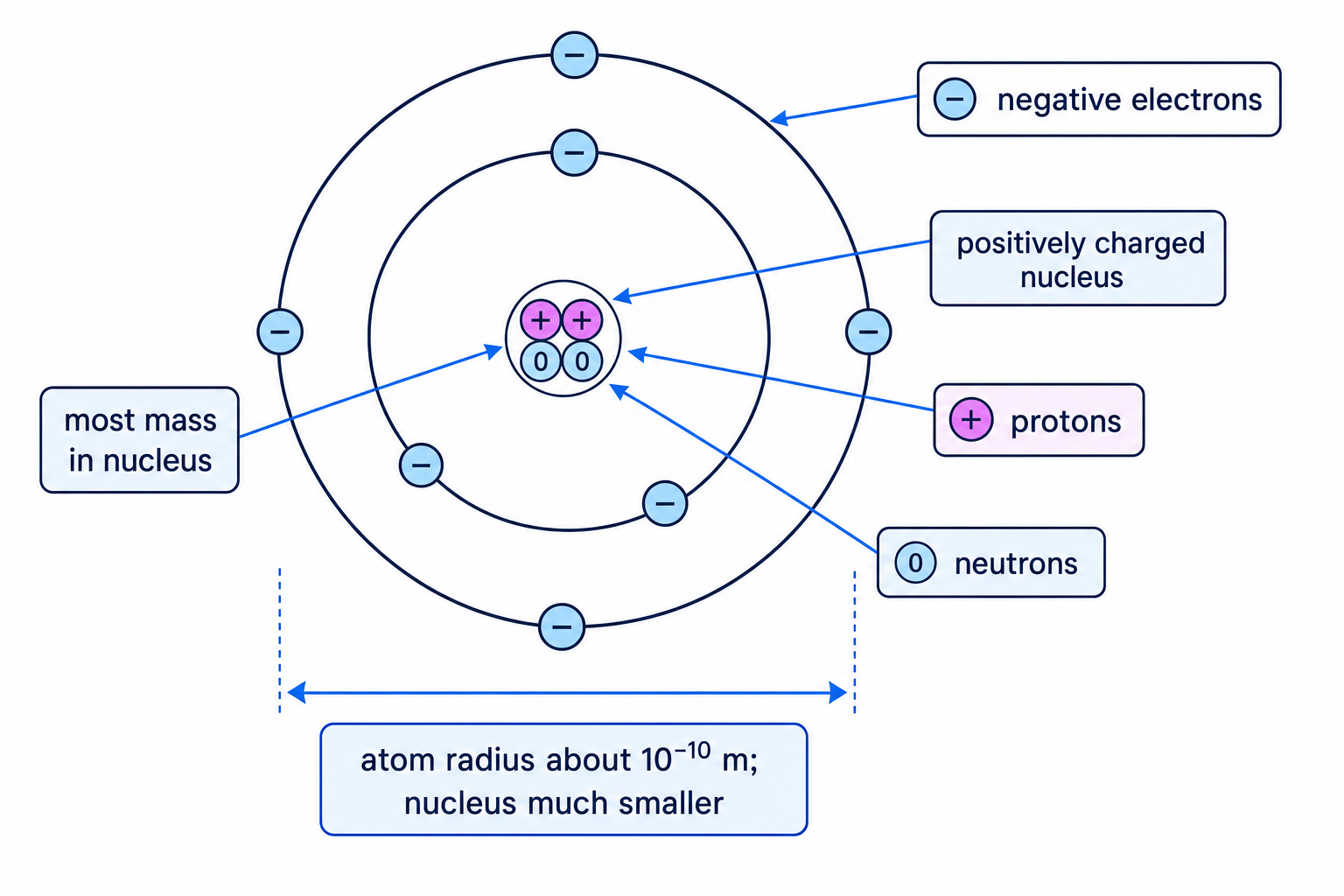
Modern atomic structure
An atom has a tiny, positively charged nucleus containing protons and neutrons, surrounded by negatively charged electrons. Most of the mass is in the nucleus.
How small are atoms?
Atoms are extremely small. A typical atomic radius and a typical bond length are about the order of 10−10 m10^{-10}\text{ m}10−10 m.
That means an atom’s size is around 0.0000000001 metres, or about 0.1 nanometres.
Order of magnitude
An order of magnitude is the nearest power of ten. Saying atoms are about 10−10 m10^{-10}\text{ m}10−10 m means we are focusing on the scale, not an exact measurement.
Small molecules are made from a few atoms bonded together, so they are still incredibly small — usually around the nanometre scale.
Estimating atoms across a centimetre
Roughly how many atoms could fit in a line across 1 cm? Use an atomic size of about 1×10⁻¹⁰ m1 \times 10^{-10}\text{ m}1×10⁻¹⁰ m.
- Convert the length into metres: 1 cm is 1×10⁻² m1 \times 10^{-2}\text{ m}1×10⁻² m.
- Compare the length with the size of one atom by dividing: 1×10⁻² m1×10−10 m\frac{1 \times 10^{-2}\text{ m}}{1 \times 10^{-10}\text{ m}}1×10⁻¹⁰ m1×10−2 m
- Subtract the powers of ten: 10−2÷10−10=10810^{-2} \div 10^{-10} = 10^{8}10−2÷10−10=108 So about 100 million atoms could fit across 1 cm.
Scale sanity check
If your answer suggests only a few hundred atoms fit across a centimetre, it is far too small. Atoms are tiny, so everyday lengths contain huge numbers of atoms.
Protons, neutrons and electrons
You need to recall the relative charge and approximate relative mass of each sub-atomic particle.
| Particle | Relative charge | Approximate relative mass | Where it is found |
|---|---|---|---|
| Proton | +1 | 1 | Nucleus |
| Neutron | 0 | 1 | Nucleus |
| Electron | -1 | about 1/1840 | Shells around nucleus |
“Relative” means compared with the others, not the actual mass in kilograms. Electrons have a very tiny mass compared with protons and neutrons, so almost all the mass of an atom is in the nucleus.
Neutral does not mean equal protons and neutrons
A neutral atom has equal numbers of protons and electrons. It does not have to have equal numbers of protons and neutrons.
Atomic number and mass number
Every element has its own number of protons. This is what makes one element different from another.
Atomic number
The atomic number, also called the proton number, is the number of protons in the nucleus of an atom.
Mass number
The mass number is the total number of protons and neutrons in the nucleus.
The key relationship is:
mass number=number of protons+number of neutrons\text{mass number} = \text{number of protons} + \text{number of neutrons}mass number=number of protons+number of neutronsSo:
number of neutrons=mass number−atomic number\text{number of neutrons} = \text{mass number} - \text{atomic number}number of neutrons=mass number−atomic numberIn standard notation, an atom or ion can be shown like this:
ZAXcharge^{A}_{Z}\mathrm{X}^{\text{charge}}ZAXcharge- X\mathrm{X}X is the chemical symbol.
- AAA is the mass number.
- ZZZ is the atomic number.
- The charge is shown only if the particle is an ion.
For example, 1123Na^{23}_{11}\mathrm{Na}1123Na is a sodium atom with mass number 23 and atomic number 11.
Isotopes
Isotope
Isotopes are atoms of the same element with the same number of protons but different numbers of neutrons.
Because isotopes of the same element have the same number of protons, they have the same atomic number. Their mass numbers are different because they have different numbers of neutrons.
For example, carbon-12 and carbon-14 are isotopes of carbon. Both have 6 protons, but carbon-12 has 6 neutrons and carbon-14 has 8 neutrons.
Element identity
The number of protons decides the element. Changing the number of neutrons makes a different isotope, not a different element.
Ions
Ion
An ion is an atom or group of atoms with an overall electric charge because it has gained or lost electrons.
A neutral atom has no overall charge because the number of positive protons equals the number of negative electrons.
If an atom loses electrons, it becomes a positive ion. If an atom gains electrons, it becomes a negative ion.
Ions do not gain or lose protons
When an atom becomes an ion, the nucleus does not change. The number of protons stays the same; only the number of electrons changes.
Calculating protons, neutrons and electrons
Use these rules:
- Protons = atomic number.
- Neutrons = mass number − atomic number.
- Electrons in a neutral atom = protons.
- For a positive ion, subtract electrons.
- For a negative ion, add electrons.
Finding particles in an ion
Find the numbers of protons, neutrons and electrons in 1327Al3+^{27}_{13}\mathrm{Al}^{3+}1327Al3+.
- Use the atomic number to find protons: atomic number 13 means 13 protons.
- Use mass number minus atomic number to find neutrons: 27−13=1427 - 13 = 1427−13=14 so there are 14 neutrons.
- A neutral aluminium atom would have 13 electrons. The 3+3+3+ charge means it has lost 3 electrons: 13−3=1013 - 3 = 1013−3=10 so the ion has 10 electrons.
Finding particles in a negative ion
Find the numbers of protons, neutrons and electrons in 816O2−^{16}_{8}\mathrm{O}^{2-}816O2−.
- The atomic number is 8, so the ion has 8 protons.
- The number of neutrons is mass number minus atomic number: 16−8=816 - 8 = 816−8=8 so it has 8 neutrons.
- A neutral oxygen atom would have 8 electrons. The 2−2-2− charge means it has gained 2 electrons: 8+2=108 + 2 = 108+2=10 so the ion has 10 electrons.
Quick ion check
Positive ion: fewer electrons than protons. Negative ion: more electrons than protons.
In the exam
- For atomic structure calculations, always start with the atomic number: it gives the number of protons.
- For isotopes, say “same number of protons, different number of neutrons” rather than just “different mass”.
- For ions, change the number of electrons only — never change the number of protons or neutrons.
Check yourself
- Why did Rutherford conclude that the atom has a tiny, dense, positively charged nucleus?
- What are the relative charges and approximate relative masses of protons, neutrons and electrons?
- How many protons, neutrons and electrons are in 1735Cl−^{35}_{17}\mathrm{Cl}^{-}1735Cl−?