

What you'll learn
- Why carbon can make a huge range of natural and synthetic compounds.
- How diamond, graphite, graphene and fullerenes have different properties even though they are all made from carbon.
- How melting point, boiling point and state depend on bond strength and intermolecular forces.
- How to link bulk properties to ionic, molecular, giant covalent, polymer and metallic structures.
1. The starting point: particles, bonds and properties
Before we explain material properties, you need the particle language secure.
Atoms, elements, compounds and mixtures
- An atom is the smallest particle of an element that still has that element’s chemical properties.
- An element is a substance made from only one type of atom.
- A compound is a substance made when atoms of two or more different elements are chemically bonded together.
- A mixture contains two or more substances that are not chemically bonded together.
A chemical bond is a strong attraction holding particles together. Different materials have different types of bonding, and their particles can be arranged in different ways.
A bulk property is a property of a sample of material as a whole, such as hardness, melting point, boiling point, electrical conductivity or malleability.
Structure controls properties
To explain a material’s properties, always link what particles are present, what bonds or forces hold them together, and whether any charged particles can move.
Atoms do not have bulk properties
A single carbon atom is not “hard”, and a single sodium ion does not “conduct electricity”. Bulk properties belong to a large structure or sample, not to one particle on its own.
2. Carbon: four bonds and many compounds
A covalent bond is a strong chemical bond where atoms share a pair of electrons. Carbon is special because each carbon atom can form four covalent bonds.
This means carbon atoms can bond to other carbon atoms, as well as to atoms such as hydrogen, oxygen, nitrogen and chlorine. Carbon atoms can form:
- chains — straight, branched or very long
- rings — closed loops of carbon atoms
- families of similar compounds — compounds with similar structures and similar chemical behaviour
Organic compounds
In GCSE chemistry, organic compounds are mainly carbon-based compounds, often containing carbon and hydrogen. Examples include fuels, oils, many medicines and plastics.
Because carbon can form four bonds and bond to itself, there is a vast range of natural organic compounds such as oils, sugars and proteins, and synthetic organic compounds such as polymers, medicines and dyes.
Why carbon chemistry is so varied
Carbon can make four strong covalent bonds, so it can build chains, rings and complex three-dimensional structures.
3. Carbon allotropes
Different forms of the same element in the same physical state are called allotropes. Diamond, graphite, graphene and fullerenes are all allotropes of carbon: they contain only carbon atoms, but their structures are different.
The diagram compares the bonding and property links for the main carbon allotropes you need to know.
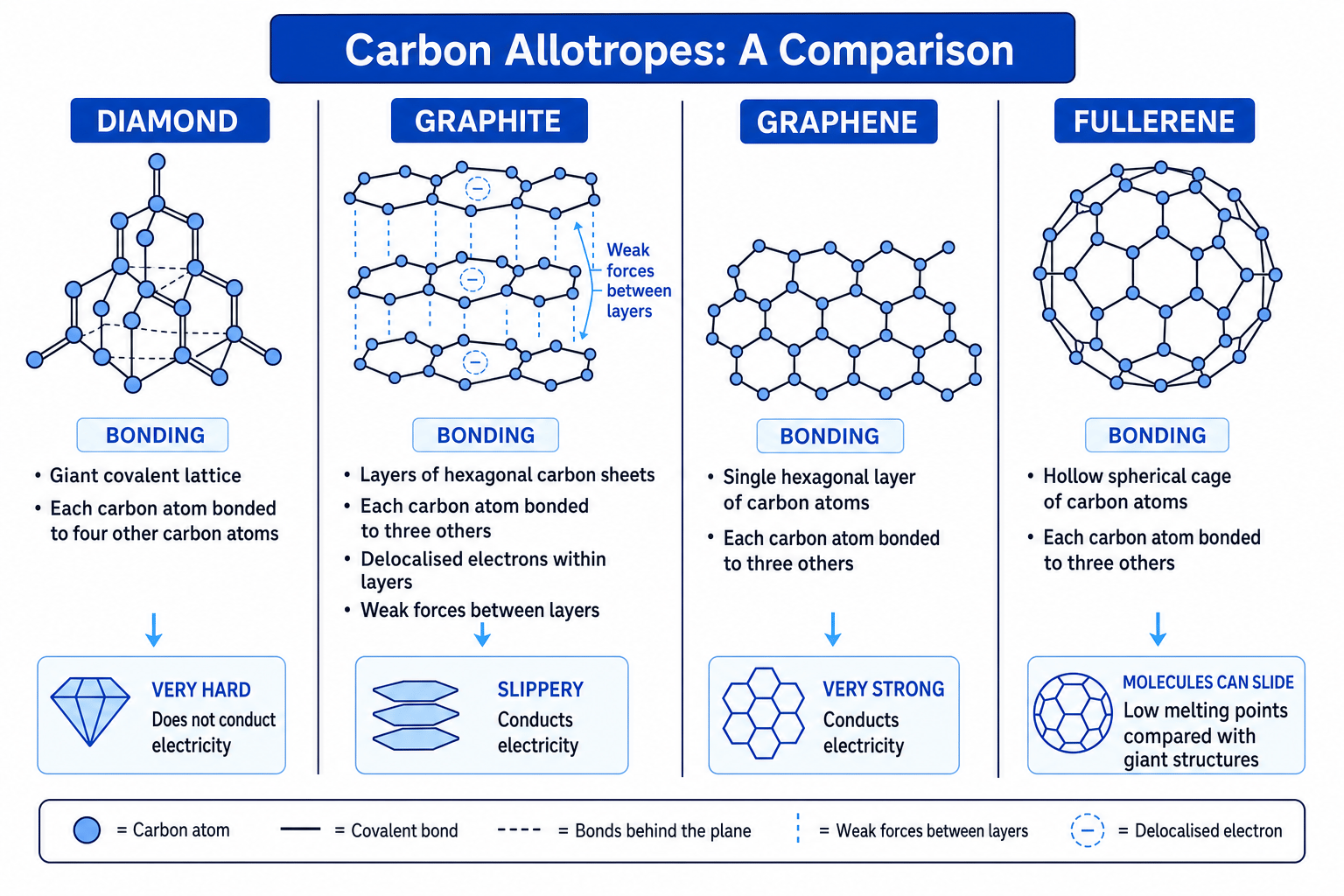
Reading 2D structure drawings
A flat drawing may represent a three-dimensional structure. Repeated patterns show that the structure continues beyond the small part drawn.
Diamond
In diamond, each carbon atom forms four covalent bonds to four other carbon atoms. This makes a giant three-dimensional covalent lattice.
Diamond is:
- very hard because strong covalent bonds hold the atoms in place in all directions
- has a very high melting point because lots of strong covalent bonds must be overcome
- does not conduct electricity because it has no mobile charged particles
Graphite
In graphite, each carbon atom forms three covalent bonds. The atoms form layers of hexagons. There are strong covalent bonds within each layer, but only weak forces between the layers.
Graphite is:
- soft and slippery because the layers can slide over each other
- has a high melting point because covalent bonds within the layers are strong
- conducts electricity because each carbon atom has one delocalised electron that can move through the layers
Graphene
Graphene is a single layer of graphite. It is one atom thick, with carbon atoms arranged in hexagons.
Graphene is:
- very strong for its mass
- an electrical conductor
- useful in modern materials because it is thin, strong and conductive
Fullerenes
Fullerenes are molecules made from carbon atoms arranged in hollow shapes, such as spheres or tubes. A well-known example is buckminsterfullerene, which has 60 carbon atoms.
Fullerenes have relatively low melting points compared with giant covalent structures because the fullerene molecules are held together by weak intermolecular forces.
Comparing electrical conductivity in diamond and graphite
- In diamond, each carbon atom forms four covalent bonds, so all its outer electrons are used in bonding.
- A solid conducts electricity only if it contains charged particles that can move. Diamond has no mobile ions or delocalised electrons.
- In graphite, each carbon atom forms three covalent bonds, leaving one electron per carbon atom delocalised within the layers. These electrons can move and carry charge, so graphite conducts.
4. Changes of state: bonds and forces
A change of state is a physical change, such as melting, boiling, freezing or condensing. The substance is not turning into a new chemical substance.
The melting point is the temperature at which a solid changes to a liquid. The boiling point is the temperature at which a liquid changes to a gas.
When a substance melts or boils, energy is transferred to the particles. That energy helps overcome the attractions holding particles in position or holding particles together.
Intermolecular forces
Intermolecular forces are weak forces between molecules. They are much weaker than covalent bonds inside molecules.
This is why simple molecular substances often have low melting and boiling points: you only need to overcome weak intermolecular forces between molecules, not the strong covalent bonds inside each molecule.
Boiling simple molecules
When water boils, the O–H covalent bonds inside each water molecule are not broken. The molecules separate from each other because intermolecular forces are overcome.
Substances with giant structures usually have much higher melting points, because strong bonds or attractions extend throughout the whole structure.
5. Predicting state from melting and boiling point data
You may be given melting point and boiling point data, then asked to predict the state at a particular temperature.
Let TmT_mTm mean melting temperature, TbT_bTb mean boiling temperature, and TTT mean the temperature being considered.
- If T<TmT < T_mT<Tm, the substance is a solid.
- If Tm<T<TbT_m < T < T_bTm<T<Tb, the substance is a liquid.
- If T>TbT > T_bT>Tb, the substance is a gas.
At the exact melting or boiling point
If the temperature is exactly at the melting point or boiling point, the substance is changing state. GCSE questions usually avoid this unless they want you to say a change of state is happening.
Predicting state from melting and boiling points
A substance has a melting point of -7 °C and a boiling point of 59 °C. Predict its state at 25 °C.
- Compare 25 °C with the melting point: 25 °C is higher than -7 °C, so the substance is not a solid.
- Compare 25 °C with the boiling point: 25 °C is lower than 59 °C, so the substance is not a gas.
- Since the temperature is between the melting point and boiling point, the substance is a liquid.
6. Main material types and their properties
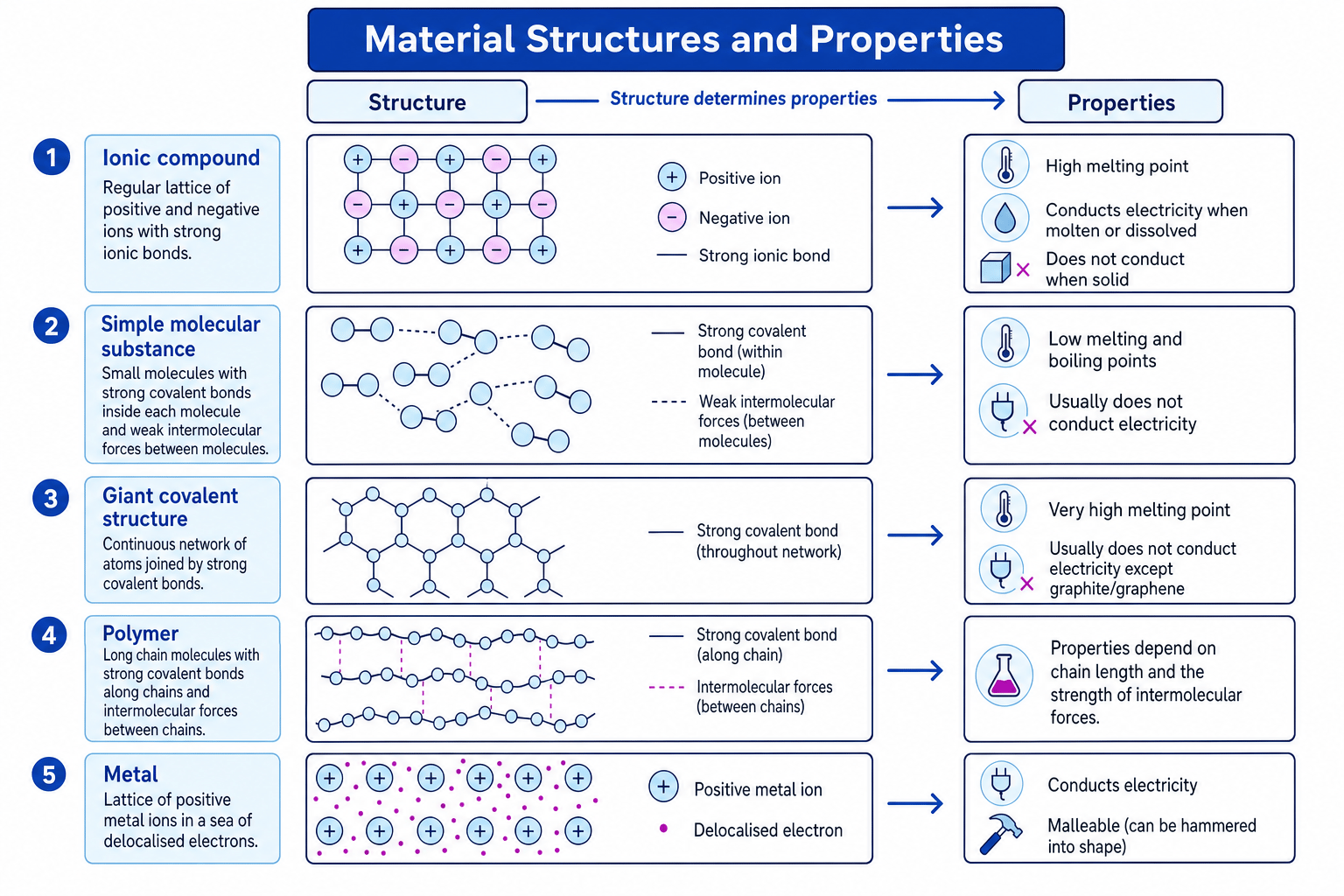
The same idea applies to many types of material: structure and bonding explain properties.
Ionic compounds
An ionic compound contains positive and negative ions arranged in a giant ionic lattice. The ions are held by strong electrostatic attractions.
Ionic compounds usually:
- have high melting and boiling points
- do not conduct electricity when solid, because ions are fixed in place
- conduct electricity when molten or dissolved in water, because ions can move
Simple molecular substances
A simple molecular substance is made from small molecules. The atoms inside each molecule are joined by strong covalent bonds, but the forces between molecules are weak.
Simple molecular substances usually:
- have low melting and boiling points
- do not conduct electricity, because they have no mobile charged particles
Examples include oxygen, carbon dioxide and many covalent liquids.
Giant covalent structures
A giant covalent structure is a huge network of atoms joined by covalent bonds.
Giant covalent structures usually:
- have very high melting points
- are hard, if the covalent bonds hold atoms in a rigid network
- do not conduct electricity, except for graphite and graphene because they have delocalised electrons
Polymers
A polymer is a very large molecule made from many repeating units joined in a long chain.
Polymers have strong covalent bonds along each chain, but forces between polymer chains can vary. Longer chains and stronger intermolecular forces usually make a polymer stronger and give it a higher softening or melting temperature.
Metals
A metal has a giant metallic structure: positive metal ions in a lattice, surrounded by delocalised electrons.
Metals usually:
- conduct electricity because delocalised electrons can move
- conduct thermal energy well
- are malleable, meaning they can be hammered or bent into shape because layers of ions can slide while the metallic bonding still holds the structure together
Identifying a material from its properties
A solid has a high melting point. It does not conduct electricity as a solid, but it conducts when molten. Identify the type of structure.
- A high melting point suggests strong attractions throughout a giant structure.
- Not conducting as a solid rules out metals and graphite, because they have mobile delocalised electrons in the solid state.
- Conducting when molten means charged particles become mobile. That fits an ionic compound, because ions can move when the lattice melts.
In the exam
- Link every property to structure: name the particles, the bonds or forces, and whether charged particles can move.
- For melting and boiling points, say whether strong chemical bonds or weak intermolecular forces are being overcome.
- For conductivity, always identify the mobile charged particles: delocalised electrons or moving ions.
Check yourself
- Why does diamond not conduct electricity, but graphite does?
- A substance has a melting point of 10 °C and a boiling point of 90 °C. What state is it at room temperature?
- Why do simple molecular substances usually have lower boiling points than giant covalent structures?
