What you'll learn
- How to write formulae for elements, covalent compounds and ionic compounds.
- How balanced chemical equations show conservation of atoms and mass.
- How to use state symbols and test for common gases.
- If you study Higher Tier, how moles, concentration, Avogadro’s constant and limiting reactants connect equations to real masses.
Reactions are rearrangements of atoms
A chemical reaction happens when substances change into new substances. The starting substances are called reactants. The new substances formed are called products.
Chemical reaction
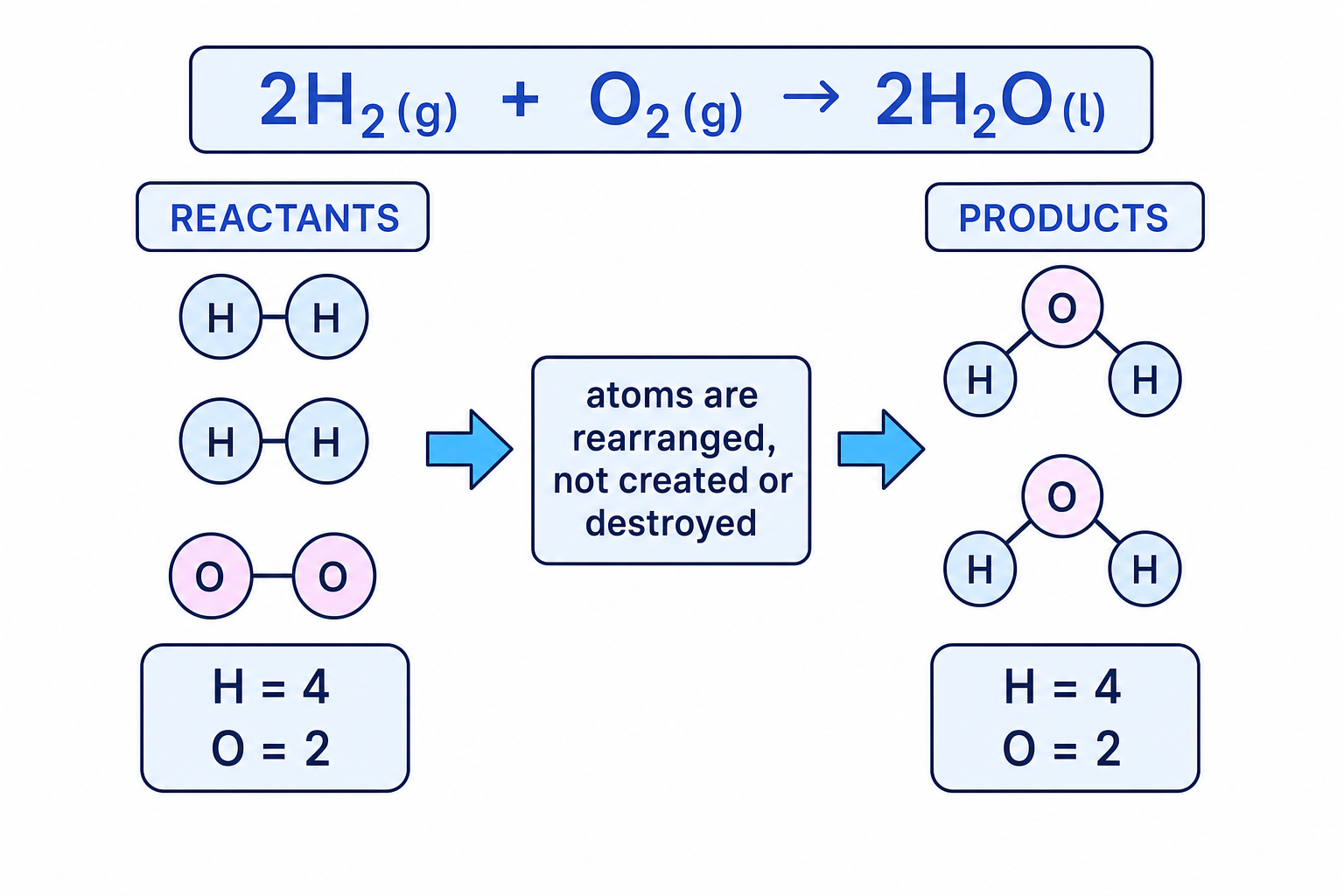
A chemical reaction is a change in which atoms are rearranged to make new substances. Atoms are not created, destroyed or changed into different elements.
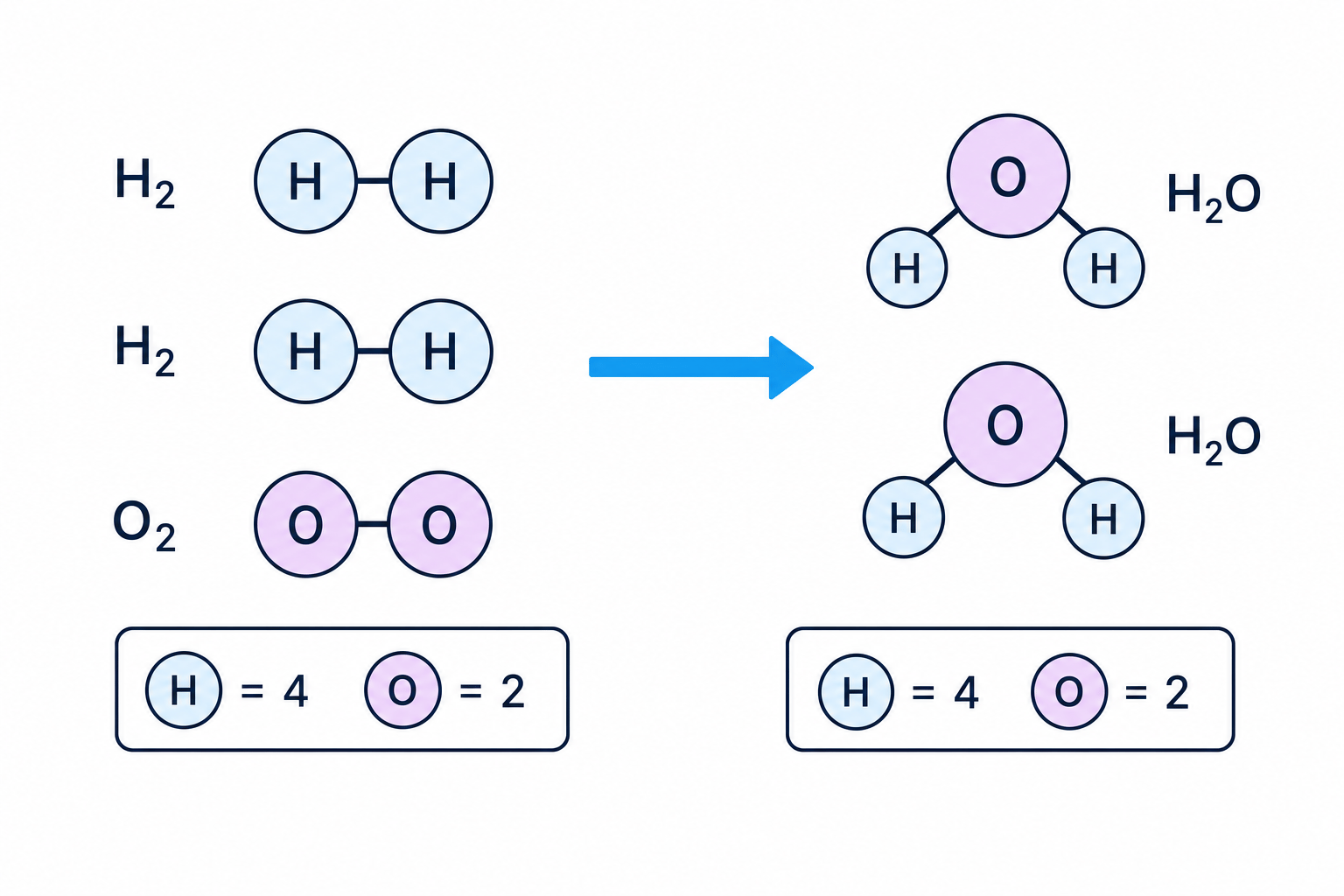
For example, hydrogen reacts with oxygen to form water: 2H₂(g) + O₂(g) → 2H₂O(l). The diagram shows why the equation must be balanced: the number of each type of atom is the same before and after the reaction.
Conservation of mass
In a closed system, no substances enter or leave, so the total mass of reactants equals the total mass of products. This is the law of conservation of mass.
In a non-enclosed system — an open container, for example — the measured mass may change because a gas escapes or a gas from the air joins the reaction.
Saying mass is lost
If a balance reading goes down during a reaction, do not say “mass has disappeared”. Say that a gas product has escaped from the apparatus, so it is no longer being measured.
Writing formulae
A chemical symbol represents an element, such as H for hydrogen, O for oxygen and Na for sodium. Be careful with capital letters: Co means cobalt, but CO means carbon monoxide.
A formula shows which atoms or ions are present, and in what ratio. You should be able to use a supplied Periodic Table, especially for the first 20 elements, Groups 1, 7 and 0, plus common elements used elsewhere in the course.
Simple covalent compounds
A covalent compound is made when non-metal atoms share electrons. Its formula shows the number of atoms in one molecule.
Examples include:
- water: H₂O
- carbon dioxide: CO₂
- methane: CH₄
Ionic compounds
An ion is a charged particle. An ionic compound is made from positive ions and negative ions. The overall charge of the compound must be zero.
Common ions include Na⁺, K⁺, Mg²⁺, Ca²⁺, Al³⁺, Cl⁻, O²⁻, OH⁻, NO₃⁻, SO₄²⁻ and CO₃²⁻.
Deducing an ionic formula
Work out the formula of aluminium sulfate from Al³⁺ and SO₄²⁻.
- Aluminium ions have a charge of 3+, while sulfate ions have a charge of 2−.
- The smallest total charge that both 3 and 2 fit into is 6, so use two Al³⁺ ions for 6+ and three SO₄²⁻ ions for 6−.
- Write the formula as Al₂(SO₄)₃. The brackets show that there are three whole sulfate ions.
Do not change ion formulae
When writing ionic formulae, change the number of ions, not the formula of the ion itself. For example, sulfate stays as SO₄²⁻; it does not become SO₃.
Balanced chemical equations
A chemical equation uses formulae to show a reaction. A number in front of a formula is called a coefficient. It multiplies the whole formula.
A state symbol shows the physical state:
- (s) = solid
- (l) = liquid
- (g) = gas
- (aq) = aqueous, meaning dissolved in water
Balancing aluminium oxide
Balance this equation: Al(s) + O₂(g) → Al₂O₃(s)
- Oxygen atoms come in pairs on the left but threes on the right, so make 6 oxygen atoms: 3O₂(g) on the left and 2Al₂O₃(s) on the right.
- Two Al₂O₃ units contain 4 aluminium atoms, so put 4Al(s) on the left.
- The balanced equation is 4Al(s) + 3O₂(g) → 2Al₂O₃(s).
Changing subscripts when balancing
Never change a formula to balance an equation. Change coefficients only. For example, write 2H₂O, not H₂O₂, unless the substance really is hydrogen peroxide.
Ionic equations and half equations
On Higher Tier, you also need to focus on ions that actually change during reactions.
A spectator ion is an ion present in the reaction mixture that does not change. An ionic equation leaves out spectator ions.
Constructing an ionic equation
Silver nitrate solution reacts with sodium chloride solution to form silver chloride precipitate:
AgNO₃(aq) + NaCl(aq) → AgCl(s) + NaNO₃(aq)
- Split the aqueous ionic compounds into ions: Ag⁺(aq), NO₃⁻(aq), Na⁺(aq) and Cl⁻(aq).
- Identify the ions that stay aqueous and unchanged: Na⁺(aq) and NO₃⁻(aq) are spectator ions.
- Remove the spectator ions to get: Ag⁺(aq) + Cl⁻(aq) → AgCl(s).
A half equation shows electrons gained or lost by one reactant. For example:
- Mg(s) → Mg²⁺(aq) + 2e⁻
- Cl₂(g) + 2e⁻ → 2Cl⁻(aq)
Tests for selected gases
You need to know these gas tests accurately.
| Gas | Positive test |
|---|---|
| Oxygen | A glowing splint relights. |
| Hydrogen | A lit splint gives a squeaky pop. |
| Carbon dioxide | Limewater turns milky or cloudy. |
| Chlorine | Damp blue litmus paper is bleached white, often after turning red first. |
The mole and Avogadro’s constant
On Higher Tier, reactions are linked to the amount of substance, measured in moles, symbol mol.
Mole
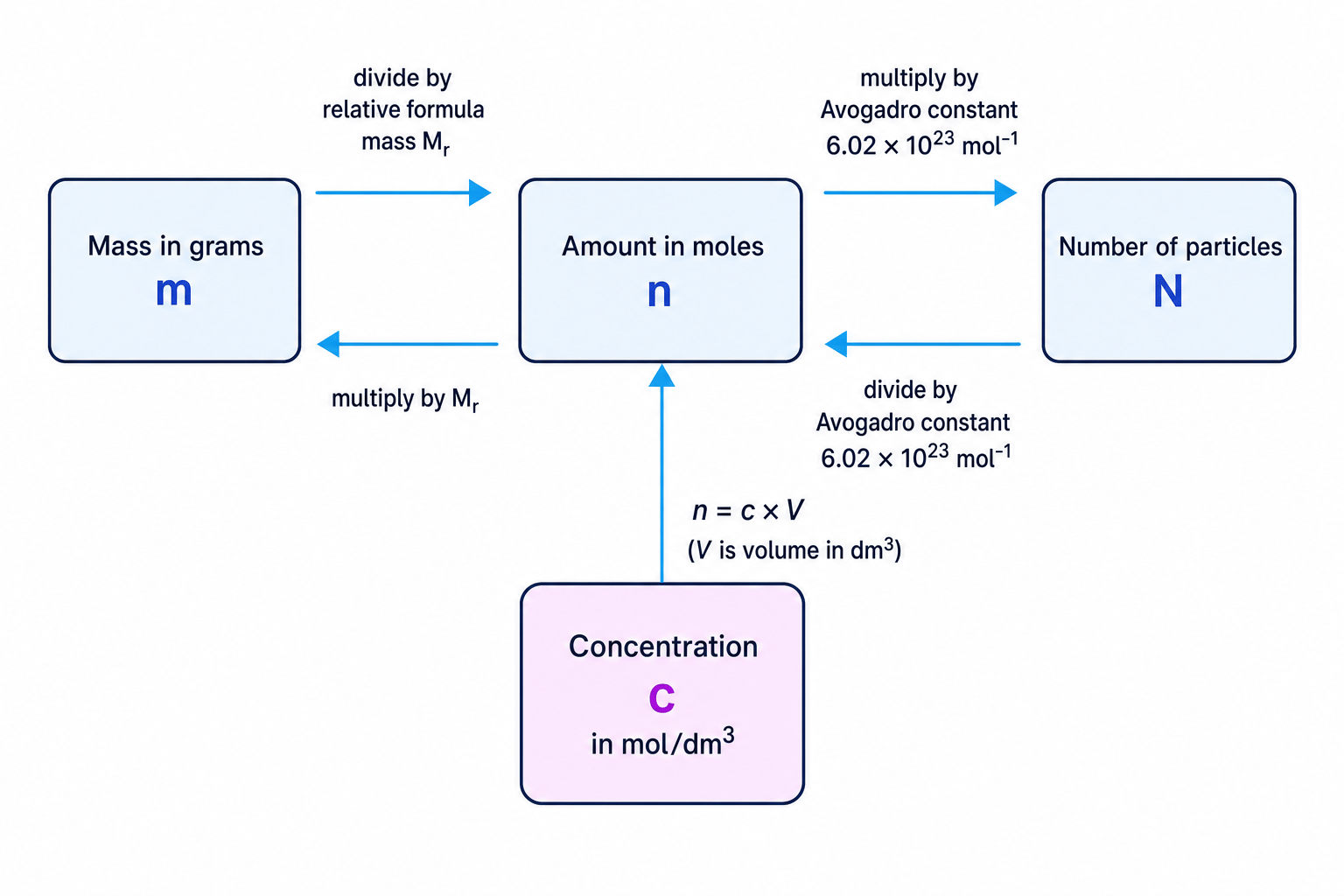
One mole contains 6.02×10236.02 \times 10^{23}6.02×10²³ particles. This number is the Avogadro constant, NA=6.02×10²³ mol−1N_A = 6.02 \times 10^{23}\ \text{mol}^{-1}NA=6.02×10²³ mol−1.
The particles might be atoms, molecules, ions or formula units. The relative formula mass, MrM_rMr, is found by adding the relative atomic masses in the formula.
The main relationships are:
n=mMrn = \frac{m}{M_r}n=Mrmwhere nnn is amount in mol and mmm is mass in grams.
Finding the mass of one molecule
Find the mass of one carbon dioxide molecule. Use C = 12, O = 16.
- Calculate the relative formula mass: Mr(CO2)=12+2(16)=44M_r(\text{CO}_2) = 12 + 2(16) = 44Mr(CO2)=12+2(16)=44.
- One mole of CO₂ molecules has a mass of 44 g and contains 6.02×10236.02 \times 10^{23}6.02×10²³ molecules.
- Divide by Avogadro’s constant: 44 g6.02×1023=7.31×10⁻²³ g\frac{44\ \text{g}}{6.02 \times 10^{23}} = 7.31 \times 10^{-23}\ \text{g}6.02×102344 g=7.31×10⁻²³ g per molecule.
Concentration of solutions
A solute is the substance dissolved. A solution is the mixture formed when a solute dissolves in a solvent, usually water.
On Higher Tier, concentration can be measured in mol/dm³:
c=nVc = \frac{n}{V}c=Vnwhere ccc is concentration, nnn is amount in mol and VVV is volume in dm³. Remember: 1000 cm³ = 1 dm³.
Calculating mass from concentration
Calculate the mass of sodium chloride needed to make 250 cm³ of 0.200 mol/dm³ NaCl solution. Use Na = 23, Cl = 35.5.
- Convert the volume: 250 cm³ = 0.250 dm³.
- Calculate moles: n=cV=0.200 mol/dm3×0.250 dm3=0.0500 moln = cV = 0.200\ \text{mol/dm}^3 \times 0.250\ \text{dm}^3 = 0.0500\ \text{mol}n=cV=0.200 mol/dm3×0.250 dm3=0.0500 mol.
- Calculate mass using Mr(NaCl)=58.5M_r(\text{NaCl}) = 58.5Mr(NaCl)=58.5: m=nMr=0.0500×58.5=2.93 gm = nM_r = 0.0500 \times 58.5 = 2.93\ \text{g}m=nMr=0.0500×58.5=2.93 g.
Stoichiometry and limiting reactants
Stoichiometry means using the ratios in a balanced equation. These ratios are mole ratios, not mass ratios.
A limiting reactant is the reactant that runs out first. It limits the maximum amount of product made.
Identifying a limiting reactant
Magnesium reacts with oxygen: 2Mg(s) + O₂(g) → 2MgO(s).
4.8 g of magnesium reacts with 4.8 g of oxygen. Use Mg = 24 and O = 16.
- Convert masses to moles: n(Mg)=4.824=0.20 moln(\text{Mg}) = \frac{4.8}{24} = 0.20\ \text{mol}n(Mg)=244.8=0.20 mol and n(O2)=4.832=0.15 moln(\text{O}_2) = \frac{4.8}{32} = 0.15\ \text{mol}n(O2)=324.8=0.15 mol.
- Use the equation ratio: 2 mol Mg needs 1 mol O₂, so 0.20 mol Mg needs 0.10 mol O₂.
- Compare with what is available: 0.15 mol O₂ is available, so oxygen is in excess and magnesium is limiting.
- Use the product ratio: 2 mol Mg makes 2 mol MgO, so 0.20 mol Mg makes 0.20 mol MgO.
- Convert to mass: m(MgO)=0.20×40=8.0 gm(\text{MgO}) = 0.20 \times 40 = 8.0\ \text{g}m(MgO)=0.20×40=8.0 g.
To deduce a formula from masses, convert each mass to moles, then reduce to the simplest whole-number ratio. This is the same ratio thinking used in balancing equations.
In the exam
- For formulae, check charges cancel to zero; for equations, count atoms on both sides.
- Always include state symbols when writing chemical equations, and use the exact gas test observations.
- For Higher calculations, write the balanced equation first, convert masses to moles, use the mole ratio, then convert back if needed.
Check yourself
- Why can the measured mass decrease when a carbonate reacts with acid in an open flask?
- What is the formula of aluminium sulfate, and why are brackets needed?
- How would you test for oxygen, hydrogen and carbon dioxide?