What you'll learn
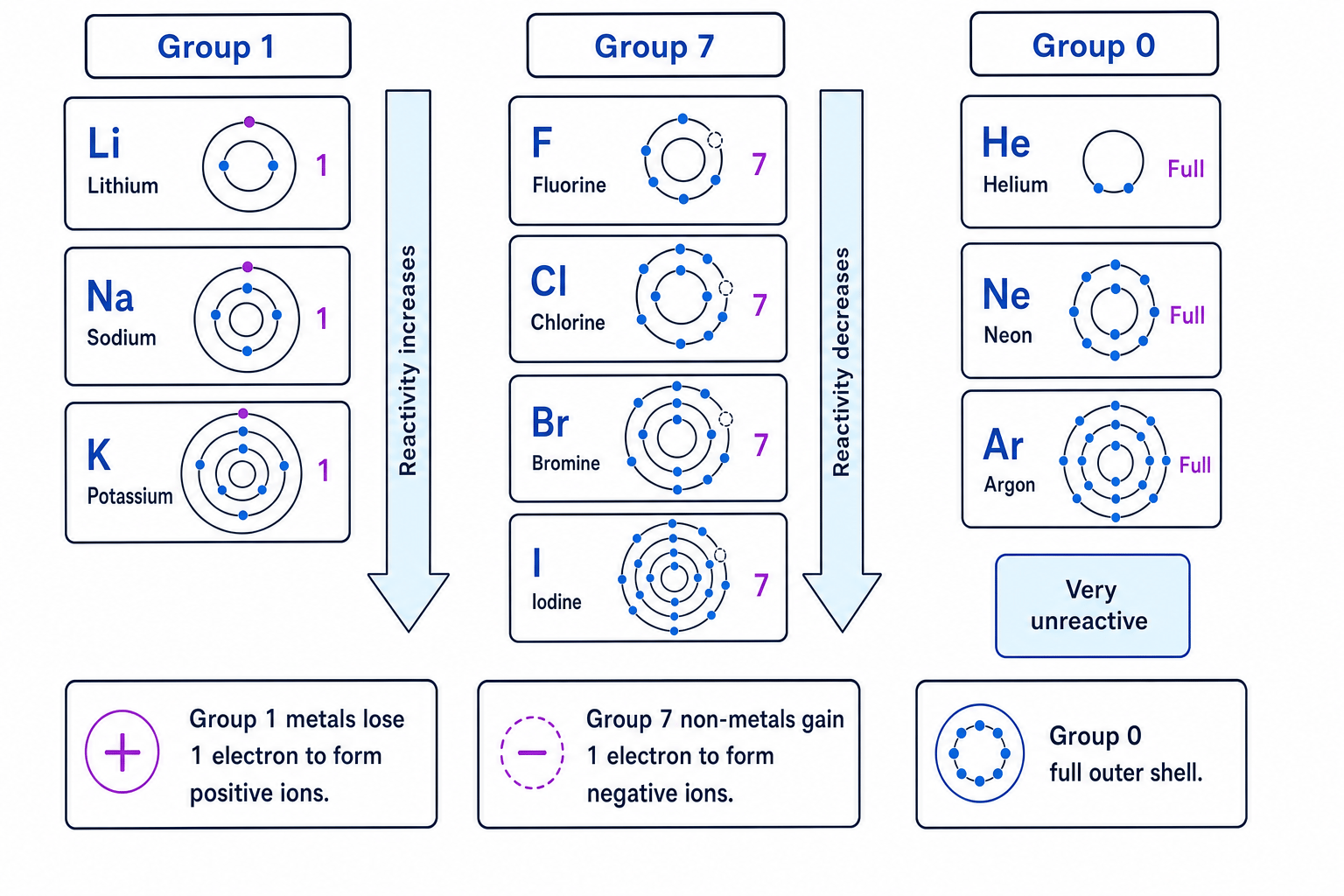
- How Groups 1, 7 and 0 in the Periodic Table behave.
- How outer-shell electrons help explain reactivity trends.
- How metals react with water and dilute acids.
- How to use experimental results to place metals in order of reactivity.
Start point: what counts as a chemical reaction?
A chemical reaction happens when atoms are rearranged to make new substances. The starting substances are called reactants, and the substances made are called products.
A physical change, such as melting, boiling, freezing or dissolving, does not usually make a new substance.
State symbols
State symbols show the physical state of each substance in a chemical equation: (s) solid, (l) liquid, (g) gas, and (aq) aqueous, meaning dissolved in water.
Dissolving is not automatically reacting
If copper sulfate crystals dissolve in water, you still have copper sulfate particles, now spread through the water. In a chemical reaction, new substances form — for example, copper metal appearing during a displacement reaction.
The Periodic Table as a prediction tool
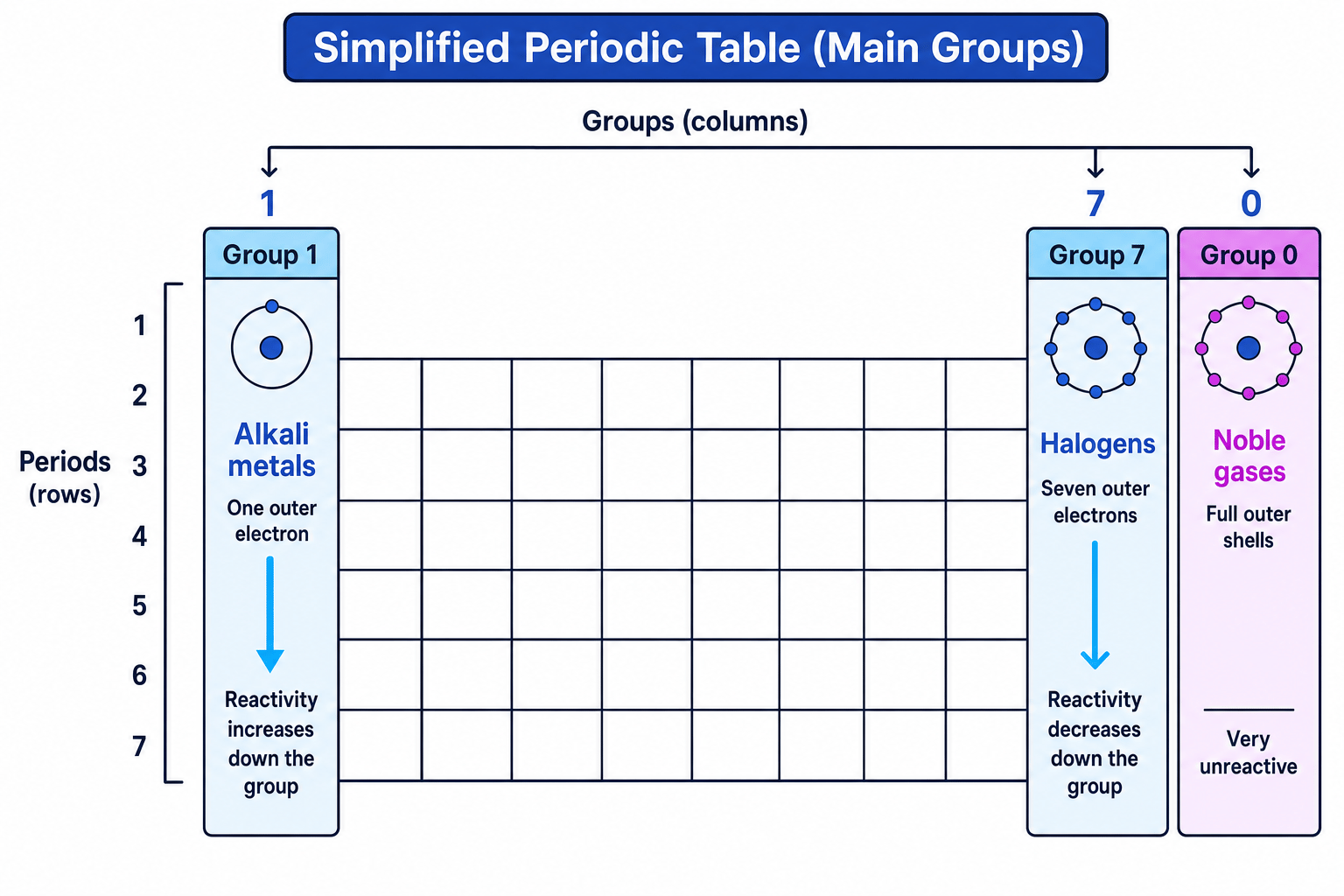
The Periodic Table is arranged so that elements with similar properties are in the same group.
Groups, periods and outer shells
A group is a vertical column in the Periodic Table. A period is a horizontal row. The outer shell is the highest occupied electron shell of an atom, and its electrons are especially important in chemical reactions.
Elements in the same group have the same number of outer-shell electrons, so they often react in similar ways. This is why the Periodic Table is so useful for predicting reactions.
Why outer electrons matter
Most chemical reactions involve atoms losing, gaining or sharing outer-shell electrons. So the group number often gives clues about the type of reaction an element will do.
Atoms are not tiny chunks of the material
A sodium atom is not “soft” or “shiny”. Those are bulk properties of a large sample of sodium metal. But the atom’s one outer electron helps explain why the bulk metal is so reactive.
Group 1: the alkali metals
Group 1 metals include lithium, sodium and potassium. Hydrogen is often shown above Group 1, but it is not treated as an alkali metal at GCSE.
Simple properties of Group 1 metals
Group 1 metals:
- are soft metals
- are shiny when freshly cut, but quickly tarnish in air
- have relatively low densities and low melting points compared with many other metals
- react with water to form an alkaline metal hydroxide solution and hydrogen gas
- become more reactive down the group
Group 1 atoms have one electron in their outer shell. In reactions, they tend to lose this electron and form positive ions such as Li⁺, Na⁺ and K⁺.
The reactivity increases down Group 1 because the outer electron is further from the nucleus and more shielded by inner electron shells. This means it is lost more easily.
Predicting a Group 1 reaction with water
Potassium is added to water. Predict the products and compare its reactivity with sodium.
-
Potassium is in Group 1, so it has one outer-shell electron and reacts by losing it to form K⁺ ions.
-
Group 1 metals react with water to form a metal hydroxide and hydrogen gas. For potassium, the hydroxide is potassium hydroxide.
-
Potassium is below sodium in Group 1, so it is more reactive than sodium. The reaction is likely to be more vigorous.
-
The balanced equation is:
2K(s) + 2H₂O(l) → 2KOH(aq) + H₂(g)
Group 7: the halogens
Group 7 elements include fluorine, chlorine, bromine and iodine. They are non-metals called the halogens.
Simple properties of Group 7
Group 7 elements:
- are coloured non-metals
- exist as diatomic molecules, such as Cl₂, Br₂ and I₂
- become darker in colour down the group
- have higher melting and boiling points down the group
- become less reactive down the group
A diatomic molecule contains two atoms joined together.
Group 7 atoms have seven electrons in their outer shell. They tend to gain one electron to form negative ions such as Cl⁻, Br⁻ and I⁻. These negative ions are called halide ions.
The reactivity decreases down Group 7 because the incoming electron is attracted less strongly by the nucleus. The outer shell is further away and there is more shielding from inner shells.
Halogen displacement reactions
A more reactive halogen can displace a less reactive halogen from a solution of its halide compound.
For example, chlorine is more reactive than bromine, so chlorine can displace bromine from potassium bromide solution.
Predicting a halogen displacement
Chlorine solution is added to potassium iodide solution. Predict whether a reaction happens.
-
Chlorine is above iodine in Group 7. Reactivity decreases down Group 7, so chlorine is more reactive than iodine.
-
Because chlorine is more reactive, chlorine molecules take electrons from iodide ions. Iodide ions become iodine molecules.
-
A reaction happens, producing potassium chloride and iodine:
Cl₂(aq) + 2KI(aq) → 2KCl(aq) + I₂(aq)
Halogen or halide?
A halogen is the element, such as chlorine, Cl₂. A halide ion is the negative ion in a compound or solution, such as chloride, Cl⁻.
Group 0: the noble gases
Group 0 elements include helium, neon, argon and krypton. They are called the noble gases.
Group 0 elements:
- are colourless gases at room temperature
- are very unreactive
- exist as single atoms, not molecules
- have low boiling points, which increase down the group
They are unreactive because their outer electron shells are full. This makes the atoms stable, so they do not usually gain, lose or share electrons.
Helium is the special case
Helium has only two electrons, not eight, but its first shell is full. That is why helium still belongs in Group 0.
Predicting reactions from position in the Periodic Table
You can often make a sensible prediction by asking:
- Is the element a metal or non-metal?
- Which group is it in?
- Does that group tend to lose or gain electrons?
- What is the trend in reactivity down the group?
Metals are mostly found on the left and centre of the Periodic Table. They usually react by losing electrons to form positive ions. Non-metals are mostly found on the right. They often react by gaining or sharing electrons.
Ion
An ion is a charged particle formed when an atom or group of atoms loses or gains electrons. Losing electrons forms a positive ion; gaining electrons forms a negative ion.
Metal reactivity: forming positive ions
Reactivity
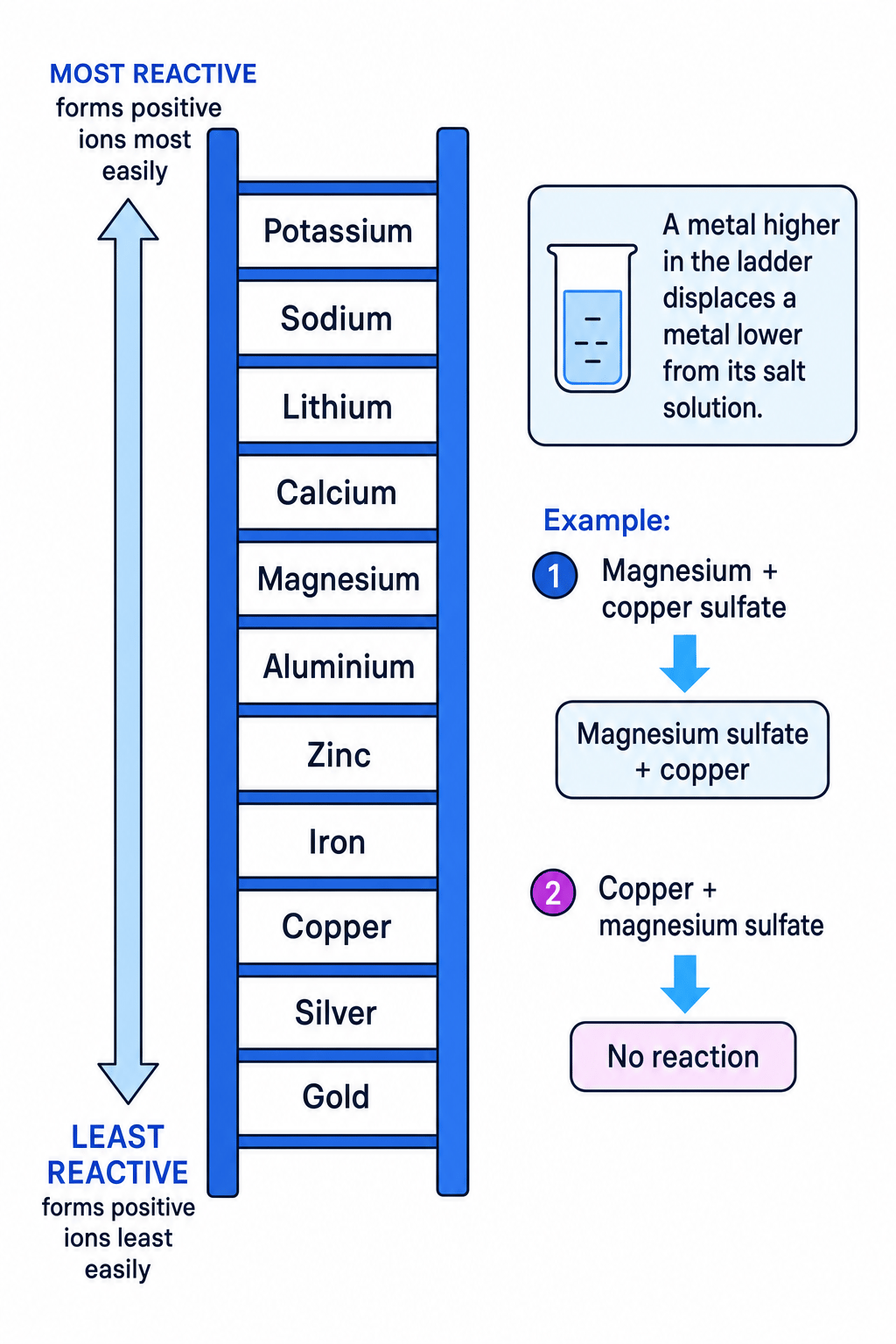
Reactivity means how readily a substance takes part in a chemical reaction. For metals in this topic, a more reactive metal forms positive ions more easily.
A metal that loses electrons easily is more reactive. This explains why metals higher in the reactivity series react more vigorously with water or dilute acids.
Reactive metals can react with cold water to produce a metal hydroxide and hydrogen. Many metals react with dilute acids to produce a salt and hydrogen.
For example, magnesium reacts with dilute hydrochloric acid:
Mg(s) + 2HCl(aq) → MgCl₂(aq) + H₂(g)
The hydrogen gas is usually seen as fizzing or bubbling.
Comparing metal reactions with dilute acid
Magnesium and copper are separately added to dilute hydrochloric acid. Predict the observations.
-
Magnesium is much more reactive than copper, so magnesium atoms form Mg²⁺ ions more readily.
-
Magnesium reacts with hydrochloric acid to form magnesium chloride and hydrogen gas:
Mg(s) + 2HCl(aq) → MgCl₂(aq) + H₂(g)
-
Magnesium should fizz as hydrogen gas is produced. Copper does not react with dilute hydrochloric acid under normal GCSE conditions, so there is no visible reaction.
Fair comparisons
When comparing metal reactivity from fizzing, keep the conditions the same: same mass or surface area of metal, same acid concentration, same acid volume and same temperature.
Oxygen can be a hidden reactant
Some reactions happen in open air, so oxygen from the air may be involved even though you cannot see it.
When a metal burns or oxidises, oxygen atoms become part of the product. This means the solid product can have a greater mass than the starting metal.
Explaining a mass increase during oxidation
Magnesium is burned in air and the solid product has a greater mass than the magnesium at the start.
-
Magnesium has reacted with oxygen gas from the air, so oxygen is a reactant even though it was not in the original solid.
-
The product, magnesium oxide, contains both magnesium atoms and oxygen atoms.
-
The balanced equation is:
2Mg(s) + O₂(g) → 2MgO(s)
The extra mass comes from oxygen atoms added from the air.
Forgetting gases in open systems
If a reaction happens in an open container, gases can enter or leave. Always consider invisible gases such as oxygen and carbon dioxide when explaining mass changes.
Displacement reactions of metals
A displacement reaction happens when a more reactive element takes the place of a less reactive element in a compound.
For metals, a more reactive metal can displace a less reactive metal from a solution of its salt. A salt solution is an ionic compound dissolved in water, such as copper sulfate solution.
For example:
Mg(s) + CuSO₄(aq) → MgSO₄(aq) + Cu(s)
Magnesium is more reactive than copper, so magnesium displaces copper from copper sulfate solution.
Displacement rule for metals
A metal can only displace another metal from its compound if it is more reactive than the metal in that compound.
Ordering metals from displacement results
A student tests zinc, iron and copper using metal salt solutions. Use the results to put the metals in order of reactivity.
-
Zinc placed in copper sulfate solution forms a reddish-brown solid of copper. So zinc is more reactive than copper:
Zn(s) + CuSO₄(aq) → ZnSO₄(aq) + Cu(s)
-
Iron placed in zinc sulfate solution shows no reaction. So iron is not reactive enough to displace zinc, meaning zinc is more reactive than iron.
-
Iron placed in copper sulfate solution forms copper metal. So iron is more reactive than copper:
Fe(s) + CuSO₄(aq) → FeSO₄(aq) + Cu(s)
-
Combining the evidence gives the order from most reactive to least reactive: zinc, iron, copper.
Pulling it together
To predict chemical reactions, combine:
- the group number and outer-shell electrons
- the trend down the group
- whether atoms tend to form positive or negative ions
- experimental evidence such as fizzing, temperature change or displacement
The aim is not to guess randomly — it is to use patterns.
In the exam
-
Identify the group first: Group 1 loses one electron, Group 7 gains one electron, and Group 0 has full outer shells.
-
For trends, remember: Group 1 gets more reactive down the group, but Group 7 gets less reactive down the group.
-
In displacement questions, compare reactivity directly: the more reactive element replaces the less reactive one.
-
Always balance symbol equations and include state symbols when writing chemical equations.
Check yourself
- Why does potassium react more vigorously with water than sodium?
- Chlorine is added to potassium bromide solution. What products would you expect?
- How could you use displacement results to decide whether zinc or copper is more reactive?