

What you'll learn
- How to measure the rate of reaction in practical experiments.
- How to interpret rate graphs, including using gradients and
1/time. - How temperature, concentration, pressure and surface area change reaction rate.
- How catalysts, including enzymes, speed up reactions using activation energy.
Starting point: what does “rate” mean?
In everyday language, a rate tells you how quickly something happens. In chemistry, the rate of reaction tells you how quickly reactants are used up or products are made.
For example, when magnesium reacts with hydrochloric acid, hydrogen gas is produced:
Mg(s) + 2HCl(aq) → MgCl₂(aq) + H₂(g)
If hydrogen gas is produced quickly, the reaction has a high rate. If it is produced slowly, the reaction has a low rate.
Rate of reaction
The rate of reaction is the change in amount of reactant or product per unit time.
rate=change in amounttime\text{rate} = \frac{\text{change in amount}}{\text{time}}rate=timechange in amountCommon units include cubic centimetres per second (cm³/s) for gas volume, or grams per second (g/s) for mass change.
Calculating mean rate from gas volume
A reaction produces 60 cm³ of gas in 150 s. Calculate the mean rate of gas production.
-
Choose the useful equation:
rate=change in volumetime\text{rate} = \frac{\text{change in volume}}{\text{time}}rate=timechange in volume -
Substitute the values with units:
rate=60 cm3150 s\text{rate} = \frac{60\ \text{cm}^3}{150\ \text{s}}rate=150 s60 cm3 -
Calculate the value:
rate=0.40 cm3/s\text{rate} = 0.40\ \text{cm}^3/\text{s}rate=0.40 cm3/s
So the mean rate is 0.40 cm³/s.
Measuring rate of reaction in practical work
To measure rate, you need to measure a change over time. The best method depends on what the reaction produces or uses up.
Method 1: measuring gas volume
If a gas is produced, collect it in a gas syringe or over water in an upside-down measuring cylinder. Record the gas volume at regular time intervals.
A common example is marble chips reacting with hydrochloric acid:
CaCO₃(s) + 2HCl(aq) → CaCl₂(aq) + CO₂(g) + H₂O(l)
Here, carbon dioxide gas is produced, so you can measure the volume of CO₂(g) over time.
Method 2: measuring mass loss
If a gas escapes from the reaction flask, the total mass decreases. You can place the flask on a balance and record the mass at regular intervals.
The rate is found from how quickly the mass falls.
Method 3: measuring a fixed visible change
In the disappearing cross experiment, a cloudy product forms and eventually hides a cross underneath the flask. You measure the time taken for the cross to disappear.
This gives a useful comparison, but it is less precise because deciding when the cross “disappears” is partly subjective.
Fair comparisons
When investigating one factor, such as temperature or concentration, keep all other variables the same. This makes it a fair test, meaning any change in rate is likely due to the variable you changed.
Interpreting rate graphs
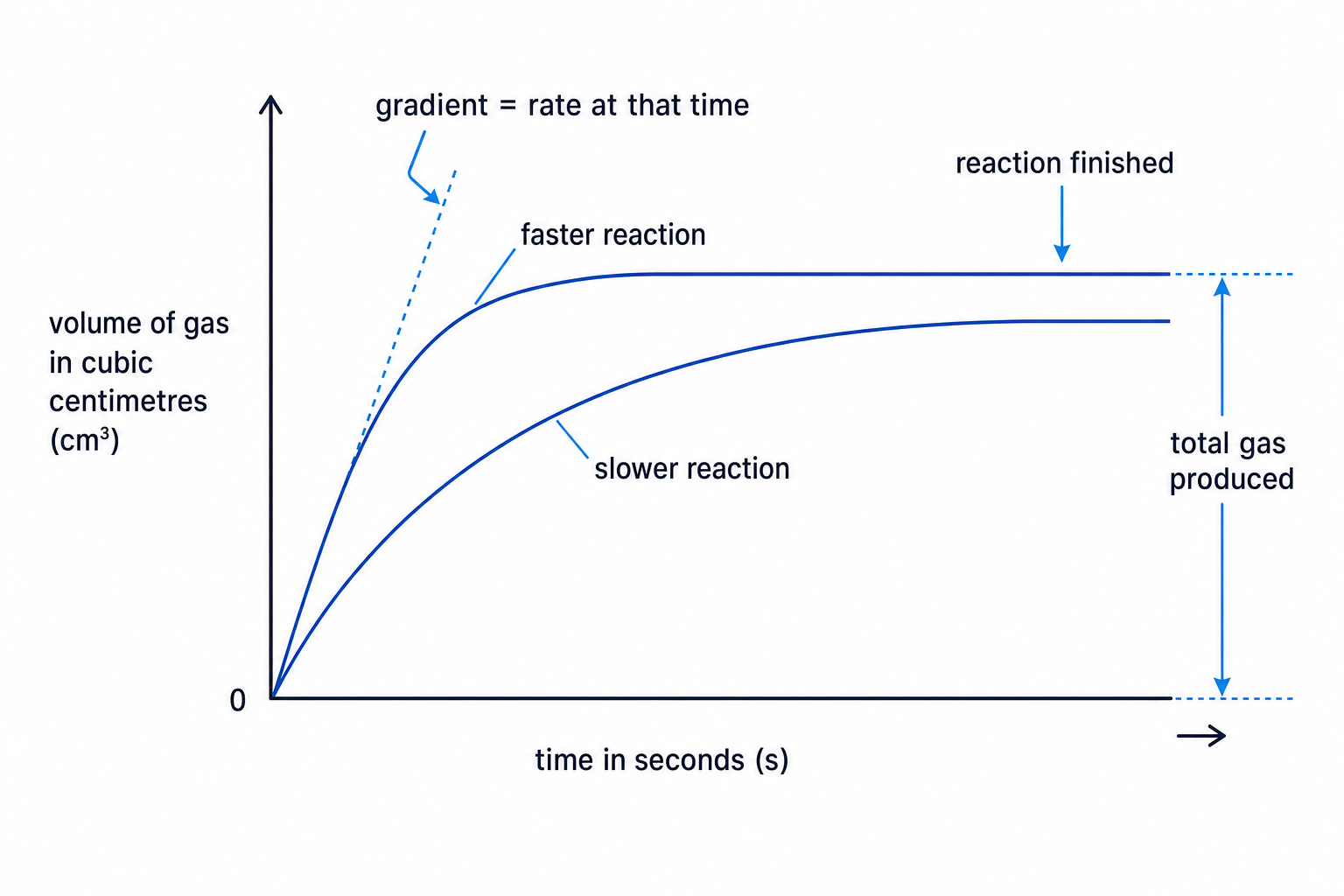
Rate graphs often show the amount of product made against time. For a gas-producing reaction, the vertical axis is often volume of gas in cm³, and the horizontal axis is time in seconds.
What the shape tells you
At the start, the curve is usually steep because reactant particles are most concentrated, so collisions happen often.
As the reaction continues, reactants get used up. The curve becomes less steep, meaning the rate decreases.
Eventually, the graph becomes flat. This means no more gas is being produced, so the reaction has finished.
Gradient
The gradient of a graph means its steepness. On a product-against-time graph, the gradient gives the rate of reaction at that time.
gradient=change in ychange in x\text{gradient} = \frac{\text{change in y}}{\text{change in x}}gradient=change in xchange in yFinding rate from a graph gradient
A tangent to a gas-volume graph passes through the points 20 s, 18 cm³ and 70 s, 43 cm³. Find the rate at that time.
-
Find the change in volume:
43 cm3−18 cm3=25 cm343\ \text{cm}^3 - 18\ \text{cm}^3 = 25\ \text{cm}^343 cm3−18 cm3=25 cm3 -
Find the change in time:
70 s−20 s=50 s70\ \text{s} - 20\ \text{s} = 50\ \text{s}70 s−20 s=50 s -
Calculate the gradient:
rate=25 cm350 s=0.50 cm3/s\text{rate} = \frac{25\ \text{cm}^3}{50\ \text{s}} = 0.50\ \text{cm}^3/\text{s}rate=50 s25 cm3=0.50 cm3/s
So the rate at that time is 0.50 cm³/s.
Misreading the flat part
A flat line does not mean the reaction is going at a steady rate. It means the rate is zero because the reaction has finished.
Using 1/time to compare rates
Sometimes you do not measure product continuously. Instead, you measure the time taken to reach a fixed endpoint, such as a cross disappearing.
If the same endpoint is used each time, then:
rate∝1t\text{rate} \propto \frac{1}{t}rate∝t1This means a shorter time means a faster reaction.
Proportional
Two quantities are proportional if they change in the same ratio. In rate experiments with a fixed endpoint, rate is proportional to 1/time, so halving the time doubles the rate.
Comparing rates using 1/time
A disappearing cross experiment is repeated at two temperatures. At 20 °C, the cross disappears in 80 s. At 40 °C, it disappears in 20 s. Compare the rates.
-
Use the fixed-endpoint idea:
rate∝1t\text{rate} \propto \frac{1}{t}rate∝t1 -
Compare the rates using the times the opposite way round:
rate at 40 °Crate at 20 °C=8020\frac{\text{rate at 40 °C}}{\text{rate at 20 °C}} = \frac{80}{20}rate at 20 °Crate at 40 °C=2080 -
Calculate the ratio:
8020=4\frac{80}{20} = 42080=4
The reaction at 40 °C is 4 times faster than the reaction at 20 °C.
Collision theory: why reactions happen
For particles to react, they must collide with enough energy. Not every collision causes a reaction.
Activation energy
The activation energy is the minimum energy that reacting particles must have when they collide for a reaction to happen.
A successful collision is a collision that leads to a reaction. To increase the rate, you need either:
- more collisions per second, or
- a greater fraction of collisions with energy at least equal to the activation energy.
Collision theory
A reaction is faster when particles have more frequent successful collisions.
Factors that affect rate
Temperature
Increasing temperature usually increases the rate of reaction.
Particles have more kinetic energy, meaning they move faster. This causes more frequent collisions. More importantly, a larger fraction of particles have enough energy to overcome the activation energy.
So temperature increases both collision frequency and collision energy.
Concentration of solutions
The concentration of a solution tells you how much dissolved substance there is in a certain volume of solution.
A more concentrated solution contains more reacting particles per unit volume. This means particles are closer together, so collisions happen more often.
For example, magnesium reacts faster with more concentrated hydrochloric acid because acid particles collide with the magnesium more frequently.
Pressure of gases
For reactions involving gases, increasing pressure pushes the gas particles closer together.
This increases the number of particles per unit volume, so collisions are more frequent. Therefore, increasing pressure usually increases the rate of reaction for gases.
Surface area of solids
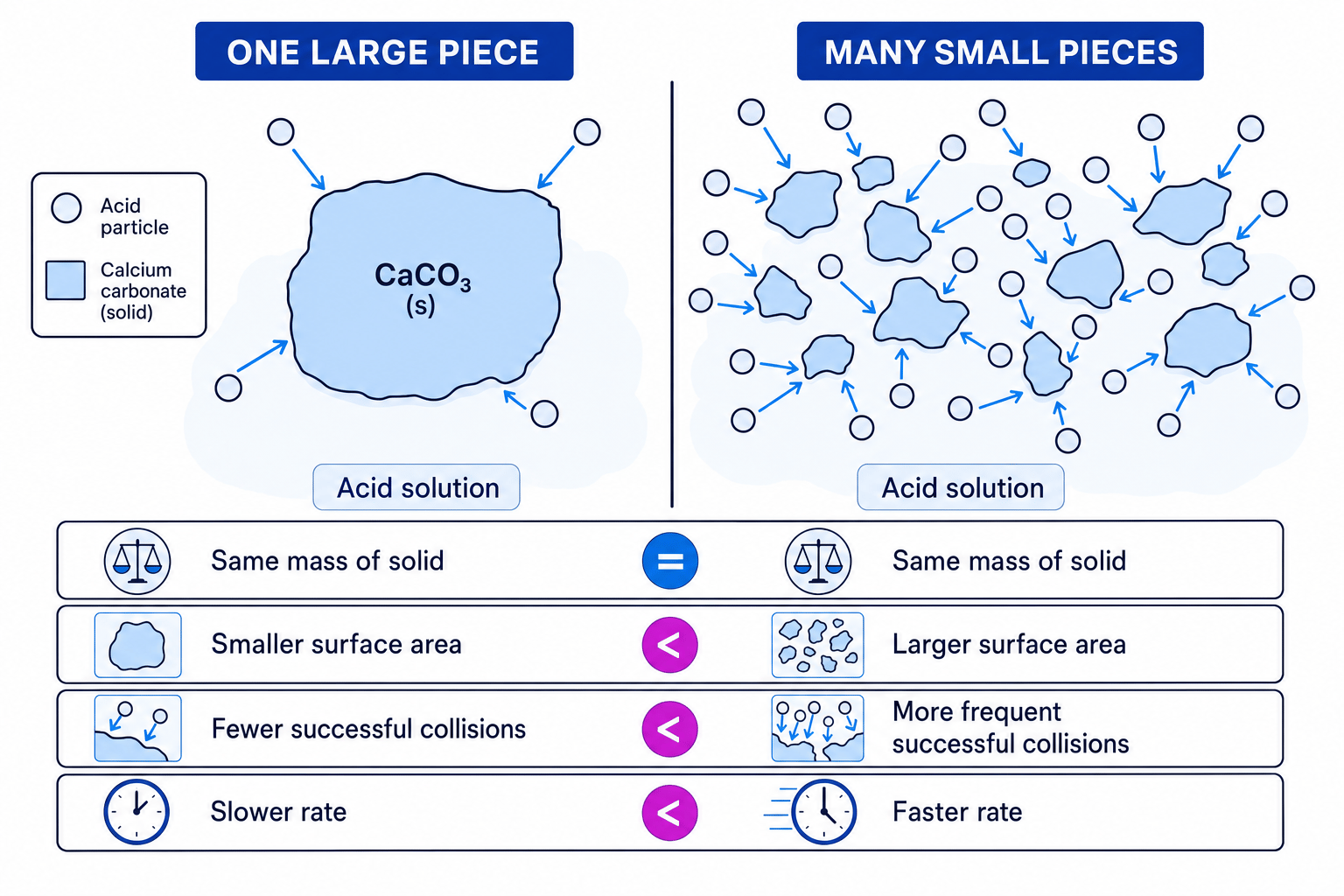
The surface area of a solid is the total area of its exposed outer surface. Only particles on the surface of a solid can collide with particles in a solution or gas.
If you break a solid into smaller pieces, the total surface area increases. This gives more places for collisions to happen.
Surface area to volume ratio
The surface area to volume ratio compares the exposed surface area with the volume of the object. Smaller pieces have a larger surface area to volume ratio than one large piece of the same total mass.
Explaining the effect of smaller pieces
Marble chips react with hydrochloric acid. The same mass of marble chips is used each time, but one experiment uses large chips and another uses powdered marble. Explain which is faster.
-
Compare the surface area: powdered marble has a larger total exposed surface area than large chips of the same mass.
-
Link surface area to collisions: more calcium carbonate particles are exposed, so acid particles can collide with the solid more often.
-
Link collisions to rate: more frequent successful collisions mean the powdered marble reacts faster.
Rate versus amount
Changing surface area or adding a catalyst changes how fast the reaction happens. If the amount of limiting reactant is unchanged, the final amount of product is usually unchanged.
Catalysts
A catalyst is a substance that increases the rate of a chemical reaction without being used up overall.
Catalyst
A catalyst speeds up a reaction and is chemically unchanged at the end of the reaction.
Catalysts are useful because a small amount can speed up a large amount of reaction. They are often shown above the reaction arrow, or they may be present at the start and recovered unchanged at the end.
For example, manganese dioxide catalyses the decomposition of hydrogen peroxide:
2H₂O₂(aq) → 2H₂O(l) + O₂(g)
The manganese dioxide is not included as a reactant or product in the overall equation because it is not used up.
Catalysts do not run out
A catalyst may be involved during the reaction, but it is regenerated by the end. Do not say it is “used up” like a reactant.
How catalysts work
Catalysts provide an alternative pathway for the reaction with a lower activation energy.
Because the activation energy is lower, more particles have enough energy to react when they collide. This increases the frequency of successful collisions, so the reaction is faster.
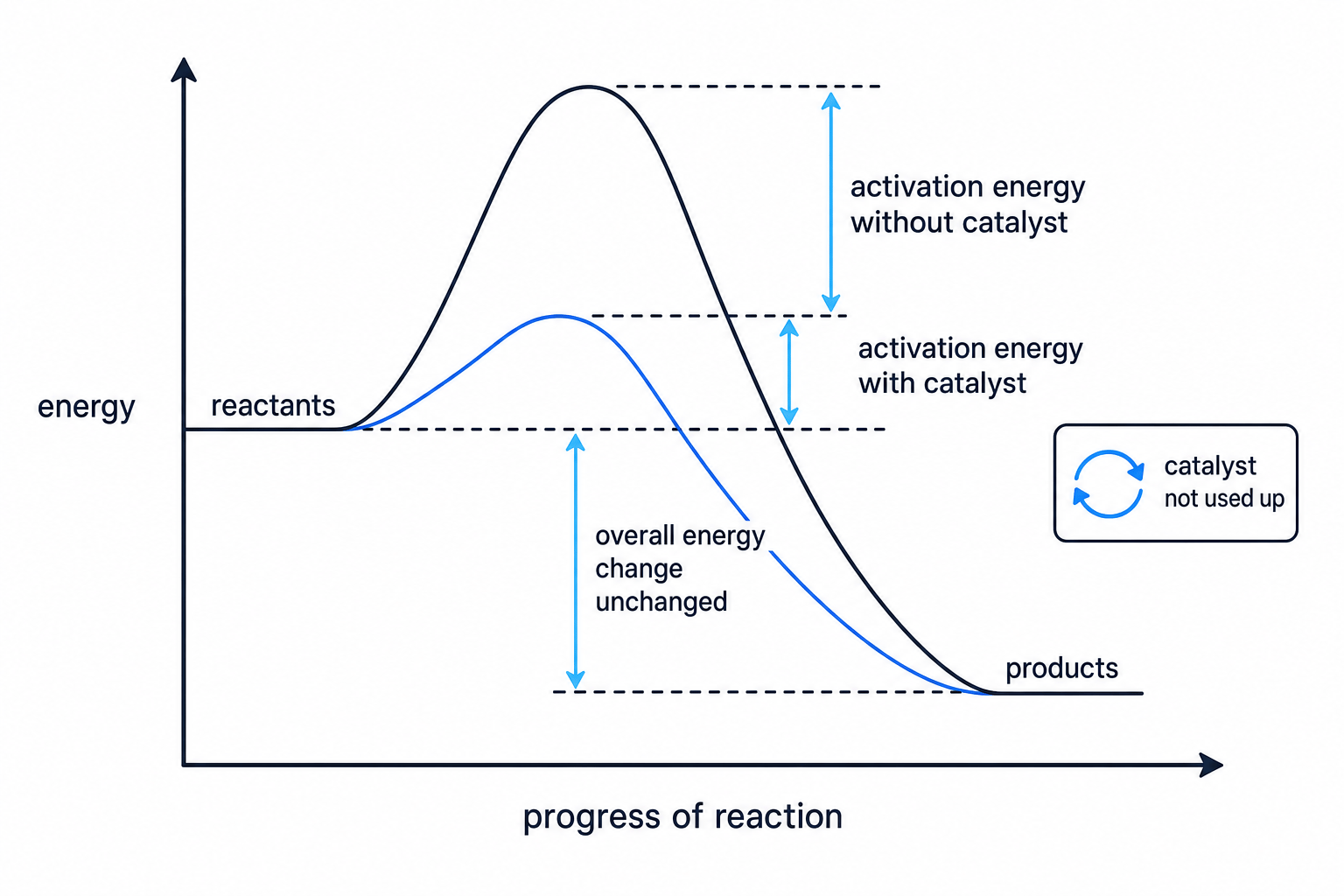
A catalyst does not change the overall energy change of the reaction. It changes the route, not the start and finish energy levels.
Identifying a catalyst from evidence
Hydrogen peroxide decomposes slowly on its own. When a black powder is added, oxygen is produced much faster. At the end, the black powder can be filtered off and has not changed. Explain why the powder is a catalyst.
-
Compare the rates: oxygen is produced faster when the black powder is present, so the powder increases the rate.
-
Check whether it is used up: the powder can be recovered at the end and has not changed overall.
-
Apply the definition: a substance that speeds up a reaction without being used up is a catalyst.
Enzymes are biological catalysts
An enzyme is a catalyst used in living organisms. Enzymes speed up biological reactions, such as digestion and reactions inside cells.
For GCSE Combined Science, the key link here is simple: enzymes are catalysts in biological systems.
In the exam
- When describing rate graphs, mention the gradient: steeper means faster, flat means finished.
- For fixed-endpoint experiments, use 1/t1/t1/t to compare rates, not just the raw time.
- In explanations, link the factor to collision frequency and/or collision energy, then link that to more successful collisions.
Check yourself
- How could you measure the rate of a reaction that produces carbon dioxide gas?
- Why does increasing temperature increase reaction rate?
- How does a catalyst make a reaction faster without being used up?
