What you'll learn
- What power tells you about how quickly energy is transferred.
- Why energy is dissipated into less useful stores rather than “used up”.
- How to calculate efficiency using useful output energy and input energy.
- How lubrication, insulation, wall thickness and thermal conductivity affect unwanted energy transfers.
Starting point: energy is conserved
In physics, a system is the object or group of objects you are thinking about, such as a kettle, a lamp, a motor, or a whole house.
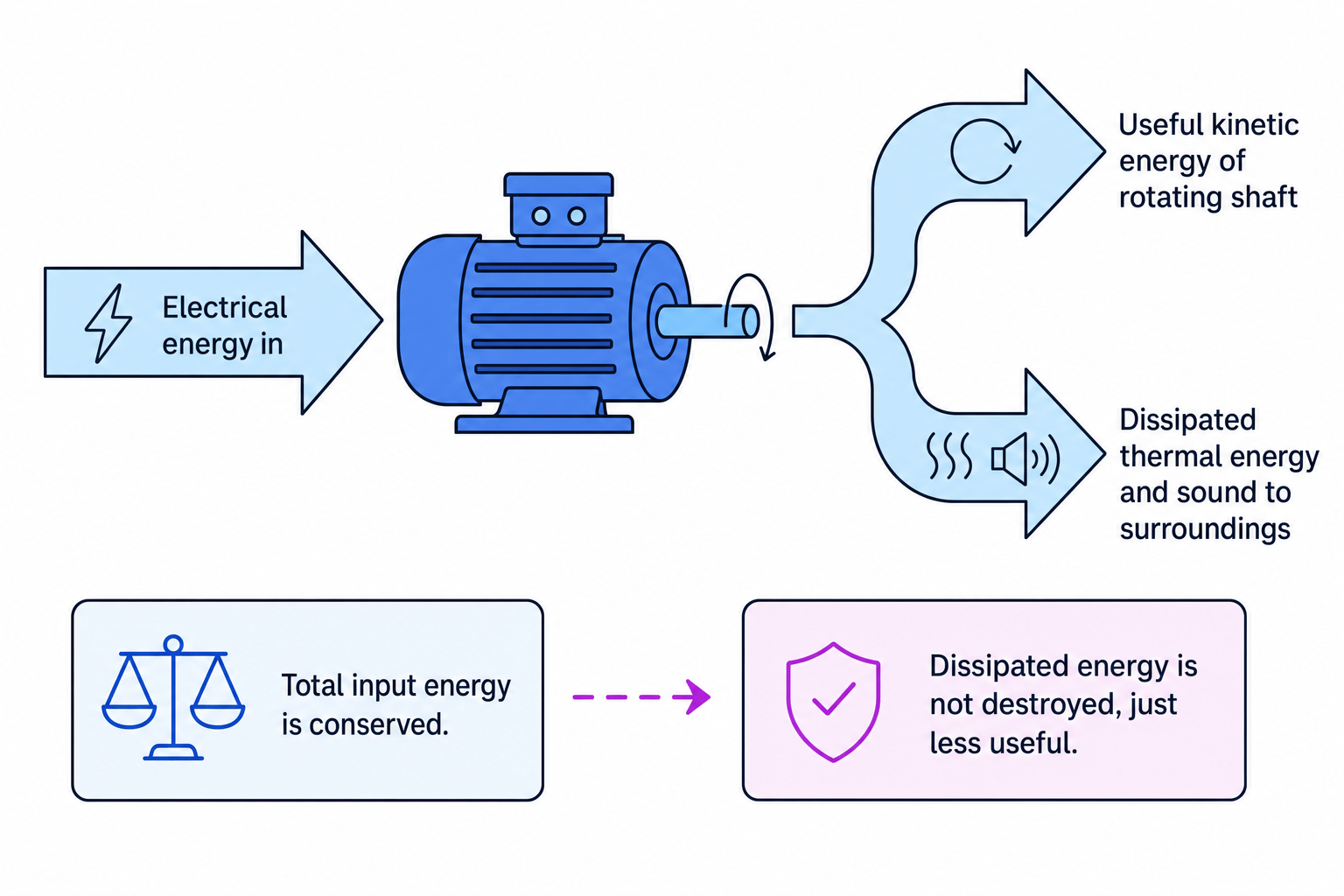
Energy can be transferred between energy stores, such as a thermal store, kinetic store, chemical store, or gravitational potential store. The key rule is that energy is conserved: it cannot be created or destroyed.
However, in real devices, not all the energy transfer is useful.
Dissipated energy
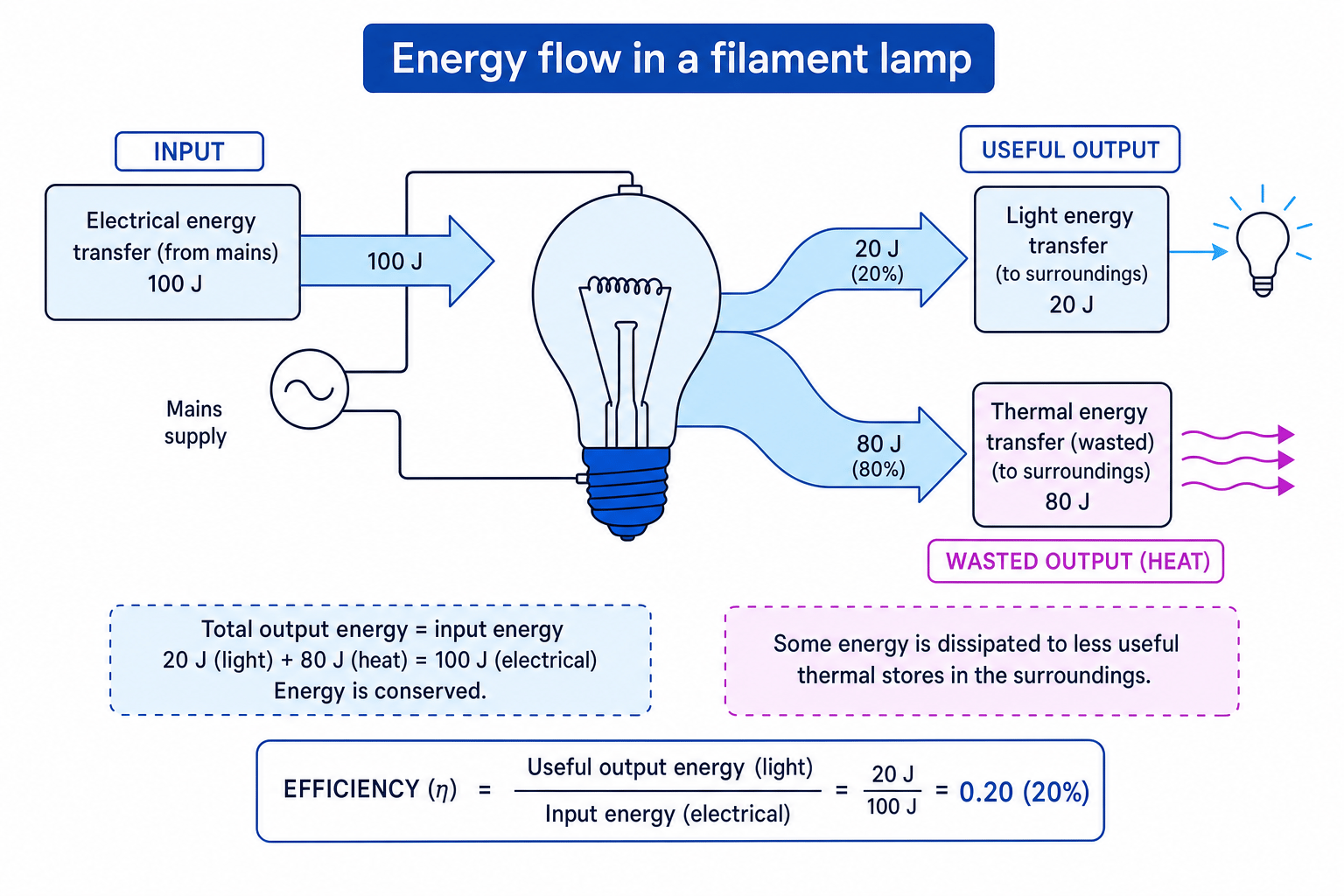
Energy is dissipated when it is spread out into less useful stores, usually the thermal stores of the surroundings. The energy has not disappeared — it has just become harder to use.
For example, a filament lamp transfers electrical energy into light, which is useful, but much more of the energy is transferred by heating to the surroundings, which is usually wasted.
Energy is not used up
In exams, phrases like “energy is wasted” or “energy is lost” mean “not usefully transferred”. They do not mean energy has been destroyed.
Describing dissipated energy
A blender receives 800 J of electrical energy. It transfers 500 J usefully to the kinetic store of the spinning blades.
- The input energy transfer is 800 J, because that is the total energy supplied to the blender.
- The useful output energy transfer is 500 J, because that energy makes the blades move.
- The wasted energy transfer is the difference: 800 J−500 J=300 J800\,\text{J} - 500\,\text{J} = 300\,\text{J}800J−500J=300J.
- That 300 J is dissipated mainly to the thermal stores of the motor and surroundings, and some may be transferred by sound.
Domestic electrical devices
A domestic appliance is a household electrical device, such as a kettle, toaster, hairdryer, lamp, vacuum cleaner or phone charger.
Appliances can receive energy from:
- batteries, which store energy chemically and transfer it electrically through a circuit
- the mains supply, which provides electrical energy to homes using a.c. or alternating current
Alternating current
Alternating current, usually written as a.c., is an electric current that repeatedly changes direction. The UK mains supply is a.c.
Different devices are designed to make different useful energy transfers:
- A kettle transfers energy electrically to the thermal store of water.
- A lamp transfers energy electrically to light and to thermal stores.
- A fan transfers energy electrically to the kinetic store of the moving blades and air.
- A speaker transfers energy electrically to sound waves.
Motors and heating devices always waste some energy. In a motor, energy may be wasted because of friction between moving parts and electrical resistance in wires. In a heating device, some energy may heat the casing, wires or surrounding air instead of the object you actually wanted to heat.
Power: how fast energy is transferred
Power tells you the rate of energy transfer. In everyday language, a “powerful” appliance transfers energy quickly.
Power
Power is the energy transferred per second. It is measured in watts (W). One watt means one joule of energy is transferred every second.
The relationship is:
P=EtP = \frac{E}{t}P=tEwhere:
- PPP is power in watts (W)
- EEE is energy transferred in joules (J)
- ttt is time in seconds (s)
You can rearrange this to find energy transferred:
E=P×tE = P \times tE=P×tA power rating is the power an appliance is designed to use when working normally. It is often printed on the appliance, for example 40 W, 800 W or 2 kW.
Power rating
A higher power rating means the appliance transfers more energy each second. It does not automatically mean the appliance is more efficient.
Calculating energy from a power rating
A 1.5 kW electric heater is switched on for 4 minutes. Calculate the energy transferred.
- Convert the power into watts: 1.5 kW=1500 W1.5\,\text{kW} = 1500\,\text{W}1.5kW=1500W.
- Convert the time into seconds: 4 min=240 s4\,\text{min} = 240\,\text{s}4min=240s.
- Use E=P×tE = P \times tE=P×t: E=1500 W×240 sE = 1500\,\text{W} \times 240\,\text{s}E=1500W×240s.
- Calculate the energy transferred: E=360000 JE = 360000\,\text{J}E=360000J.
Power calculation units
Use watts and seconds in E=P×tE = P \times tE=P×t. If the question gives kilowatts or minutes, convert them first.
Efficiency
No real device transfers all its input energy usefully. Efficiency tells you what fraction of the input energy becomes useful output energy.
Efficiency
Efficiency is the useful output energy transfer divided by the total input energy transfer. OCR expects you to recall and apply this equation.
Efficiency can be written as a decimal or as a percentage:
percentage efficiency=useful output energy transferinput energy transfer×100%\text{percentage efficiency} = \frac{\text{useful output energy transfer}}{\text{input energy transfer}} \times 100\%percentage efficiency=input energy transferuseful output energy transfer×100%For example, an efficiency of 0.25 is the same as 25%.
Calculating efficiency
A motor transfers 2000 J of energy electrically. It transfers 700 J usefully to the kinetic store of a load. Calculate its efficiency.
- Identify the useful output energy transfer: 700 J.
- Identify the input energy transfer: 2000 J.
- Substitute into the equation: efficiency=700 J2000 J\text{efficiency} = \frac{700\,\text{J}}{2000\,\text{J}}efficiency=2000J700J.
- Calculate the decimal efficiency: efficiency=0.35\text{efficiency} = 0.35efficiency=0.35.
- Convert to a percentage if needed: 0.35×100%=35%0.35 \times 100\% = 35\%0.35×100%=35%.
Forgetting what goes on top
The useful output goes on the top of the efficiency fraction. The total input goes on the bottom.
Efficiency can never be greater than 1, or greater than 100%, because that would mean more useful energy came out than the total energy supplied.
Increasing efficiency
For Higher Tier, you can be asked directly how to increase efficiency. The idea is simple: reduce unwanted energy transfers, so a larger fraction of the input energy becomes useful output energy.
You do not make extra energy. You make less of the input energy end up in wasted stores.
Increasing efficiency
To increase efficiency, reduce wasted transfers such as heating due to friction, heating of surroundings, sound, or unwanted radiation.
Lubrication
Friction is a force that opposes motion between surfaces in contact. When surfaces rub, energy is transferred to thermal stores and sometimes by sound. This is usually wasted.
Lubrication
Lubrication means adding a substance such as oil or grease between moving surfaces to reduce friction.
In a bicycle chain, oil reduces friction between the moving metal parts. Less energy is dissipated as heating, so more of the rider’s energy is transferred usefully to the kinetic store of the bike.
Explaining lubrication in a motor
A motor becomes hot when it runs. Oil is added to the bearings.
- The bearings contain moving surfaces, so friction acts between them.
- Friction transfers energy from the motor’s input energy to thermal stores of the bearings and surroundings.
- Oil reduces friction, so less energy is dissipated by heating.
- A greater proportion of the input energy is transferred usefully to movement, so efficiency increases.
Thermal insulation
Thermal insulation reduces unwanted energy transfer by heating. This is especially important in homes, where energy is paid for and heat loss increases energy bills.
Thermal insulation
Thermal insulation is the use of materials or structures that reduce energy transfer from a warmer region to a cooler region.
In a house, unwanted energy transfer can be reduced by loft insulation, cavity wall insulation, double glazing, draught excluders and reflective foil behind radiators.
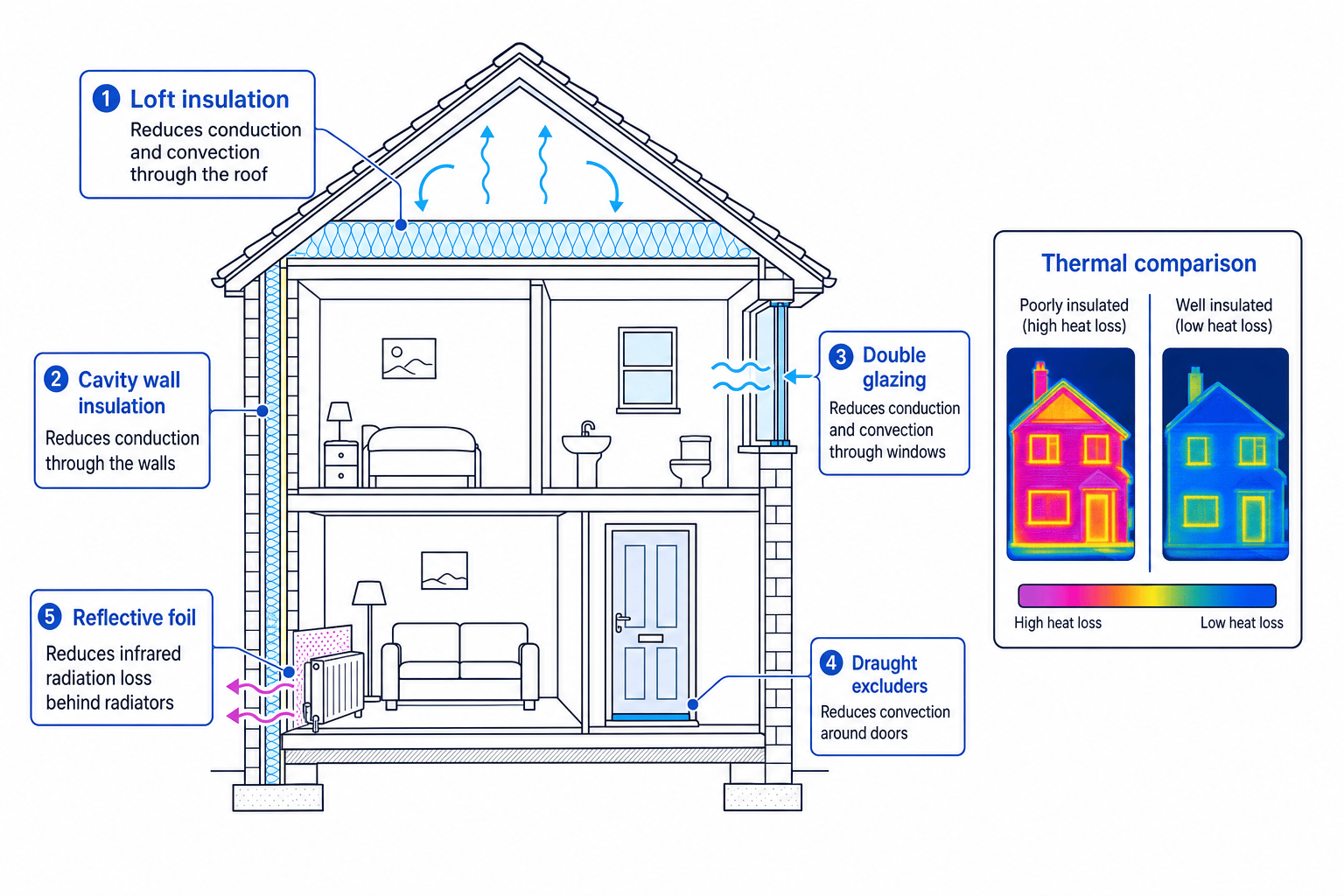
These methods reduce energy transfer in different ways:
- Loft insulation reduces conduction and convection through the roof.
- Cavity wall insulation traps air and reduces conduction through walls.
- Double glazing reduces conduction and convection through windows.
- Draught excluders reduce convection by stopping warm air escaping through gaps.
- Reflective foil reduces energy transfer by infrared radiation behind radiators.
Thermal conductivity
Thermal conductivity describes how easily energy is transferred through a material by conduction. A material with low thermal conductivity is a good thermal insulator.
Rate of cooling
The rate of cooling means how quickly the temperature of an object decreases. On a temperature-time graph, faster cooling gives a steeper downward curve.
The rate of cooling depends on how quickly energy is transferred from the object to the surroundings. Two important factors are:
- the thickness of the walls or insulation
- the thermal conductivity of the wall material
Thicker walls reduce the rate of energy transfer. Materials with lower thermal conductivity also reduce the rate of energy transfer.
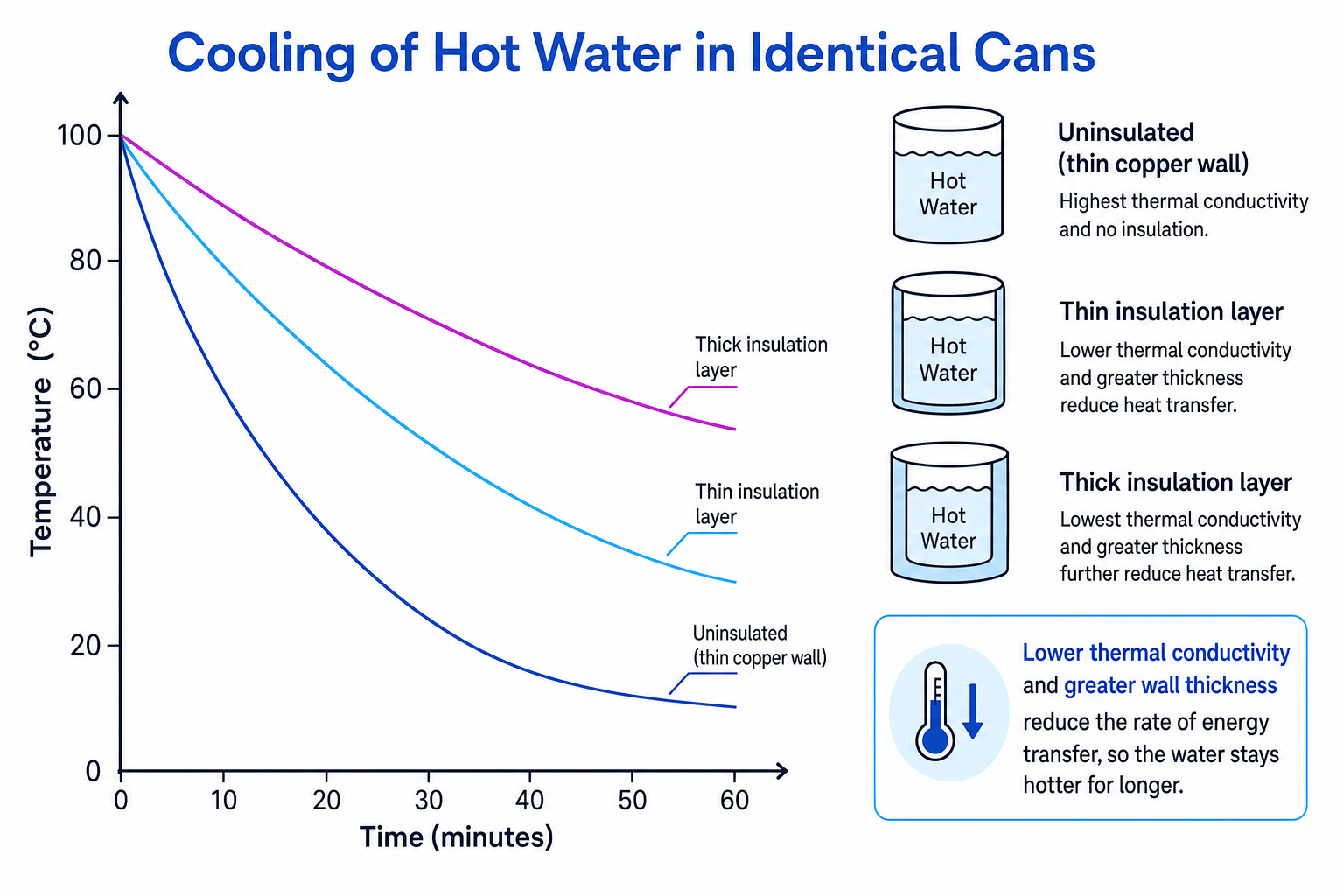
In practical work, you might compare insulated and non-insulated copper cans filled with hot water. To make it a fair test, you would keep variables such as the starting temperature, volume of water, can size and room conditions the same.
Interpreting cooling curves
Three identical cans contain hot water. Can A is uninsulated, can B has thin insulation, and can C has thick insulation.
- Compare the steepness of the temperature-time curves: the steepest curve shows the fastest cooling.
- The uninsulated can cools fastest because energy is transferred more quickly through the wall to the surroundings.
- The thickly insulated can cools slowest because greater thickness and lower thermal conductivity reduce the rate of energy transfer.
- Therefore, the thick insulation keeps the water hot for longer by reducing unwanted energy transfer.
Qualitative only
For this topic, you only need to describe the effect of wall thickness and thermal conductivity on cooling. You do not need to calculate thermal conductivity.
In the exam
- If asked about “wasted” energy, say where it is transferred, usually to thermal stores of the surroundings, and remember it is still conserved.
- For efficiency calculations, use useful output divided by input, then multiply by 100% only if a percentage is wanted.
- For insulation questions, link the method to the type of unwanted transfer it reduces: friction, conduction, convection or radiation.
Check yourself
- Why can an appliance never be more than 100% efficient?
- A device has a power rating of 800 W. What does that tell you about its energy transfer each second?
- How do thicker walls and lower thermal conductivity affect the rate of cooling?