Physics on the move
What you'll learn
- How to recall and estimate typical speeds and accelerations in everyday life.
- How to convert units and calculate rates such as speed and acceleration.
- How reaction time is measured and why it affects road safety.
- How thinking distance, braking distance and deceleration link to safer car design.
Everyday speeds
A speed tells you how quickly distance is covered. It is a type of rate, which means “how much something changes per unit time”.
Speed
Speed is the distance travelled per second. It is usually measured in metres per second, m/s.
v=dtv = \frac{d}{t}v=tdwhere vvv is speed, ddd is distance and ttt is time.
You should have a feel for typical speeds. You do not need perfect values, but your estimates should be sensible.
| Situation | Typical speed |
|---|---|
| Walking | about 1.5 m/s |
| Running | about 3 to 6 m/s |
| Sprinting | about 10 m/s |
| Cycling | about 5 to 8 m/s |
| Light wind / breeze | about 3 to 5 m/s |
| Strong wind | about 15 to 20 m/s |
| Car in a town, 30 mph | about 13 m/s |
| Car on a motorway, 70 mph | about 31 m/s |
| Train | about 50 to 80 m/s |
| Sound in air | about 330 m/s |
| Passenger aircraft | about 250 m/s |
Scale of speeds
Walking is about 1 m/s, cars are usually tens of m/s, and sound is hundreds of m/s. This “scale sense” helps you spot unrealistic answers.
Estimating a walking time
A student walks 600 m to school at about 1.5 m/s. Estimate the time taken.
-
Use the speed equation and rearrange it for time:
t=dvt = \frac{d}{v}t=vd -
Substitute the distance and speed:
t=600 m1.5 m/s=400 st = \frac{600\ \text{m}}{1.5\ \text{m/s}} = 400\ \text{s}t=1.5 m/s600 m=400 s -
Convert seconds to minutes:
400 s÷60≈6.7 min400\ \text{s} \div 60 \approx 6.7\ \text{min}400 s÷60≈6.7 min
So the walk takes about 7 minutes.
Acceleration and deceleration
A velocity is speed in a particular direction. An object accelerates when its velocity changes. This could mean it speeds up, slows down, or changes direction.
Acceleration
Acceleration is the rate of change of velocity. It is measured in metres per second squared, m/s².
a=Δvta = \frac{\Delta v}{t}a=tΔvwhere aaa is acceleration, Δv\Delta vΔv is change in velocity, and ttt is time.
Everyday accelerations are usually a few m/s². For example:
- A cyclist starting from rest: about 1 m/s².
- A car accelerating normally: about 1 to 3 m/s².
- Emergency braking: often several m/s².
- Free fall near Earth, ignoring air resistance: about 9.8 m/s².
Deceleration
Deceleration means an object’s speed is decreasing. It is acceleration in the opposite direction to motion.
Acceleration is not the same as speed
Speed tells you how fast something is moving. Acceleration tells you how quickly the speed or direction is changing.
Estimating a car’s acceleration
A car speeds up from rest to 20 m/s in 8 s. Estimate its acceleration.
-
Identify the change in velocity. From rest means the initial velocity is 0 m/s, so:
Δv=20 m/s−0 m/s=20 m/s\Delta v = 20\ \text{m/s} - 0\ \text{m/s} = 20\ \text{m/s}Δv=20 m/s−0 m/s=20 m/s -
Substitute into the acceleration equation:
a=20 m/s8 sa = \frac{20\ \text{m/s}}{8\ \text{s}}a=8 s20 m/s -
Calculate the acceleration:
a=2.5 m/s2a = 2.5\ \text{m/s}^2a=2.5 m/s2
So the car’s acceleration is about 2.5 m/s².
Converting units and calculating rates
In physics, you usually calculate using SI units: metres, seconds, kilograms, newtons and so on. Road speeds in the UK are often given in miles per hour, mph, but equations usually need metres per second, m/s.
Useful conversions:
- To convert kilometres per hour to metres per second, divide by 3.6.
- To convert metres per second to kilometres per hour, multiply by 3.6.
- 30 mph is about 13 m/s.
- 70 mph is about 31 m/s.
Quick km/h conversion
Because 1 hour is 3600 s and 1 km is 1000 m:
1 km/h=1000 m3600 s≈0.278 m/s1\ \text{km/h} = \frac{1000\ \text{m}}{3600\ \text{s}} \approx 0.278\ \text{m/s}1 km/h=3600 s1000 m≈0.278 m/sSo dividing by 3.6 changes km/h into m/s.
Converting speed and finding distance
A cyclist travels at 18 km/h for 12 s. How far do they travel?
-
Convert 18 km/h into m/s:
18÷3.6=5 m/s18 \div 3.6 = 5\ \text{m/s}18÷3.6=5 m/s -
Use the speed equation rearranged for distance:
d=vtd = v td=vt -
Substitute the values:
d=5 m/s×12 s=60 md = 5\ \text{m/s} \times 12\ \text{s} = 60\ \text{m}d=5 m/s×12 s=60 m
The cyclist travels 60 m.
Human reaction time
Your reaction time is the time between noticing a stimulus and starting your response. For road safety, this is the delay between seeing a hazard and pressing the brake.
Reaction time
Reaction time is the time taken to respond to a stimulus. A typical human reaction time is about 0.2 to 0.3 s.
A common school method is the ruler drop experiment. One person holds a ruler vertically with the zero mark level with another person’s fingers. The ruler is dropped without warning, and the second person catches it as quickly as possible. The distance the ruler falls is used to estimate reaction time.
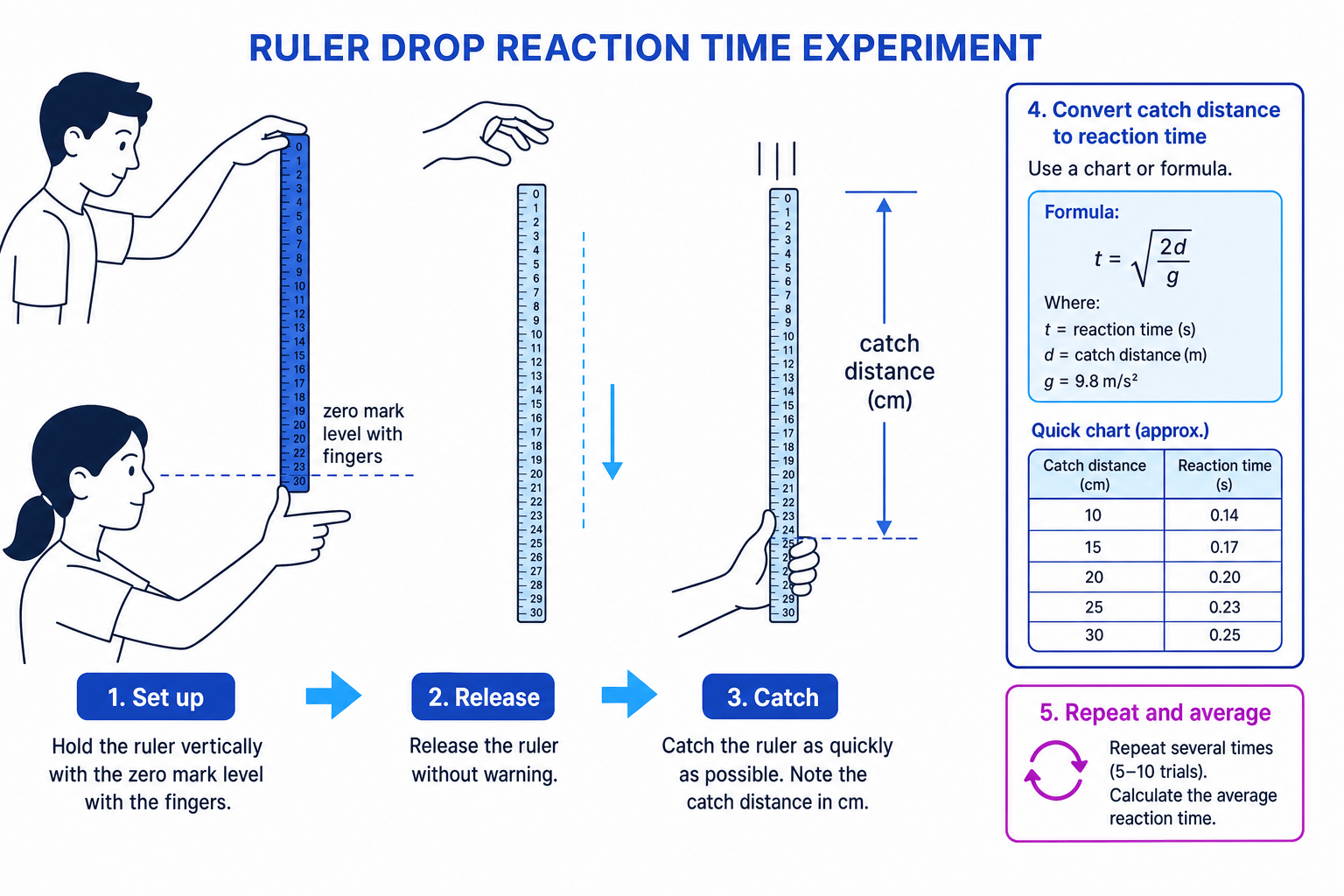
To make the result more reliable:
- repeat the test several times;
- calculate a mean;
- keep the setup the same each time;
- avoid giving clues about when the ruler will be released.
Reaction time can be increased by tiredness, alcohol, some drugs, distractions such as mobile phones, and lack of concentration.
Calculating a mean reaction time
A student measures reaction times of 0.20 s, 0.22 s, 0.21 s, 0.38 s and 0.19 s. The 0.38 s result happened when the student fumbled the catch. Calculate a suitable mean.
-
Decide whether any result is anomalous. The 0.38 s value is much larger than the others and has a known cause, so it is reasonable to exclude it.
-
Add the remaining values:
0.20+0.22+0.21+0.19=0.82 s0.20 + 0.22 + 0.21 + 0.19 = 0.82\ \text{s}0.20+0.22+0.21+0.19=0.82 s -
Divide by the number of values used:
0.82 s4=0.205 s\frac{0.82\ \text{s}}{4} = 0.205\ \text{s}40.82 s=0.205 s
A suitable mean reaction time is about 0.21 s.
Thinking distance, braking distance and stopping distance
When a vehicle stops in an emergency, it does not stop instantly. The total distance has two parts.
Stopping distance
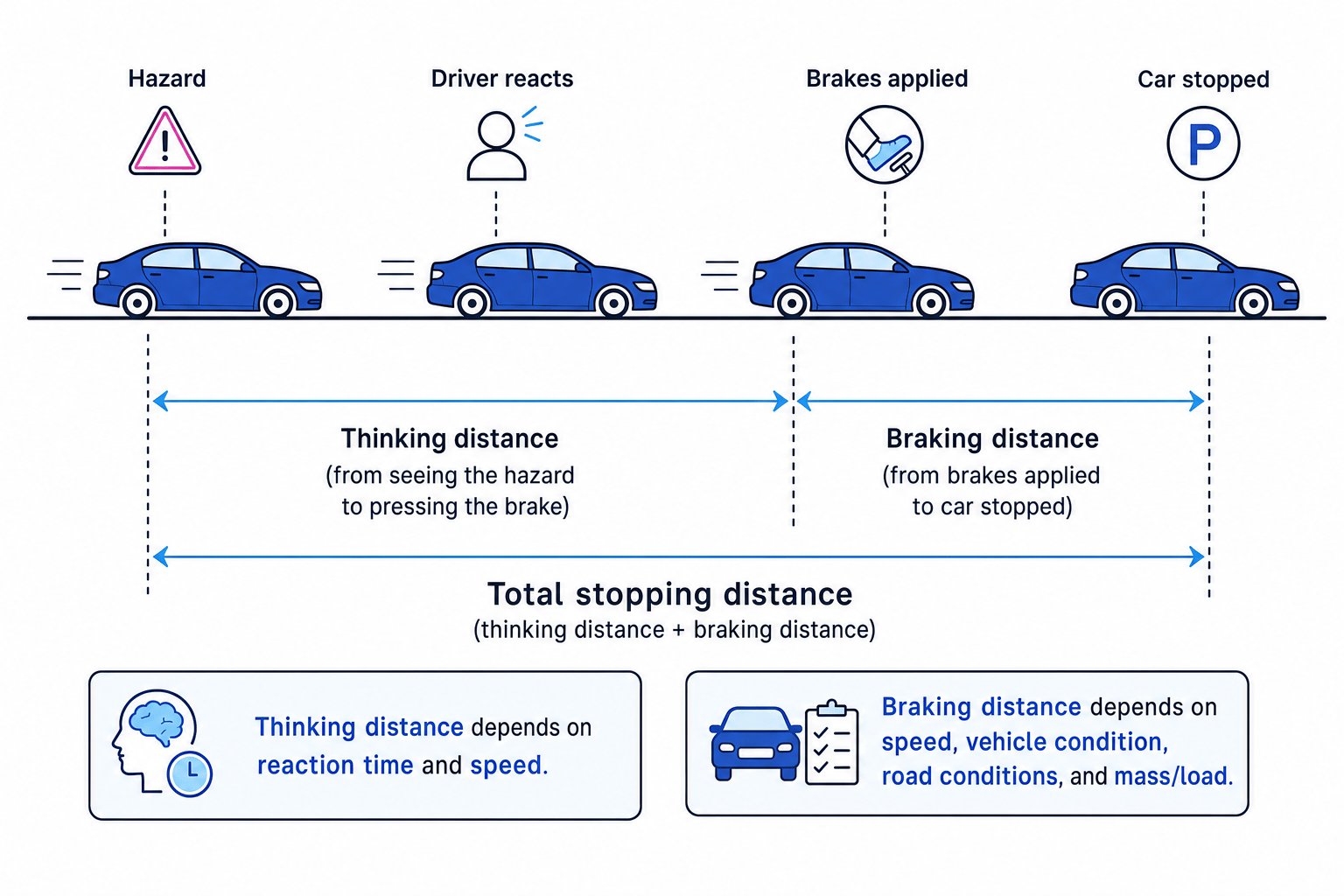
Stopping distance is the total distance travelled from the moment the driver sees a hazard to the moment the vehicle stops.
stopping distance=thinking distance+braking distance\text{stopping distance} = \text{thinking distance} + \text{braking distance}stopping distance=thinking distance+braking distanceThinking distance is the distance travelled during the driver’s reaction time. It depends on the vehicle’s speed and the driver’s reaction time.
Braking distance is the distance travelled after the brakes are applied. It depends on speed, road conditions, tyre condition, brake condition and the vehicle’s mass or load.
Mixing up thinking and braking factors
Alcohol, drugs, tiredness and distractions mainly increase thinking distance because they increase reaction time. Worn tyres, poor brakes and icy roads increase braking distance.
If the vehicle is travelling faster, both parts usually increase:
- thinking distance increases because the vehicle covers more distance each second;
- braking distance increases because the vehicle has more energy to remove.
No single braking-distance formula
At GCSE, braking distance questions often give you the braking distance or ask for a qualitative explanation. Do not invent a simple formula for braking distance because it depends on many real-world factors.
Calculating stopping distance
A car travels at 20 m/s. The driver’s reaction time is 0.75 s. Once the brakes are applied, the car travels a further 25 m before stopping. Calculate the total stopping distance.
-
Calculate the thinking distance using distance equals speed times time:
d=vt=20 m/s×0.75 s=15 md = v t = 20\ \text{m/s} \times 0.75\ \text{s} = 15\ \text{m}d=vt=20 m/s×0.75 s=15 m -
Add the braking distance:
stopping distance=15 m+25 m\text{stopping distance} = 15\ \text{m} + 25\ \text{m}stopping distance=15 m+25 m -
Calculate the total:
stopping distance=40 m\text{stopping distance} = 40\ \text{m}stopping distance=40 m
The car travels 40 m before stopping.
Why large decelerations are dangerous
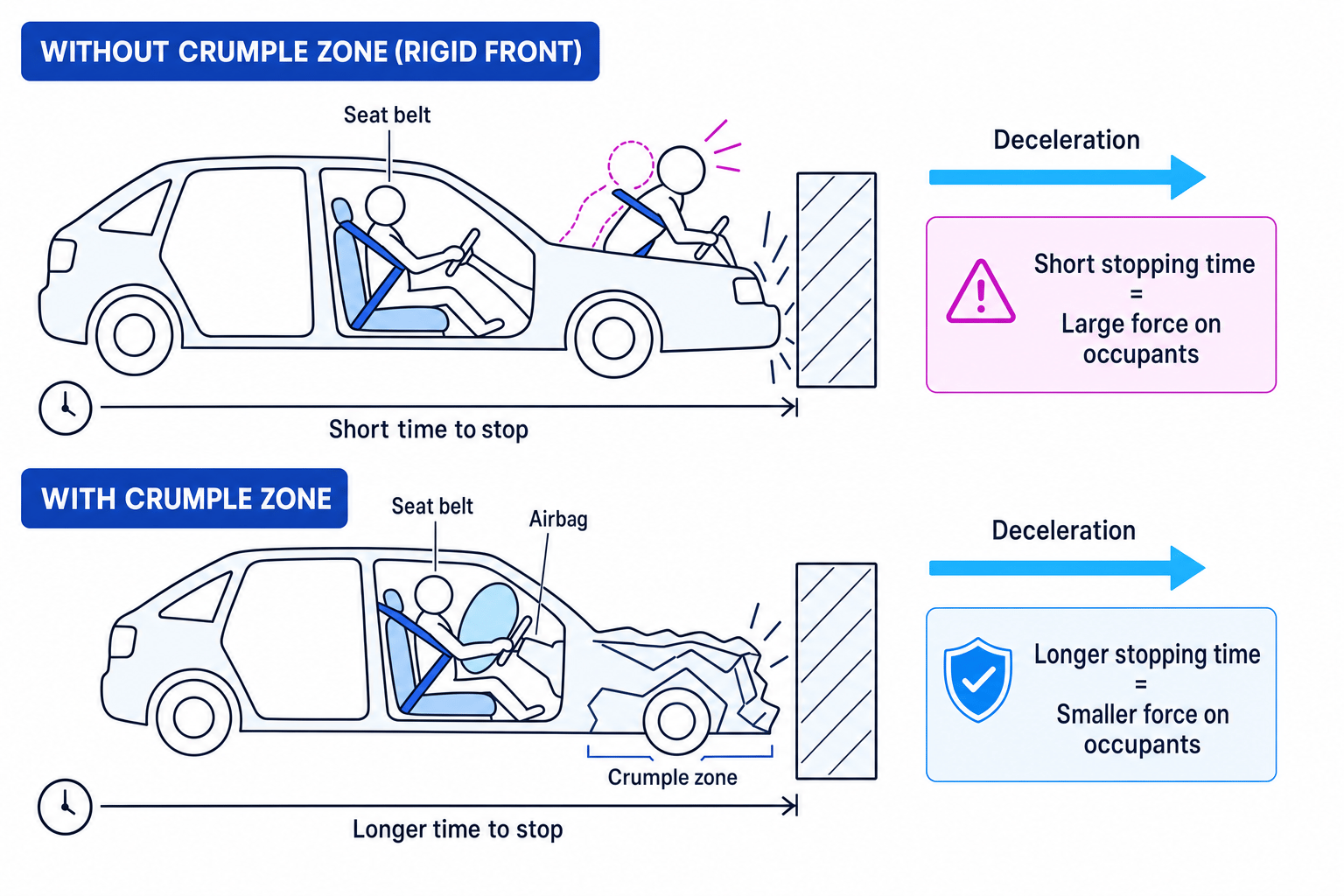
In a crash, the vehicle and passengers may go from a high speed to rest in a very short time. That means a very large deceleration.
A large deceleration is dangerous because it produces large forces on the body. The body’s organs can keep moving due to inertia, causing serious injury.
Safety features reduce injury by increasing the time or distance over which the person stops. These include:
- seat belts;
- airbags;
- crumple zones;
- helmets;
- padding.
How safety features help
For the same change in velocity, increasing the stopping time reduces the deceleration. A smaller deceleration means a smaller force on the person.
Comparing crash decelerations
A car passenger slows from 20 m/s to rest. In one crash they stop in 0.05 s. With better safety features they stop in 0.20 s. Compare the decelerations.
-
The change in speed is 20 m/s in both crashes.
-
Calculate the deceleration for the very sudden stop:
a=20 m/s0.05 s=400 m/s2a = \frac{20\ \text{m/s}}{0.05\ \text{s}} = 400\ \text{m/s}^2a=0.05 s20 m/s=400 m/s2 -
Calculate the deceleration when the stopping time is longer:
a=20 m/s0.20 s=100 m/s2a = \frac{20\ \text{m/s}}{0.20\ \text{s}} = 100\ \text{m/s}^2a=0.20 s20 m/s=100 m/s2 -
Compare the values. The longer stopping time gives one quarter of the deceleration, so the force on the passenger is much smaller.
In the exam
- Check units before calculating: speeds in km/h or mph often need converting to m/s.
- Keep thinking distance and braking distance separate, then add them for stopping distance.
- For safety features, always link your answer to increasing stopping time and therefore reducing deceleration or force.
Check yourself
- What is a typical reaction time for a human, and how could you measure it?
- Which factors affect thinking distance, and which factors affect braking distance?
- Why does a crumple zone reduce the risk of injury in a crash?