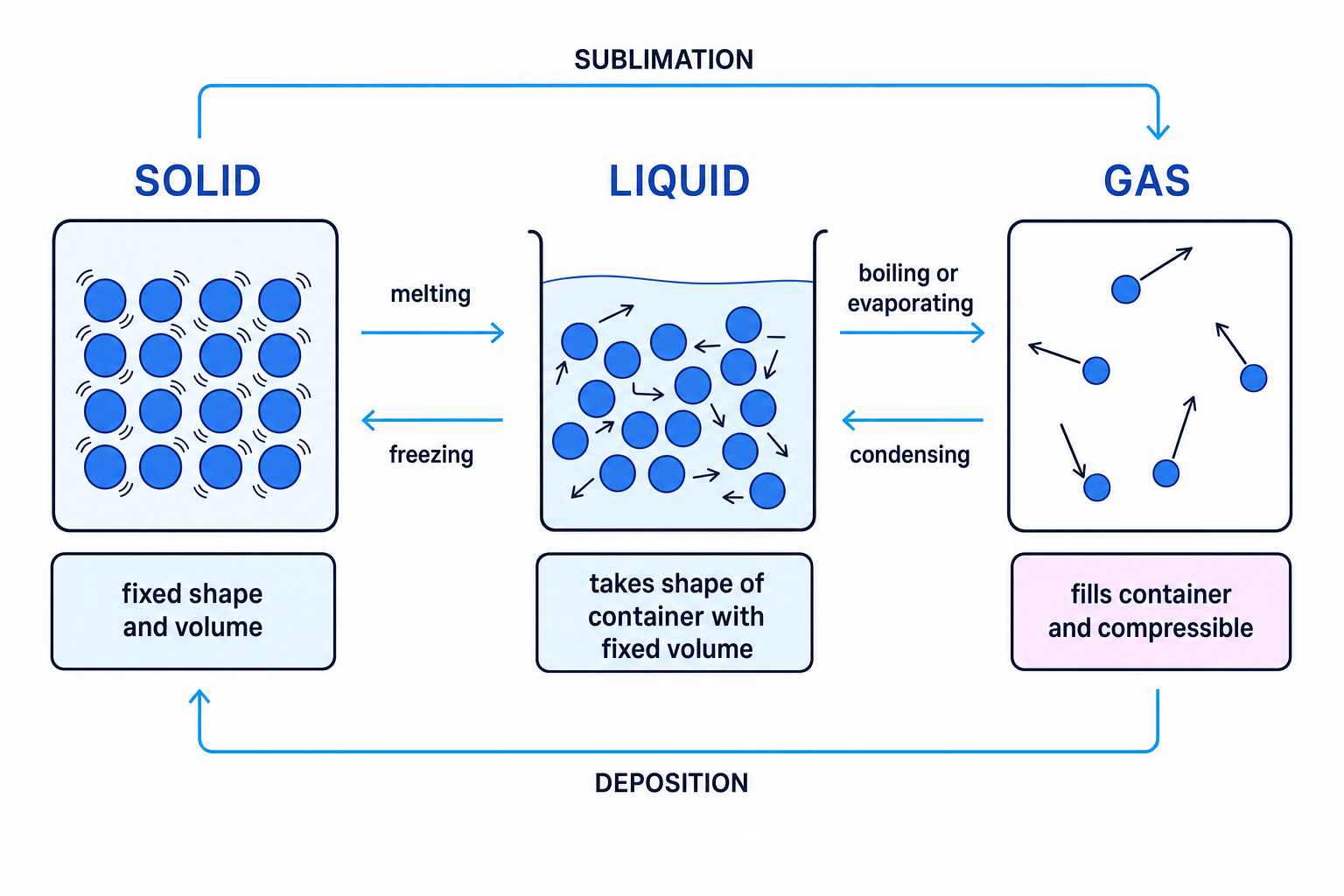
What you'll learn
- How the particle model represents solids, liquids and gases.
- How particles behave during changes of state such as melting, boiling and condensing.
- How to tell the difference between physical changes and chemical changes.
- Why the simple “particles as little balls” model is useful, but not perfect.
Matter is made of particles
Matter means anything that has mass and takes up space. In chemistry, we explain matter using particles: tiny units that make up substances. A particle might be an atom, a molecule or an ion, depending on the substance.
The particle model is a simplified way of imagining matter. It does not show every detail, but it helps you explain many observations clearly.
Particle model
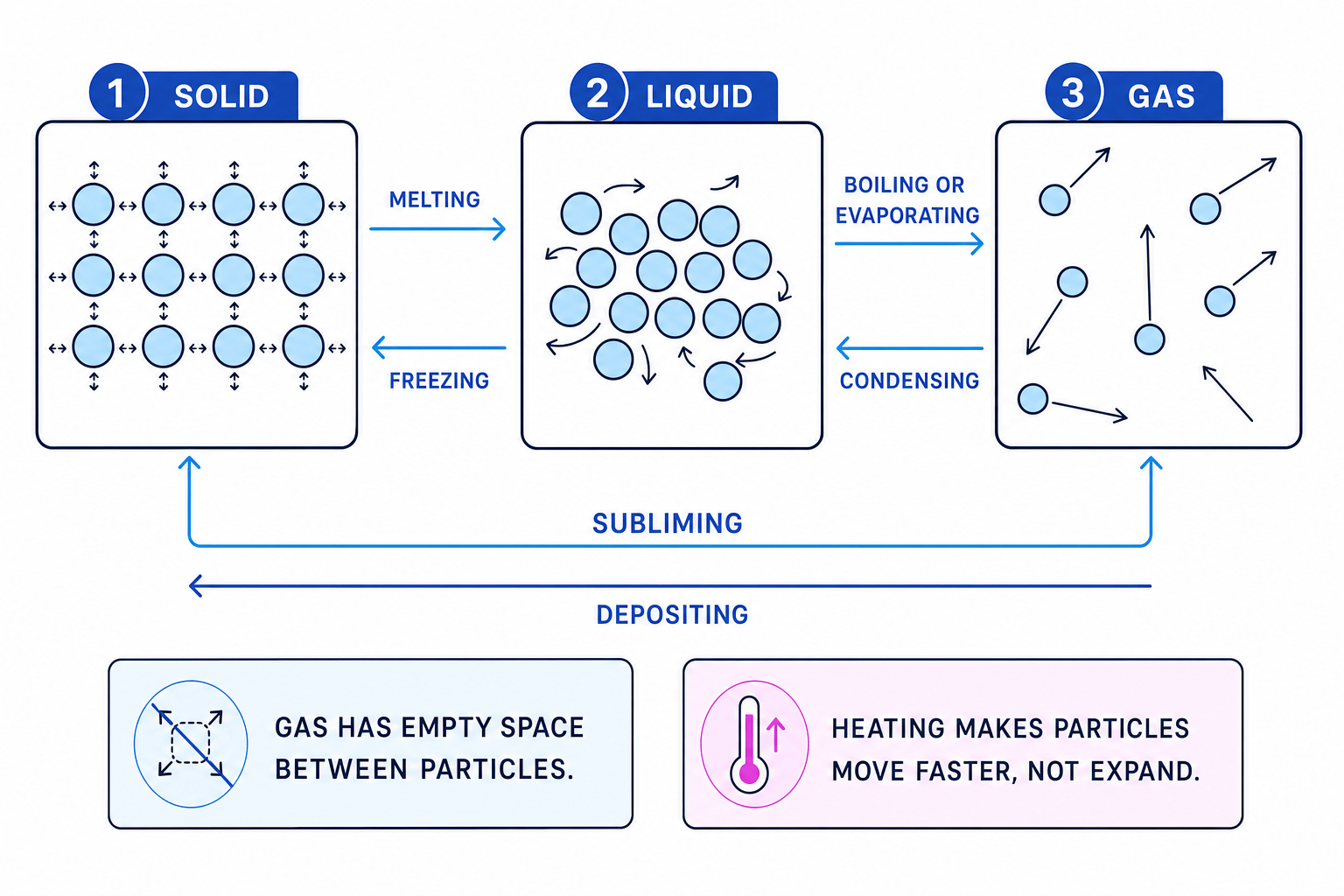
The particle model describes matter as being made of tiny particles with spaces between them. The particles are always moving, and heating makes them move faster or vibrate more strongly.
A key GCSE idea is that particles themselves do not expand when a substance is heated. Instead, they move more and often become further apart.
Particles do not get bigger
When a gas expands on heating, do not say “the particles expanded”. Say “the particles moved faster and became further apart”.
Atoms, elements and compounds
Before using the particle model properly, you need three important words.
Atoms, elements and compounds
- An atom is the smallest part of an element that can still be identified as that element.
- An element is a substance made from only one type of atom.
- A compound is a substance made when atoms of different elements are chemically joined together.
For example, oxygen is an element because it contains only oxygen atoms. Water is a compound because it contains hydrogen and oxygen atoms chemically joined together.
States of matter
A state of matter is the physical form a substance is in. The three main states you need here are solid, liquid and gas.
Particle diagrams are usually drawn as flat circles on paper, but real substances are three-dimensional. The circles are a model, not a photograph of what particles “look like”.
Solids
In a solid, particles are close together in a regular arrangement. They are held in fixed positions, but they still vibrate. This explains why solids have a fixed shape and a fixed volume.
Liquids
In a liquid, particles are close together but arranged randomly. They can move past each other, so liquids can flow and take the shape of their container. Liquids still have a fixed volume because the particles remain close together.
Gases
In a gas, particles are far apart and move quickly in random directions. There is a lot of empty space between them. This explains why gases can be compressed and why they spread out to fill a container.
The big comparison
Solids: particles close and fixed. Liquids: particles close but able to move past each other. Gases: particles far apart and moving freely.
Explaining why gases can be compressed
A syringe contains air. The end is sealed, and the plunger is pushed in.
- In air, the particles are already far apart, with empty space between them.
- Pushing the plunger reduces the volume of the gas, so the particles are forced closer together.
- The particles themselves have not been squashed; the empty space between them has decreased.
Changes of state
A change of state happens when a substance changes between solid, liquid and gas. These changes are caused by energy being transferred to or from the particles.
When a substance is heated, energy is transferred to its particles. They move faster or vibrate more strongly. If enough energy is transferred, particles can overcome some of the forces of attraction between them. A force of attraction is a pull between particles.
When a substance is cooled, energy is transferred away from its particles. They move less, and attractions can pull them closer together.
Names of changes of state
- Melting: solid → liquid
- Freezing: liquid → solid
- Boiling: liquid → gas throughout the liquid
- Evaporating: liquid → gas from the surface
- Condensing: gas → liquid
- Subliming: solid → gas
- Depositing: gas → solid
Most changes of state are reversible, meaning they can be undone by changing the conditions. For example, ice melts to liquid water, and liquid water can freeze back into ice.
Explaining melting using particles
Ice is heated until it melts into liquid water.
- Heating transfers energy to the water particles, so they vibrate more strongly.
- Eventually, the particles have enough energy to move out of their fixed positions.
- The particles are still water particles, but they can now move past each other, so the substance has become a liquid.
The particles do not melt
The substance melts. The particles do not melt individually. In melting, the arrangement and movement of the particles change.
Physical changes and chemical changes
A physical change changes the form, state or appearance of a substance, but does not make a new substance. Changes of state are physical changes.
A chemical change makes one or more new substances. In particle terms, atoms become joined in different ways. A chemical bond is a strong attraction that holds atoms or ions together in a substance.
Examples of physical changes include melting ice, boiling water and freezing molten wax.
Examples of chemical changes include burning, rusting and reacting an acid with a metal.
Best test for physical vs chemical
Ask: “Are the same particles still present, just arranged differently?” If yes, it is probably a physical change. If new substances with different particles have formed, it is a chemical change.
Classifying burning magnesium
Magnesium ribbon burns in oxygen to form magnesium oxide:
2Mg(s) + O₂(g) → 2MgO(s)
- Compare the substances before and after: magnesium and oxygen are present at the start, but magnesium oxide is present at the end.
- In particle terms, magnesium atoms and oxygen atoms have become chemically joined in a new compound.
- Because a new substance has formed, burning magnesium is a chemical change, not just a change of state.
Clues are not proof on their own
Gas bubbles, colour change or temperature change can suggest a chemical reaction, but the key evidence is that a new substance has formed.
Limitations of the particle model
The simple particle model is very useful, but it is still only a model. It helps explain states of matter and changes of state, but it does not fully explain why different materials have different properties.
For example, the model might show all particles as identical little circles. That can hide the fact that different substances contain different particles, and those particles may be held together in different ways.
If you are taking Higher Tier, you should also be able to explain the limitations of representing particles as inelastic spheres, like tiny bowling balls.
Inelastic sphere model
An inelastic sphere model represents particles as simple hard balls. This is useful for showing arrangement and movement, but it does not show real particle size, real spacing, shape, or forces of attraction between particles.
The model has three important limitations:
- It often does not show the forces of attraction between particles.
- It is usually not to scale, so it can give a wrong idea of particle size and the space between particles.
- It can make particles look like solid balls, even though real atoms, molecules and ions are more complex.
This matters because attractions between particles help explain why energy is needed for melting and boiling. Different strengths of attraction help explain why some substances are gases at room temperature while others are solids.
Improving a weak particle explanation
A student writes: “When iodine sublimes, the iodine particles expand and float away.”
- Identify the correct idea: subliming means iodine changes from solid directly to gas.
- Correct the particle error: the iodine particles do not expand; they gain energy, move faster and become much further apart.
- Improve the model explanation: the particles overcome attractions between them, but the simple ball model does not show those attractions very well.
In the exam
- For state questions, always describe both arrangement and movement of particles.
- For changes of state, say the particles stay the same but their energy, spacing and movement change.
- For physical vs chemical changes, focus on whether a new substance has formed.
Check yourself
- Why can a gas be compressed much more easily than a liquid?
- What happens to particle movement when a solid melts?
- How would you tell, in particle terms, whether a change is physical or chemical?