

What you'll learn
- How health, disease, pathogens and risk factors are linked.
- How communicable diseases spread, and how animals and plants defend against them.
- How vaccines, medicines, drug trials, stem cells and gene technology are used in modern medicine.
- How lifestyle factors affect non-communicable diseases such as cardiovascular disease, cancer and type 2 diabetes.
Health and disease: the big picture
Health and disease
Health is a state of physical and mental wellbeing. Disease is a condition that stops part of the body or mind working normally.
Health is not just “not being ill”. Your health can be affected by diet, exercise, stress, infection, inherited factors, access to healthcare, and the environment.
Diseases can also interact. One disease may make another more likely, more severe, or harder to treat.
Communicable and non-communicable diseases
A communicable disease can be spread from one organism to another. A non-communicable disease cannot be passed directly between organisms.
Types of disease
Communicable diseases are caused by pathogens, which are microorganisms or viruses that cause disease. Pathogens include:
- Viruses — tiny particles that reproduce inside host cells.
- Bacteria — single-celled organisms; some cause disease.
- Fungi — organisms such as moulds and yeasts.
- Protists — single-celled eukaryotic organisms; some are parasites.
Non-communicable diseases include cardiovascular disease, many cancers, bronchitis, cirrhosis, and type 2 diabetes. They are often caused by several interacting factors rather than one single cause.
Caught or inherited?
Do not sort diseases by “serious” versus “not serious”. Sort them by whether they are transmitted. HIV/AIDS is communicable. Many cancers are non-communicable, even though cancer involves changes in DNA.
How diseases interact
Some infections weaken the body and make other diseases more likely. For example, HIV attacks the immune system. If untreated, it can lead to AIDS, where the immune system is badly damaged. This makes infections such as tuberculosis, caused by bacteria, much more dangerous.
Another important interaction is HPV and cervical cancer. HPV, the human papillomavirus, is a sexually transmitted virus. Some types of HPV increase the risk of changes in cervical cells that may develop into cancer.
Disease interactions
A disease does not always act alone. One disease can increase the risk of another by damaging tissues, weakening immunity, or changing how cells divide.
How communicable diseases spread
Pathogens can spread between animals, between plants, and between animals and plants in different ways.
In animals and humans
Common routes include:
- Airborne droplets from coughing or sneezing.
- Direct contact, including sexual contact.
- Contaminated food or water.
- Vectors, which are organisms that carry pathogens from one host to another, such as mosquitoes.
- Blood contact, for example through shared needles.
In plants
Plant pathogens may spread through:
- Spores carried by wind or water.
- Insects feeding on plant sap.
- Contaminated soil.
- Garden tools or machinery.
- Infected plant material, such as cuttings or seeds.
Examples you should know
For humans, useful examples include:
- Viral infection: HIV/AIDS or influenza.
- Bacterial infection: salmonella food poisoning or tuberculosis.
- Fungal infection: athlete’s foot.
- Sexually transmitted infection: HIV, HPV, chlamydia or gonorrhoea.
For plants, examples include:
- Tobacco mosaic virus, or TMV — a viral disease causing mottled leaves and reduced photosynthesis.
- Barley powdery mildew, caused by the fungus Erysiphe graminis.
- Crown gall disease, caused by the bacterium Agrobacterium tumefaciens.
Estimating infected plants
A farmer samples 200 barley plants and finds 18 showing powdery mildew symptoms. The field contains about 5000 barley plants. Estimate the number infected.
- Work out the infected fraction in the sample: 18200=0.09\frac{18}{200}=0.0920018=0.09.
- Apply this fraction to the whole field: 0.09×5000=4500.09 \times 5000=4500.09×5000=450.
- State the estimate with sensible wording: about 450 plants may be infected, assuming the sample was representative.
Reducing the spread of communicable disease
The best prevention methods depend on how the pathogen spreads.
For humans and animals, spread can be reduced by:
- Good hygiene, such as handwashing.
- Safe food preparation and clean water.
- Condoms to reduce sexually transmitted infections.
- Isolation of infected individuals.
- Vaccination.
- Controlling vectors, such as mosquito nets or insecticides.
- Testing blood products and avoiding shared needles.
For plants, spread can be reduced by:
- Removing and destroying infected plants.
- Using resistant crop varieties.
- Controlling insect vectors.
- Cleaning tools and machinery.
- Growing crops in suitable conditions so plants stay healthy.
Detecting disease
Disease can be detected by:
- Visual identification, such as recognising leaf spots, galls, wilting or powdery mildew.
- Antigen testing, where molecules on a pathogen are detected.
- DNA testing, where genetic material from the pathogen is identified.
Sampling matters
A disease estimate is only useful if the sample is representative. Sampling only the worst-looking corner of a field will overestimate infection.
Your body’s defences
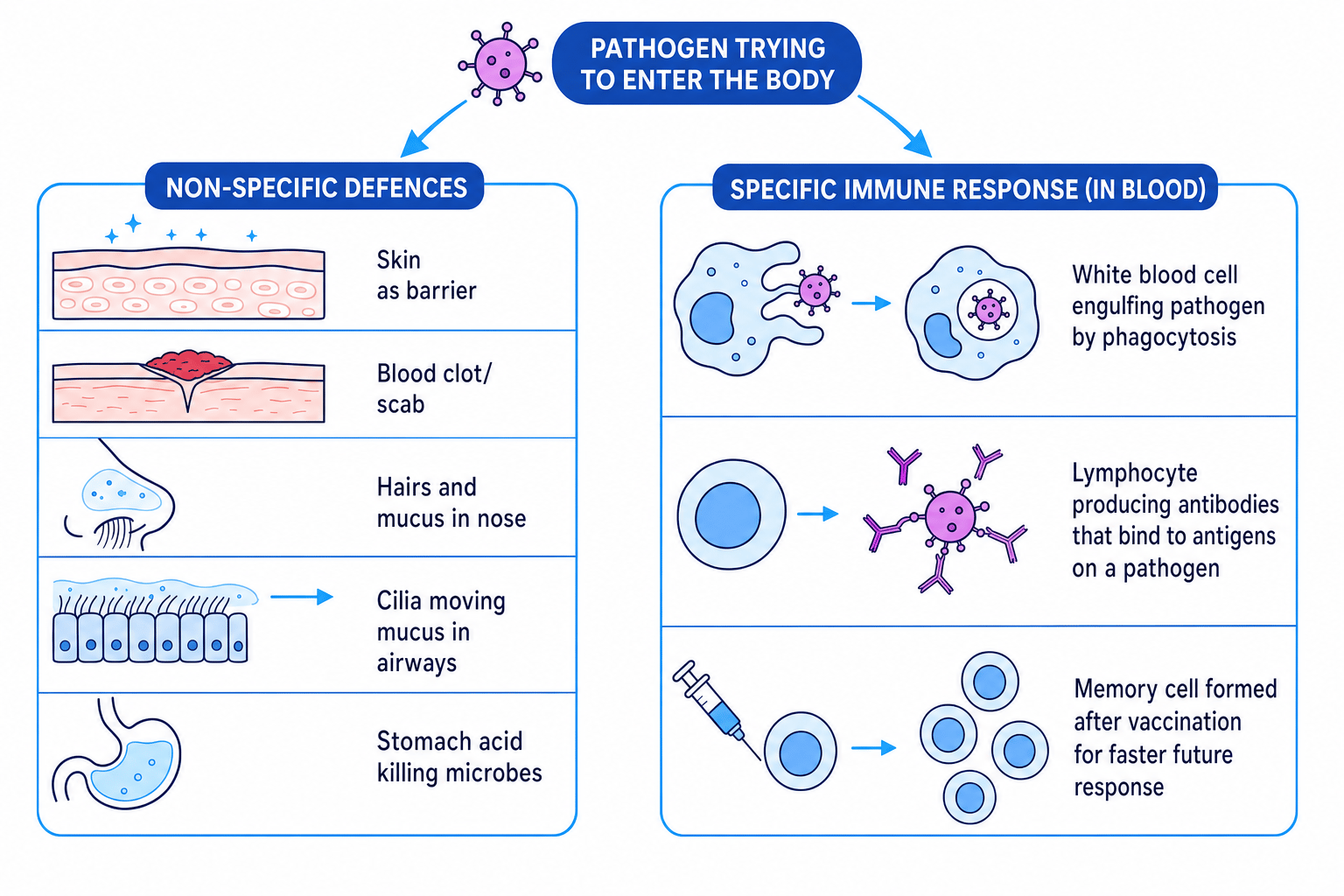
Your body has non-specific defences, which act against many pathogens, and a specific immune response, which targets particular pathogens.
Non-specific defence systems
Non-specific defences include:
- Skin, which acts as a physical barrier.
- Blood clotting, which seals wounds and forms a scab.
- Mucus, which traps pathogens in the nose and airways.
- Cilia, tiny hair-like structures that move mucus away from the lungs.
- Stomach acid, which kills many swallowed pathogens.
White blood cells and platelets
White blood cells defend the body. Some can change shape and engulf pathogens by phagocytosis. Others produce antibodies, which bind to pathogen antigens, or antitoxins, which neutralise toxins.
Antigen and antibody
An antigen is a molecule on the surface of a pathogen that the immune system recognises as foreign. An antibody is a protein made by white blood cells that binds to a specific antigen.
Platelets are tiny cell fragments in the blood. They are adapted for defence because they help blood clot quickly at wounds, reducing blood loss and stopping pathogens entering through broken skin.
Vaccines and medicines
A vaccine contains a harmless form of a pathogen, or parts of its antigens. It stimulates white blood cells to make antibodies and memory cells. If the real pathogen enters later, memory cells help produce antibodies faster.
Vaccines prevent, they do not usually cure
Vaccination prepares the immune system before infection. It is not the same as treating someone who is already seriously ill with that disease.
Medicines
Different medicines work in different ways:
- Antibiotics kill bacteria or stop them reproducing.
- Antivirals slow down viral replication inside cells.
- Antiseptics kill or inhibit microorganisms on living tissue, such as skin.
Antibiotics and viruses
Antibiotics do not treat viral diseases, because viruses reproduce inside body cells and do not have the same structures and processes as bacteria.
Testing antiseptics and antibiotics
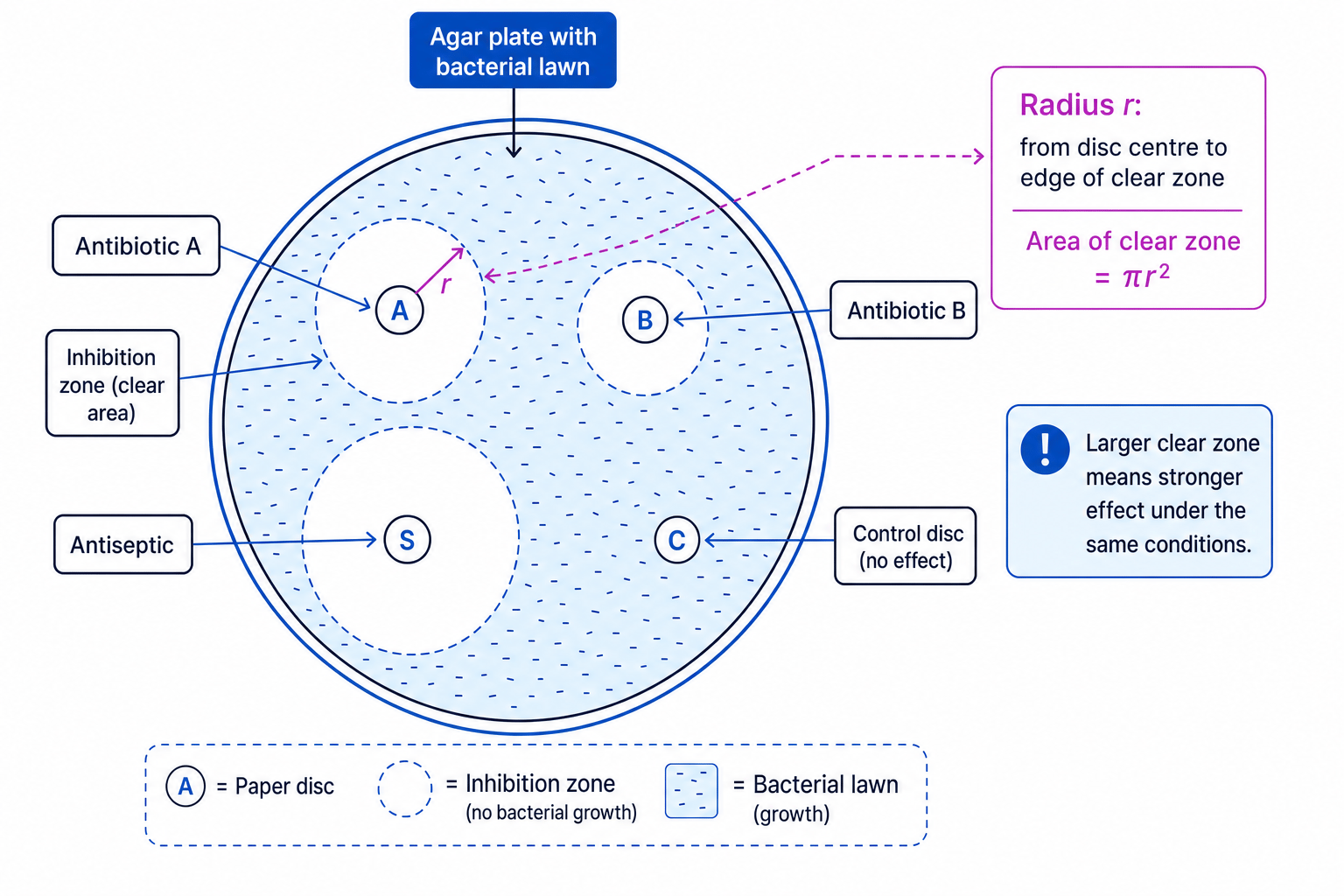
In school practical work, agar plates can be used to grow bacteria safely using aseptic technique, which means methods that prevent contamination. Paper discs soaked in antibiotics or antiseptics are placed on a bacterial lawn. A clear area shows where bacteria have not grown.
Calculating an inhibition zone
An antibiotic disc produces a clear circular zone with radius 12 mm. Calculate the area of the clear zone.
- Choose the circle area formula: A=πr2A=\pi r^2A=πr2.
- Substitute the radius: A=π×122A=\pi \times 12^2A=π×122.
- Calculate: A≈452 mm2A\approx 452\text{ mm}^2A≈452 mm2.
- Interpret the result: a larger clear zone suggests a stronger effect, but only if conditions such as disc size, bacterial species and incubation time were the same.
Developing new medicines
New medicines must be tested for:
- Toxicity — whether they are harmful.
- Efficacy — whether they work.
- Dose — how much should be given.
Preclinical testing
Preclinical testing happens before testing in patients. It may involve computer models, cells, tissues and animals. Scientists look for harmful effects and whether the medicine has a useful effect.
Clinical testing
Clinical testing involves humans. It usually begins with a small number of healthy volunteers to test safety, then patients to test whether the medicine works.
Good trials often use:
- A placebo, a treatment with no active drug.
- Random allocation, so participants are fairly assigned to groups.
- Double-blind testing, where neither patients nor doctors know who has the real drug until after results are collected.
- A large enough sample to make results more reliable.
Non-communicable disease and lifestyle
Many non-communicable diseases are caused by an interaction of risk factors. A risk factor is something linked to an increased chance of disease.
Examples include:
- Lack of exercise and poor diet increasing risk of cardiovascular disease and type 2 diabetes.
- Smoking increasing risk of lung disease, cardiovascular disease and many cancers.
- Alcohol increasing risk of liver cirrhosis.
- Poor nutrition causing deficiency diseases or obesity-related disease.
Correlation is not proof by itself
If two variables change together, that is a correlation. To argue for causation, scientists need more evidence, such as a mechanism, repeated studies, and control of other variables.
Interpreting lifestyle data
Three regions have smoking rates of 10%, 20% and 30%. Their bronchitis rates are 35, 55 and 80 cases per 10 000 people.
- Compare the pattern: as smoking rate increases, bronchitis rate also increases.
- Identify the relationship: this is a positive correlation.
- Add a careful conclusion: the data supports a link between smoking and bronchitis, but other factors such as air pollution, age and healthcare access could also affect the rates.
Cardiovascular disease treatments
Cardiovascular disease affects the heart and blood vessels. Treatments can be grouped as lifestyle, medical and surgical.
Lifestyle treatments include stopping smoking, exercising more and improving diet. They reduce risk and have wide health benefits, but require long-term behaviour change.
Medical treatments include drugs such as statins, which lower blood cholesterol, and medicines to reduce blood pressure or clotting risk. They can be effective but may have side effects and must be taken correctly.
Surgical treatments include stents to keep arteries open, bypass surgery, valve replacement, or in severe cases heart transplant. These can greatly improve survival, but involve risk, cost and recovery time.
Cancer
Cancer is caused by changes in cells that lead to uncontrolled growth and division. These changes are often mutations in DNA that affect how the cell cycle is controlled.
A tumour may be benign, meaning it stays in one place, or malignant, meaning cancer cells can invade other tissues and spread around the body.
Cancer and genes
Cancer involves genetic changes in body cells, but that does not mean most cancers are directly inherited. Some inherited alleles increase risk, but lifestyle and environmental factors can also contribute.
Stem cells in medicine
Stem cells are unspecialised cells that can divide and develop into specialised cells. They could be used to replace damaged tissues, for example in tissue transplantation.
Potential benefits include repairing damaged organs, treating blood disorders, and testing medicines on human cells in the lab.
Potential risks include immune rejection, infection, uncontrolled cell division forming tumours, and ethical concerns, especially around embryonic stem cells.
Gene technology and the human genome
The human genome is the complete set of DNA in a human cell. As scientists understand it better, medicine can become more personalised.
Gene technology may help by:
- Identifying alleles linked to higher disease risk.
- Producing medicines, such as human insulin made using genetically modified bacteria.
- Developing gene therapy, where working genes are added to cells.
- Choosing drugs targeted to a person’s genome.
However, there are risks and ethical issues. Genetic information is private, predictions are not always certain, treatments may be expensive, and gene technologies could have unintended effects.
In the exam
- State whether a disease is communicable or non-communicable before explaining causes, spread or prevention.
- For data questions, describe the trend, use figures from the data, and avoid claiming causation from correlation alone.
- For treatment questions, balance benefits and risks: effectiveness, side effects, cost, ethics and long-term impact.
Check yourself
- How does vaccination lead to a faster immune response during a later infection?
- Why can HIV increase the risk of tuberculosis becoming serious?
- What evidence would help you decide whether smoking is causing higher bronchitis rates, rather than just being correlated with them?
