What you'll learn
- How forces are shown with arrows and combined to find a resultant force.
- How Newton’s first, second and third laws describe motion.
- How to use the key equations for force, momentum, work done and power.
- How ideas like terminal velocity and circular motion fit with forces.
Forces: the starting point
A force is a push or pull on an object. Forces can change an object’s shape, speed, or direction of motion. The unit of force is the newton (N).
Forces happen because objects interact. Some interactions need contact, and some do not.
Contact and non-contact forces
Contact forces act when objects touch. Important examples are:
- normal contact force: the support force from a surface, acting at right angles to the surface
- friction: a force that opposes motion or attempted motion between surfaces
- air resistance or drag: friction from moving through air or a fluid
Non-contact forces act without touching. GCSE examples include:
- gravity, such as Earth pulling objects down
- magnetism, such as a magnet attracting an iron nail
- electrostatic force, such as charged objects attracting or repelling
Forces come from interactions
Whenever two objects interact, each object experiences a force. This idea leads to Newton’s third law later: force interactions always involve a pair of objects.
Forces are vectors
A scalar quantity has size only, such as speed or mass. A vector quantity has size and direction. Force is a vector, so you must think about both its size and its direction.
A free-body diagram shows the forces acting on one chosen object. The object is drawn simply, and each force is shown as an arrow:
- arrow direction = direction of the force
- arrow length = size of the force, if drawn to scale
- label = name and size of the force, often in newtons
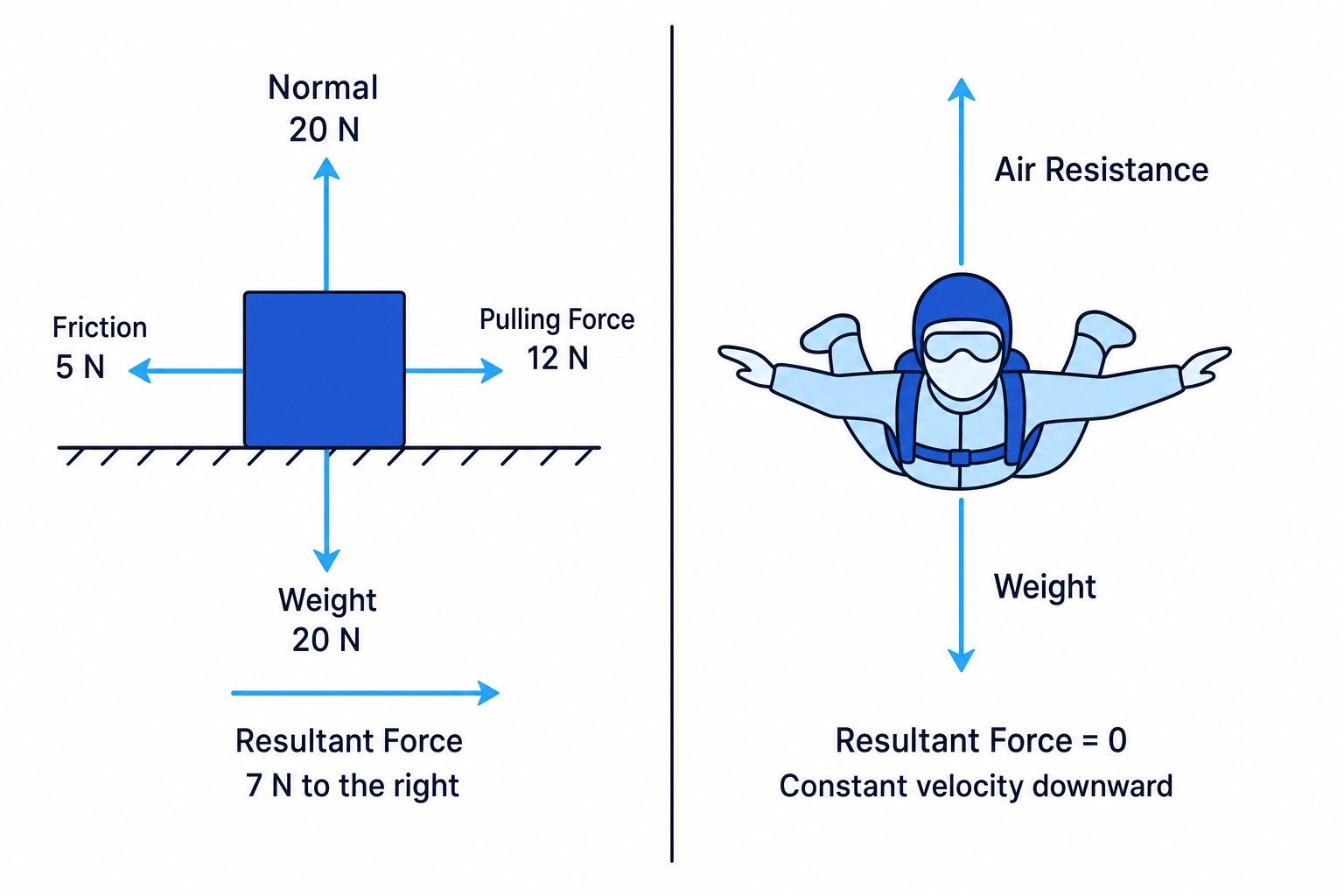
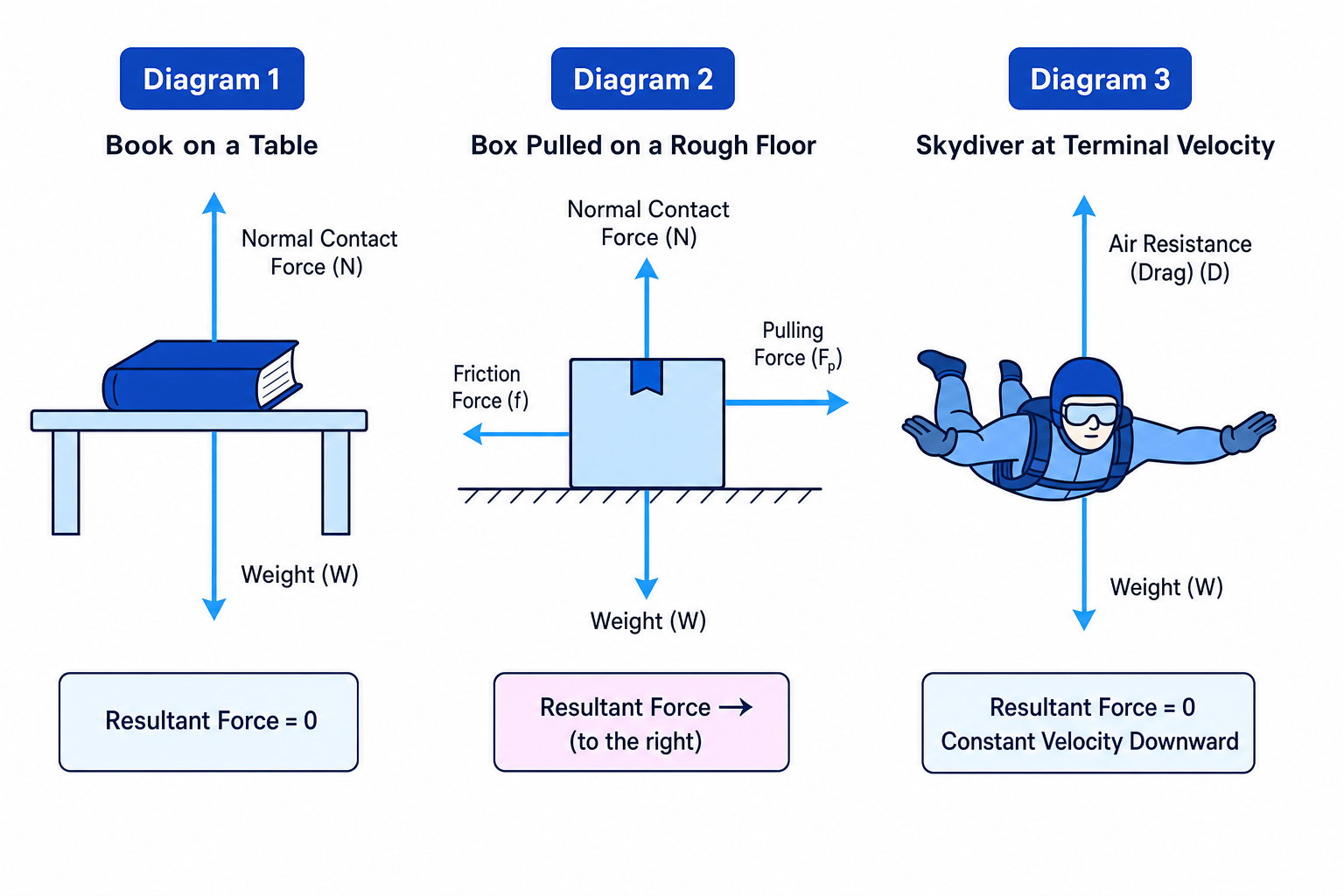
The diagrams below show balanced forces, unbalanced forces, and terminal velocity.
Resultant force
The resultant force is the single overall force found by combining all the forces acting on an object.
If the resultant force is zero, the forces are balanced. The object is in equilibrium, meaning its velocity does not change.
If the resultant force is not zero, the forces are unbalanced, so the object accelerates.
Finding the resultant force on a box
A box has a pulling force of 12 N to the right and friction of 5 N to the left. Its weight is 20 N downwards and the normal contact force is 20 N upwards.
- Compare the vertical forces: 20 N upwards and 20 N downwards are equal and opposite, so the vertical resultant is 0 N.
- Compare the horizontal forces: the right force is larger, so subtract the smaller opposing force: 12 N−5 N=7 N12\ \text{N} - 5\ \text{N} = 7\ \text{N}12 N−5 N=7 N.
- The resultant force is 7 N to the right, so the box accelerates to the right.
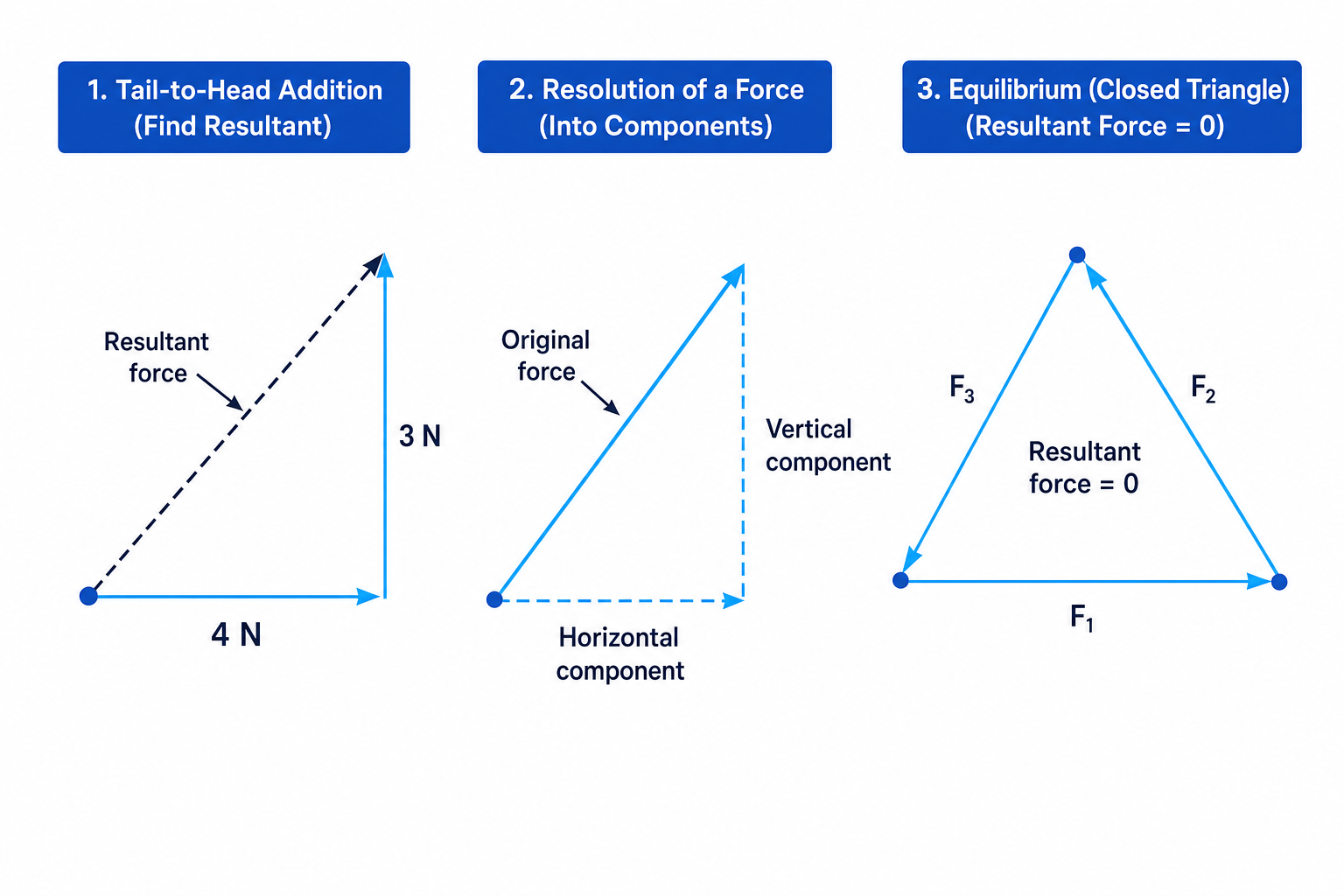
For Higher Tier, you may also need to use vector diagrams to show resolution of forces. This means splitting one force into perpendicular components, usually horizontal and vertical. You may also draw forces tip-to-tail to find a resultant, or show equilibrium when the force arrows form a closed shape.
Vector diagram shortcut
For a resultant force, place arrows head-to-tail and draw the resultant from the start of the first arrow to the end of the last arrow. If the arrows form a closed loop, the resultant force is zero.
Newton’s first law
Newton’s first law says that if the resultant force on an object is zero, the object will:
- stay stationary, if it was already stationary
- continue moving at uniform velocity, if it was already moving
Uniform velocity means constant speed in a straight line. Velocity is a vector, so direction matters.
If an object’s speed changes or its direction changes, its velocity changes. That means there must be a resultant force.
Forces are not needed to keep steady motion going
An object moving at constant velocity has zero resultant force. A force is needed to change velocity, not to keep velocity constant.
Newton’s second law
Acceleration is the rate of change of velocity. If the resultant force on an object is bigger, the acceleration is bigger. If the mass is bigger, the acceleration is smaller for the same force.
You need to recall and apply:
F=maF = maF=mawhere:
- FFF is resultant force in newtons (N)
- mmm is mass in kilograms (kg)
- aaa is acceleration in metres per second squared (m/s²)
Use the resultant force
In F=maF = maF=ma, the force is the resultant force, not just any one force acting on the object.
Using Newton’s second law
A trolley has a mass of 3.0 kg. A motor provides a forward force of 10 N, and friction is 4 N backwards. Calculate the acceleration.
-
Find the resultant force by subtracting the opposing friction: 10 N−4 N=6 N10\ \text{N} - 4\ \text{N} = 6\ \text{N}10 N−4 N=6 N forwards.
-
Substitute into a=Fma = \frac{F}{m}a=mF:
a=6.0 N3.0 kg=2.0 m/s2a = \frac{6.0\ \text{N}}{3.0\ \text{kg}} = 2.0\ \text{m/s}^2a=3.0 kg6.0 N=2.0 m/s2 -
The acceleration is 2.0 m/s² forwards.
In practical work, trolleys, masses and light gates can be used to investigate how acceleration changes when force or mass changes.
For Higher Tier, inertia is how difficult it is to change an object’s velocity. Inertial mass is defined by:
m=Fam = \frac{F}{a}m=aFA larger inertial mass means the same resultant force produces a smaller acceleration.
Terminal velocity
For Higher Tier, you should be able to explain terminal velocity using free-body diagrams.
When an object falls, its weight acts downwards. As it speeds up, air resistance or drag increases upwards. Eventually, drag becomes equal to weight. The resultant force is then zero, so the object falls at constant velocity. This is terminal velocity.
Explaining a parachute opening
A skydiver is falling and then opens a parachute.
- Before the parachute opens, the skydiver speeds up until air resistance equals weight, so the skydiver reaches a terminal velocity.
- When the parachute opens, air resistance suddenly becomes larger than weight, giving an upward resultant force, so the skydiver slows down.
- As the skydiver slows, air resistance decreases until it equals weight again, giving a new, lower terminal velocity.
Newton’s third law
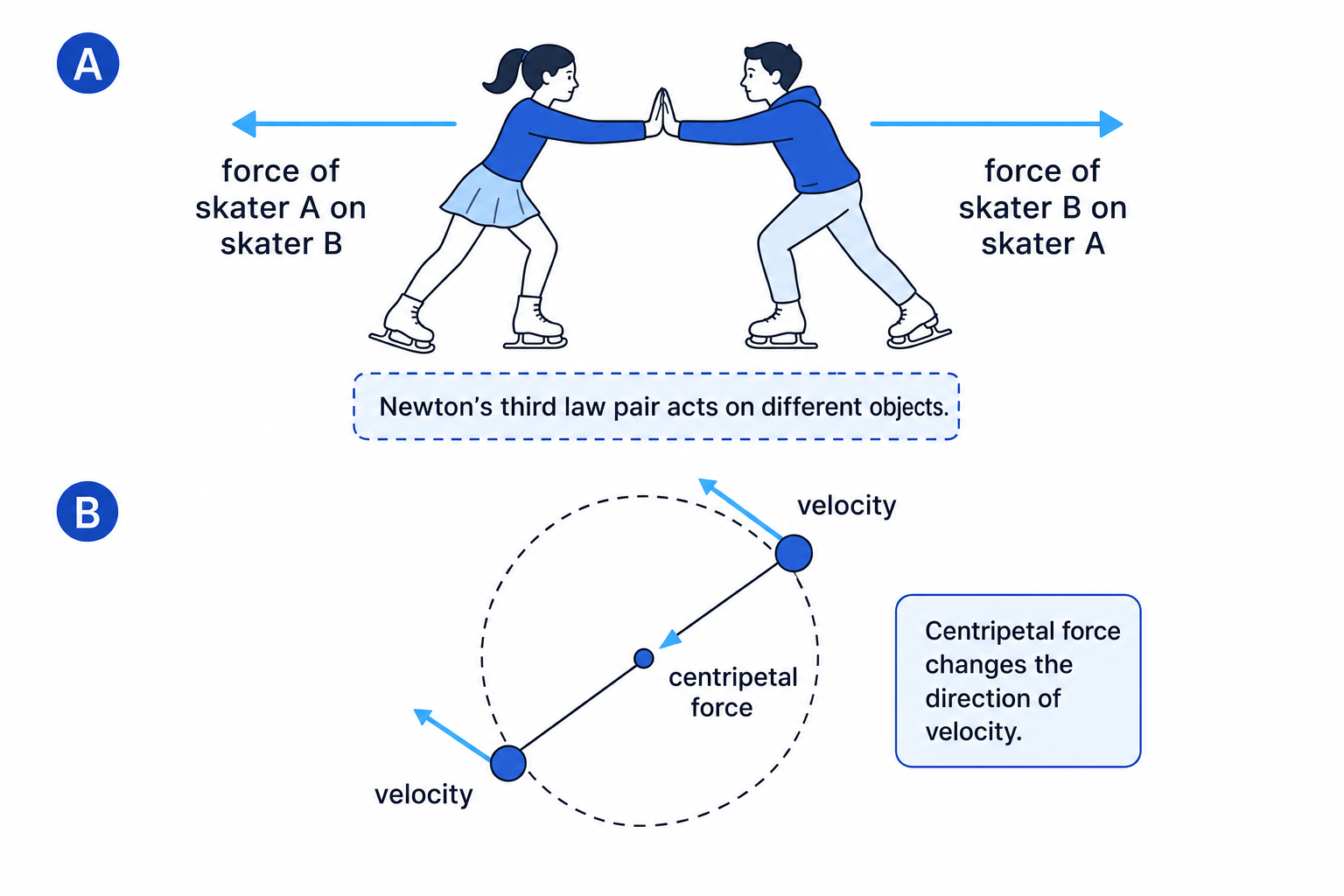
Newton’s third law says that if object A exerts a force on object B, then object B exerts an equal and opposite force on object A.
These two forces:
- are the same type of force
- are equal in size
- act in opposite directions
- act on different objects
This applies whether the objects are in equilibrium or not. For example, if two ice skaters push each other, each skater feels an equal and opposite force, but their accelerations may differ if their masses are different.
For Higher Tier, you also need to know that an object moving in a circle at constant speed has a changing velocity, because its direction is constantly changing. A resultant force towards the centre of the circle changes the direction of motion.
Third-law pairs do not cancel
Newton’s third-law forces act on different objects, so they do not cancel each other on one free-body diagram. Balanced forces cancel only when they act on the same object.
Momentum
For Higher Tier, you need to recall and apply:
p=mvp = mvp=mvwhere:
- ppp is momentum in kilogram metres per second (kg m/s)
- mmm is mass in kilograms (kg)
- vvv is velocity in metres per second (m/s)
Momentum is a vector because velocity has direction.
In a collision or explosion, total momentum is conserved if there is no external resultant force on the system. A system is the group of objects you are considering.
Calculating momentum after a collision
A 0.50 kg trolley moving at 2.0 m/s collides with a stationary 0.50 kg trolley. They stick together. Calculate their speed after the collision.
-
Calculate the initial momentum of the moving trolley:
p=mv=0.50 kg×2.0 m/s=1.0 kg m/sp = mv = 0.50\ \text{kg} \times 2.0\ \text{m/s} = 1.0\ \text{kg m/s}p=mv=0.50 kg×2.0 m/s=1.0 kg m/s -
The second trolley is stationary, so its initial momentum is 0 kg m/s. Total momentum before collision is 1.0 kg m/s.
-
After collision, the total mass is 1.0 kg. Using conservation of momentum:
v=pm=1.0 kg m/s1.0 kg=1.0 m/sv = \frac{p}{m} = \frac{1.0\ \text{kg m/s}}{1.0\ \text{kg}} = 1.0\ \text{m/s}v=mp=1.0 kg1.0 kg m/s=1.0 m/s
Work done and energy transfer
Work done means energy transferred by a force moving an object through a distance. You need to recall and apply:
work done=force×distance\text{work done} = \text{force} \times \text{distance}work done=force×distanceThe distance must be measured along the line of action of the force, which means in the direction the force acts.
Work done is measured in joules (J). One newton-metre is equal to one joule:
1 N m=1 J1\ \text{N m} = 1\ \text{J}1 N m=1 JFor example, lifting an object transfers energy to its gravitational store. Dragging an object against friction transfers energy to thermal stores.
Distance must match the force direction
Use the distance moved in the direction of the force. If the force and movement are not along the same line, this simple equation only uses the component of force along the movement.
Power
Power is the rate at which energy is transferred, or the rate at which work is done. You need to recall and apply:
P=WtP = \frac{W}{t}P=tWwhere:
- PPP is power in watts (W)
- WWW is work done in joules (J)
- ttt is time in seconds (s)
One watt means one joule transferred per second.
Calculating work done and power
A student lifts a weight using a force of 45 N through a vertical distance of 2.0 m. The lift takes 3.0 s.
-
Calculate the work done using force multiplied by distance:
W=45 N×2.0 m=90 JW = 45\ \text{N} \times 2.0\ \text{m} = 90\ \text{J}W=45 N×2.0 m=90 J -
Use power equals work done divided by time:
P=90 J3.0 s=30 WP = \frac{90\ \text{J}}{3.0\ \text{s}} = 30\ \text{W}P=3.0 s90 J=30 W -
The student transfers energy at a rate of 30 W.
In the exam
- Start force questions by drawing or imagining a free-body diagram for one object only.
- Use the phrase “resultant force” when explaining changes in motion.
- In F=maF = maF=ma, use the resultant force and include the direction of acceleration.
- For third-law pairs, check that the two forces act on different objects.
- For work and power calculations, keep units in N, m, J, s and W.
Check yourself
- A car travels at constant velocity. What is the resultant force on it?
- A 2.0 kg object has a resultant force of 8.0 N. What is its acceleration?
- Why does an object moving in a circle at constant speed still have changing velocity?