

What you'll learn
- How to measure distance and time, then use them to calculate speed.
- How to tell the difference between scalar quantities and vector quantities.
- How to interpret distance–time graphs and velocity–time graphs.
- How to use the motion equations for acceleration and kinetic energy.
Describing motion
An object is in motion when its position changes compared with a chosen reference point. A reference point is the place or object you compare the motion to.
For example, if you sit on a bus, you are stationary relative to the bus seat, but moving relative to the road.
Measuring distance and time
Distance is how far an object travels. In physics, distance is usually measured in metres (m).
Time is how long something takes. Time is measured in seconds (s).
You can measure distance and time in different ways:
- For a person running: use a tape measure for distance and a stopwatch for time.
- For a trolley on a ramp: use a metre rule for distance and light gates or a data logger for time.
- For fast or awkward motion: use video analysis, motion sensors, or light gates to reduce reaction-time error.
Choosing measurements for a trolley on a ramp
A class investigates the motion of a trolley down a ramp.
- Measure the distance along the ramp between two fixed points, not just the horizontal distance across the bench.
- Use light gates rather than a hand stopwatch because the trolley may move quickly, so human reaction time could be a large source of error.
- Repeat the run several times and calculate a mean time before using it to calculate speed.
Speed: how quickly distance is covered
Speed
Speed is the rate at which distance is travelled. It tells you how much distance is covered each second.
Speed is measured in metres per second (m/s). In P2.1, you must recall and apply this equation:
d=v×td = v \times td=v×twhere:
- ddd is distance travelled in metres (m)
- vvv is speed in metres per second (m/s)
- ttt is time in seconds (s)
You can rearrange it to calculate speed:
v=dtv = \frac{d}{t}v=tdCalculating speed from distance and time
A student runs 60 m in 8.0 s. Calculate their average speed.
- Choose the speed form of the equation: v=dtv = \frac{d}{t}v=td.
- Substitute the values with units: v=60 m8.0 sv = \frac{60\ \text{m}}{8.0\ \text{s}}v=8.0 s60 m.
- Calculate: v=7.5 m/sv = 7.5\ \text{m/s}v=7.5 m/s.
Unit conversions and rates
A rate tells you how quickly one quantity changes compared with another. Speed is a rate because it compares distance with time.
Before using equations, check that your units are SI units: metres, seconds, metres per second.
Quick speed conversions
- To convert kilometres per hour to metres per second, divide by 3.6.
- To convert metres per second to kilometres per hour, multiply by 3.6.
Converting speed and finding distance
A car travels at 72 km/h for 5.0 s. Calculate the distance travelled in metres.
- Convert the speed to metres per second: 72÷3.6=20 m/s72 \div 3.6 = 20\ \text{m/s}72÷3.6=20 m/s.
- Use d=v×td = v \times td=v×t with the converted speed: d=20 m/s×5.0 sd = 20\ \text{m/s} \times 5.0\ \text{s}d=20 m/s×5.0 s.
- Calculate the distance: d=100 md = 100\ \text{m}d=100 m.
Average speed for non-uniform motion
Uniform motion means moving at a constant speed. Non-uniform motion means the speed changes during the journey.
For non-uniform motion, average speed is:
average speed=total distance travelledtotal time taken\text{average speed} = \frac{\text{total distance travelled}}{\text{total time taken}}average speed=total time takentotal distance travelledThe total time includes stops.
Calculating average speed with a stop
A cyclist travels 300 m in 20 s, stops for 10 s, then travels another 200 m in 25 s.
- Add the distances: 300 m+200 m=500 m300\ \text{m} + 200\ \text{m} = 500\ \text{m}300 m+200 m=500 m.
- Add the whole journey time, including the stop: 20 s+10 s+25 s=55 s20\ \text{s} + 10\ \text{s} + 25\ \text{s} = 55\ \text{s}20 s+10 s+25 s=55 s.
- Calculate average speed: 500 m55 s=9.1 m/s\frac{500\ \text{m}}{55\ \text{s}} = 9.1\ \text{m/s}55 s500 m=9.1 m/s.
Scalars and vectors
Scalars and vectors
- A scalar has size only.
- A vector has size and direction.
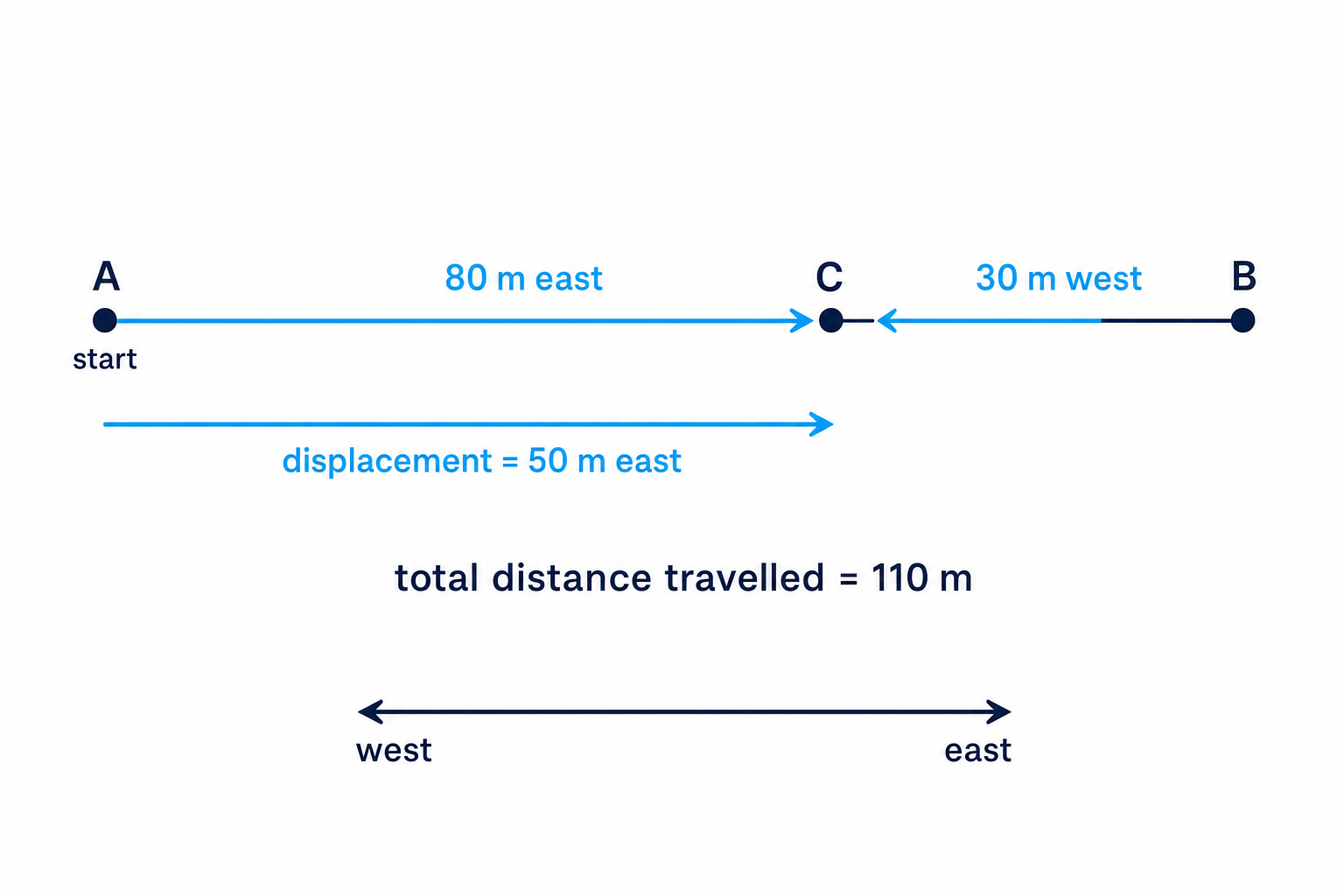
Distance is a scalar: it only tells you the total length travelled.
Displacement is a vector: it tells you the straight-line change in position from start to finish, including direction.
Speed is a scalar. Velocity is a vector: it is speed in a stated direction.
This diagram shows why distance and displacement are not the same thing.
Calculating distance and displacement
A student walks 80 m east, then 30 m west.
- For distance, add the full path travelled: 80 m+30 m=110 m80\ \text{m} + 30\ \text{m} = 110\ \text{m}80 m+30 m=110 m.
- For displacement, choose east as positive: +80 m−30 m=+50 m+80\ \text{m} - 30\ \text{m} = +50\ \text{m}+80 m−30 m=+50 m.
- State the vector with direction: the displacement is 50 m east.
Negative velocity is allowed
Speed cannot be negative, but velocity can be negative if the object moves in the chosen negative direction. Negative velocity does not automatically mean the object is slowing down.
Acceleration
Acceleration
Acceleration is the rate of change of velocity. It tells you how much the velocity changes each second.
Acceleration is measured in metres per second squared (m/s²). In P2.1, you must recall and apply:
a=Δvt=v−uta = \frac{\Delta v}{t} = \frac{v-u}{t}a=tΔv=tv−uwhere:
- aaa is acceleration in m/s²
- vvv is final velocity in m/s
- uuu is initial velocity in m/s
- ttt is time in seconds
- Δv\Delta vΔv means change in velocity
Calculating acceleration
A cyclist speeds up from 3.0 m/s to 11.0 m/s in 4.0 s. Calculate the acceleration.
- Find the change in velocity: 11.0 m/s−3.0 m/s=8.0 m/s11.0\ \text{m/s} - 3.0\ \text{m/s} = 8.0\ \text{m/s}11.0 m/s−3.0 m/s=8.0 m/s.
- Substitute into a=Δvta = \frac{\Delta v}{t}a=tΔv: a=8.0 m/s4.0 sa = \frac{8.0\ \text{m/s}}{4.0\ \text{s}}a=4.0 s8.0 m/s.
- Calculate: a=2.0 m/s2a = 2.0\ \text{m/s}^2a=2.0 m/s2.
Uniform acceleration without time
For motion with uniform acceleration, the acceleration is constant.
This equation is an apply equation in P2.1: it is provided on the equation sheet, but you still need to recognise when to use it and rearrange it correctly.
v2−u2=2asv^2 - u^2 = 2asv2−u2=2aswhere sss is the distance travelled in metres.
Only for uniform acceleration
Use v2−u2=2asv^2 - u^2 = 2asv2−u2=2as only when the acceleration is constant. It is especially useful when the question gives speeds and distance, but not time.
Finding acceleration without time
A car accelerates uniformly from 5.0 m/s to 15.0 m/s over a distance of 50 m. Calculate the acceleration.
- Time is not given, so choose v2−u2=2asv^2 - u^2 = 2asv2−u2=2as.
- Rearrange for acceleration: a=v2−u22sa = \frac{v^2-u^2}{2s}a=2sv2−u2.
- Substitute: a=15.02−5.022×50a = \frac{15.0^2 - 5.0^2}{2 \times 50}a=2×5015.02−5.02.
- Calculate: a=225−25100=2.0 m/s2a = \frac{225 - 25}{100} = 2.0\ \text{m/s}^2a=100225−25=2.0 m/s2.
Motion graphs
Graphs are a powerful way to describe a journey.
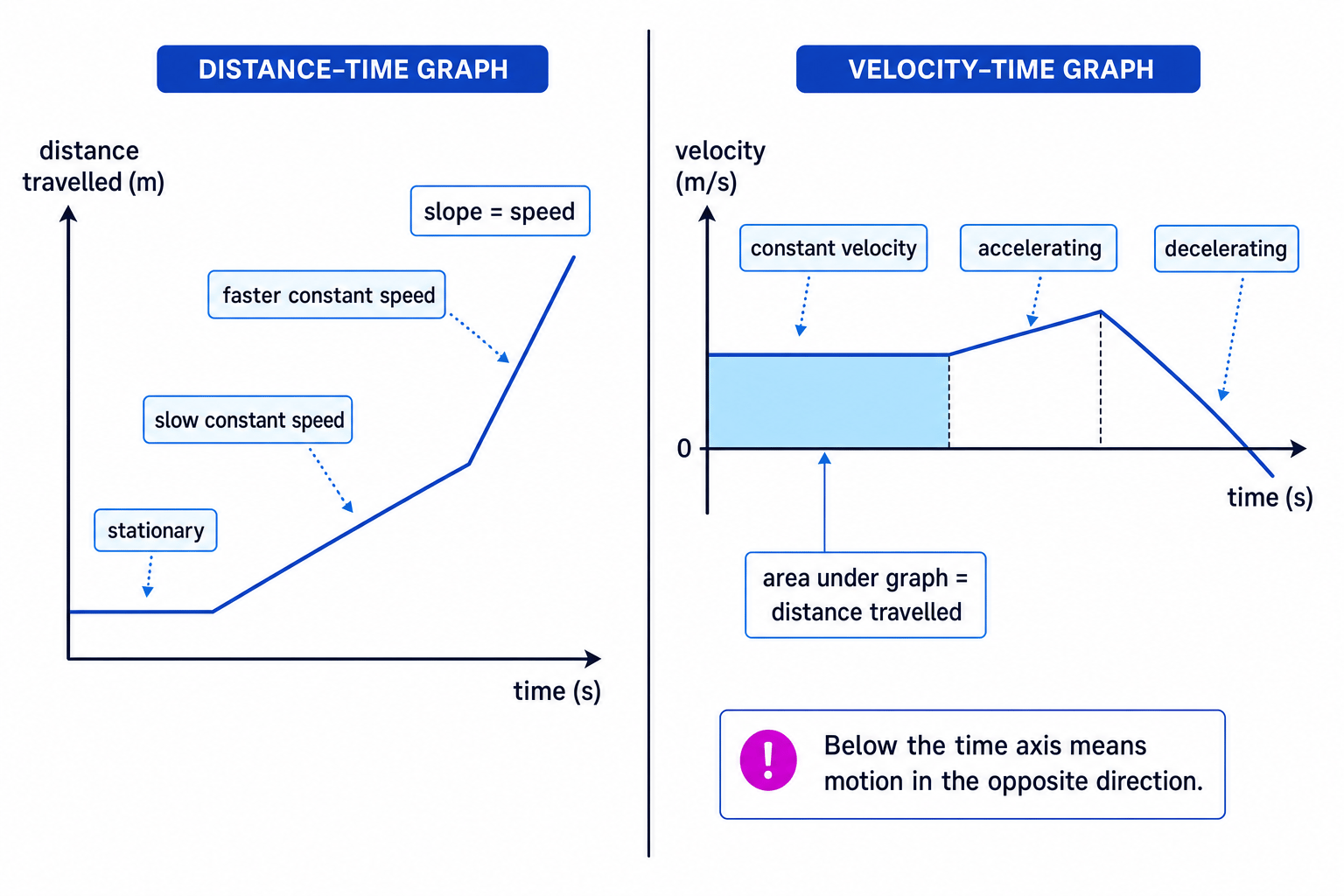
On a distance–time graph, the gradient gives speed. A horizontal line means stationary. A steeper line means a higher speed.
On a velocity–time graph, the gradient gives acceleration. A horizontal line means constant velocity. If the graph goes below the time axis, the object is moving in the opposite direction.
The diagram below compares the key shapes on distance–time and velocity–time graphs.
Gradients on motion graphs
- Distance–time graph: gradient gives speed.
- Velocity–time graph: gradient gives acceleration.
Finding speed from a distance-time graph
A distance–time graph shows an object moving from 20 m to 80 m between 4 s and 10 s. Calculate its speed during this section.
- Find the change in distance: 80 m−20 m=60 m80\ \text{m} - 20\ \text{m} = 60\ \text{m}80 m−20 m=60 m.
- Find the change in time: 10 s−4 s=6 s10\ \text{s} - 4\ \text{s} = 6\ \text{s}10 s−4 s=6 s.
- Use gradient: speed=60 m6 s=10 m/s\text{speed} = \frac{60\ \text{m}}{6\ \text{s}} = 10\ \text{m/s}speed=6 s60 m=10 m/s.
If you are sitting Higher Tier, you also need to interpret enclosed areas on velocity–time graphs. The area between the line and the time axis gives the distance travelled if the velocity is positive throughout. If parts are below the time axis, the signed area gives displacement.
Using a velocity-time graph
A velocity–time graph shows an object accelerating from 0 to 12 m/s in 4 s, then moving at 12 m/s for another 6 s.
- Find the acceleration from the first section’s gradient: 12 m/s−0 m/s4 s=3.0 m/s2\frac{12\ \text{m/s} - 0\ \text{m/s}}{4\ \text{s}} = 3.0\ \text{m/s}^24 s12 m/s−0 m/s=3.0 m/s2.
- Find the distance during acceleration using the triangle area: 12×4 s×12 m/s=24 m\frac{1}{2} \times 4\ \text{s} \times 12\ \text{m/s} = 24\ \text{m}21×4 s×12 m/s=24 m.
- Find the distance during constant velocity using the rectangle area: 6 s×12 m/s=72 m6\ \text{s} \times 12\ \text{m/s} = 72\ \text{m}6 s×12 m/s=72 m.
- Add the areas: 24 m+72 m=96 m24\ \text{m} + 72\ \text{m} = 96\ \text{m}24 m+72 m=96 m.
Gradient and area do different jobs
On a distance–time graph, gradient gives speed. On a velocity–time graph, gradient gives acceleration, while area under the line gives distance or displacement.
Kinetic energy
Kinetic energy
Kinetic energy is the energy an object has because it is moving.
Kinetic energy is measured in joules (J). In P2.1, you must recall and apply:
Ek=12mv2E_k = \frac{1}{2}mv^2Ek=21mv2where:
- EkE_kEk is kinetic energy in joules (J)
- mmm is mass in kilograms (kg)
- vvv is speed in metres per second (m/s)
Speed has a big effect
Kinetic energy depends on speed squared, so doubling the speed makes the kinetic energy four times bigger.
Calculating kinetic energy
A 0.20 kg ball moves at 15 m/s. Calculate its kinetic energy.
- Choose the kinetic energy equation: Ek=12mv2E_k = \frac{1}{2}mv^2Ek=21mv2.
- Substitute the values: Ek=12×0.20 kg×152E_k = \frac{1}{2} \times 0.20\ \text{kg} \times 15^2Ek=21×0.20 kg×152.
- Calculate: Ek=22.5 JE_k = 22.5\ \text{J}Ek=22.5 J.
In the exam
- Convert units before substituting into equations, especially km/h to m/s and minutes to seconds.
- For graphs, read the axis labels carefully before deciding whether you need gradient or area.
- Include direction for vectors such as displacement and velocity, especially if a value could be negative.
Check yourself
- How would you calculate the average speed of a journey that includes a stop?
- What is the difference between distance and displacement?
- On a velocity–time graph, what do the gradient and the area under the line represent?
