What you'll learn
- Why stretching, bending or compressing an object needs forces acting in different places.
- How springs behave, including elastic deformation, plastic deformation and Hooke’s law.
- How to calculate spring constant and work done in stretching.
- How gravitational fields cause weight, free fall and gravitational potential energy.
Forces can change shape
A force is a push or pull on an object. Forces can change an object’s motion, but they can also change its shape.
To stretch, bend or compress an object, you need more than one force acting on it. A single unbalanced force mainly makes the whole object accelerate. Deformation happens when different parts of the object are pushed or pulled in different directions.
Deformation
A deformation is a change in shape. Stretching makes an object longer, compression makes it shorter or squashed, and bending changes its shape without simply making it longer or shorter.
For example, an elastic band stretches because your two hands pull opposite ends. A sponge is compressed because your hand pushes down while the table pushes up. A ruler bends because one part is held while another part is pushed.
Explaining why a spring stretches
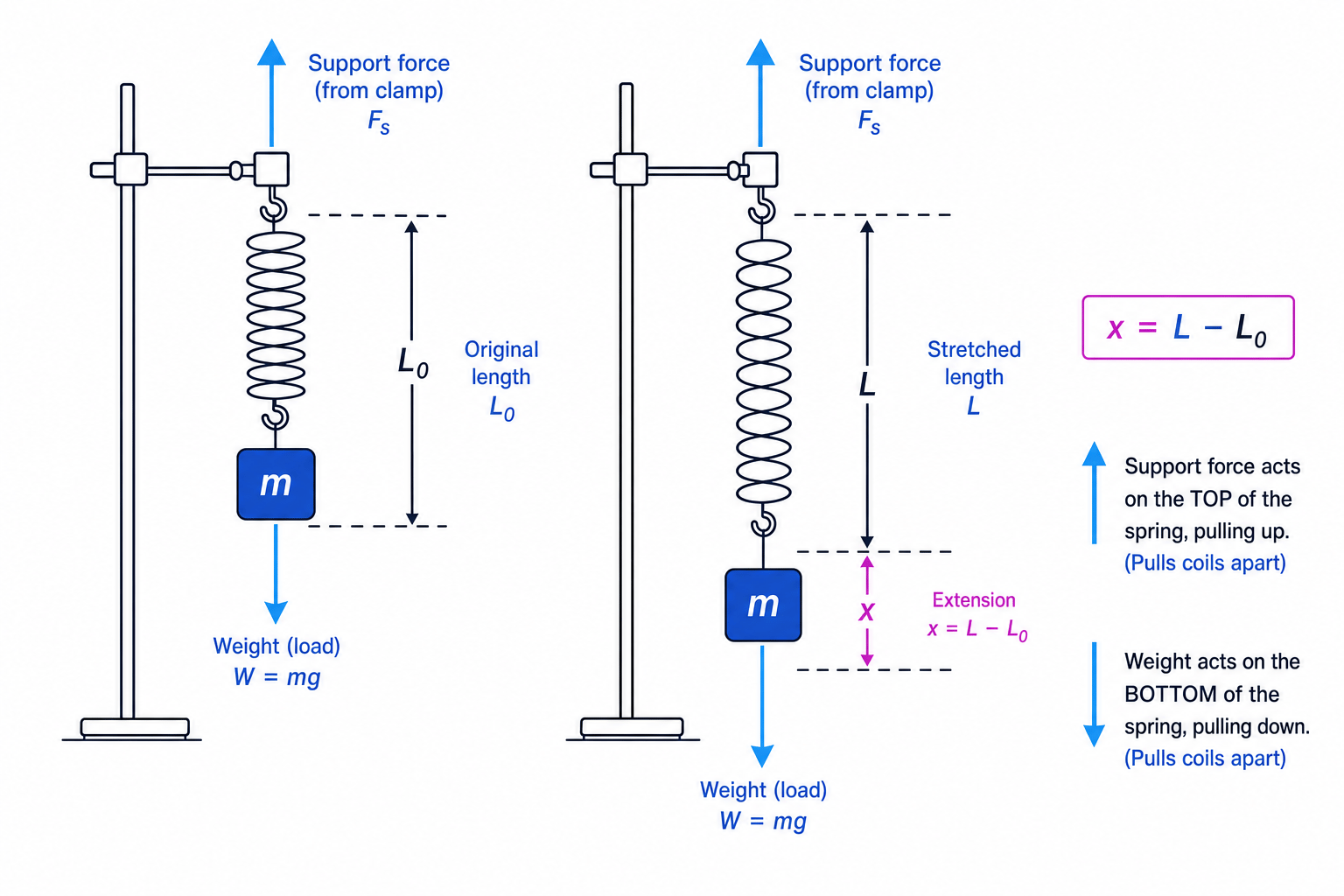
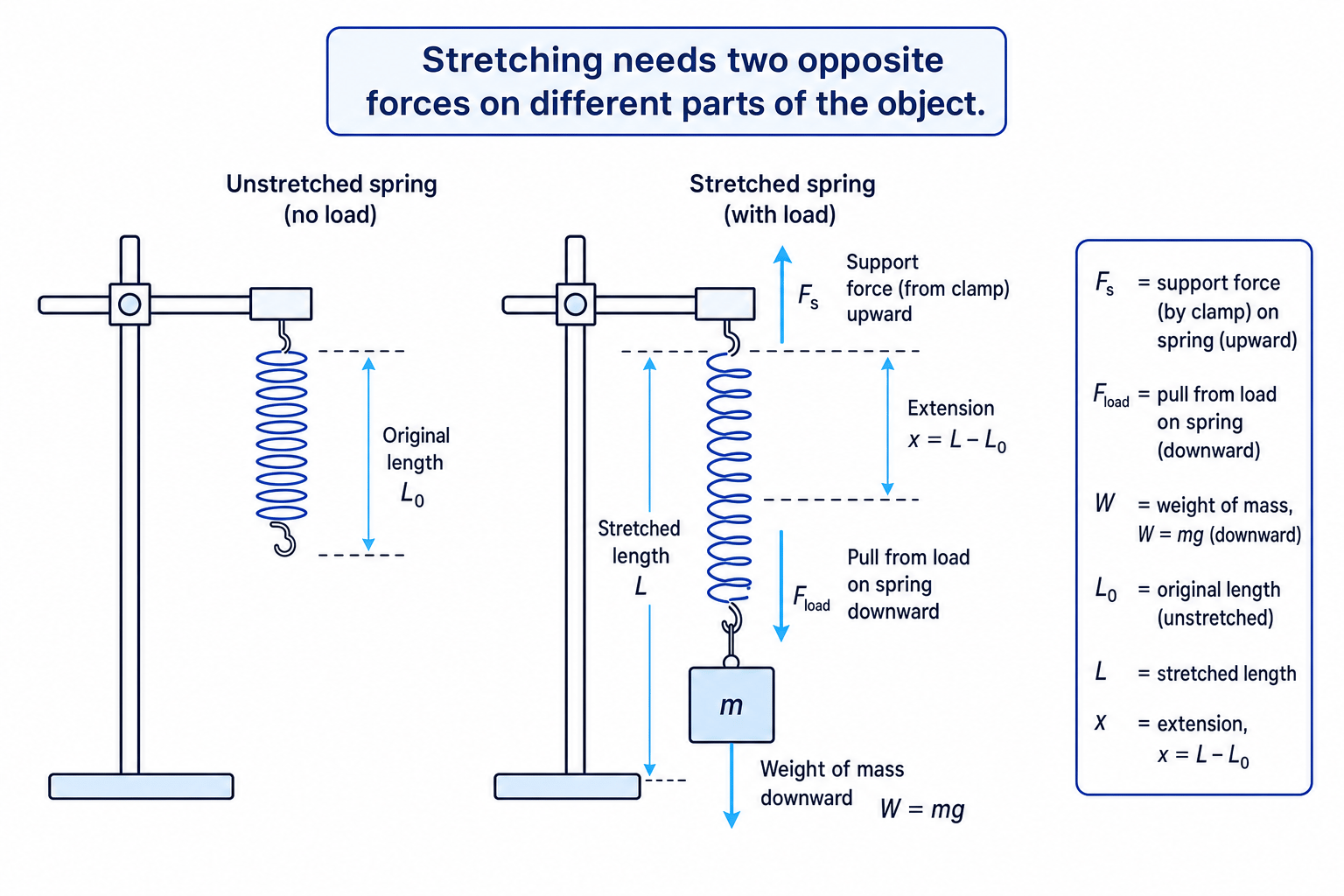
A mass is hung from a spring fixed to a clamp stand. Explain why the spring is deformed.
- The load pulls downward on the lower end of the spring, while the clamp pulls upward on the upper end.
- These forces act in opposite directions on different parts of the spring, so the coils are pulled apart and the spring stretches.
- If the clamp were removed, the spring and mass would accelerate downward instead of being held in a stretched position.
Elastic and plastic deformation
When a force is removed, objects do not all behave in the same way.
Elastic and plastic deformation
- Elastic deformation means the object returns to its original shape when the force is removed.
- Plastic deformation means the object does not return fully to its original shape, so the deformation is permanent.
Springs, rubber bands and bungee cords are designed to deform elastically over a useful range. Plasticine, bent paperclips and car crumple zones show plastic deformation: the shape change remains after the force is removed.
The elastic limit is the point beyond which an object will not return to its original shape. In real life, useful safety designs depend on this. A car crumple zone is meant to deform plastically to transfer energy away from the passengers, while a mattress spring should deform elastically so it returns to shape.
Extension: the key measurement for springs
For springs, you usually measure extension, not just length.
Extension
The extension, xxx, is the increase in length of an object:
x=stretched length−original lengthx = \text{stretched length} - \text{original length}x=stretched length−original lengthExtension is measured in metres (m).
Using length instead of extension
If a spring is originally 12 cm long and becomes 17 cm long, the extension is 5 cm, not 17 cm. Always subtract the original length first, then convert to metres if needed.
Hooke’s law
For many springs, as long as they are not stretched too far, the force is directly proportional to the extension. This is Hooke’s law.
Hooke’s law
For a spring in its linear region:
F=kxF = kxF=kxYou need to recall and apply this equation. FFF is force in newtons (N), kkk is spring constant in newtons per metre (N/m), and xxx is extension in metres (m).
The spring constant, kkk, tells you how stiff a spring is. A larger spring constant means a larger force is needed for the same extension.
Calculating spring constant
A spring is 10.0 cm long at first. A 2.5 N force stretches it to 15.0 cm. Calculate the spring constant.
- Calculate the extension: 15.0 cm - 10.0 cm = 5.0 cm, which is 0.050 m.
- Rearrange Hooke’s law: from F=kxF = kxF=kx, so k=Fxk = \frac{F}{x}k=xF.
- Substitute and calculate:
Unit check
Spring constant is in N/m, so extension must be in metres. Convert centimetres to metres before substituting into F=kxF = kxF=kx.
Force-extension graphs
A force-extension graph shows how the force changes as the extension changes.
A linear relationship gives a straight line. If the straight line goes through the origin, force is directly proportional to extension. A non-linear relationship gives a curve, so the gradient changes as the object stretches.
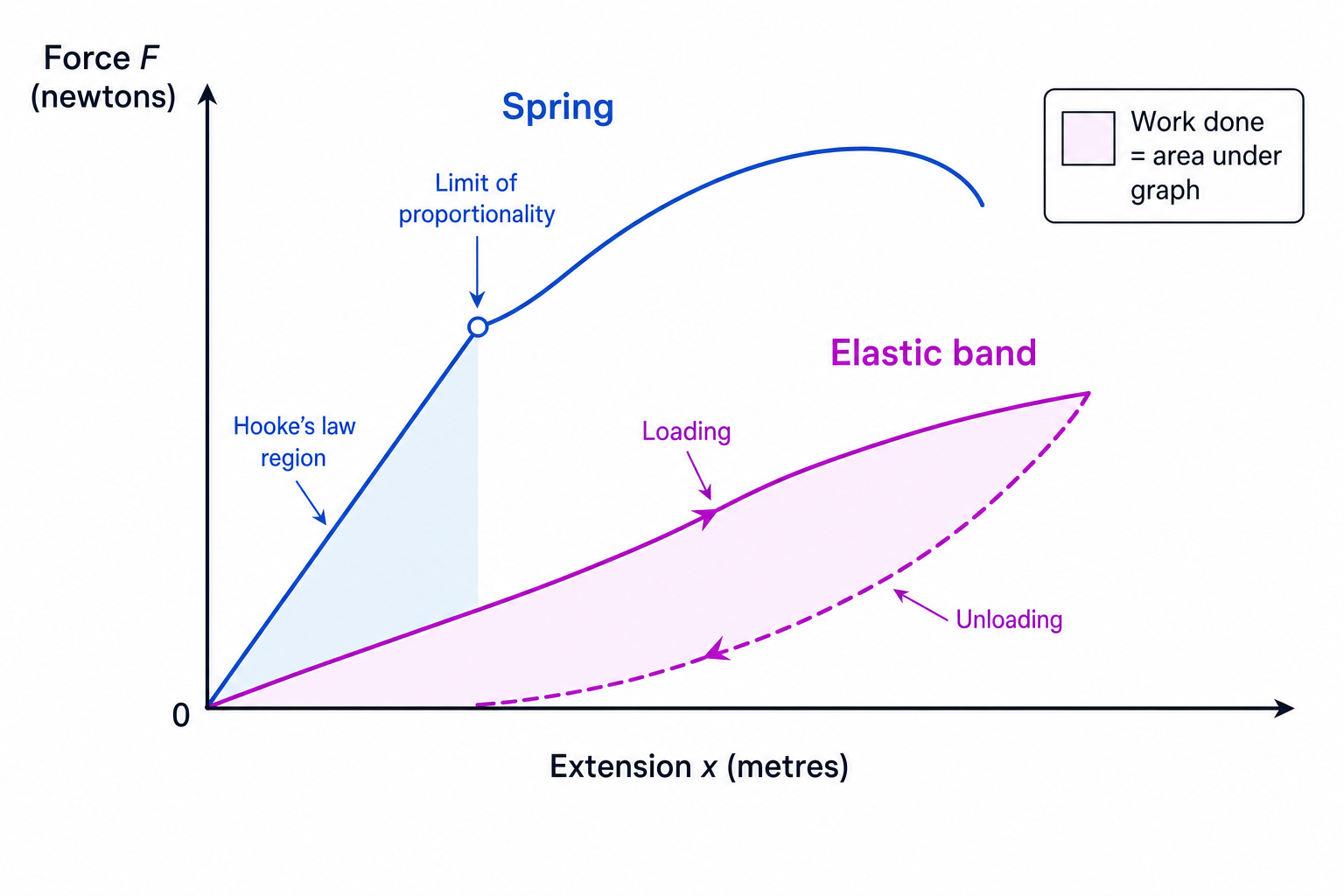
For a spring, the first straight-line part is the Hooke’s law region. The limit of proportionality is where the graph stops being a straight line. After this point, F=kxF = kxF=kx no longer works because the spring constant is not constant.
Elastic bands often have non-linear force-extension graphs. Their loading and unloading curves may be different, meaning some energy is transferred to the surroundings, usually as thermal energy.
Gradient of the graph
If force is on the vertical axis and extension is on the horizontal axis, the gradient of the straight-line section is the spring constant, kkk. If the axes are swapped, the gradient is not kkk.
In the Hooke’s law practical, you add masses, convert their mass to weight, measure the spring’s length, calculate extension, and plot a graph. Adding the masses gradually helps you avoid passing the elastic limit too soon.
Work done in stretching
When you stretch a spring or elastic band, a force moves through a distance. This means work is done, so energy is transferred. If the deformation is elastic, much of this energy is stored as elastic potential energy.
For any force-extension graph:
Work from a force-extension graph
The work done in stretching is the area under the force-extension graph.
For a spring obeying Hooke’s law, the graph is a straight line through the origin, so the area is a triangle. This gives:
E=12kx2E = \frac{1}{2}kx^2E=21kx2OCR lists this as an equation to apply, so it is supplied on the equation sheet, but you must know how to use it correctly. EEE is energy transferred in joules (J), kkk is spring constant in N/m, and xxx is extension in m.
When the spring formula works
The equation E=12kx2E = \frac{1}{2}kx^2E=21kx2 is for a linear spring starting from zero extension. For a non-linear graph, use the area under the graph instead.
Calculating energy stored in a stretched spring
A spring with spring constant 80 N/m is stretched by 0.15 m. Calculate the energy transferred to the spring.
- The extension is already in metres, and the spring is being treated as a linear spring, so use E=12kx2E = \frac{1}{2}kx^2E=21kx2.
- Substitute the values:
- Calculate the squared extension and final energy:
Forgetting to square the extension
In E=12kx2E = \frac{1}{2}kx^2E=21kx2, only the extension is squared. Doubling the extension makes the stored energy four times larger, as long as the spring stays in the linear region.
Gravitational fields
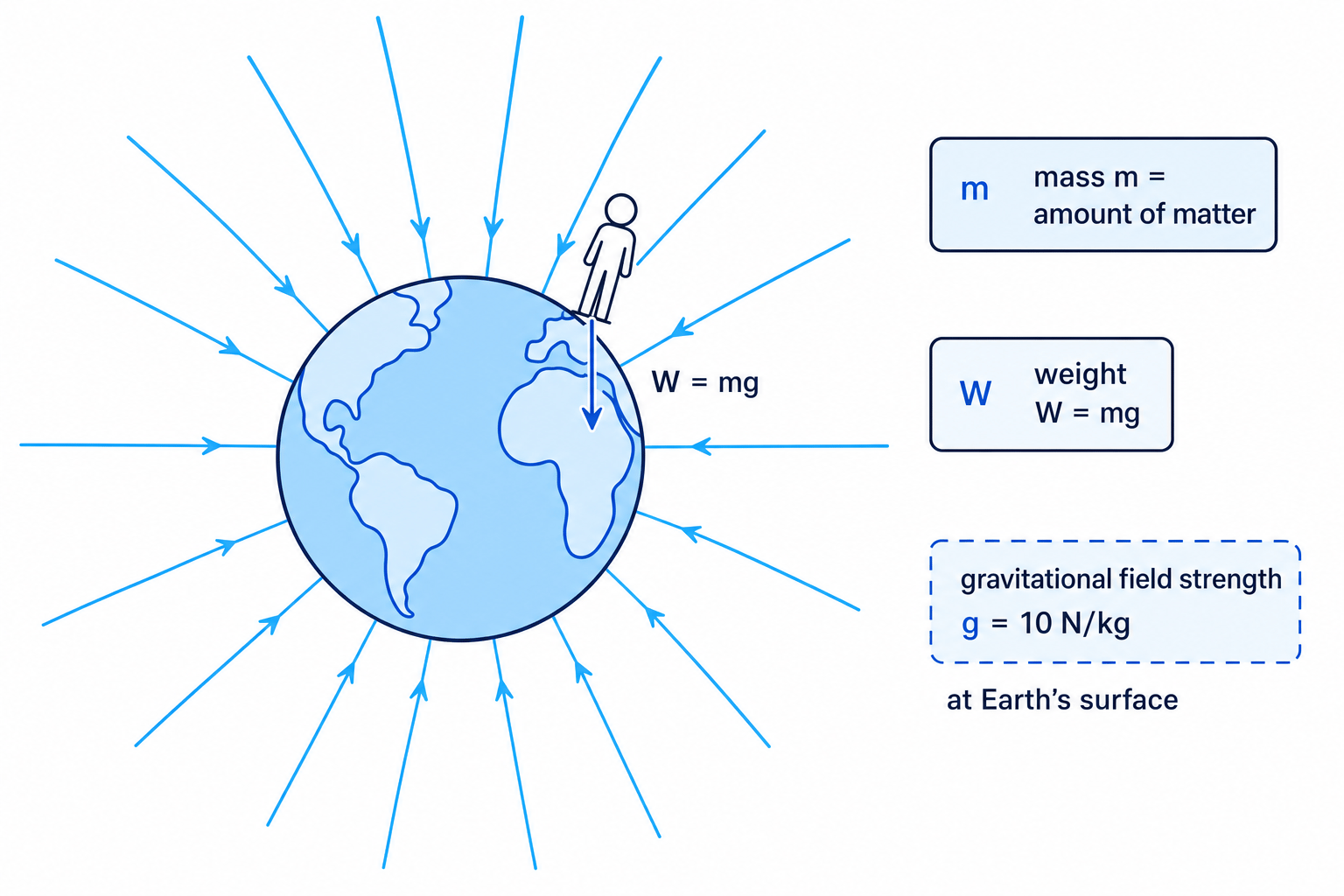
A field is a region where an object can experience a non-contact force. A gravitational field is the region around a mass where another mass experiences gravitational attraction.
All matter has a gravitational field, but the field is much stronger for very massive objects such as planets and stars. Near Earth, gravity pulls objects towards the centre of Earth.
Gravitational field strength
Gravitational field strength, ggg, is the force per kilogram on a mass in a gravitational field. Near Earth’s surface, g=10 N/kgg = 10\ \text{N/kg}g=10 N/kg.
Mass and weight
Mass is the amount of matter in an object. It is measured in kilograms (kg) and does not change when you move to another planet.
Weight is the gravitational force acting on an object. It is measured in newtons (N) using a newtonmeter.
Weight equation
Weight is calculated using:
W=mgW = mgW=mgYou need to recall and apply this equation. WWW is weight in N, mmm is mass in kg, and ggg is gravitational field strength in N/kg.
Mass is not weight
In everyday language people say “weighing” when they often mean measuring mass. In physics, mass is in kg and weight is in N. Your mass would be the same on the Moon, but your weight would be smaller because the Moon’s gravitational field strength is smaller.
Calculating weight on another planet
A student has a mass of 60 kg. Calculate their weight on Earth, where g=10 N/kgg = 10\ \text{N/kg}g=10 N/kg, and on Mars, where g=3.7 N/kgg = 3.7\ \text{N/kg}g=3.7 N/kg.
- On Earth, use W=mgW = mgW=mg:
- On Mars, use the different gravitational field strength:
- The mass stays 60 kg in both places, but the weight changes because ggg changes.
Free fall
An object is in free fall if gravity is the only force acting on it. Near Earth’s surface, the acceleration in free fall is 10 m/s² downwards.
This value is closely linked to gravitational field strength: 10 N/kg means each kilogram experiences 10 N of gravitational force, and 10 m/s² means the object’s velocity changes by 10 metres per second every second when only gravity acts.
If air resistance is significant, the object is not in pure free fall because there is another force acting.
Gravitational potential energy
When you lift an object, you do work against gravity. Energy is transferred to the object’s gravitational potential energy store.
Gravitational potential energy equation
Gravitational potential energy is calculated using:
Ep=mghE_p = mghEp=mghYou need to recall and apply this equation. EpE_pEp is energy in J, mmm is mass in kg, ggg is gravitational field strength in N/kg, and hhh is vertical height in m.
Only the vertical height change matters. Lifting a bag 1 m straight up and carrying it up a ramp to end 1 m higher both increase its gravitational potential energy by the same amount, ignoring friction and other losses.
Calculating gravitational potential energy
A 2.5 kg box is lifted onto a shelf 1.2 m above the floor. Calculate the increase in gravitational potential energy. Use g=10 N/kgg = 10\ \text{N/kg}g=10 N/kg.
- Identify the vertical height change as 1.2 m, because gravitational potential energy depends on height gained.
- Substitute into Ep=mghE_p = mghEp=mgh:
- Calculate the energy transferred:
In the exam
- For spring questions, use extension, not total length, and convert cm or mm into m before using equations.
- For graphs, decide whether the relationship is linear or non-linear; use gradient for spring constant only when force is on the vertical axis and extension is on the horizontal axis.
- For gravity questions, keep mass and weight separate: kg for mass, N for weight, and use g=10 N/kgg = 10\ \text{N/kg}g=10 N/kg near Earth unless another value is given.
Check yourself
- A spring changes length from 8.0 cm to 11.5 cm when a 1.4 N force is applied. What is its spring constant?
- Why does compressing a sponge on a table involve two forces?
- How are mass, weight and gravitational field strength linked?