

What you'll learn
- Why individuals in the same species are not all genetically identical.
- How random mutation and environmental selection pressures can lead to natural selection.
- What evolution means, including how new species may form over time.
- How fossils, antibiotic resistance, and DNA sequencing provide evidence for evolution and relationships between organisms.
Starting point: species, populations and genomes
A species is a group of organisms that can usually breed together to produce fertile offspring.
A population is all the organisms of the same species living in the same area at the same time.
The genome is the full set of genetic material in an organism. In most animal and plant cells, this genetic material is DNA found in chromosomes in the nucleus. A gene is a section of DNA that affects a characteristic, and an allele is a different version of a gene.
Genetic variation
Genetic variation means differences in the alleles carried by individuals in a population. GCSE Gateway expects you to know that there is usually extensive genetic variation within a population of a species.
Genetic variation matters because natural selection can only “work with” variation that already exists. If every individual had exactly the same alleles, there would be no genetic differences for the environment to select between.
Not all variation is genetic. Some differences are caused by the environment, such as scars, diet, exercise, or learning. Environmental differences are not usually passed on through genes.
Variation gives natural selection something to act on
A population usually contains many genetic variants. Some variants may give individuals a better chance of surviving and reproducing in a particular environment.
Mutation: where new genetic variation comes from
A mutation is a random change in DNA. Mutations can create new alleles.
Most mutations have no noticeable effect. Some are harmful. Very occasionally, a mutation gives an organism a useful characteristic in a particular environment.
Phenotype
A phenotype is the observable characteristics of an organism, such as fur colour, beak shape, height, or resistance to an antibiotic. Phenotype is affected by genes and often by the environment too.
A mutation does not happen because an organism “needs” it. Mutations are random. The environment then affects whether that mutation becomes more common.
Mutation is not purposeful
Do not write that an organism mutates “in order to survive”. Mutations happen randomly; if a mutation gives an advantage, natural selection may make it more common over generations.
Natural selection
Natural selection is the process where organisms with phenotypes better suited to their environment are more likely to survive and reproduce, so the alleles causing those phenotypes become more common in the population over generations.
A selection pressure is an environmental factor that affects survival and reproduction. Examples include predators, disease, competition for food, climate, or antibiotics.
This flow diagram shows the main logic of natural selection, from variation to a change in the population over many generations.
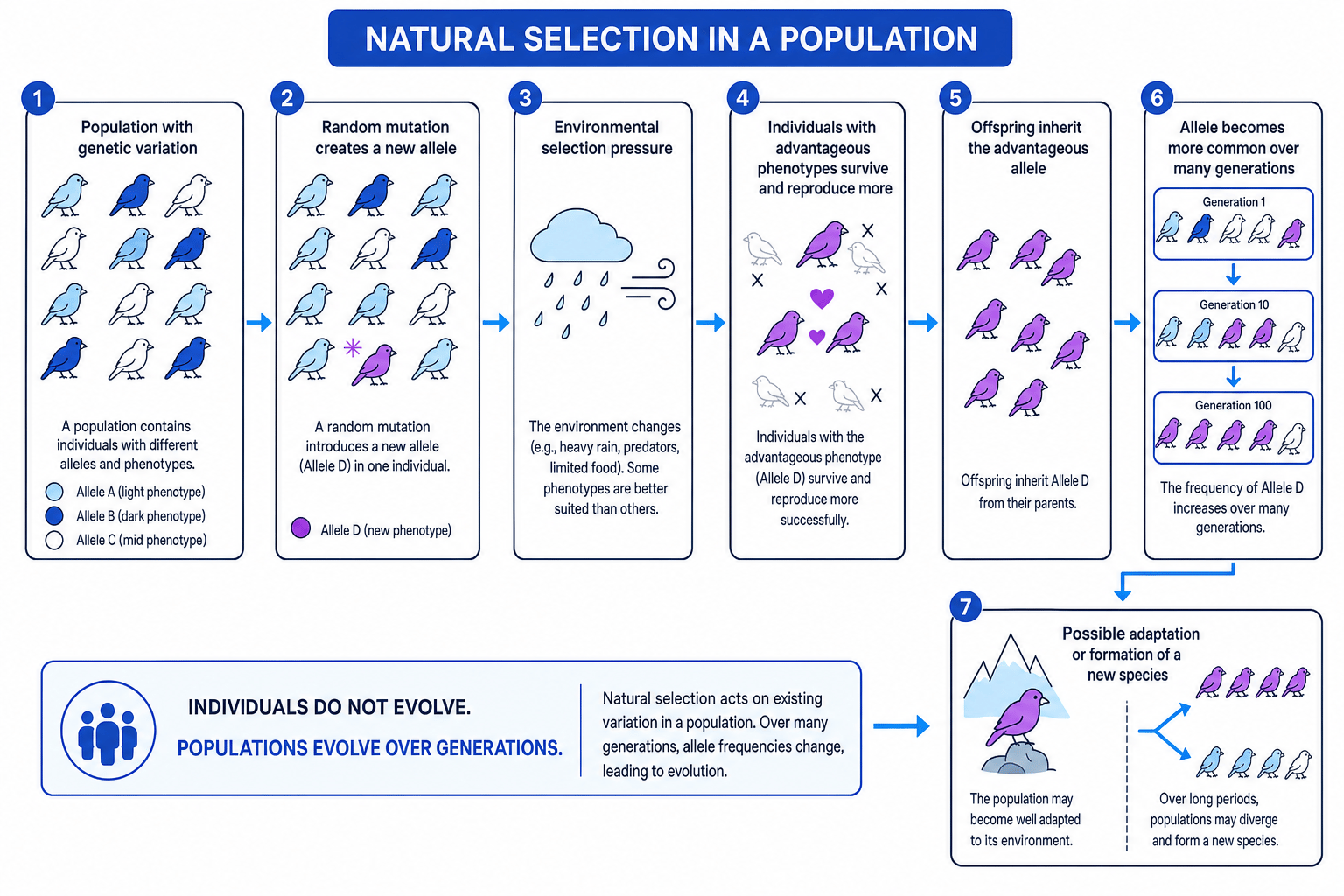
The basic sequence is:
- There is genetic variation in a population.
- A selection pressure affects the population.
- Individuals with advantageous phenotypes survive and reproduce more successfully.
- They pass on the advantageous alleles to their offspring.
- Over many generations, those alleles become more common.
- The population becomes better adapted to its environment.
Adaptation
An adaptation is an inherited characteristic that helps an organism survive and reproduce in its environment.
Explaining natural selection in moths
Suppose a population of moths lives on dark tree bark. Some moths are pale and some are dark.
- Identify the variation: the moth population contains genetic variation for body colour, so some moths have alleles for pale colour and some have alleles for dark colour.
- Apply the selection pressure: birds are predators, and pale moths are easier to see on dark bark, so they are more likely to be eaten.
- Compare survival and reproduction: dark moths are better camouflaged, so a greater proportion of dark moths survive long enough to reproduce.
- Link to inheritance: surviving dark moths pass the alleles for dark colour to their offspring.
- Describe the population change: over many generations, the allele for dark colour becomes more common, so the moth population evolves to contain a higher proportion of dark moths.
Individuals do not evolve
An individual organism cannot evolve during its lifetime by natural selection. Individuals may survive or die; populations evolve over many generations.
Evolution
Evolution
Evolution is a change in the inherited characteristics of a population over time, through a process such as natural selection.
Evolution can lead to biodiversity, which means the variety of living organisms. It also explains why organisms are related to different degrees. Species with a more recent common ancestor usually share more features and more similar DNA.
Over a very long time, evolution may result in the formation of a new species. This is called speciation.
How new species may form
Speciation often begins when populations of the same species become separated. This could happen because of a river, mountain range, island formation, climate change, or different behaviour.
If the separated populations experience different selection pressures, different alleles may become common in each population. After many generations, the populations may become so different that they can no longer breed together to produce fertile offspring.
Evolution changes populations over time
Natural selection can change allele frequencies in a population. If populations become separated and change in different ways for long enough, new species may form.
Extinction: when species cannot keep up
Extinction means that no individuals of a species remain alive.
Environmental change can leave some individuals, or even whole species, unable to compete, survive, and reproduce. This can happen if the change is too fast or too extreme.
Examples of causes of extinction include:
- rapid climate change
- new predators
- new diseases
- loss of habitat
- competition from a better-adapted species
- major events such as volcanic eruptions or asteroid impacts
Classification systems and developments in biology
Classification means organising organisms into groups. Classification systems have changed as biology has developed and scientists have collected better evidence.
Artificial classification
An artificial classification system groups organisms using obvious or convenient features, often chosen by humans. For example, you might group animals by whether they can fly.
This can be useful, but it may not show true evolutionary relationships. A bat, a bird, and an insect can all fly, but they are not closely related in the same way.
Natural classification
A natural classification system groups organisms according to many shared features and evolutionary relationships. It aims to reflect how closely organisms are related.
Early classification relied heavily on visible features, such as body structure. Improved microscopes helped scientists compare cells in more detail.
Molecular phylogenetics
Molecular phylogenetics uses molecules, especially DNA, to work out evolutionary relationships. DNA sequencing means finding the order of bases in DNA.
Species with more similar DNA sequences are usually more closely related and share a more recent common ancestor. This has changed classification systems because DNA evidence can reveal relationships that were not obvious from appearance alone.
Using DNA evidence for classification
Three species are compared with species X.
- Species A has 97% DNA similarity with species X.
- Species B has 84% DNA similarity with species X.
- Species C has 62% DNA similarity with species X.
- Compare the DNA similarities: species A has the highest similarity to species X, followed by B, then C.
- Link similarity to relatedness: higher DNA similarity suggests a more recent common ancestor.
- Make the classification decision: species A should be classified as the closest relative of species X out of the three options.
Classification has improved with evidence
Older systems often used visible features. Modern systems can also use DNA sequencing, which gives stronger evidence about evolutionary relationships.
Evidence for evolution
Scientists use many forms of evidence for evolution. For GCSE Combined Science, two important examples are fossils and antibiotic resistance in bacteria.
Fossils
A fossil is the preserved remains or traces of an organism from the past. Fossils may include bones, shells, footprints, burrows, or impressions in rock.
Fossils provide evidence for evolution because they show that:
- organisms existed in the past that are now extinct
- organisms have changed over long periods of time
- some fossils have features that link different groups of organisms
- the order of fossils in rock layers can show a sequence of change
Older fossils are usually found in deeper rock layers, while newer fossils are usually found closer to the surface, although folding and movement of rocks can complicate this.
The fossil record is incomplete
Not every organism becomes a fossil. Fossilisation needs special conditions, and soft-bodied organisms are less likely to be preserved.
Antibiotic resistance in bacteria
An antibiotic is a medicine that kills bacteria or stops them growing. Antibiotic resistance means bacteria can survive exposure to an antibiotic that would normally kill them.
Antibiotic resistance is strong evidence for evolution because it can happen quickly enough for humans to observe.
This sequence shows how antibiotic resistance spreads by natural selection in a bacterial population.
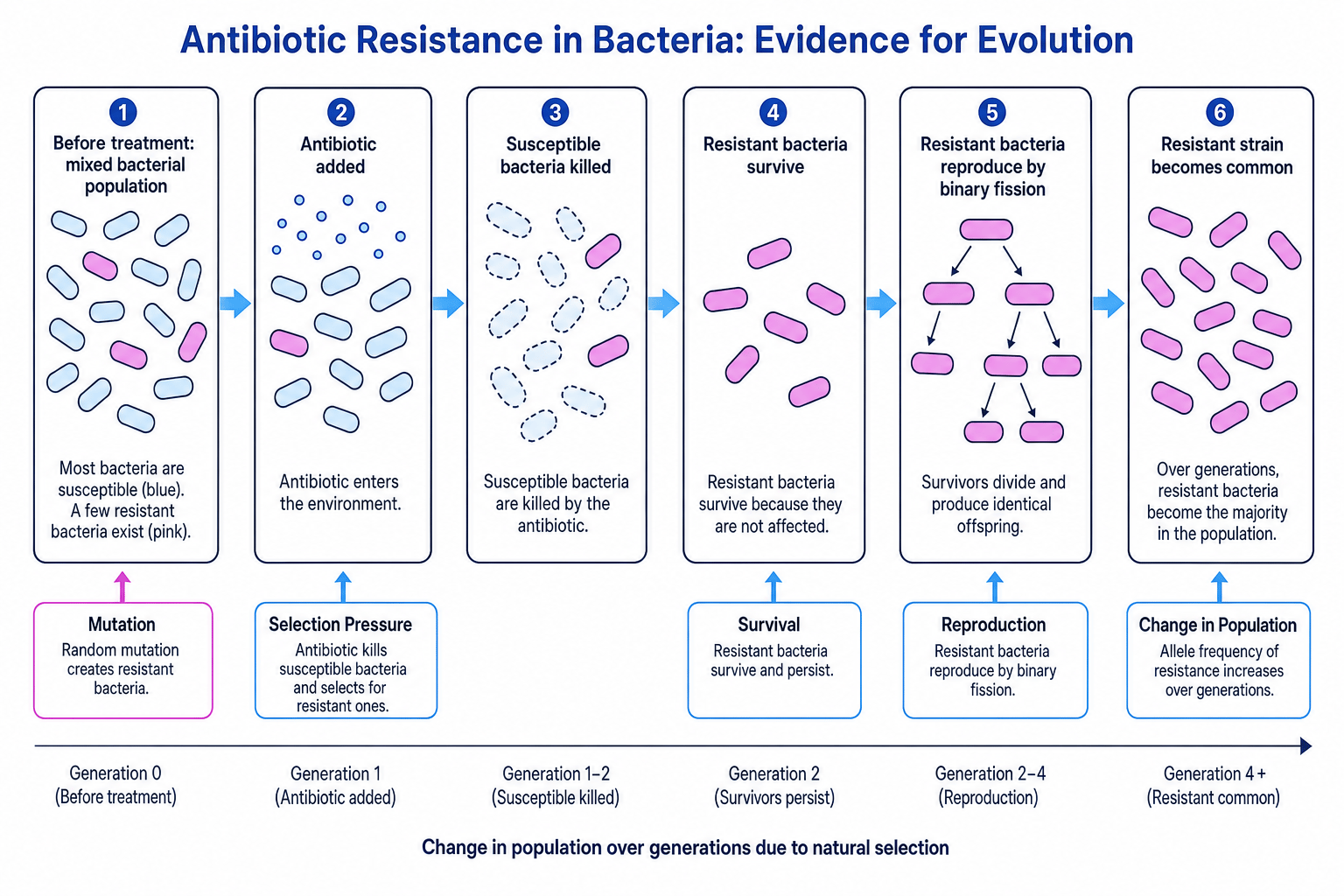
The process is natural selection:
- Random mutations produce genetic variation in bacteria.
- A few bacteria may have alleles that make them resistant to an antibiotic.
- The antibiotic acts as a selection pressure.
- Non-resistant bacteria are killed.
- Resistant bacteria survive and reproduce rapidly.
- The resistant allele becomes more common in the bacterial population.
Explaining antibiotic resistance
A patient has a bacterial infection. After antibiotic treatment, most bacteria die, but a few survive and the infection returns.
- Identify the original variation: before treatment, the bacterial population contained variation; a few bacteria were already resistant because of random mutations.
- Apply the selection pressure: the antibiotic killed the non-resistant bacteria, but resistant bacteria survived.
- Link survival to reproduction: the resistant bacteria reproduced, passing on the resistance allele to their offspring.
- Describe evolution: over generations, the bacterial population changed so that resistant bacteria became much more common.
People do not become antibiotic-resistant
It is the bacteria that become resistant, not the person. The person may carry an infection caused by resistant bacteria.
The big picture
Natural selection explains how populations become adapted to their environments without needing a designer or a plan.
The environment does not “choose” on purpose. Instead, individuals with certain inherited characteristics are more likely to survive and reproduce. Over many generations, this changes the inherited characteristics of the population.
Natural selection in one sentence
Random mutations create variation; selection pressures make some phenotypes more successful; inherited alleles become more or less common over generations.
In the exam
- When explaining natural selection, always include variation, selection pressure, survival and reproduction, inheritance, and change over generations.
- Avoid wording that suggests purpose, such as “the organism changed so it could survive”; write that mutations are random and advantageous alleles become more common.
- For evidence questions, name the evidence clearly — fossils or antibiotic resistance — then explain how it shows populations changing over time.
Check yourself
- Why does natural selection require genetic variation in a population?
- How can antibiotic resistance in bacteria be used as evidence for evolution?
- What extra evidence can DNA sequencing give scientists when classifying organisms?
