What you'll learn
- What inherited information is, and how it is organised inside cells.
- How stored genetic information and the environment affect visible features.
- Why sex cells contain half the normal chromosome number.
- How simple parent crosses predict probabilities for offspring.
The genetic-material “address system”
Inheritance is the passing on of genetic information from parents to offspring. This is why offspring often resemble their parents, while still being different from them.
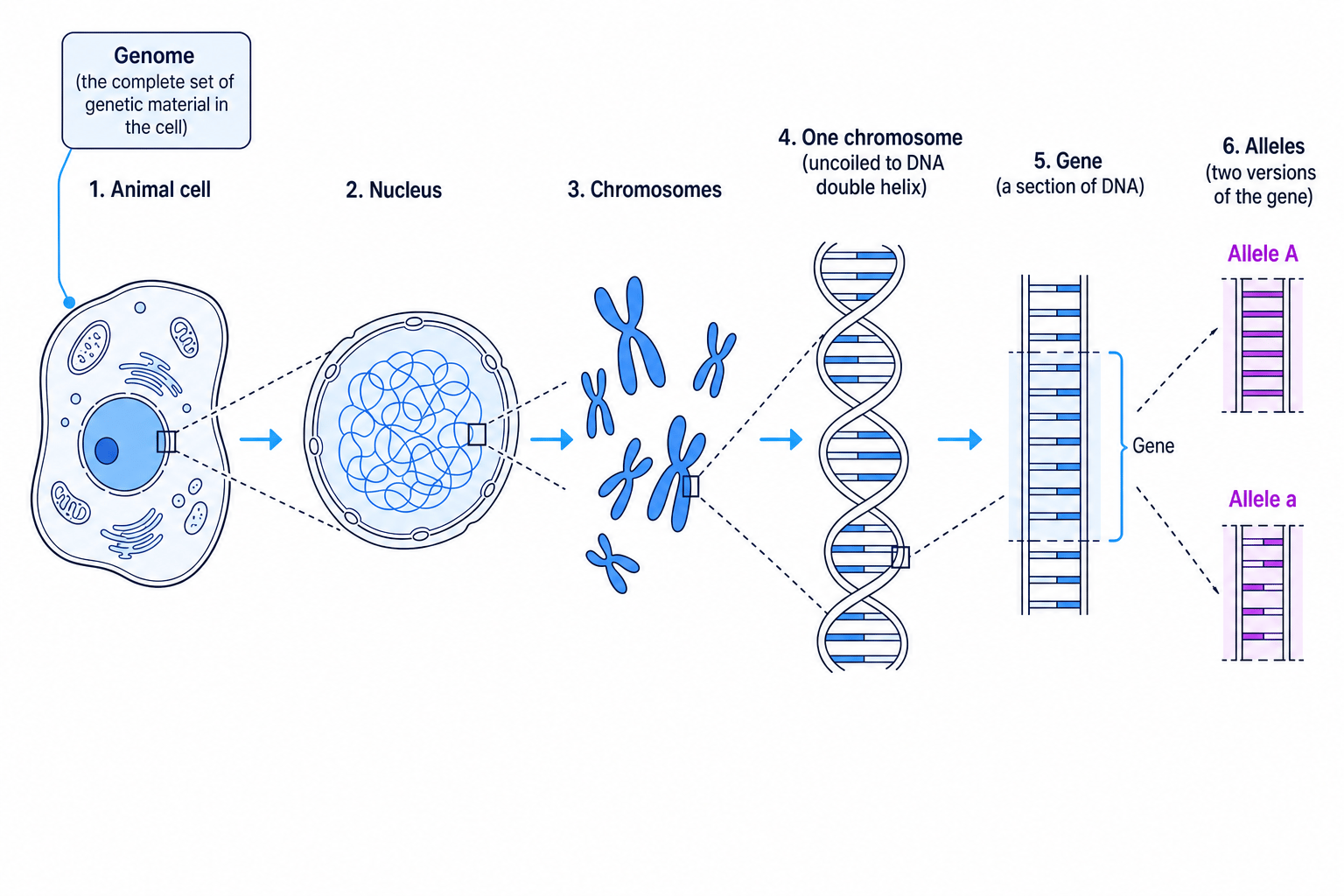
DNA stands for deoxyribonucleic acid. It is the long chemical molecule that stores genetic information. In animal and plant cells, most DNA is found inside the nucleus, the cell compartment that contains the chromosomes.
Genetic material: the main terms
- Chromosome: a long, coiled DNA molecule carrying many genes.
- Gene: a section of DNA that affects a characteristic, often by coding for a protein.
- Allele, also called a variant: a different version of the same gene.
- Genome: the entire genetic material of an organism.
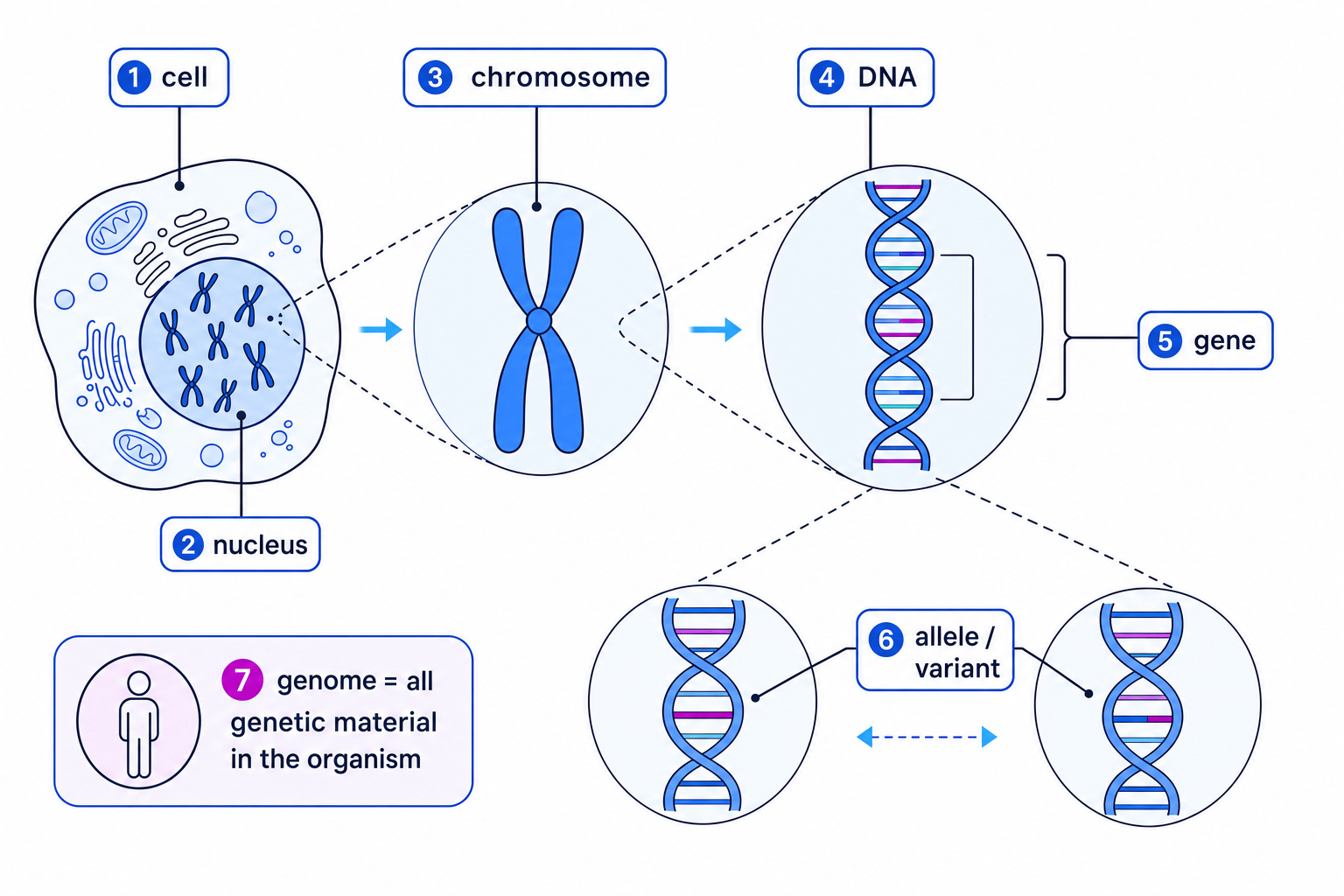
The important size order is: a cell contains a nucleus, the nucleus contains chromosomes, chromosomes are made of DNA, and genes are sections of DNA. The genome is the whole set of genetic material, not just one gene.
Mixing up gene, chromosome and genome
A gene is a small section of DNA. A chromosome is a much larger DNA structure carrying many genes. The genome means all the genetic material in the organism.
Genotype and phenotype
A living organism’s features are not just “what genes it has”. You also need to think about which versions of genes it has, and how those interact with the environment.
Allele language
- Genotype: the alleles an organism has for a particular gene, for example BB, Bb or bb.
- Phenotype: the observable characteristic, such as brown fur or blue eyes.
- Dominant allele: an allele that is shown in the phenotype when one copy is present.
- Recessive allele: an allele that is only shown in the phenotype when no dominant allele is present for that gene.
- Homozygous: having two identical alleles, such as BB or bb.
- Heterozygous: having two different alleles, such as Bb.
GCSE genetics often uses letters. A capital letter usually represents the dominant allele, and the matching lower-case letter represents the recessive allele.
Linking genotype to phenotype
Suppose B is a dominant allele for brown fur and b is a recessive allele for white fur.
- For genotype BB, both alleles are dominant, so the organism is homozygous dominant and has brown fur.
- For genotype Bb, one dominant allele is present, so the organism is heterozygous and still has brown fur.
- For genotype bb, there is no dominant allele present, so the recessive phenotype is shown and the organism has white fur.
Dominant does not mean stronger
A dominant allele is not “more powerful”, and a recessive allele is not usually an absence of the dominant allele. Dominant and recessive describe the pattern seen in the phenotype.
Genome, environment and variation
The genome influences the development of the phenotype, but the environment can also affect it. For example, height is influenced by genetic information, but also by nutrition and health.
Some features show discontinuous variation, where organisms fall into clear categories, such as eye colour groups. Other features show continuous variation, where values form a range, such as height or body mass.
Most features are not single-gene features
Most phenotypic features are controlled by multiple genes, and many are also affected by the environment. Single-gene inheritance is a useful GCSE model, but it only applies to some characteristics.
Classifying variation
A class measures student heights and gets values from 1.45 m to 1.88 m, with many values in between.
- The data do not fall into separate categories; they form a spread of measurements.
- A smooth range suggests that more than one gene is involved, and environmental factors such as nutrition may also contribute.
- Height is therefore an example of continuous variation.
Acquired characteristics
Scars, tattoos, learned skills and muscles built by exercise are not usually inherited, because they are not changes to DNA in gametes.
Mutations and new variants
A mutation is a change in the DNA sequence. All allele variants arise from mutations.
Most mutations have no effect on the phenotype. Some mutations influence the phenotype. A very small number determine the phenotype, meaning they directly cause a particular characteristic or condition.
Mutations create genetic variation
New variants begin as mutations. If a mutation is in a gamete, it can be passed on to offspring.
Haploid, diploid and meiosis
A gamete is a sex cell. In animals, sperm and egg cells are gametes.
Chromosome number
- Diploid cells have two sets of chromosomes. Human body cells are diploid, with 46 chromosomes arranged in 23 pairs.
- Haploid cells have one set of chromosomes. Human gametes are haploid, with 23 chromosomes.
- Meiosis is cell division that produces haploid gametes from diploid cells.
Meiosis halves the chromosome number. This matters because fertilisation combines two gametes. A zygote is the first cell formed when a sperm and egg fuse.
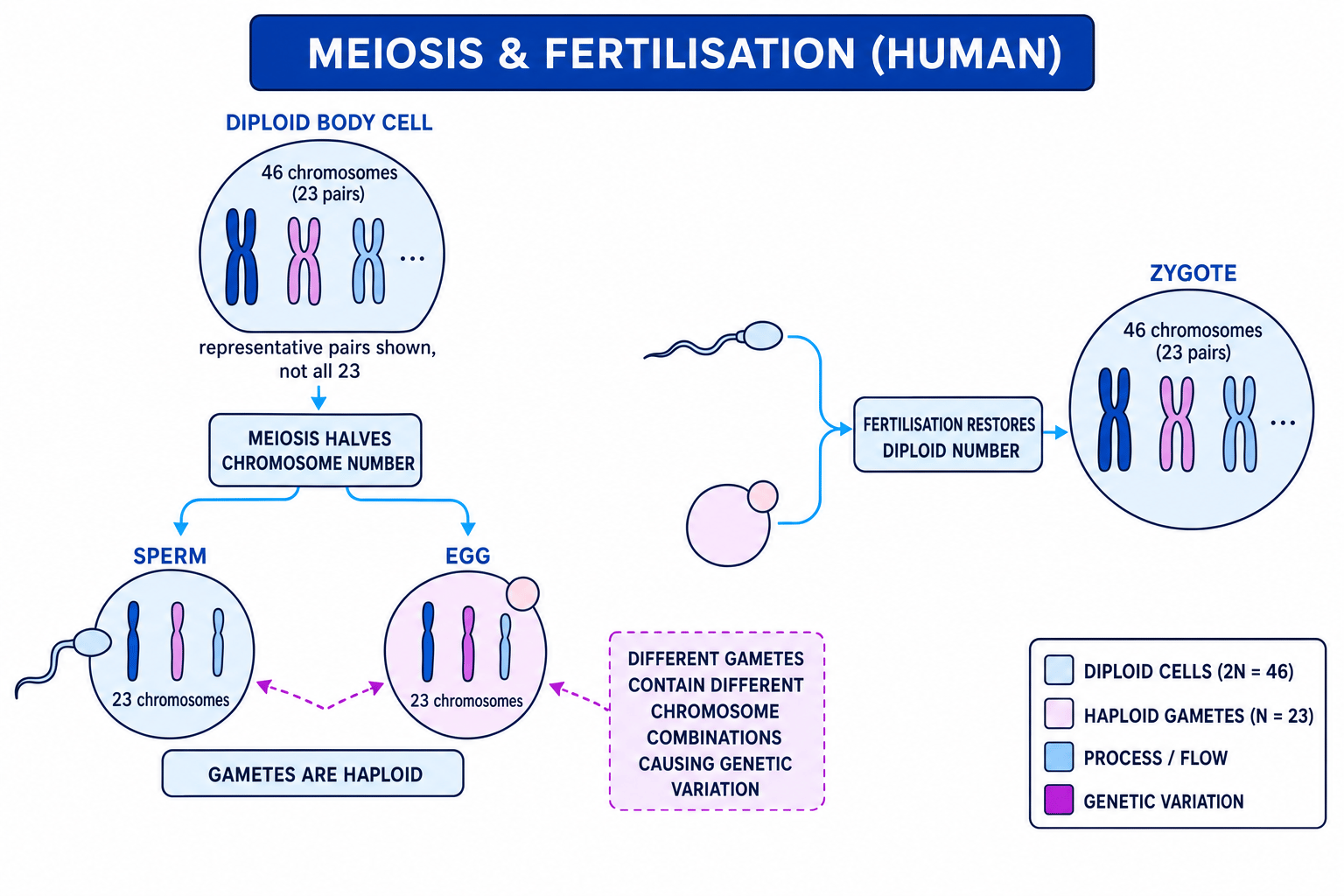
Meiosis is also a source of genetic variation because different gametes contain different combinations of chromosomes.
Maintaining chromosome number
In humans, a sperm fertilises an egg.
- The sperm is haploid, so it contains 23 chromosomes.
- The egg is also haploid, so it contains 23 chromosomes.
- At fertilisation, the chromosome numbers combine: 23+23=4623 + 23 = 4623+23=46, so the zygote is diploid.
- If meiosis did not halve the chromosome number, fertilisation would keep doubling the number each generation.
Single-gene inheritance
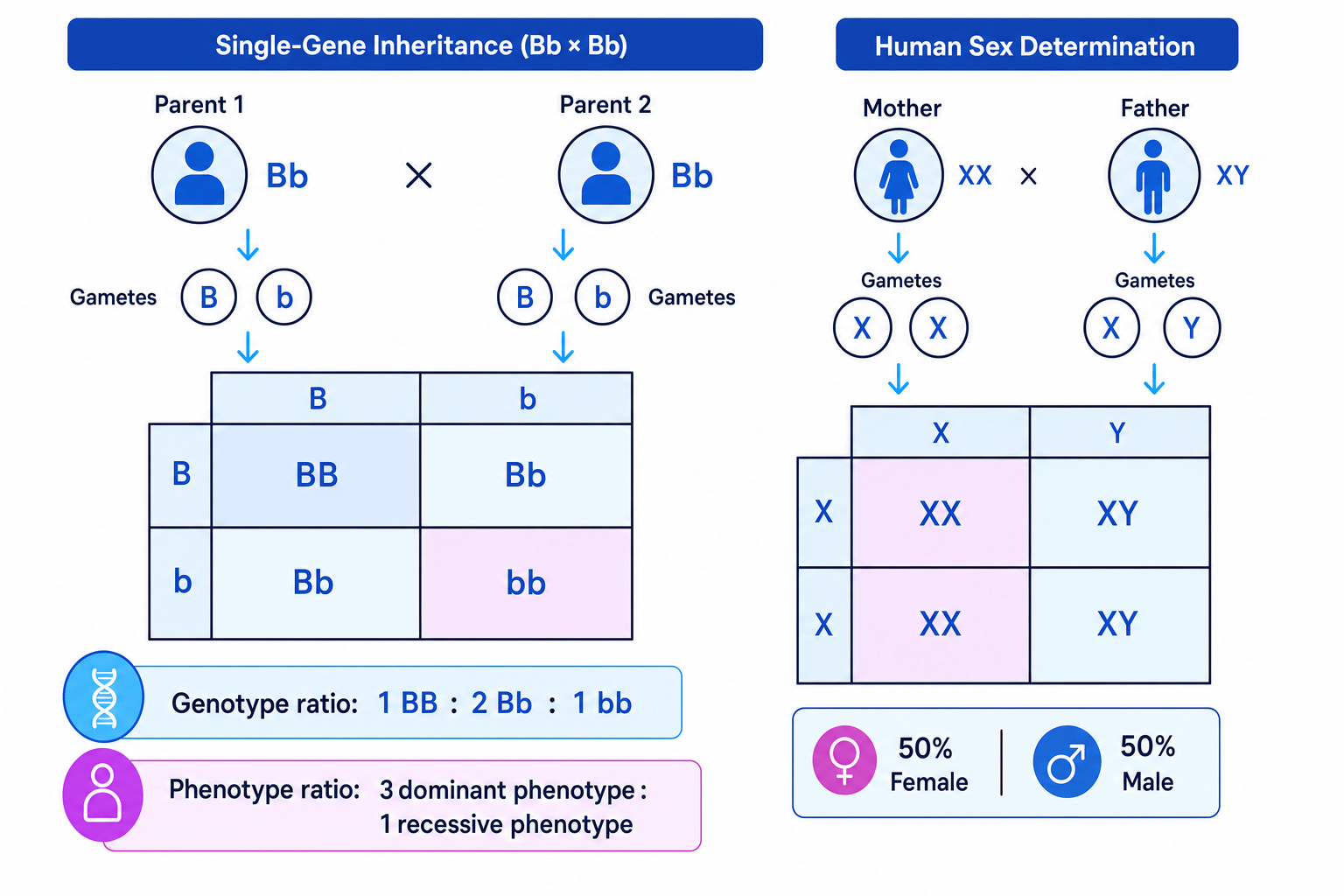
Single-gene inheritance means a characteristic is controlled by one gene. You can predict possible offspring genotypes using a Punnett square, which is a grid showing how gametes from two parents can combine.
A genetic cross means comparing the alleles in two parents to predict the possible genotypes and phenotypes of their offspring.
The diagram below shows both a single-gene Punnett square and the same grid idea for human sex determination.
Predicting offspring from two heterozygous parents
A brown-fur allele B is dominant over a white-fur allele b. Two heterozygous parents are crossed: Bb and Bb.
- Each parent can pass on either B or b in a gamete.
- Combining the gametes gives four possible offspring genotypes: BB, Bb, Bb and bb.
- The genotype ratio is 1 BB : 2 Bb : 1 bb.
- BB and Bb show the dominant brown phenotype, while bb shows the recessive white phenotype.
- The phenotype ratio is 3 brown : 1 white, so the probability of a brown offspring is 75% and the probability of a white offspring is 25%.
Probability is not a promise
A 25% chance does not mean exactly one out of every four offspring must have that phenotype. It means each offspring has that probability independently.
Sex determination in humans
Humans have sex chromosomes. In the GCSE model, females are XX and males are XY.
Egg cells always contain an X chromosome. Sperm cells contain either an X chromosome or a Y chromosome. So it is the sperm that determines whether the zygote is XX or XY.
Predicting human sex chromosomes
A mother has XX chromosomes and a father has XY chromosomes.
- The mother’s eggs can only contain X.
- The father’s sperm can contain X or Y.
- Combining them gives XX or XY with equal probability.
- Therefore, the predicted probability is 50% female and 50% male for each child.
In the exam
- Define your allele symbols first, and state which allele is dominant if the question tells you.
- Put the possible gametes around the Punnett square, then combine one allele from each parent in every box.
- Give both genotype and phenotype probabilities when asked, and remember that probabilities predict chances, not guaranteed family outcomes.
Check yourself
- What is the difference between a gene, an allele and a genome?
- Why does meiosis need to halve the chromosome number before fertilisation?
- In a cross between Bb and bb, what offspring genotypes could be produced?