What you'll learn
- How the particle model explains solids, liquids, gases and changes of state.
- Why mass is conserved during melting, freezing, evaporating, condensing and sublimating.
- How to choose between specific heat capacity and specific latent heat calculations.
- How gas temperature affects gas pressure in a closed system.
The particle model: the starting point
Matter is anything that has mass and takes up space. In GCSE physics, we often explain matter using the particle model: we imagine substances as being made from tiny particles with spaces between them.
Particle
A particle is a tiny part of matter in a model. It could represent an atom, a molecule or an ion — so “particle” does not always mean “atom”.
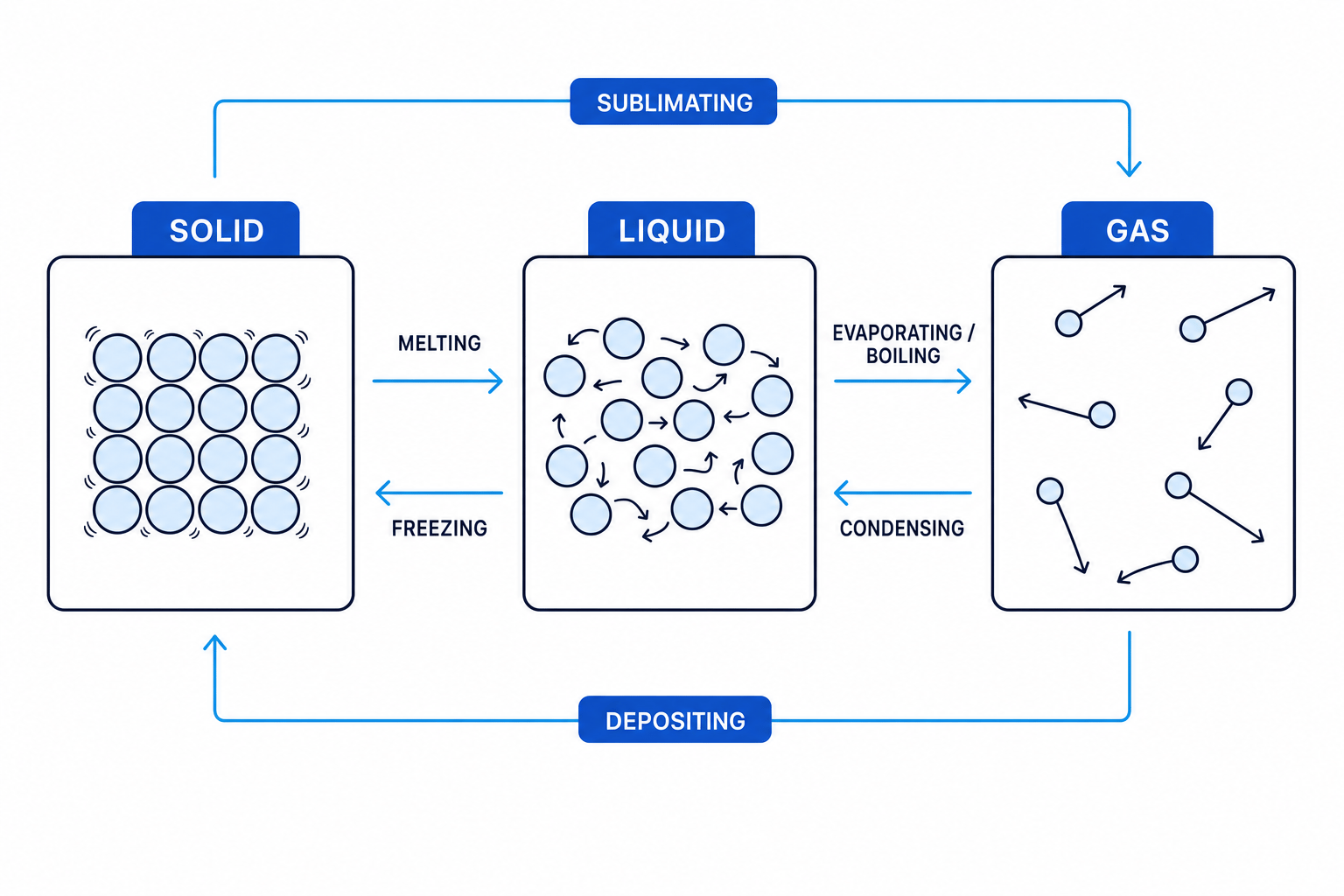
In a solid, particles are close together in fixed positions and vibrate. In a liquid, particles are still close together but can move past each other. In a gas, particles are far apart and move randomly in all directions.
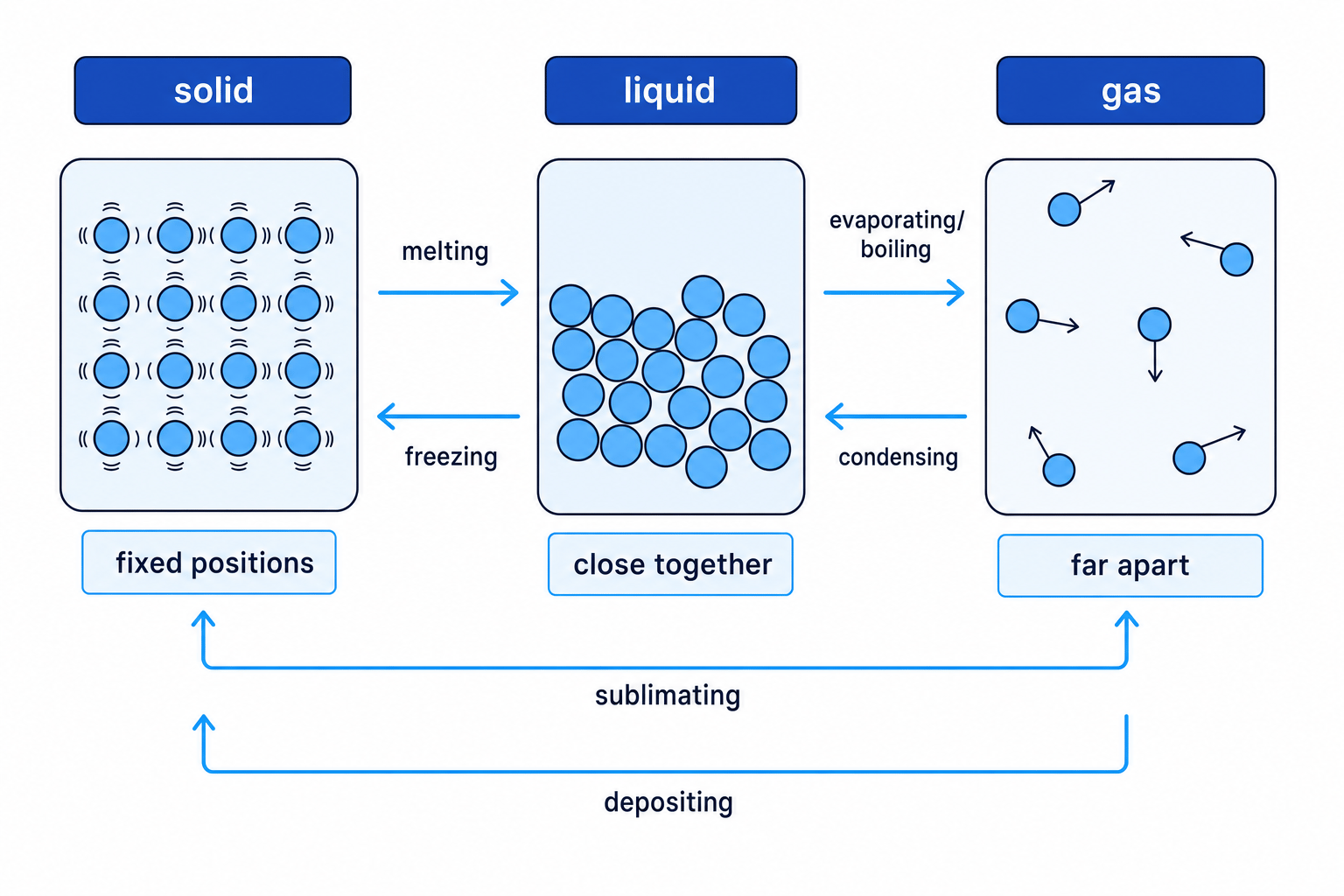
Do not fill the gaps with air
The spaces between particles are not automatically “air”. In a pure gas, the particles are far apart with mostly empty space between them.
The names of changes of state
A change of state is a physical change where a substance changes between solid, liquid and gas.
- Melting: solid → liquid
- Freezing: liquid → solid
- Evaporating: liquid → gas from the surface, below boiling point
- Boiling: liquid → gas throughout the liquid, at boiling point
- Condensing: gas → liquid
- Sublimating: solid → gas
- Depositing: gas → solid
Same particles, different arrangement
During a change of state, the particles themselves do not change into different particles. Their arrangement, spacing and movement change.
Mass is conserved
When a substance changes state, its mass is conserved. This means the total mass stays the same, as long as no material enters or leaves the system.
Closed system
A closed system is a system where no matter can enter or leave. Energy may still be transferred in or out.
For example, if ice melts in a sealed container, the mass of ice plus water stays the same. If water evaporates in an open beaker, the mass shown on the balance may decrease because water vapour escapes into the air — but the water particles have not been destroyed.
Finding the mass after melting
A sealed container has a mass of 0.060 kg. It contains 0.025 kg of ice. The ice melts completely. What mass will a balance show?
- The container is sealed, so this is a closed system: no matter can enter or leave.
- Melting is a change of state, so the ice particles become liquid water particles but their total mass is unchanged.
- Add the container and water masses:
The balance will show 0.085 kg.
Physical changes and chemical changes
A physical change changes the form or state of a material, but does not make a new substance. If the change is reversed, the material recovers its original properties.
Melting ice is physical: water can freeze again to form ice. Boiling water is physical: steam can condense back to liquid water.
A chemical change produces new substances. Burning wood, rusting iron and cooking an egg are chemical changes; they are not simply reversed by cooling or heating in the opposite direction.
Heating, internal energy and temperature
When you heat a material, energy is transferred to it. This increases the energy stored in the material, called its internal energy.
Internal energy
Internal energy is the energy stored by the particles in a system, mainly due to their movement and their positions relative to each other.
Heating can do two different things:
- It can raise the temperature of the material. The particles move faster or vibrate more strongly.
- It can change the state of the material. Energy is used to separate particles or change their arrangement, so the temperature stays constant during the change.
Temperature
Temperature tells you how hot something is. In particle terms, it is linked to the average kinetic energy of the particles.
A heating curve shows what happens when a pure substance is heated steadily.
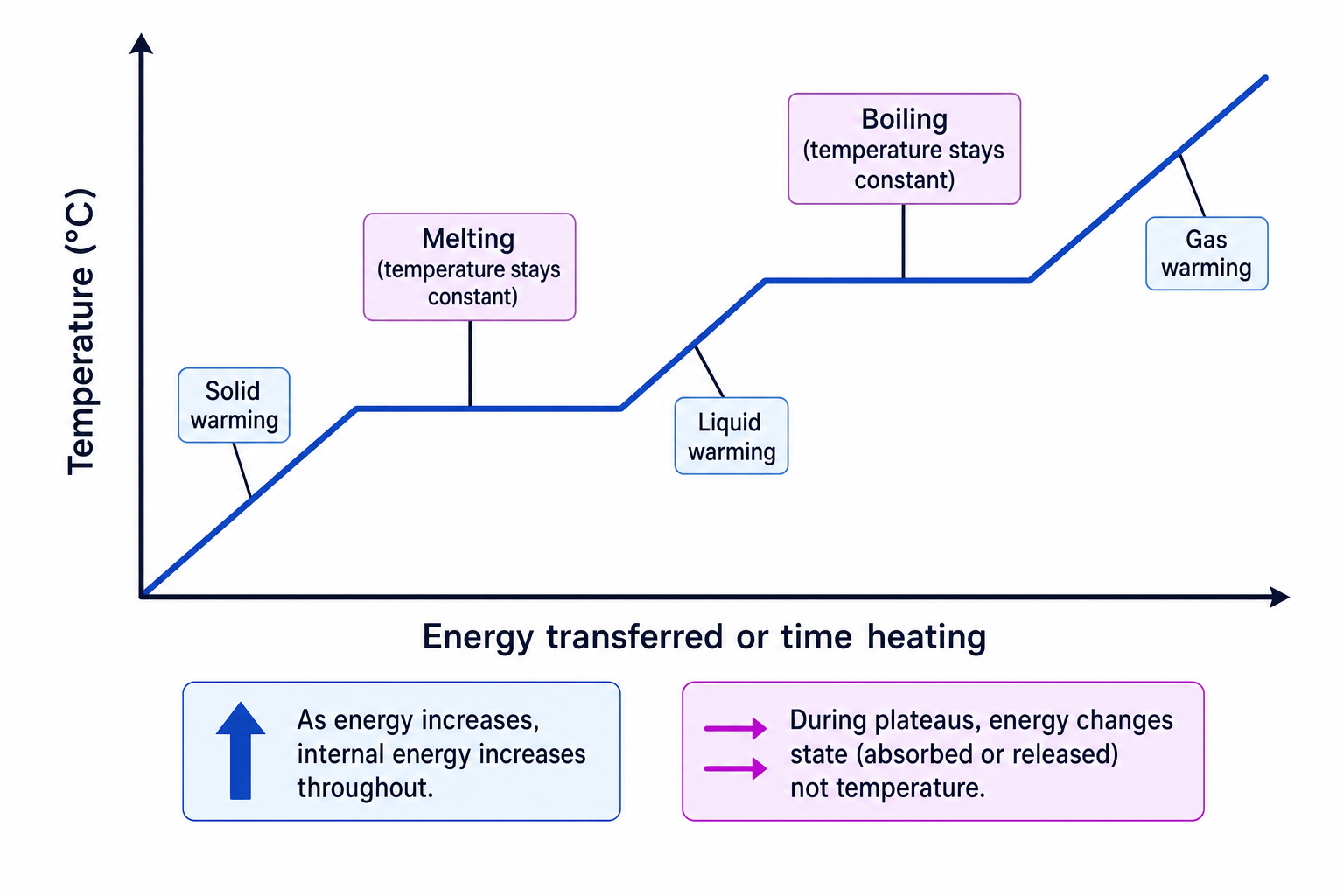
Flat sections matter
On a heating curve, a flat section does not mean heating has stopped. Energy is still being transferred, but it is changing the state instead of raising the temperature.
Interpreting a heating curve plateau
A pure solid is heated. Its temperature rises, then stays constant for several minutes before rising again. Explain what is happening during the constant-temperature section.
- A constant temperature during heating means the average kinetic energy of the particles is not increasing.
- The energy being transferred is instead increasing the internal energy by changing the particles’ arrangement.
- For a solid being heated, this flat section is melting: solid particles become liquid particles.
Specific heat capacity: energy for a temperature change
Sometimes heating changes temperature but not state. To calculate the energy transferred, use specific heat capacity.
Specific heat capacity
The specific heat capacity, ccc, of a material is the energy needed to raise the temperature of 1 kg of the material by 1 °C, without changing state. Its unit is joules per kilogram degree Celsius, J/kg °C.
For OCR Gateway, this relationship is provided on the physics equation sheet, but you must know when to use it:
ΔE=mcΔθ \Delta E = mc\Delta \theta ΔE=mcΔθwhere:
- ΔE\Delta EΔE is change in internal energy in joules, J
- mmm is mass in kilograms, kg
- ccc is specific heat capacity in J/kg °C
- Δθ\Delta \thetaΔθ is change in temperature in °C
Calculating energy for a temperature rise
0.50 kg of water is heated from 15 °C to 35 °C. The specific heat capacity of water is 4200 J/kg °C. Calculate the energy transferred.
- The water stays liquid and its temperature changes, so use:
- Calculate the temperature change:
- Substitute the values:
The energy transferred is 42 000 J, or 42 kJ.
Specific latent heat: energy for a change of state
Sometimes energy is transferred but the temperature does not change. This happens during a change of state. To calculate this energy, use specific latent heat.
Specific latent heat
The specific latent heat, LLL, of a material is the energy needed to change the state of 1 kg of the material without changing its temperature. Its unit is joules per kilogram, J/kg.
For OCR Gateway, this relationship is also provided on the physics equation sheet:
E=mL E = mL E=mLThere are two common types:
- Specific latent heat of fusion: energy for melting or freezing.
- Specific latent heat of vaporisation: energy for boiling/evaporating or condensing.
Choosing the wrong equation
Use ΔE=mcΔθ\Delta E = mc\Delta \thetaΔE=mcΔθ when the temperature changes. Use E=mLE = mLE=mL when the state changes at constant temperature.
Calculating energy for melting
A 0.20 kg block of ice melts at 0 °C. The specific latent heat of fusion of ice is 334 000 J/kg. Calculate the energy needed.
- The ice is changing state from solid to liquid, with no temperature change, so use:
- Substitute the mass and specific latent heat:
- Calculate the energy:
The energy needed is 66 800 J, or 66.8 kJ.
Check the mass unit
In both energy equations, mass must be in kilograms. If the question gives grams, divide by 1000 before substituting.
Gas pressure and temperature
A gas exerts pressure because its particles collide with the walls of its container. Each collision produces a tiny force on the wall. Lots of collisions over an area create pressure.
Gas pressure
Gas pressure is the force per unit area caused by gas particles colliding with surfaces.
In a closed, rigid container:
- the number of particles stays the same
- the volume stays the same
- increasing temperature makes the gas particles move faster
- faster particles collide with the walls more often and more forcefully
- so the pressure increases
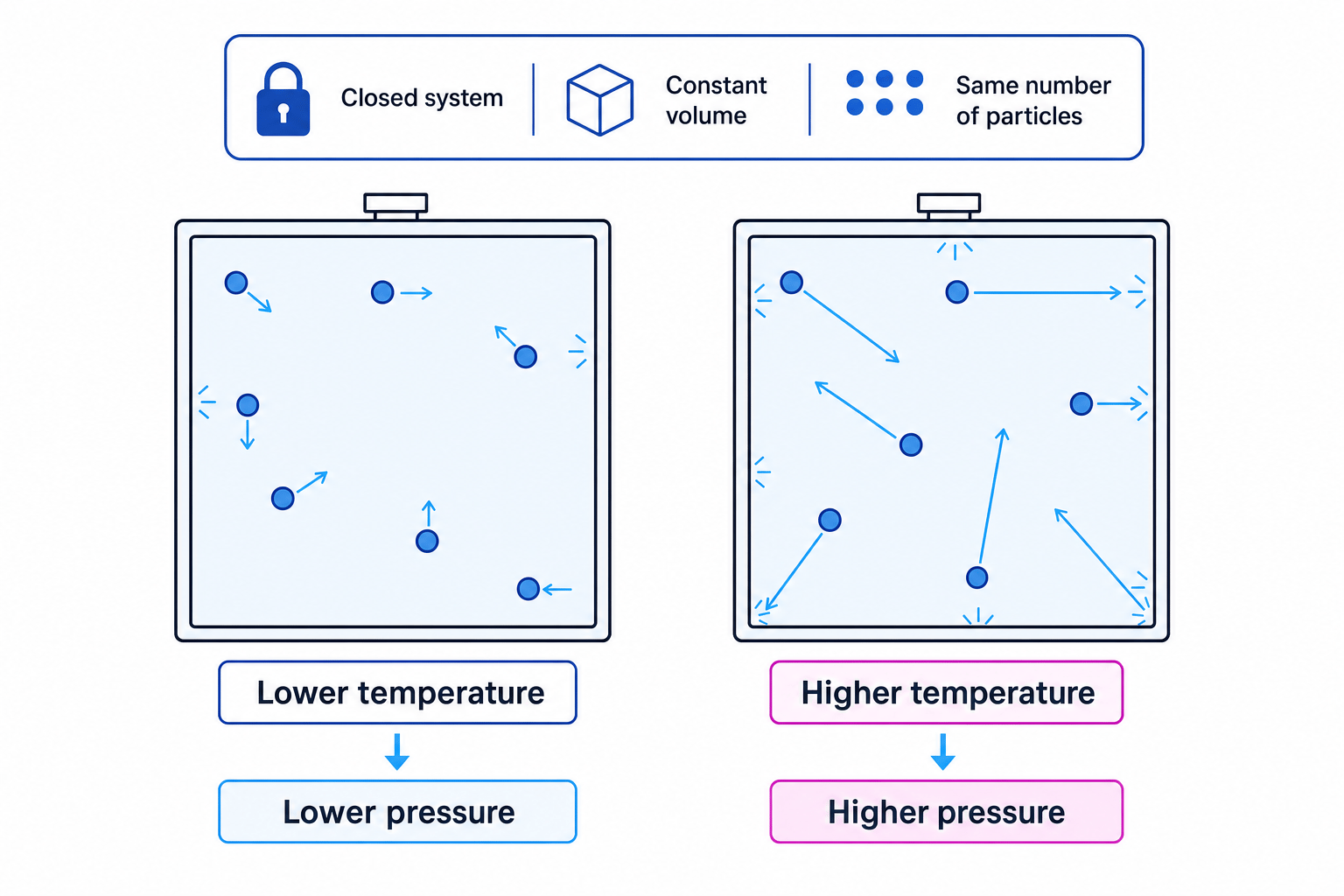
Constant volume matters
The simple relationship “higher temperature means higher pressure” is for a gas at constant volume. In a flexible container, like a balloon, the volume can change too.
Explaining pressure in a heated can
A sealed metal can containing gas is heated. Explain why the pressure inside the can increases.
- The can is sealed, so the number of gas particles stays the same.
- The metal can is rigid, so the volume stays almost constant.
- Heating increases the temperature, so the gas particles have greater average kinetic energy and move faster.
- Faster particles collide with the walls more frequently and with greater force, so the gas pressure increases.
In the exam
- If you see a temperature change with no state change, choose ΔE=mcΔθ\Delta E = mc\Delta \thetaΔE=mcΔθ.
- If you see melting, freezing, boiling, evaporating or condensing at constant temperature, choose E=mLE = mLE=mL.
- Always convert mass to kilograms before using the equations.
- For gas pressure explanations, mention particle speed, collision frequency or force, and constant volume.
Check yourself
- Why does the temperature stay constant while a substance is melting?
- What is the difference between specific heat capacity and specific latent heat?
- Why does the pressure of a gas increase when it is heated in a rigid sealed container?