

What you'll learn
- Why a growing human population increases pressure on food supplies.
- How selective breeding changes food plants and domesticated animals over generations.
- What genetic engineering means, and the main Higher Tier steps involved.
- How to weigh up benefits, risks, practical issues and ethical issues in modern agriculture.
Why feeding humans is a biological challenge
The human population is increasing, so the world needs more food. That food must also support a healthy diet: enough carbohydrates, fats, proteins, vitamins, minerals, fibre and water.
Food production depends on living organisms, including crop plants and farm animals, and it also affects the environment around them.
Food security
Food security means having reliable access to enough safe, nutritious food. It is not just about producing more calories — it is also about cost, distribution, climate, soil, water and health.
An ecosystem is all the organisms in an area, plus the non-living conditions such as soil, water, temperature and light. The challenge is to increase food production without causing too much damage to ecosystems.
The biology you need first: DNA, genes and variation
Most characteristics of plants and animals are influenced by their DNA.
Genes, genomes and characteristics
- A gene is a section of DNA that codes for a particular protein or affects a characteristic.
- A genome is all the genetic material of an organism.
- A characteristic is a feature of an organism, such as grain size, milk yield or disease resistance.
- Variation means differences between individuals of the same species.
Selective breeding and genetic engineering both rely on variation, but they use it in very different ways.
Selective breeding
Selective breeding is sometimes called artificial selection. Humans choose organisms with desirable characteristics and breed them together.
A crop is a plant grown for food or another useful product. A domesticated animal is an animal species kept and bred by humans, such as cattle, sheep or chickens.
How selective breeding works
A farmer or scientist might:
- Choose parents with useful characteristics, such as high yield or disease resistance.
- Breed those parents together.
- Select the best offspring.
- Repeat this over many generations.
Over time, the desirable characteristic becomes more common in the population.
Selective breeding changes populations
Selective breeding does not create a new gene on demand. It increases the proportion of organisms with desirable inherited characteristics over many generations.
Benefits of selective breeding
Selective breeding can increase food production by producing:
- crop plants with higher yield
- plants that resist disease better
- crops with improved taste, storage life or nutritional content
- animals that produce more milk, meat or eggs
- animals that grow faster or are easier to handle
Long-running field experiments, such as the Rothamsted Broadbalk experiment, help scientists compare crop varieties and farming methods using real yield data over time.
Problems caused by selective breeding
Selective breeding can also cause problems.
The gene pool is the total genetic variation in a population. If only a few “best” individuals are used for breeding, the gene pool may shrink. This can make the population less able to survive new diseases or environmental changes.
Inbreeding means breeding closely related individuals. It can increase the chance of harmful inherited conditions appearing.
Selective breeding may also raise animal welfare concerns. For example, animals bred for very fast growth may suffer health problems.
In crop farming, using one very similar crop variety over a large area is called a monoculture. Monocultures can reduce biodiversity, meaning the variety of different species in an ecosystem.
Interpreting crop yield data
A field trial compares an older wheat variety with a selectively bred variety. The older variety produces 0.45 kilograms per square metre (kg/m²). The selectively bred variety produces 0.63 kg/m².
-
Find the difference in yield: 0.63−0.45=0.18 kg/m20.63 - 0.45 = 0.18\ \text{kg/m}^20.63−0.45=0.18 kg/m2.
-
Use the percentage increase formula:
percentage increase=new yield−old yieldold yield×100\text{percentage increase} = \frac{\text{new yield} - \text{old yield}}{\text{old yield}} \times 100percentage increase=old yieldnew yield−old yield×100 -
Substitute the values: 0.180.45×100=40%\frac{0.18}{0.45} \times 100 = 40\%0.450.18×100=40%. The selectively bred variety gives a 40% higher yield in this trial, but you should still consider repeats, field conditions and whether other impacts were measured.
Selective breeding is not genetic engineering
In selective breeding, whole organisms are bred together and many genes are passed on at once. In genetic engineering, the genome is modified more directly, often by adding a specific gene.
Genetic engineering
Genetic engineering
Genetic engineering is a process that involves modifying the genome of an organism to introduce desirable characteristics. An organism produced in this way is called genetically modified, or GM.
Genetic engineering can be more direct than selective breeding. It may allow a useful gene to be introduced from a different species, which selective breeding normally cannot do.
Examples in agriculture include crops engineered for pest resistance, disease resistance, drought tolerance or improved nutritional content.
Main genetic engineering steps
If you are taking Higher Tier, you need to describe the main steps in genetic engineering using the correct biological terms.
Genetic engineering tools
- A restriction enzyme cuts DNA at specific base sequences.
- Sticky ends are short, unpaired DNA bases left after some restriction enzymes cut DNA.
- DNA ligase is an enzyme that joins pieces of DNA together.
- A vector is something used to transfer DNA into a cell.
- A plasmid is a small circular piece of DNA found in bacteria; it can act as a vector.
- A host bacterium is a bacterial cell used to take up the modified plasmid.
- An antibiotic resistance marker is a gene that lets scientists identify cells that have taken up the plasmid because those cells survive in an antibiotic.
The diagram below shows how these tools fit together when a useful gene is moved into cells.
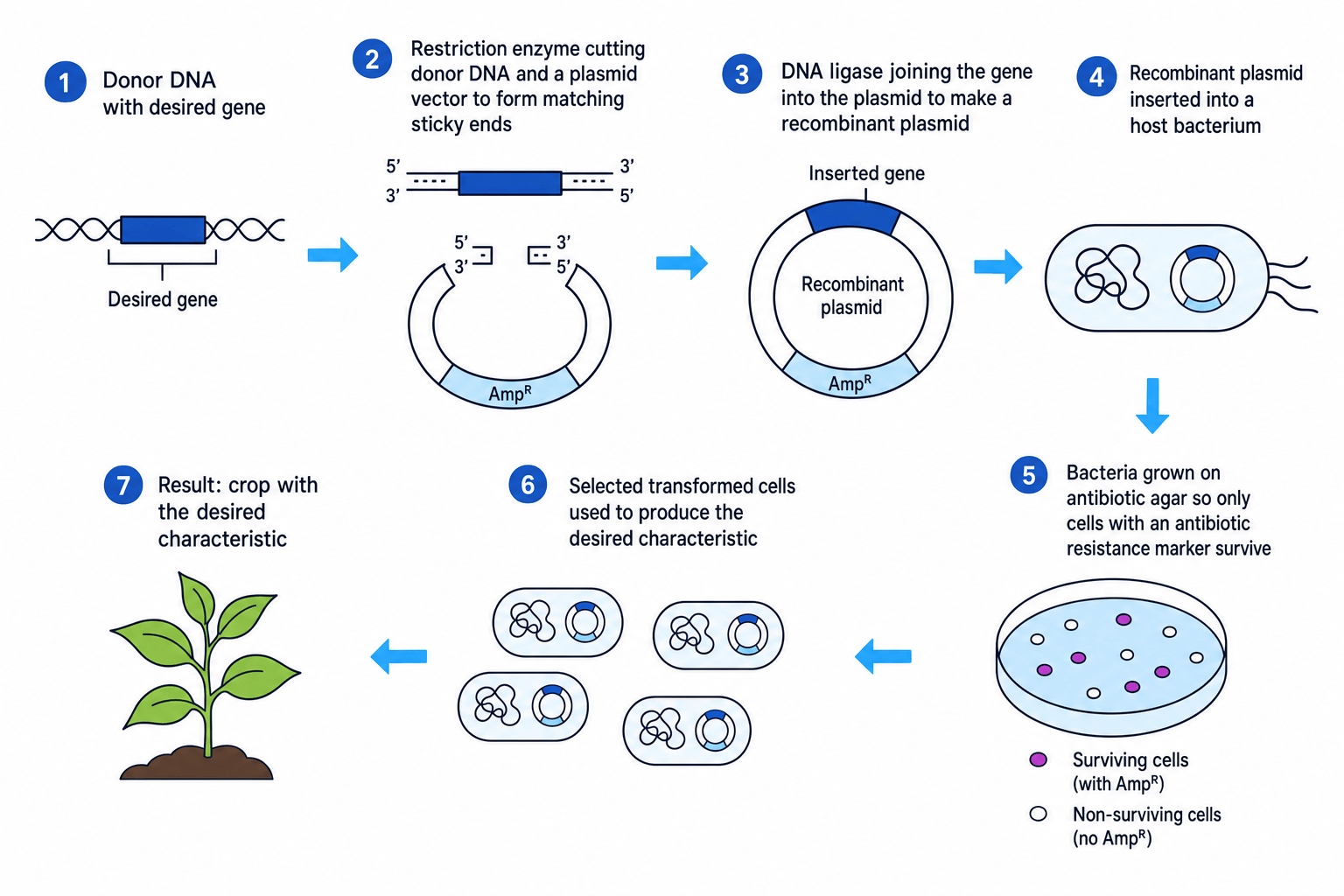
The main process is:
- Identify and isolate the gene for the desirable characteristic.
- Use restriction enzymes to cut out the gene and cut open a plasmid vector, producing matching sticky ends.
- Insert the gene into the plasmid. The sticky ends help the DNA pieces line up.
- Use DNA ligase to join the DNA, forming a recombinant plasmid — a plasmid containing DNA from more than one source.
- Put the recombinant plasmid into host bacteria. Cells that successfully take up the plasmid are called transformed cells.
- Grow the bacteria on agar containing an antibiotic. Agar is a nutrient jelly used to grow microorganisms.
- Only bacteria with the antibiotic resistance marker survive, so scientists can select the transformed cells.
Selecting transformed bacteria
A plasmid contains an antibiotic resistance marker. After genetic engineering, bacteria are spread onto agar containing that antibiotic.
-
Bacteria without the plasmid do not have the resistance marker, so the antibiotic prevents them from growing.
-
Bacteria that survive are likely to have taken up the plasmid, so they are selected for further growth.
-
The surviving bacteria may still need further testing, because antibiotic resistance shows that the plasmid was taken up, not automatically that the desired characteristic works properly in the final crop.
Benefits and risks of gene technology in agriculture
Gene technology means using knowledge of genes and DNA to change or study organisms. Genetic engineering is one type of gene technology.
Possible benefits
Gene technology may help food security by producing crops that:
- give higher yields
- resist pests or diseases
- survive drought, salty soils or changing climates
- contain extra nutrients
- stay fresh for longer
- reduce crop losses, which can reduce food waste
A pest-resistant GM crop may need less insecticide spraying. An insecticide is a chemical used to kill insect pests.
Possible risks and concerns
There are also practical and ethical concerns.
A practical consideration is about whether something works safely and reliably in the real world. Examples include cost, farmer training, field testing, regulation and whether the crop performs well in different climates.
An ethical consideration is about what people think is right, fair or acceptable. Examples include food labelling, animal welfare, effects on small farmers, and whether companies should own patents on seeds.
Possible risks include:
- the inserted gene spreading to wild relatives
- pests evolving resistance over time
- effects on non-target species in the ecosystem
- reduced biodiversity if GM crops encourage monocultures
- concerns about allergies or long-term health effects, so testing is important
- concerns about antibiotic resistance marker genes, depending on how the technology is used
Genetic engineering and pesticide use
Genetic engineering does not automatically increase pesticide use. A pest-resistant GM crop may reduce insecticide spraying, while a herbicide-tolerant crop could be linked with more herbicide use. Always judge the specific trait.
A herbicide is a chemical used to kill unwanted plants, often called weeds.
Balancing benefits and risks
A GM crop is engineered to resist an insect pest. Crop loss falls from 20% to 5%, but scientists are concerned about effects on nearby wild plants and insects.
-
Compare the benefit using the data: 20%−5%=15 percentage points20\% - 5\% = 15\text{ percentage points}20%−5%=15 percentage points less crop loss, so more food may be produced from the same land.
-
Identify a linked risk: if the gene spreads or if pests evolve resistance, the benefit may decrease and the ecosystem could be affected.
-
Make a balanced judgement: the crop could be useful, but field trials, monitoring, regulation and clear labelling would be needed before wide use.
Using data in this topic
You may be given charts, graphs or tables about yield, pesticide use, cost, vitamin content, biodiversity or disease resistance.
Using data
For “use the data” questions, describe the trend and support it with figures and units. Compare like with like, and be cautious if there is only one trial or no information about repeats.
In the exam
-
Keep the methods separate: selective breeding means choosing parents over generations; genetic engineering means modifying the genome directly.
-
For “impact” or “evaluate” questions, include both benefits and risks, such as yield, food security, biodiversity, animal welfare and ethical concerns.
-
When data is provided, quote numbers with units and explain what they show instead of making vague statements like “it is better”.
Check yourself
- Why can selective breeding reduce genetic variation in a population?
- What do restriction enzymes, sticky ends and DNA ligase do in genetic engineering?
- Give one possible benefit and one possible risk of using GM crops in agriculture.
