

What you'll learn
- What scientists mean by particles, atoms, molecules and subatomic particles.
- How the atomic model changed from Thomson to Rutherford and Bohr.
- The structure and typical size of an atom.
- How to use density to explain and calculate changes in solids, liquids and gases.
Particles: the basic idea
Matter is anything that has mass and takes up space. A particle model is a way of explaining matter by imagining it as being made from tiny pieces.
At GCSE, the word “particle” can mean different things depending on the scale you are talking about.
Particles, atoms and molecules
- A particle is a tiny piece of matter. In this topic, it might mean an atom, molecule, or subatomic particle.
- An atom is the smallest part of an element that still behaves like that element.
- A molecule is two or more atoms joined together.
- A compound is a substance made from atoms of two or more different elements chemically bonded together.
- A subatomic particle is a particle smaller than an atom, such as a proton, neutron or electron.
Different meanings of particle
Do not mix up subatomic particles with atoms or molecules. Protons, neutrons and electrons are inside or around atoms; atoms can then join to make molecules.
How the atomic model changed
A scientific model is an idea or diagram used to explain observations and make predictions. Models change when new evidence shows that the old model is incomplete or wrong.
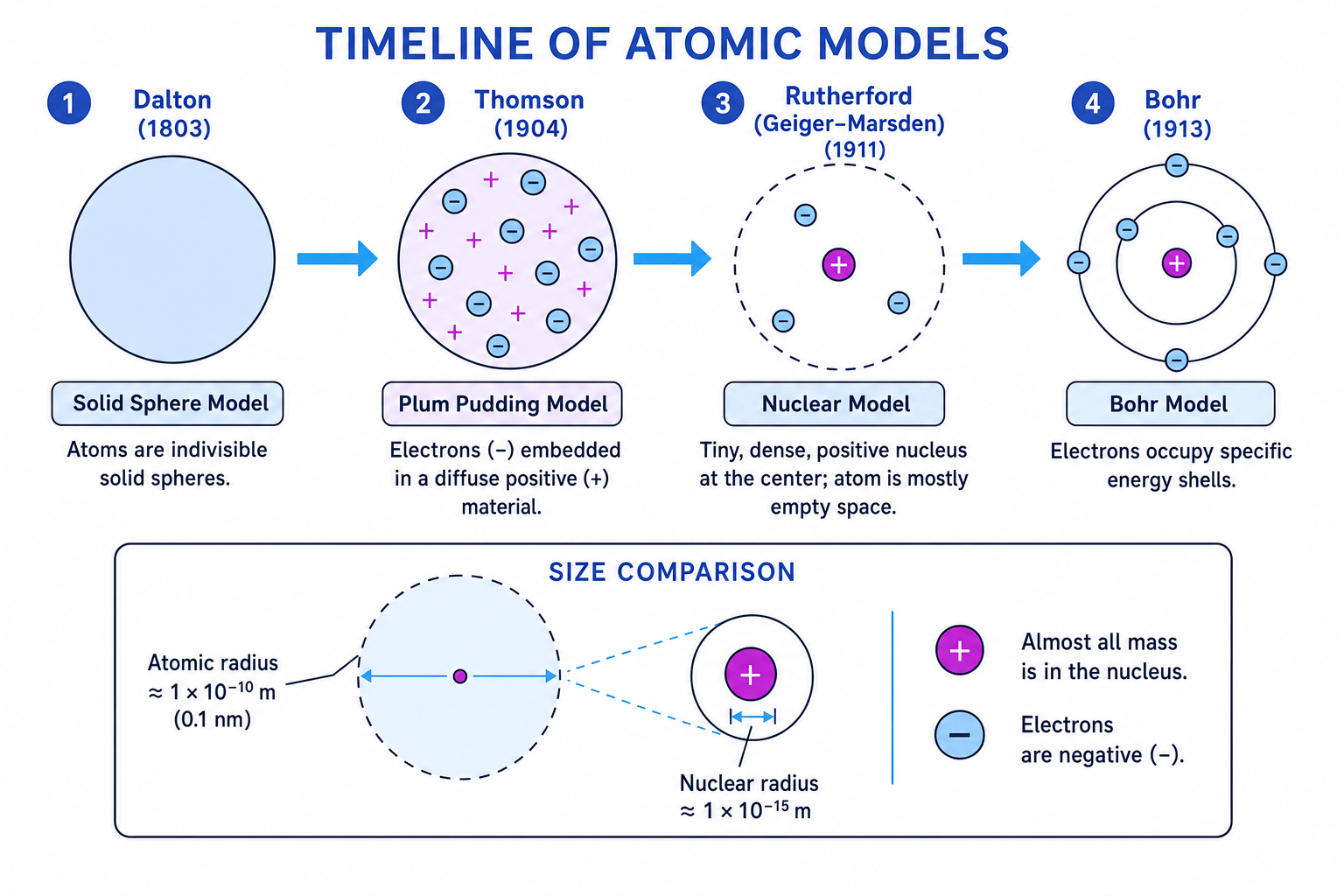
Before modern atomic theory, atoms were often thought of as tiny solid spheres. Then scientists found evidence for smaller particles inside atoms, so the model had to change.
Thomson’s model
J. J. Thomson discovered the electron, a negatively charged subatomic particle. This showed that atoms were not just solid, indivisible spheres.
Thomson suggested the plum pudding model: negative electrons embedded in a spread-out positively charged material.
Rutherford, Geiger and Marsden
Rutherford worked with Geiger and Marsden on the alpha scattering experiment. An alpha particle is a positively charged particle. They fired alpha particles at very thin gold foil.
They found that:
- most alpha particles passed straight through
- some were deflected
- a very small number bounced back
This evidence did not fit Thomson’s plum pudding model. It suggested that most of the atom is empty space, with a tiny, dense, positively charged centre.
Bohr’s model
Bohr improved the nuclear model by suggesting that electrons are arranged in shells around the nucleus. A shell is a region where electrons are found at a particular distance from the nucleus.
Using scattering evidence
- Most alpha particles passed through the gold foil, so the atom must be mostly empty space rather than solid all the way through.
- A few alpha particles were strongly deflected or bounced back, so there must be a small region with a strong positive charge repelling the positive alpha particles.
- Because only a tiny number bounced back, that positive region must be very small compared with the whole atom: this led to the nuclear model.
What an atom looks like now
An atom has a tiny central nucleus surrounded by electrons. The nucleus is positively charged overall, and the electrons are negatively charged.
The nucleus contains most of the atom’s mass. This is because protons and neutrons are much more massive than electrons.
| Subatomic particle | Relative charge | Relative mass | Position |
|---|---|---|---|
| Proton | +1 | 1 | In the nucleus |
| Neutron | 0 | 1 | In the nucleus |
| Electron | -1 | Very small | In shells around the nucleus |
A neutral atom has the same number of protons and electrons, so the positive and negative charges balance.
Structure of the atom
An atom is mostly empty space: a tiny, positively charged nucleus contains almost all the mass, with negatively charged electrons around it.
How small are atoms?
An order of magnitude is the nearest power of ten, used to describe the scale of something.
Atoms and small molecules are typically about:
1×10⁻¹⁰ m1 \times 10^{-10}\text{ m}1×10⁻¹⁰ macross. That is 0.1 nanometres (0.1 nm). The nucleus is much smaller than the whole atom, so atomic diagrams are never drawn to scale.
Density: mass packed into volume
Density tells you how much mass is packed into a certain volume.
Density
Density is the mass per unit volume of a substance. A material with a high density has a lot of mass in a small volume.
For OCR Gateway P1.1, you need to recall and apply the density equation:
ρ=mV\rho = \frac{m}{V}ρ=Vmwhere:
- ρ\rhoρ is density in kilograms per cubic metre (kg/m³)
- mmm is mass in kilograms (kg)
- VVV is volume in cubic metres (m³)
The useful rearrangements are m=ρVm = \rho Vm=ρV and V=mρV = \frac{m}{\rho}V=ρm.
Rearranging density
Cover the quantity you want: density is mass divided by volume, mass is density multiplied by volume, and volume is mass divided by density.
Calculating density
A metal block has a mass of 0.54 kg. Its volume is 6.0×10⁻⁵ m36.0 \times 10^{-5}\text{ m}^36.0×10⁻⁵ m3. Calculate its density.
- Choose the correct relationship: ρ=mV\rho = \frac{m}{V}ρ=Vm because the question gives mass and volume.
- Substitute the values with units: ρ=0.54 kg6.0×10−5 m3\rho = \frac{0.54\text{ kg}}{6.0 \times 10^{-5}\text{ m}^3}ρ=6.0×10⁻⁵ m30.54 kg.
- Calculate: ρ=9000 kg/m3\rho = 9000\text{ kg/m}^3ρ=9000 kg/m3.
Volume conversions
Be careful with cubic units. 1 cm3=1×10⁻⁶ m31\text{ cm}^3 = 1 \times 10^{-6}\text{ m}^31 cm3=1×10⁻⁶ m3, not 1×10⁻² m31 \times 10^{-2}\text{ m}^31×10−2 m3. If you use kg and m³, your density will be in kg/m³.
Measuring density in the lab
For a regular solid, such as a cuboid, you can:
- measure its mass using a balance
- measure its length, width and height using a ruler or callipers
- calculate volume using V=length×width×heightV = \text{length} \times \text{width} \times \text{height}V=length×width×height
- calculate density using ρ=mV\rho = \frac{m}{V}ρ=Vm
For an irregular solid, you can use water displacement. Put the object into a measuring cylinder or use a eureka can. The volume of water displaced is equal to the volume of the object.
For a liquid, measure its volume in a measuring cylinder, then find its mass by subtracting the mass of the empty container from the mass of the container plus liquid.
Explaining density using states of matter
A state of matter is the physical form a substance is in: solid, liquid or gas.
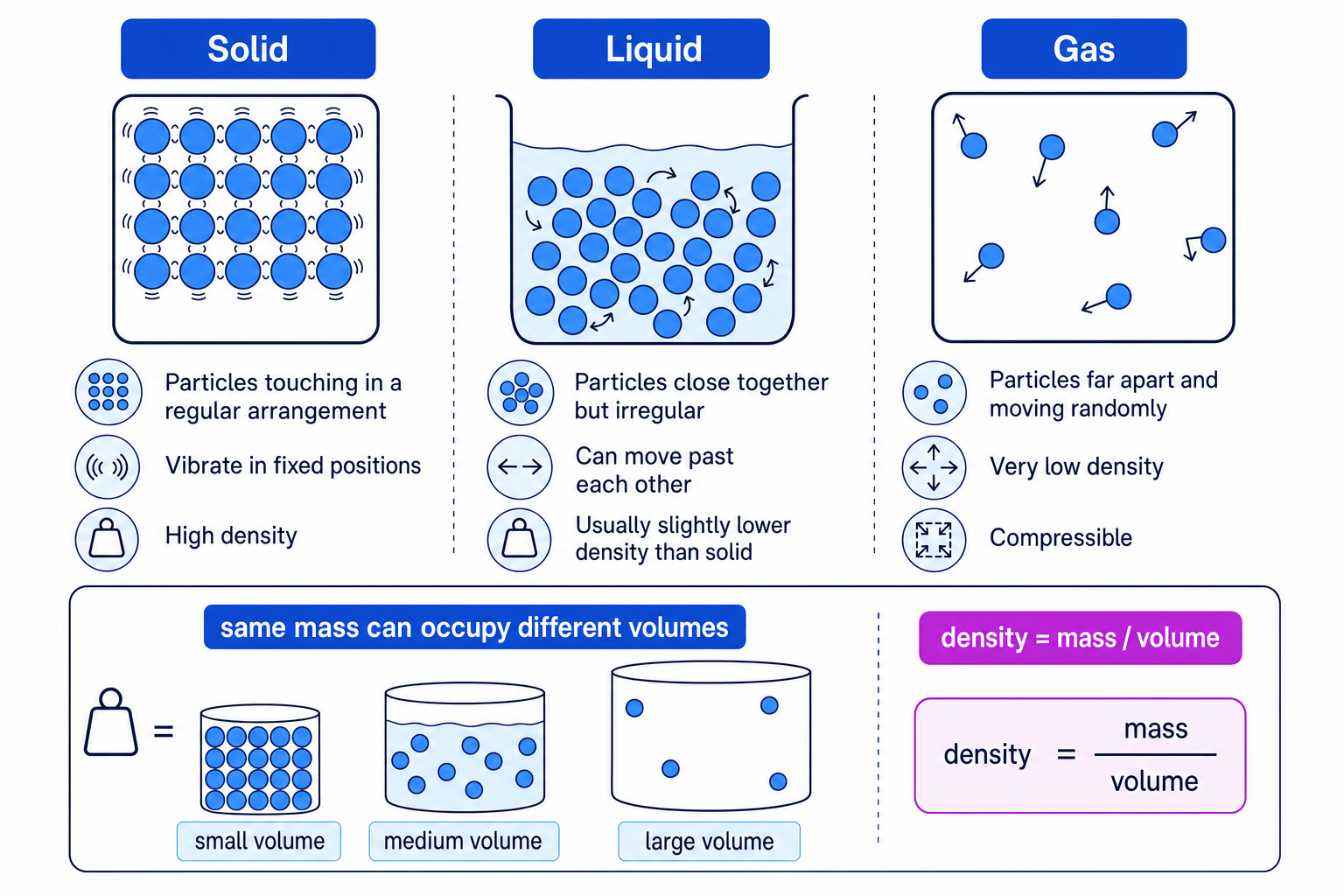
The density of a substance depends on how its particles are arranged and how much space they take up.
Solids
In a solid, particles are close together in a regular arrangement. They vibrate about fixed positions. Because the particles are packed closely, solids usually have high density.
Liquids
In a liquid, particles are still close together, but they are arranged irregularly and can move past each other. Liquids usually have a density similar to, but slightly lower than, the solid form of the same substance.
Gases
In a gas, particles are far apart and move randomly. The same mass of gas takes up a much larger volume, so gases have much lower density. Gases are also compressible, meaning their volume can be reduced by squeezing the particles closer together.
Density and particle spacing
For the same mass, a larger volume means a lower density. Gases are much less dense than solids and liquids because their particles are much further apart.
Water is unusual
Most substances are denser as solids than as liquids, but water is an important exception: ice is less dense than liquid water, which is why ice floats.
Changes where mass is conserved
Mass is conserved when the total mass stays the same. This happens in a closed system, where no matter enters or leaves.
If mass stays the same but volume changes, density must change:
- if volume increases, density decreases
- if volume decreases, density increases
Applying conserved mass
A sealed syringe contains 0.020 kg of air. Its volume changes from 8.0×10⁻⁴ m38.0 \times 10^{-4}\text{ m}^38.0×10⁻⁴ m3 to 4.0×10⁻⁴ m34.0 \times 10^{-4}\text{ m}^34.0×10⁻⁴ m3. Calculate the density before and after compression.
- Because the syringe is sealed, the mass is conserved: m=0.020 kgm = 0.020\text{ kg}m=0.020 kg before and after.
- Calculate the starting density: ρ=0.0208.0×10−4=25 kg/m3\rho = \frac{0.020}{8.0 \times 10^{-4}} = 25\text{ kg/m}^3ρ=8.0×10−40.020=25 kg/m3.
- Calculate the final density: ρ=0.0204.0×10−4=50 kg/m3\rho = \frac{0.020}{4.0 \times 10^{-4}} = 50\text{ kg/m}^3ρ=4.0×10−40.020=50 kg/m3.
- Compare the results: the volume has halved, so the density has doubled.
In the exam
- Check the scale first: is the question about subatomic particles, atoms, molecules, or particles in solids, liquids and gases?
- For density calculations, convert to kilograms and cubic metres if the answer needs kg/m³.
- When explaining atomic model changes, link each observation to a conclusion: evidence causes the model to change.
Check yourself
- Why did the alpha scattering experiment lead to the idea of a tiny positive nucleus?
- What is the typical order of magnitude of the size of an atom?
- If the mass of a gas stays the same but its volume increases, what happens to its density?
