What you'll learn
- How Earth’s atmosphere is thought to have changed from the early Earth to today.
- How the greenhouse effect works, and why extra greenhouse gases affect climate.
- How to interpret evidence for human-caused climate change, including graphs and correlations.
- The main atmospheric pollutants and how potable water can be produced.
Earth systems: the big picture
Earth is not just “rock”. It is a set of linked systems: the atmosphere, oceans, rocks, living things and human activity all affect one another.
Earth system
An Earth system is a part of Earth, such as the atmosphere, oceans, rocks or living organisms, that interacts with other parts of Earth.
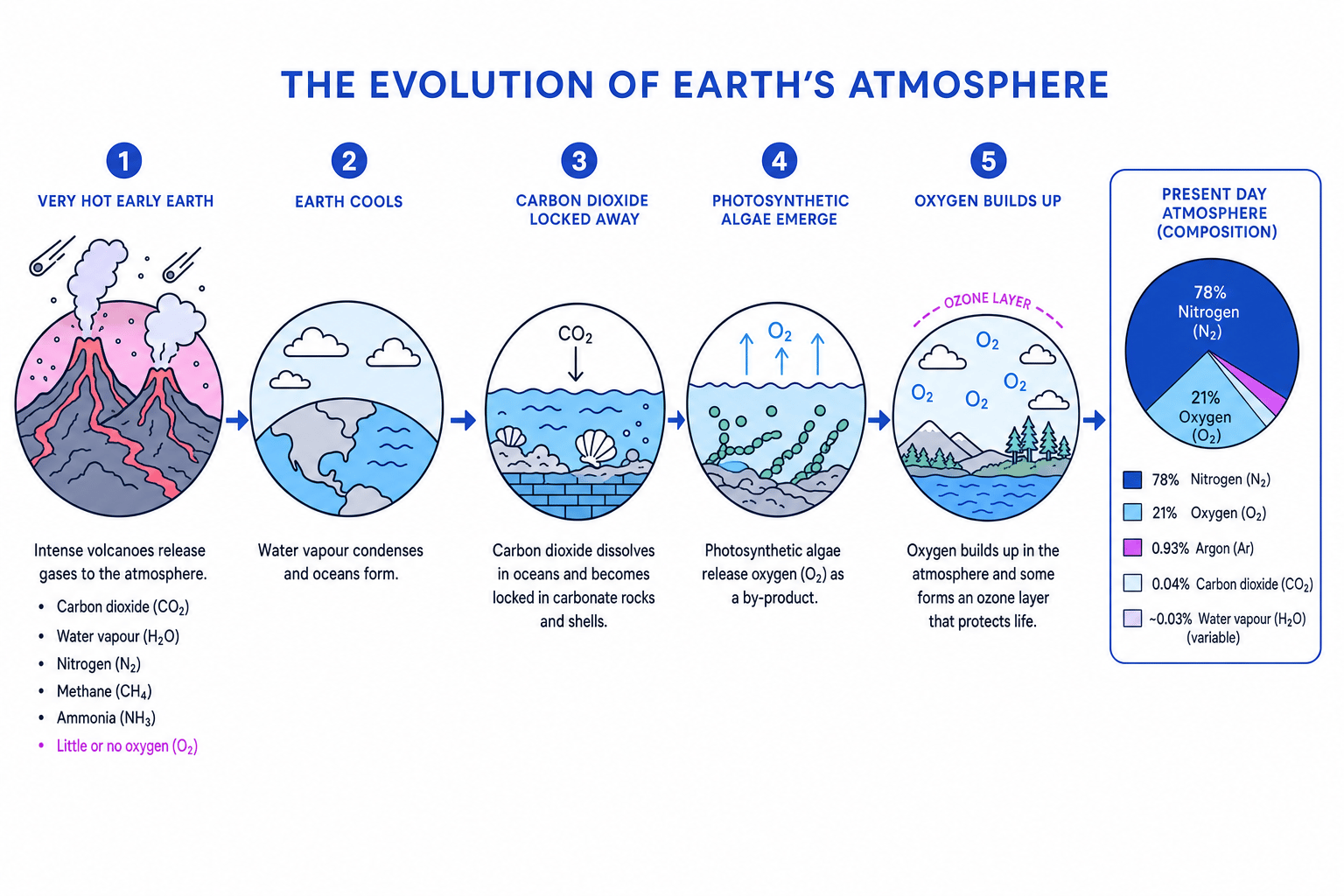
The atmosphere is the layer of gases around Earth. Today it is mostly nitrogen and oxygen, with small amounts of argon, carbon dioxide and water vapour. Even tiny percentages matter: carbon dioxide is only about 0.04% of the atmosphere, but it strongly affects how infrared radiation interacts with air.
Small does not mean unimportant
A gas can be present in a very small percentage but still have a large effect if it absorbs radiation or affects living organisms.
How the atmosphere was originally formed
Scientists cannot travel back to the early Earth, so they use evidence from rocks, fossils, volcanoes and comparisons with other planets to build models.
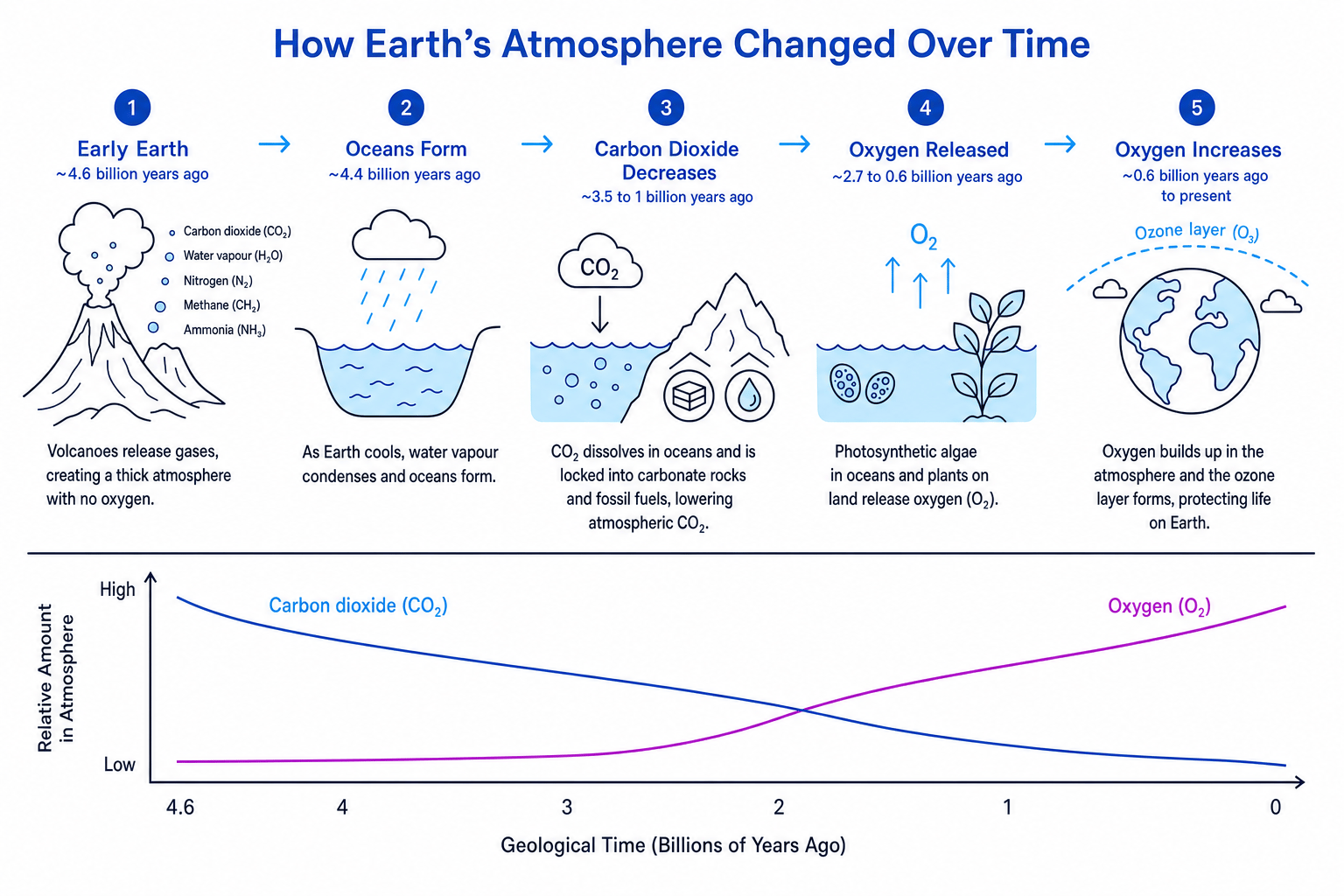
The early Earth formed about 4.6 billion years ago. It was very hot and had intense volcanic activity. Volcanoes released gases including carbon dioxide, water vapour, nitrogen, methane and ammonia. There was little or no oxygen.
As Earth cooled, water vapour condensed to form oceans. Large amounts of carbon dioxide dissolved in the oceans. Some carbon became locked away in carbonate rocks, shells and later fossil fuels, so the amount of carbon dioxide in the atmosphere decreased over time.
Using orders of magnitude for atmosphere data
A simplified model suggests an early atmosphere may have contained about 95% carbon dioxide. Today, carbon dioxide is about 0.04%.
- Compare the two percentages by dividing the larger value by the smaller value:
- Write this approximately as a power of ten:
- Interpret the result: the carbon dioxide percentage is roughly 2400 times lower today, which is about 3 orders of magnitude lower.
How oxygen increased
Photosynthesis
Photosynthesis is the process in which plants, algae and some bacteria use light energy to make glucose from carbon dioxide and water, releasing oxygen.
The word equation is:
carbon dioxide + water → glucose + oxygen
A balanced chemical equation is:
6CO₂(g) + 6H₂O(l) → C₆H₁₂O₆(aq) + 6O₂(g)
At first, oxygen released by early algae reacted with dissolved iron and minerals, so it did not immediately build up in the air. Eventually, more oxygen accumulated in the atmosphere.
Some oxygen also formed ozone in the upper atmosphere. The ozone layer absorbs harmful ultraviolet radiation from the Sun, which helped life develop on land.
Ozone layer versus global warming
The hole in the ozone layer is not the main cause of global warming. Global warming is linked to increased greenhouse gases absorbing infrared radiation.
The greenhouse effect
Greenhouse gas
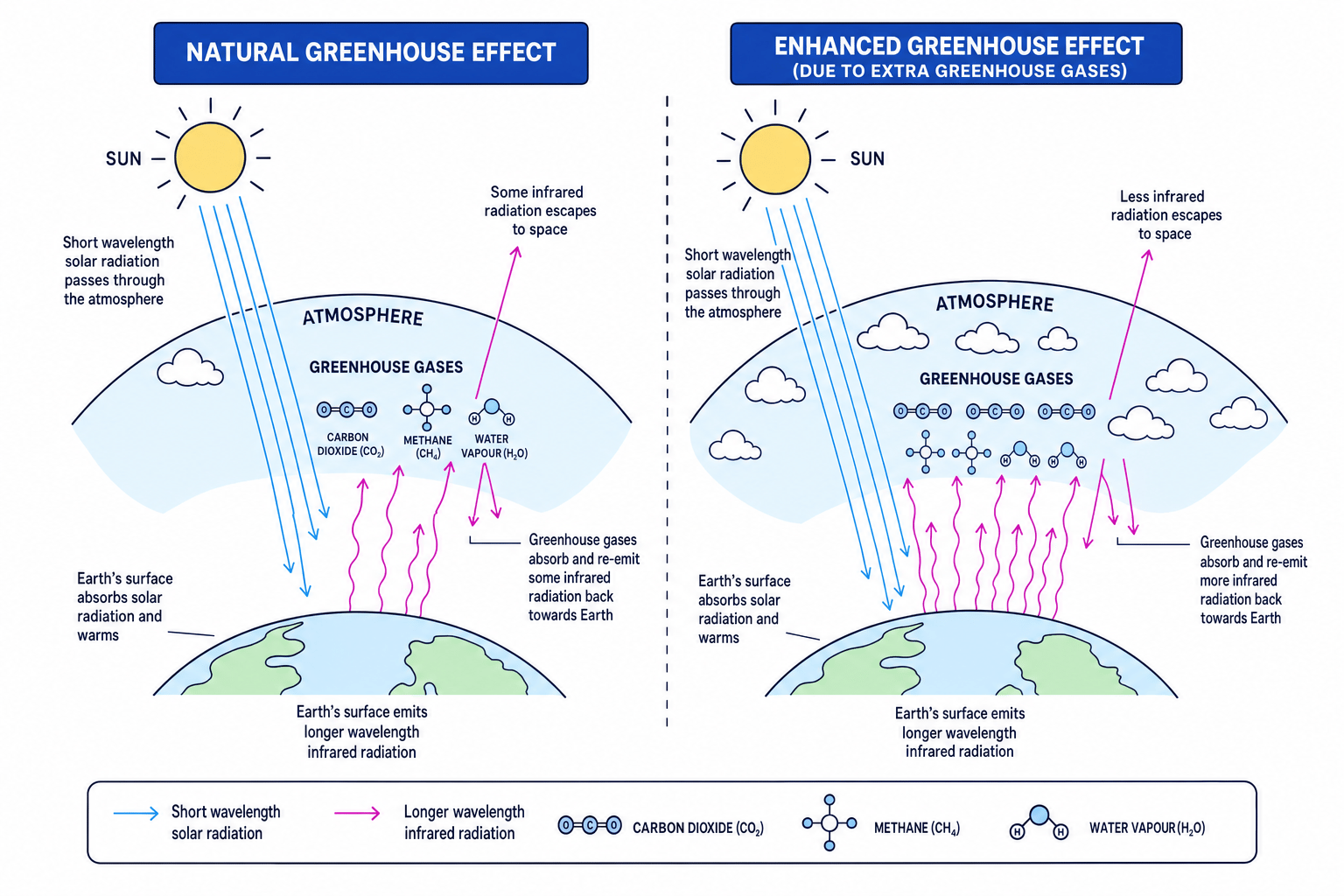
A greenhouse gas is a gas that absorbs and re-emits infrared radiation. Important examples include carbon dioxide, methane and water vapour.
The Sun emits short-wavelength radiation, which passes through the atmosphere and warms Earth’s surface. The warm surface emits longer-wavelength infrared radiation. Greenhouse gases absorb some of this infrared radiation and re-emit it in all directions, including back towards Earth.
This is the natural greenhouse effect, and it keeps Earth warm enough for life. Human activity can cause an enhanced greenhouse effect by increasing the concentration of greenhouse gases.
The greenhouse effect is natural
Human activity did not create the greenhouse effect. The problem is that extra greenhouse gases can enhance it and change the climate.
Evidence for human-caused climate change
Anthropogenic
Anthropogenic means caused by human activity.
Burning fossil fuels releases carbon dioxide. Fossil fuels include coal, crude oil and natural gas. For example:
CH₄(g) + 2O₂(g) → CO₂(g) + 2H₂O(g)
Scientists compare records of fossil fuel use, atmospheric carbon dioxide concentration and global temperature. A correlation is a relationship between two variables: when one changes, the other tends to change too.
Parts per million
Parts per million, or ppm, means the number of particles of a substance in one million particles of mixture. For example, 400 ppm carbon dioxide means 400 carbon dioxide molecules per million air molecules.
Interpreting a correlation
A data set shows that in 1960 atmospheric carbon dioxide was 317 ppm and fossil fuel carbon dioxide emissions were 9 billion tonnes per year. In 2020, carbon dioxide was 414 ppm and emissions were 35 billion tonnes per year.
- Calculate the change in carbon dioxide concentration:
- Calculate the percentage increase in carbon dioxide concentration:
- Compare fossil fuel emissions:
Emissions became about 3.9 times larger.
- Interpret the evidence: both carbon dioxide concentration and fossil fuel use increased, so there is a positive correlation. The data alone does not prove cause, but it supports the explanation when combined with the known greenhouse effect.
There are uncertainties in climate evidence. Older temperature data may be less direct, and natural factors such as volcanic eruptions, changes in solar output and ocean cycles can also affect climate. Climate models must simplify a very complex Earth system.
However, uncertainty does not mean “we know nothing”. Scientists look for agreement between different types of evidence, such as ice cores, modern measurements, satellite data and climate models.
Evaluating evidence
Strong answers often say both: “there is a correlation” and “correlation alone is not proof, but a known mechanism makes the link more convincing.”
Effects of increased carbon dioxide and methane
Carbon dioxide is released by burning fossil fuels, deforestation and some industrial processes. Methane is released from agriculture, landfill sites and leaks from natural gas systems.
Higher levels of carbon dioxide and methane can increase global temperatures. Possible effects include:
- melting glaciers and ice sheets
- sea level rise
- more frequent heatwaves
- changes in rainfall patterns
- increased flooding or drought in some regions
- effects on habitats, biodiversity and food production
These effects are not evenly spread around the world. Some places may face much greater risks than others.
Mitigation means reducing the size or impact of a problem. Climate change can be mitigated by using renewable energy, improving energy efficiency, planting trees, reducing deforestation, capturing methane from landfill, changing farming methods and using carbon capture and storage.
Comparing mitigation choices
A town can fund either improved home insulation saving 12 000 tonnes of carbon dioxide per year, or landfill methane capture saving 36 000 tonnes of carbon dioxide equivalent per year.
- Compare the scale of the saving:
Methane capture gives three times the climate benefit in this data set.
-
Consider risk and practicality: insulation may also reduce fuel bills for households, while methane capture depends on the landfill producing enough methane and being safely maintained.
-
Make a balanced judgement: methane capture has the larger direct saving, but the best decision may depend on cost, reliability and wider social benefits.
Atmospheric pollutants
Some gases and particles are harmful even when they are not the main greenhouse gases.
Particulates
Particulates are tiny solid particles or liquid droplets suspended in the air, such as soot, dust or smoke.
| Pollutant | Major sources | Problems caused |
|---|---|---|
| Carbon monoxide | Incomplete combustion in vehicle engines, faulty boilers and fires | Toxic; reduces the blood’s ability to carry oxygen |
| Sulfur dioxide | Burning fuels containing sulfur, especially some coal and oil; volcanoes | Acid rain and breathing problems |
| Oxides of nitrogen | High-temperature combustion in engines and power stations | Acid rain, photochemical smog and breathing problems |
| Particulates | Diesel engines, fires, industry, dust and soot | Lung and heart problems; can reduce air quality and visibility |
Carbon monoxide is not carbon dioxide
Carbon monoxide, CO, is a poisonous pollutant. Carbon dioxide, CO₂, is a greenhouse gas. They have different effects and different formulae.
Increasing the availability of potable water
Potable water
Potable water is water that is safe to drink. It does not have to be pure water; it just needs low enough levels of dissolved substances and microorganisms.
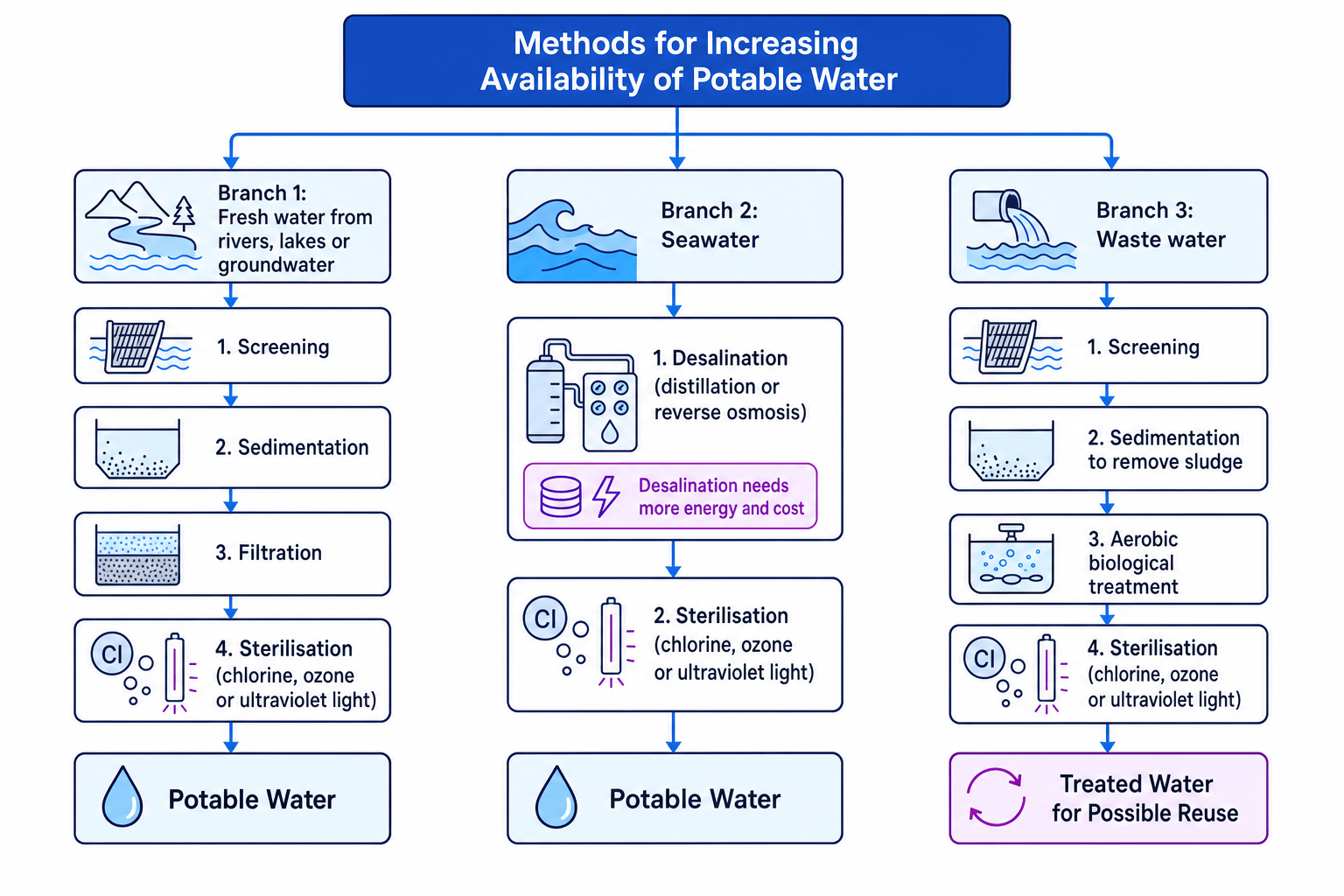
Fresh water from rivers, lakes or groundwater is usually easier to treat than seawater. It may need screening, sedimentation, filtration and sterilisation.
- Screening removes large objects such as leaves and plastic.
- Sedimentation lets heavier particles settle out.
- Filtration removes smaller insoluble particles.
- Sterilisation kills microorganisms, using chlorine, ozone or ultraviolet light.
Seawater contains dissolved salts, so it needs desalination. This can be done by distillation or reverse osmosis, but both require more energy and cost than treating fresh water.
Waste water can also be treated. It is screened, allowed to settle, treated biologically using aerobic microorganisms, and sterilised before possible reuse.
Choosing a water treatment method
A water company has three sources: muddy river water, seawater and waste water from homes.
-
For muddy river water, choose screening, sedimentation and filtration because the main problem is insoluble solids, then sterilise to kill microorganisms.
-
For seawater, choose desalination because dissolved salts cannot be removed by ordinary filtration.
-
For waste water, include biological treatment because organic waste must be broken down before the water can be sterilised and reused.
In the exam
- When given a graph, describe the trend first, then use numbers from the graph to support your point.
- For climate evidence, separate correlation, mechanism and uncertainty instead of making one vague statement.
- For water treatment questions, identify the main problem first: insoluble solids, microorganisms, dissolved salts or organic waste.
Check yourself
- Why did carbon dioxide decrease as oceans formed?
- How do greenhouse gases interact with infrared radiation?
- Why is desalination usually more expensive than treating fresh water?