

What you'll learn
- Why organisms need to keep their internal conditions stable.
- How homeostasis uses receptors, coordination centres and effectors.
- How insulin controls blood glucose levels.
- How insulin and glucagon work together, and how diabetes can be treated.
Why your internal environment must be controlled
Your cells are constantly carrying out metabolic reactions. Metabolic reactions are the chemical reactions happening inside living organisms, such as respiration, protein synthesis and digestion inside cells.
Many of these reactions are controlled by enzymes, which are biological catalysts: they speed up reactions without being used up. Enzymes work best under particular conditions, such as the right temperature and pH.
Internal environment
The internal environment means the conditions inside your body, especially in the blood and tissue fluid surrounding cells. Examples include body temperature, blood glucose concentration and water balance.
If internal conditions change too much, enzyme-controlled reactions may become too slow, or enzymes may stop working properly. For example, if body temperature gets too high, enzymes can denature, meaning their active sites change shape so substrates no longer fit.
Homeostasis
Homeostasis is the regulation of internal conditions to keep them within safe limits, even when internal or external conditions change.
Homeostasis matters because it allows metabolic reactions to happen at appropriate rates. It does not mean conditions never change at all; it means the body keeps them close enough to normal for cells to function.
Explaining why hypothermia is dangerous
A person’s core body temperature falls well below normal after being in very cold water.
- The low temperature means enzyme-controlled reactions in cells happen more slowly, because reacting particles have less kinetic energy.
- Respiration becomes less effective, so cells release energy more slowly.
- Organs such as the brain and heart may not receive enough usable energy for normal function, so hypothermia can become life-threatening.
Homeostasis uses negative feedback
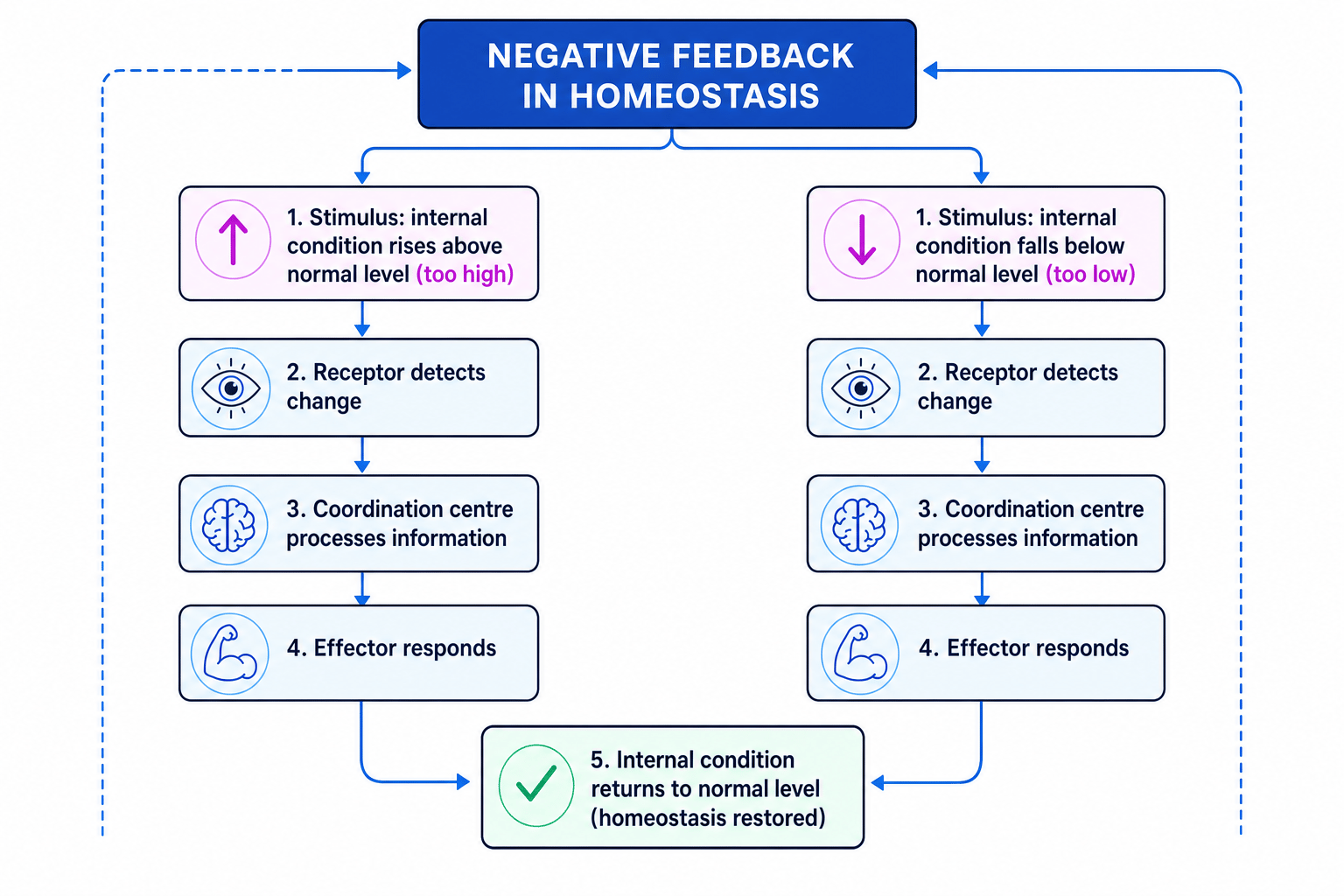
Most homeostatic systems use negative feedback. This means the body detects a change away from the normal level and brings the condition back towards normal.
The basic pathway is:
- A stimulus is a change in the internal or external environment.
- A receptor detects the change.
- A coordination centre receives and processes information.
- An effector produces a response.
- The response reduces the original change.
Negative feedback
Negative feedback reverses a change: if a level becomes too high, the response lowers it; if a level becomes too low, the response raises it.
In some systems, the coordination centre is the brain or spinal cord. In blood glucose control, the pancreas is especially important because it detects blood glucose changes and releases hormones.
Blood glucose: the key example
Glucose is a simple sugar used by cells in respiration. It is carried around the body in the blood.
Blood glucose level
Blood glucose level means the concentration of glucose dissolved in the blood. In GCSE questions, “blood sugar” usually means blood glucose.
Blood glucose must be controlled carefully:
- If it is too low, cells may not have enough glucose for respiration.
- If it is too high for too long, it can damage tissues and organs.
Blood glucose changes during the day. It usually rises after a meal containing carbohydrates, because digestion breaks carbohydrates down into glucose. It may fall between meals or during exercise, because cells are using glucose in respiration.
Insulin lowers blood glucose
A hormone is a chemical messenger released by an endocrine gland into the blood. Hormones travel in the blood and affect target organs.
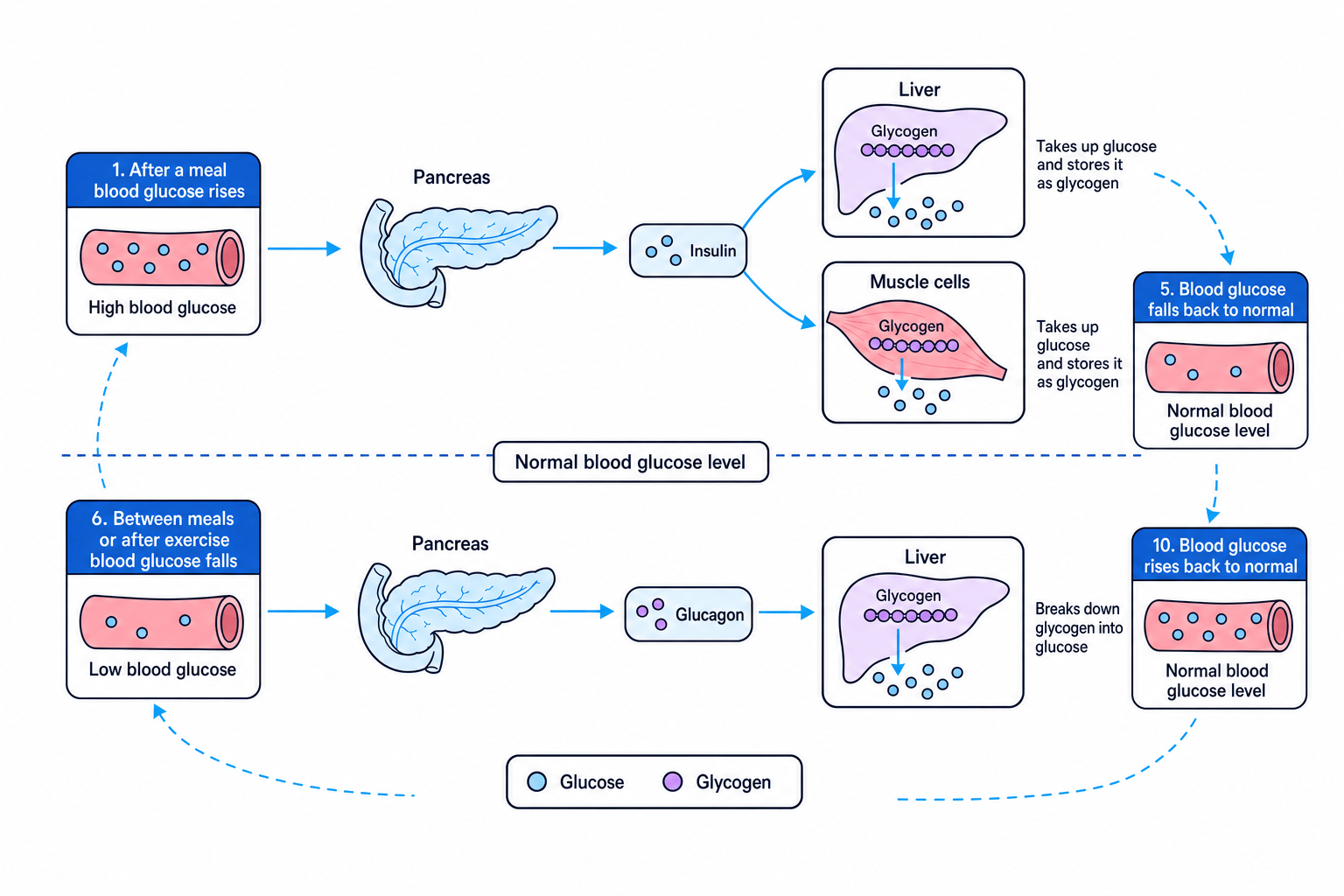
The pancreas releases the hormone insulin when blood glucose is too high, such as after a meal.
Insulin causes:
- body cells to take in more glucose from the blood
- liver and muscle cells to store glucose as glycogen
Glycogen
Glycogen is an insoluble storage carbohydrate made from many glucose molecules joined together. Animals store glycogen mainly in the liver and muscles.
This removes glucose from the blood, so blood glucose falls back towards the normal level.
Insulin lowers blood glucose
When blood glucose is too high, insulin is released by the pancreas. Insulin causes glucose to leave the blood and be stored as glycogen, bringing blood glucose down.
Saying insulin breaks down glucose
Insulin does not chemically break down glucose. It is a signal that makes cells take up glucose and makes liver and muscle cells store glucose as glycogen.
Glucagon raises blood glucose
If you are sitting Higher Tier, you also need to explain how glucagon interacts with insulin.
Glucagon is another hormone released by the pancreas. It is released when blood glucose is too low, such as between meals or after exercise.
Glucagon causes liver cells to break down glycogen into glucose. The glucose is released into the blood, so blood glucose rises back towards normal.
Insulin and glucagon have opposite effects:
| Situation | Hormone released | Main effect | Result |
|---|---|---|---|
| Blood glucose too high | Insulin | Glucose is taken into cells and stored as glycogen | Blood glucose falls |
| Blood glucose too low | Glucagon | Glycogen in the liver is broken down into glucose | Blood glucose rises |
Quick memory link
Insulin helps glucose go into cells. Glucagon helps glucose be gone from glycogen stores back into the blood.
Choosing the hormone from blood glucose data
A person’s normal blood glucose level is 5 arbitrary units. After lunch it rises to 8 arbitrary units. Later, after exercise, it falls to 3 arbitrary units.
- After lunch, 8 arbitrary units is above the normal level, so the body needs a response that lowers blood glucose.
- The pancreas releases insulin, which causes cells to take up glucose and liver or muscle cells to store glucose as glycogen.
- After exercise, 3 arbitrary units is below the normal level, so the body needs a response that raises blood glucose.
- On Higher Tier, the hormone to name is glucagon, which causes liver glycogen to be broken down into glucose and released into the blood.
Diabetes: when blood glucose control goes wrong
Diabetes
Diabetes mellitus is a condition where blood glucose is not properly controlled, so blood glucose can become too high.
In practical work, glucose test strips such as Clinistix can be used with fake urine samples. A colour change shows glucose is present. Normally, urine should contain little or no glucose, so glucose in urine can suggest blood glucose has been too high. It does not, by itself, tell you which type of diabetes a person has.
Comparing type 1 and type 2 diabetes
| Feature | Type 1 diabetes | Type 2 diabetes |
|---|---|---|
| Main problem | The pancreas produces little or no insulin | Body cells become resistant to insulin |
| Usual cause | Often an immune system attack on insulin-producing cells | Linked to risk factors such as obesity, inactivity, age and genetics |
| Typical onset | Often begins in childhood or teenage years | More common in adults, but can occur younger |
| Blood glucose effect | Blood glucose rises because there is not enough insulin | Blood glucose rises because cells do not respond properly to insulin |
| Treatment | Insulin injections or an insulin pump; careful monitoring of blood glucose; balanced diet | Carbohydrate-controlled diet, regular exercise, weight loss if needed, medicines, and sometimes insulin |
Be careful with wording: type 2 diabetes is linked to lifestyle factors, but it is not simply “caused by eating sugar”. Genetics, age and body response to insulin also matter.
Identifying diabetes type and treatment
A patient has high blood glucose. Tests show their pancreas makes almost no insulin.
- The key evidence is that the pancreas makes almost no insulin, so the problem is insulin production rather than insulin resistance.
- This matches type 1 diabetes, where the body cannot produce enough insulin.
- A suitable treatment would include insulin injections or an insulin pump, along with monitoring blood glucose and managing diet.
In the exam
- Link homeostasis to enzyme-controlled metabolic reactions happening at suitable rates.
- For blood glucose questions, always state the direction of change first: too high means insulin; too low means glucagon on Higher Tier.
- When comparing diabetes types, focus on the mechanism: type 1 is lack of insulin production; type 2 is reduced response to insulin.
Check yourself
- Why does your body need to keep internal conditions within safe limits?
- What happens to blood glucose after insulin is released?
- How are type 1 and type 2 diabetes different in cause and treatment?
