What you'll learn
- What hormones are and how the endocrine system coordinates the body.
- How adrenaline and thyroxine affect the body, including thyroxine negative feedback at Higher tier.
- How hormones control human reproduction and the menstrual cycle.
- How contraception and fertility treatments use knowledge of hormones.
Big picture: why the body needs coordination
Your body has to coordinate lots of processes at the same time: growth, metabolism, stress responses, reproduction, and keeping internal conditions steady.
There are two main coordination systems:
- the nervous system, which uses electrical impulses through neurones and is usually very fast
- the endocrine system, which uses hormones carried in the blood and is usually slower but longer-lasting
Hormone
A hormone is a chemical messenger made by a gland and transported in the blood to change the activity of specific target cells, tissues or organs.
The endocrine system
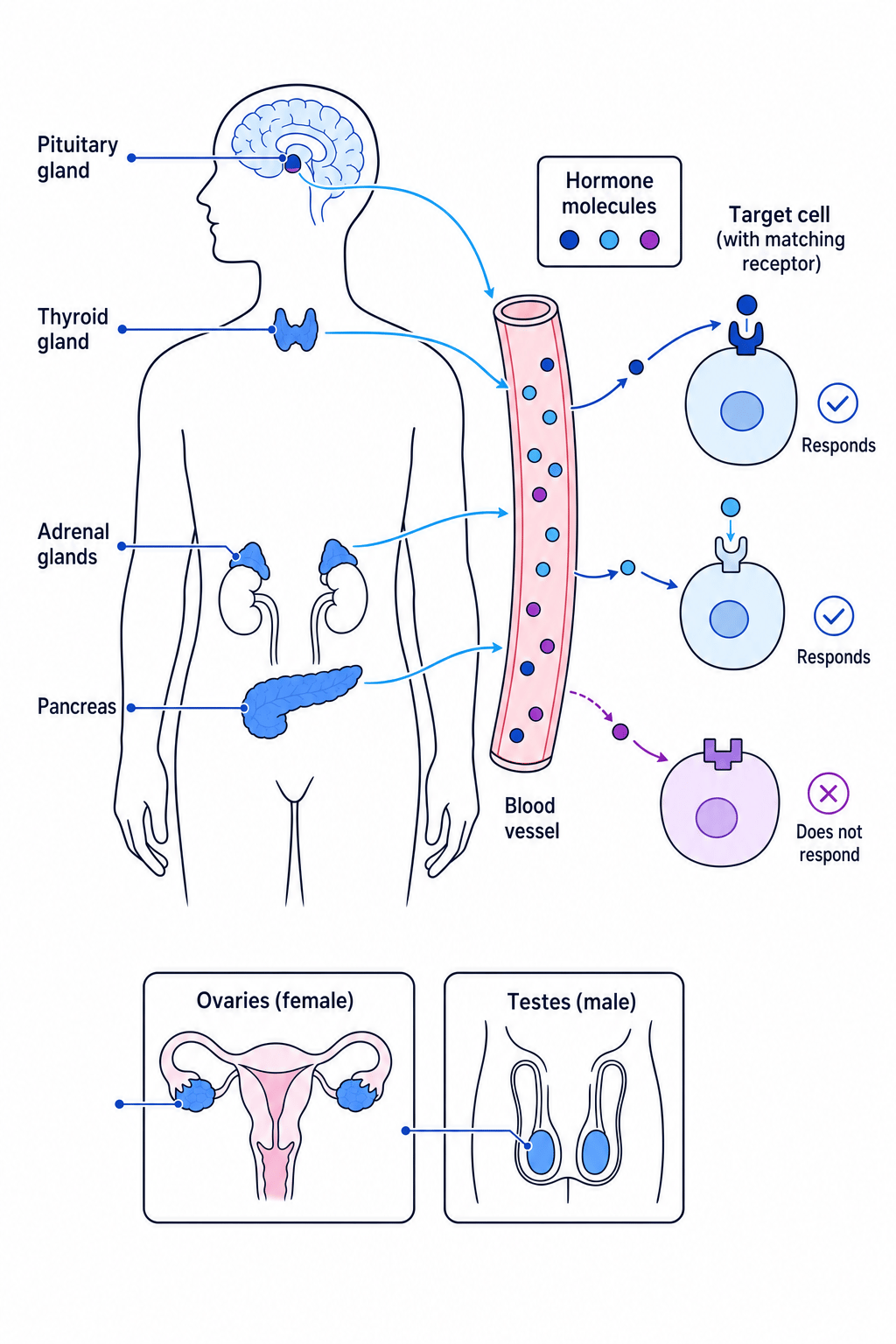
The endocrine system is made of endocrine glands. A gland is an organ that secretes a useful substance. Endocrine glands secrete hormones directly into the bloodstream.
Important human endocrine glands include:
- the pituitary gland in the brain
- the thyroid gland in the neck
- the adrenal glands above the kidneys
- the pancreas
- the ovaries in females
- the testes in males
Hormones travel all around the body in the blood, but only some cells respond. These are target cells. A target cell has the correct receptor, which is a molecule with a shape that the hormone can bind to.
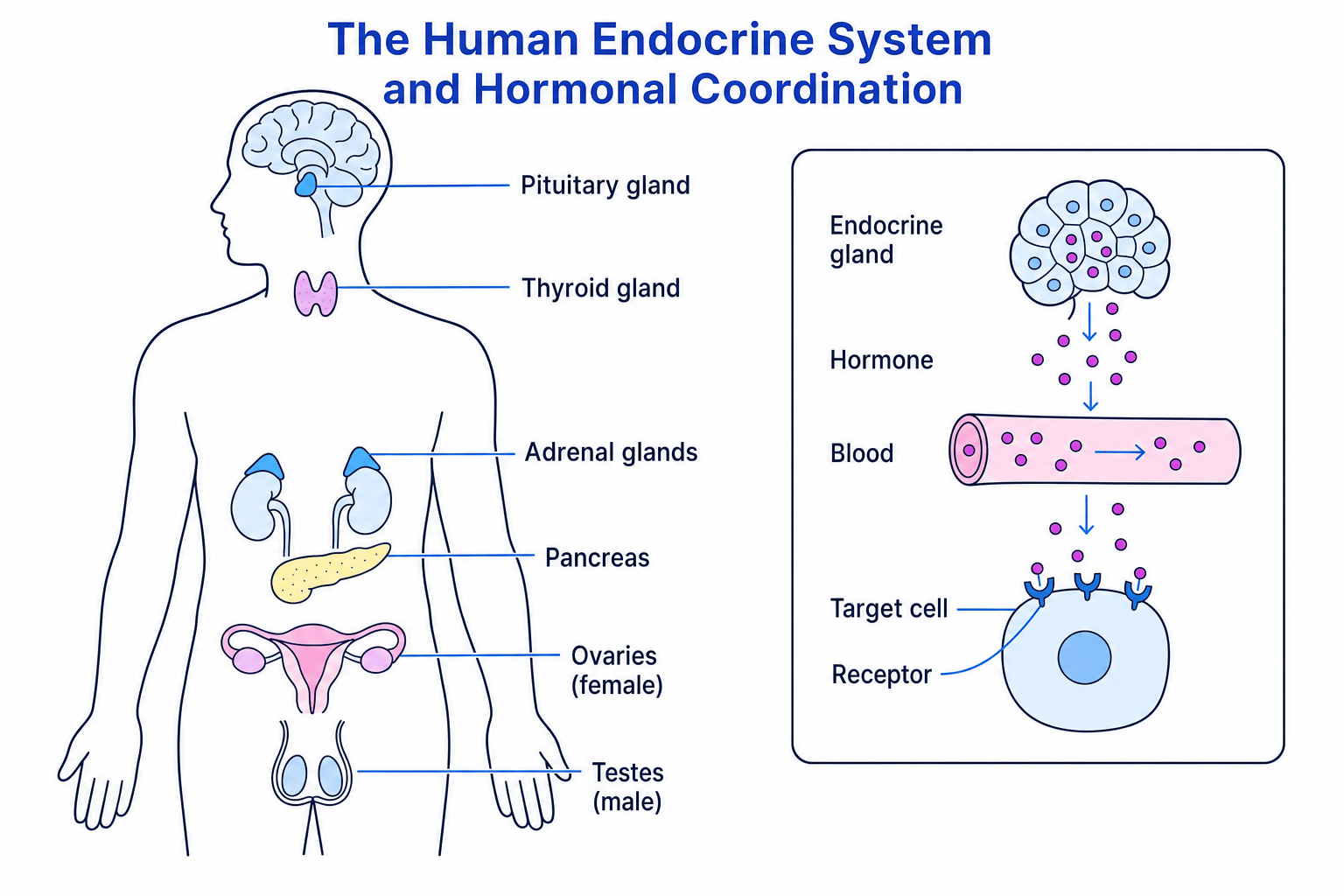
Why only target cells respond
A hormone may be carried everywhere in the blood, but it only affects cells with the correct receptor. No receptor means no response.
Hormonal vs nervous coordination
| Feature | Nervous system | Endocrine system |
|---|---|---|
| Signal | Electrical impulses | Chemical hormones |
| Route | Along neurones | In the blood |
| Speed | Very fast | Usually slower |
| Duration | Usually short-lived | Often longer-lasting |
| Example | Reflex action | Menstrual cycle control |
Adrenaline and thyroxine
At Higher tier, you need to be able to explain the roles of adrenaline and thyroxine, not just name them.
Adrenaline
Adrenaline is a hormone released by the adrenal glands. It prepares the body for a “fight or flight” response when you are frightened, excited or stressed.
Adrenaline can:
- increase heart rate, so more oxygen and glucose are delivered to muscles
- increase breathing rate, so more oxygen enters the blood
- increase blood glucose concentration, giving cells more fuel for respiration
- redirect blood flow towards muscles
Thyroxine
Thyroxine is a hormone released by the thyroid gland. It helps control the body’s metabolic rate, which means the rate of chemical reactions in cells. Thyroxine also affects growth and development.
Thyroxine levels are controlled by negative feedback.
Negative feedback
Negative feedback is a control mechanism where a change from the normal level causes responses that reverse the change, bringing the level back towards normal.
For thyroxine:
- If thyroxine level is too low, the pituitary gland releases more TSH.
- TSH stands for thyroid-stimulating hormone. It stimulates the thyroid gland to release more thyroxine.
- If thyroxine level becomes too high, the pituitary releases less TSH.
- Less TSH means the thyroid releases less thyroxine.
Predicting thyroxine negative feedback
A person’s thyroxine level rises above normal. What should happen next?
- The body compares the thyroxine level with the normal level and detects that it is too high.
- Negative feedback must reduce the process that raises thyroxine, so the pituitary gland releases less TSH.
- With less TSH stimulation, the thyroid gland releases less thyroxine, so the thyroxine level falls back towards normal.
Hormones in human reproduction
Human reproduction is controlled by several hormones. Some are involved in puberty, sperm production, egg maturation and the menstrual cycle.
Key reproductive hormones
| Hormone | Main source | Main role |
|---|---|---|
| Testosterone | Testes | Stimulates sperm production and male secondary sexual characteristics |
| Oestrogen | Ovaries | Helps thicken the uterus lining and is involved in the menstrual cycle |
| Progesterone | Ovaries after ovulation | Maintains the uterus lining |
| FSH | Pituitary gland | Causes an egg to mature in an ovary |
| LH | Pituitary gland | Triggers ovulation |
FSH stands for follicle-stimulating hormone. LH stands for luteinising hormone.
The menstrual cycle
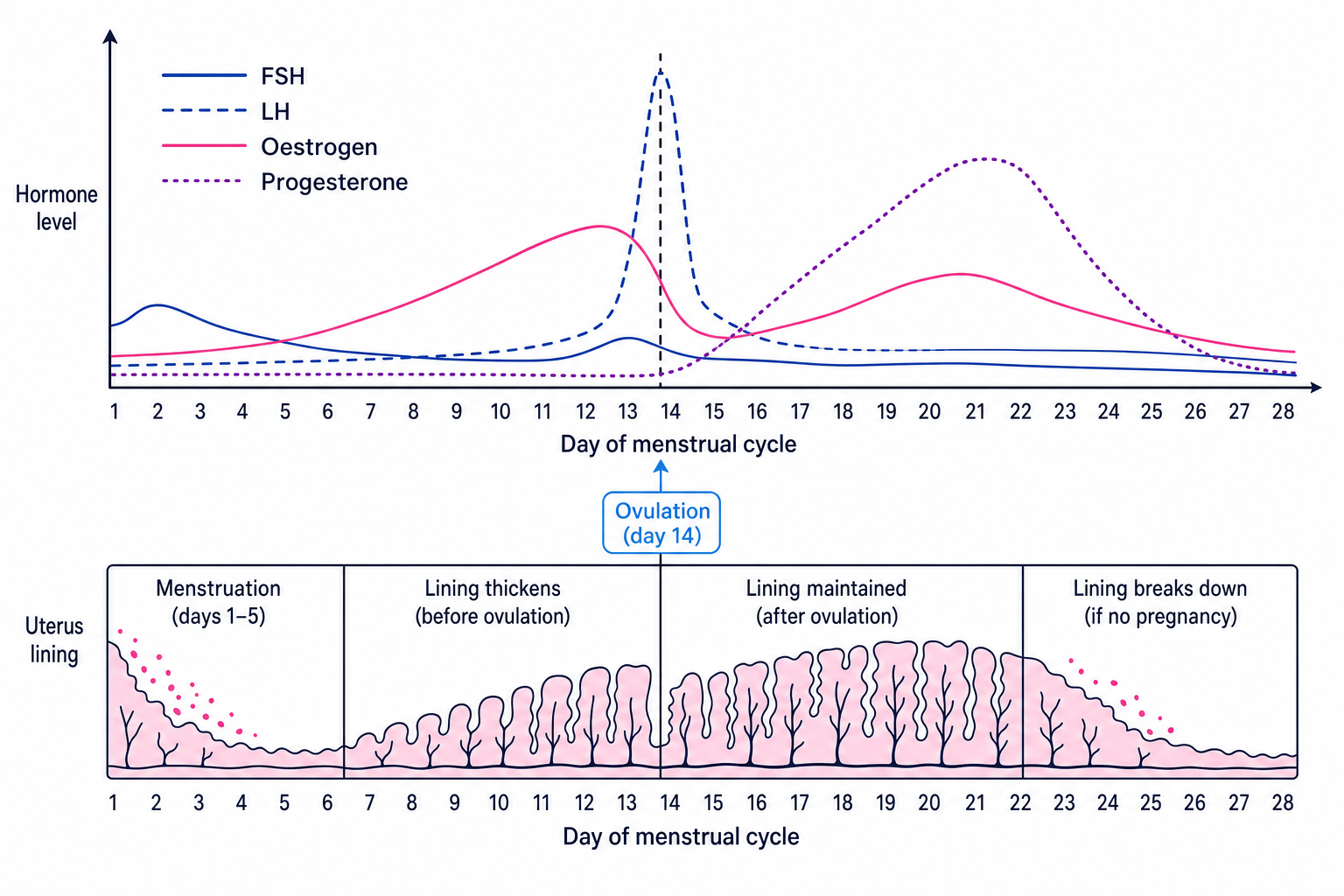
The menstrual cycle is a repeating cycle of changes in the ovaries and uterus. A typical cycle is about 28 days, but real cycles vary between people and from month to month.
The cycle starts on day 1, the first day of menstruation. Menstruation is when the uterus lining breaks down and leaves the body.
Ovulation is the release of an egg from an ovary. In a typical 28-day cycle, this happens around day 14.
The graph below shows the relative changes in the main menstrual cycle hormones. Focus on the pattern, especially the LH peak at ovulation and the rise in progesterone after ovulation.
The hormone interactions
At Higher tier, you need to explain how FSH, LH, oestrogen and progesterone interact.
- FSH is released by the pituitary gland. It causes an egg to mature in a follicle in the ovary.
- The developing follicle releases oestrogen.
- Oestrogen causes the uterus lining to thicken, preparing it for possible implantation of an embryo.
- Oestrogen also reduces FSH release, so usually only one egg matures.
- When oestrogen becomes high enough, it stimulates a sharp rise in LH.
- The LH surge triggers ovulation.
- After ovulation, the ovary releases progesterone.
- Progesterone maintains the thick uterus lining and inhibits FSH and LH.
- If pregnancy does not happen, progesterone falls and the uterus lining breaks down, causing menstruation.
Conception and the uterus lining
Conception is most likely around ovulation, when an egg has just been released. By the time an embryo implants, the uterus lining should be thick and maintained by progesterone, not breaking down.
Explaining ovulation from hormone data
A graph shows oestrogen rising before day 14, a sharp LH peak at day 14, and progesterone rising after day 14. Explain what is happening.
- Rising oestrogen shows that a follicle is developing in the ovary and the uterus lining is thickening.
- The sharp LH peak at day 14 is the trigger for ovulation, so this is when the egg is released.
- The rise in progesterone after day 14 shows that the uterus lining is being maintained in case an embryo implants.
Contraception
Contraception means methods used to reduce the chance of pregnancy.
Contraception can be hormonal or non-hormonal.
Hormonal contraception
Hormonal contraception uses synthetic versions of reproductive hormones. These can prevent pregnancy by:
- stopping FSH release, so an egg does not mature
- stopping the LH surge, so ovulation does not happen
- thickening mucus at the cervix, making it harder for sperm to reach an egg
- making the uterus lining less suitable for implantation
Examples include:
- the contraceptive pill
- patches
- injections
- implants
- hormonal intrauterine systems, often called IUS
Long-acting methods such as implants and IUS are usually very effective because the user does not have to remember them every day.
Non-hormonal contraception
Non-hormonal methods do not use hormones. Examples include:
- condoms, which act as a barrier and also reduce the spread of sexually transmitted infections, or STIs
- diaphragms, which cover the cervix
- copper intrauterine devices, often called copper IUDs, which mainly prevent fertilisation
- sterilisation, a surgical method intended to be permanent
- natural family planning, which avoids sex around the most fertile days, but is less reliable because cycles vary
Judging contraception effectiveness
When comparing contraception, ask: How effective is it at preventing pregnancy? Does it protect against STIs? Is it reversible? Does it rely on the user remembering it? Are there side effects or personal concerns?
Choosing contraception methods
A couple wants very effective pregnancy prevention and also wants protection from STIs. Compare suitable options.
- Condoms are important because they are the main contraceptive method that also protects against STIs.
- For very high pregnancy prevention, a long-acting method such as an implant, IUS or IUD is usually more reliable than a method that must be remembered every day.
- A strong evaluation is that using condoms together with a long-acting contraceptive gives STI protection and very effective pregnancy prevention, but personal choice, side effects and access still matter.
Fertility treatments
At Higher tier, you also need to explain how hormones are used in modern reproductive technologies to treat infertility. Infertility means difficulty becoming pregnant despite regular unprotected sex.
Fertility drugs
Fertility drugs can contain hormones such as FSH and LH. These stimulate eggs to mature and can trigger ovulation. This may help if infertility is caused by eggs not maturing or ovulation not happening regularly.
IVF
IVF stands for in vitro fertilisation. “In vitro” means outside the body, in laboratory conditions.
A simplified IVF process is:
- The woman is given hormones such as FSH and LH to stimulate several eggs to mature.
- Eggs are collected from the ovaries.
- The eggs are fertilised with sperm in a laboratory.
- Embryos are grown for a short time.
- One or more embryos are transferred into the uterus.
IVF can help people have a baby, but it is not guaranteed to work. It can be physically and emotionally stressful. There may also be ethical concerns about unused embryos, and transferring more than one embryo can increase the chance of multiple births, which carry extra health risks.
In the exam
- For hormone questions, always link together gland → hormone → blood → target organ → response.
- For menstrual cycle graphs, identify the LH peak for ovulation and progesterone for maintaining the uterus lining.
- For contraception or IVF evaluation, give both benefits and limitations, then make a clear judgement based on the situation.
Check yourself
- Why does a hormone only affect certain cells, even though it travels in the blood around the whole body?
- How do FSH, oestrogen, LH and progesterone interact during the menstrual cycle?
- Why might a long-acting contraceptive be more reliable than a daily pill?