What you'll learn
- How ecosystems are organised, from one organism to a whole ecosystem.
- How materials such as carbon, nitrogen and water cycle through living and non-living parts.
- Why microorganisms are vital decomposers.
- How abiotic factors, biotic factors, interdependence and competition affect communities.
Ecosystems: living and non-living parts working together
A species is a group of organisms that can reproduce together to produce fertile offspring. One member of a species is an individual organism.
A habitat is the place where an organism lives, such as a pond, woodland, field or rock pool.
Ecosystem
An ecosystem is a community of living organisms interacting with each other and with the non-living conditions around them.
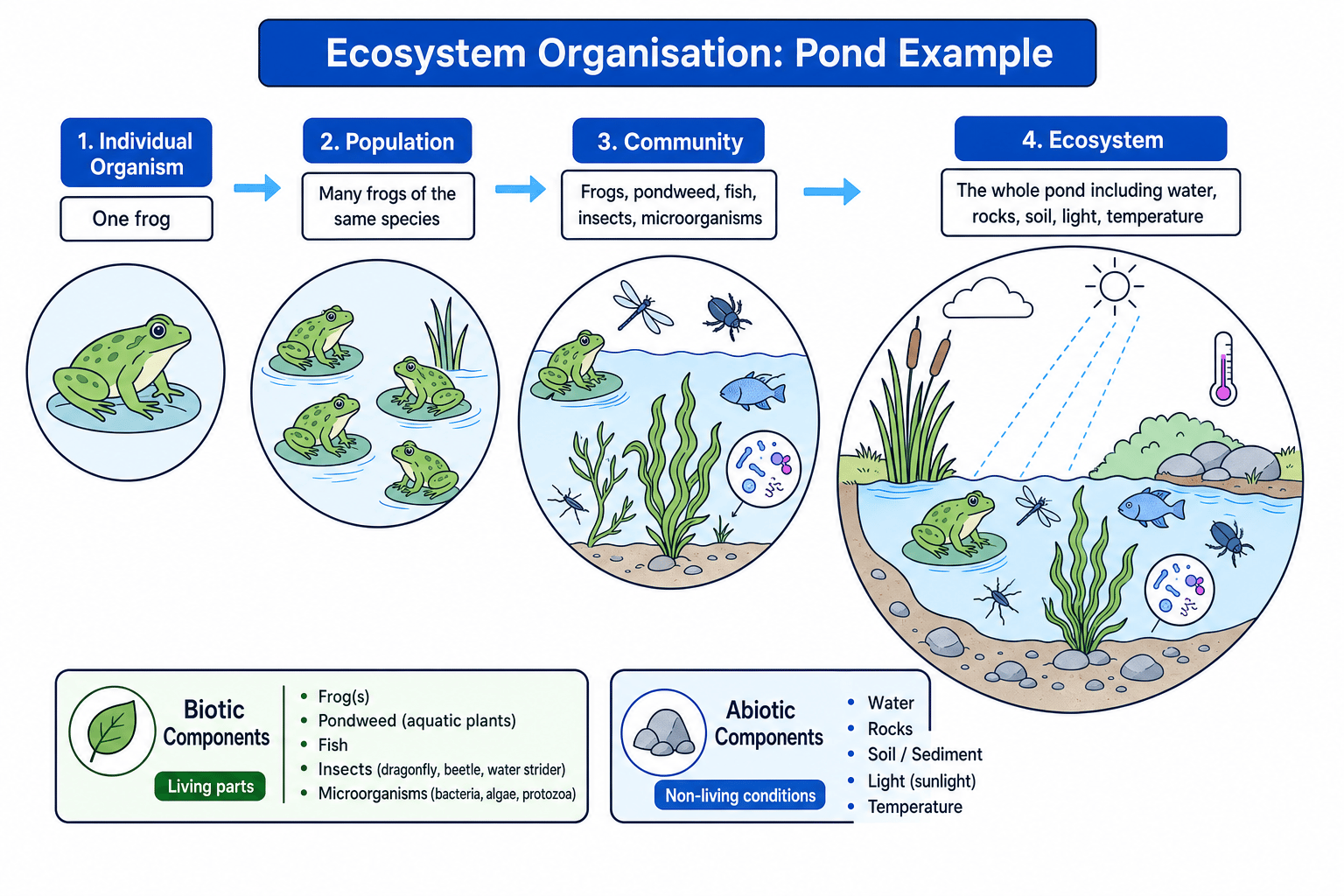
The living parts are called biotic components. Examples include plants, animals, fungi, bacteria and protists. The non-living parts are called abiotic components. Examples include light intensity, temperature, water, soil pH and mineral ions.
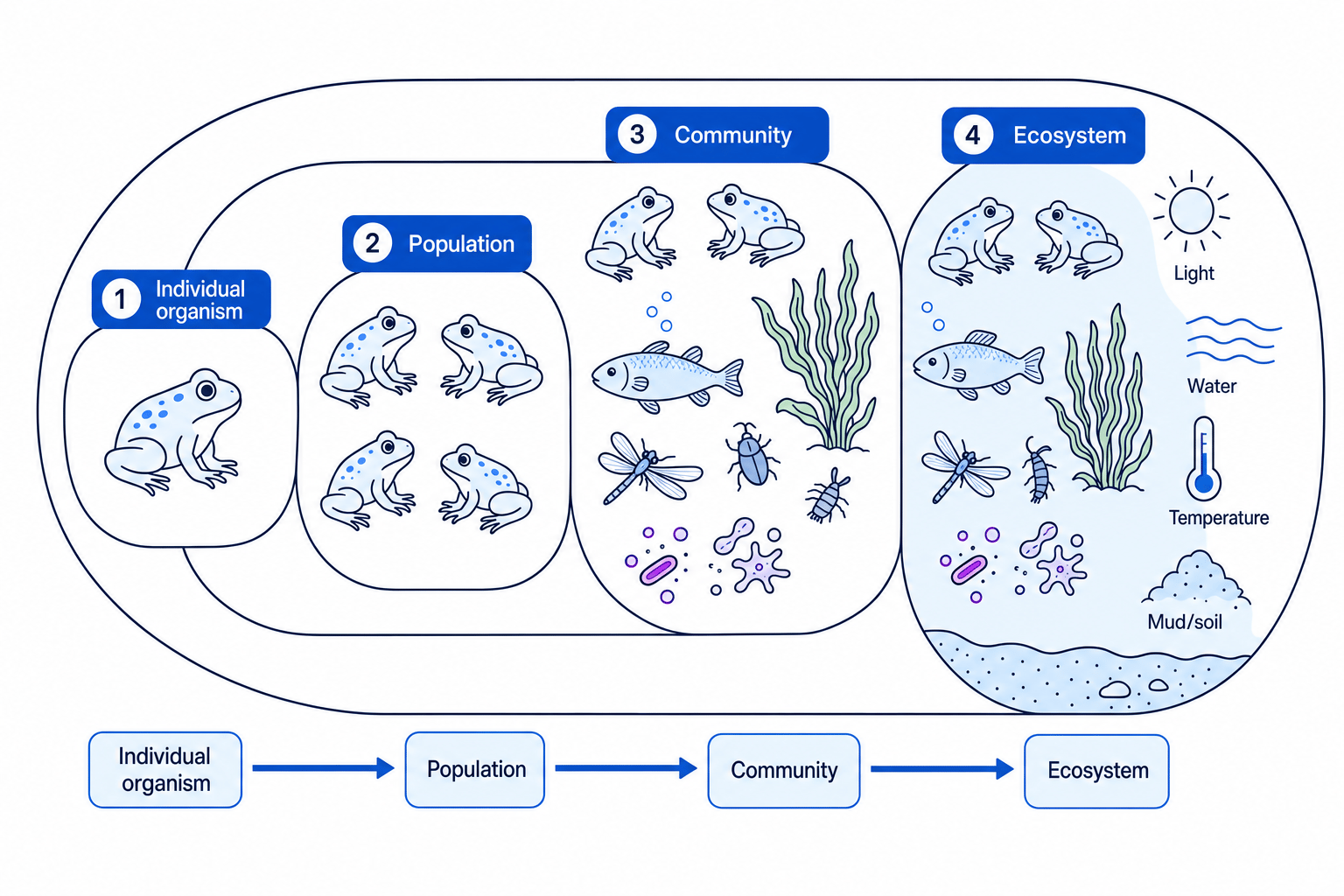
Ecosystems are organised in levels:
- Individual organism: one living thing, such as one frog.
- Population: all the organisms of one species in an area, such as all the frogs in one pond.
- Community: all the different populations living together, such as frogs, fish, pondweed and microorganisms.
- Ecosystem: the community plus the abiotic conditions, such as water, light and temperature.
Organisation order
Remember the order: individual organism → population → community → ecosystem.
Materials cycle through ecosystems
Materials do not get “used up” forever. Atoms are recycled between the biotic living parts and the abiotic non-living parts of ecosystems.
Examples of cycled materials include:
- Carbon, found in carbon dioxide, carbohydrates, fats and proteins.
- Nitrogen, needed to make proteins and DNA.
- Water, needed for chemical reactions, transport and habitats.
Cycling materials
Ecosystems depend on the continuous cycling of materials between organisms and their surroundings.
Microorganisms and decomposition
A microorganism is a microscopic living organism, such as a bacterium, fungus or protist. Many microorganisms act as decomposers.
Decomposers
Decomposers are organisms that break down dead organisms and waste material, releasing useful substances back into the environment.
During decomposition, microorganisms release enzymes onto dead material and waste. These enzymes break large biological molecules into smaller soluble substances. The microorganisms absorb some of these substances for growth and respiration.
Decomposition is important because it:
- Releases mineral ions back into the soil for plants to absorb.
- Returns carbon to the atmosphere as carbon dioxide through respiration.
- Prevents dead material and waste from building up.
Decomposition is usually faster in warm, moist, oxygen-rich conditions because microorganisms respire and grow more quickly.
Explaining decomposition rate
A gardener notices that grass cuttings rot faster in a warm, damp compost bin than in a cold, dry pile.
- Compare the abiotic conditions: the compost bin is warmer and moister, while the dry pile has less water available.
- Link conditions to microorganisms: decomposer bacteria and fungi need water for chemical reactions, and their enzyme-controlled reactions are faster at suitable warm temperatures.
- Explain the result: microorganisms grow and respire faster in the compost bin, so they break down the grass cuttings more quickly.
The carbon cycle and water cycle
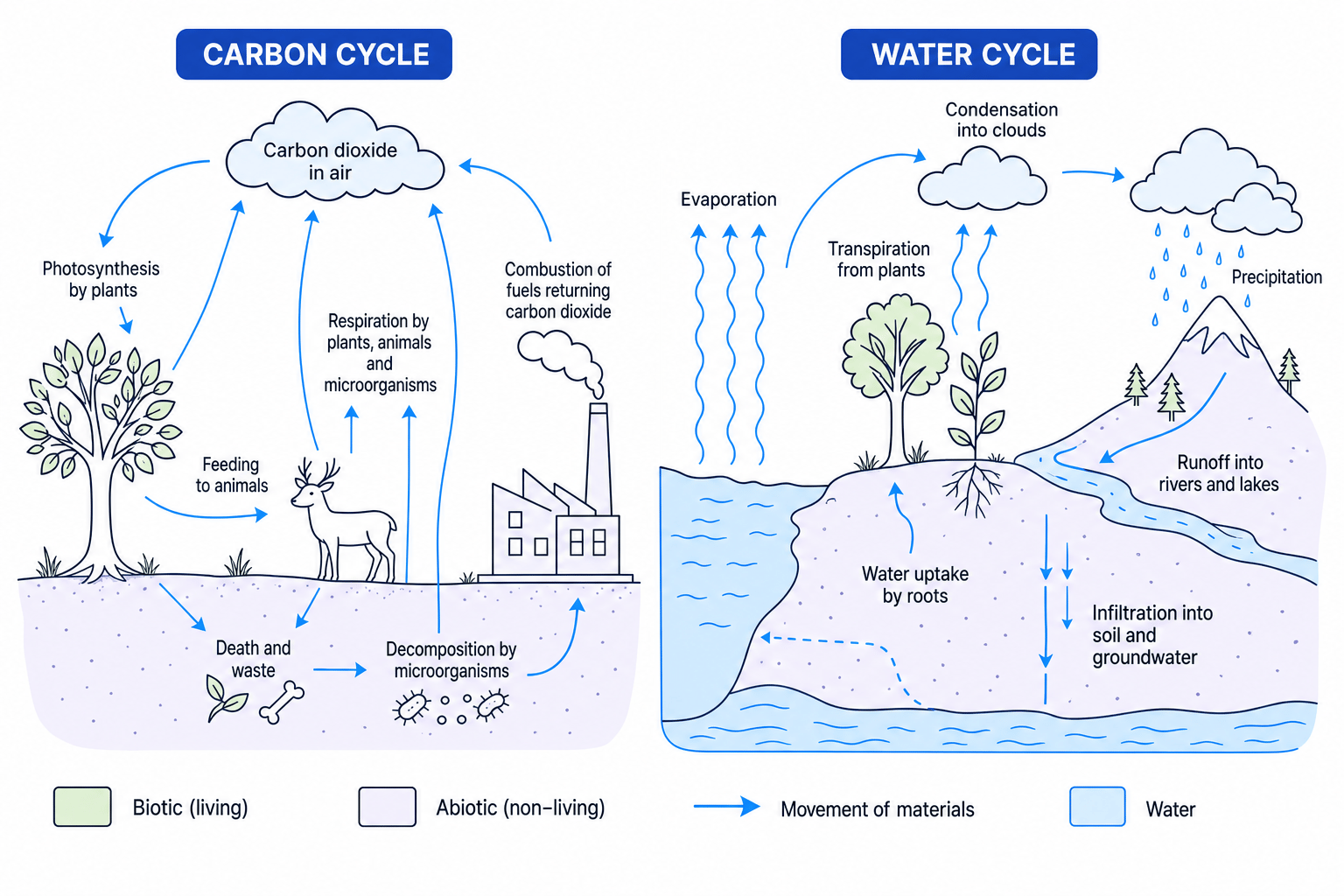
The carbon cycle moves carbon between organisms and the environment.
Main stages of the carbon cycle:
- Plants take in carbon dioxide from the air for photosynthesis.
- Carbon becomes part of plant biomass, such as glucose, starch, cellulose and proteins.
- Animals obtain carbon by feeding on plants or other animals.
- Plants, animals and microorganisms release carbon dioxide by respiration.
- Dead organisms and waste are broken down by decomposers.
- Combustion of fuels releases carbon dioxide into the atmosphere.
The water cycle moves water between land, living organisms, oceans and the atmosphere.
Main stages of the water cycle:
- Evaporation: liquid water changes into water vapour.
- Transpiration: water vapour leaves plants, mainly through leaves.
- Condensation: water vapour cools and forms clouds.
- Precipitation: water falls as rain, snow, sleet or hail.
- Runoff: water flows over land into rivers, lakes and seas.
- Infiltration: water soaks into soil and groundwater.
- Uptake by roots: plants absorb water from the soil.
These cycles are vital because carbon is needed to build biomass, and water helps maintain habitats, transport substances and move nutrients through ecosystems.
Feeding relationships and biomass flow
A producer is an organism that makes its own food, usually by photosynthesis. Green plants and algae are producers.
A consumer is an organism that feeds on other organisms. Animals are consumers.
A food chain shows feeding relationships in a simple line. A food web shows many connected food chains in a community.
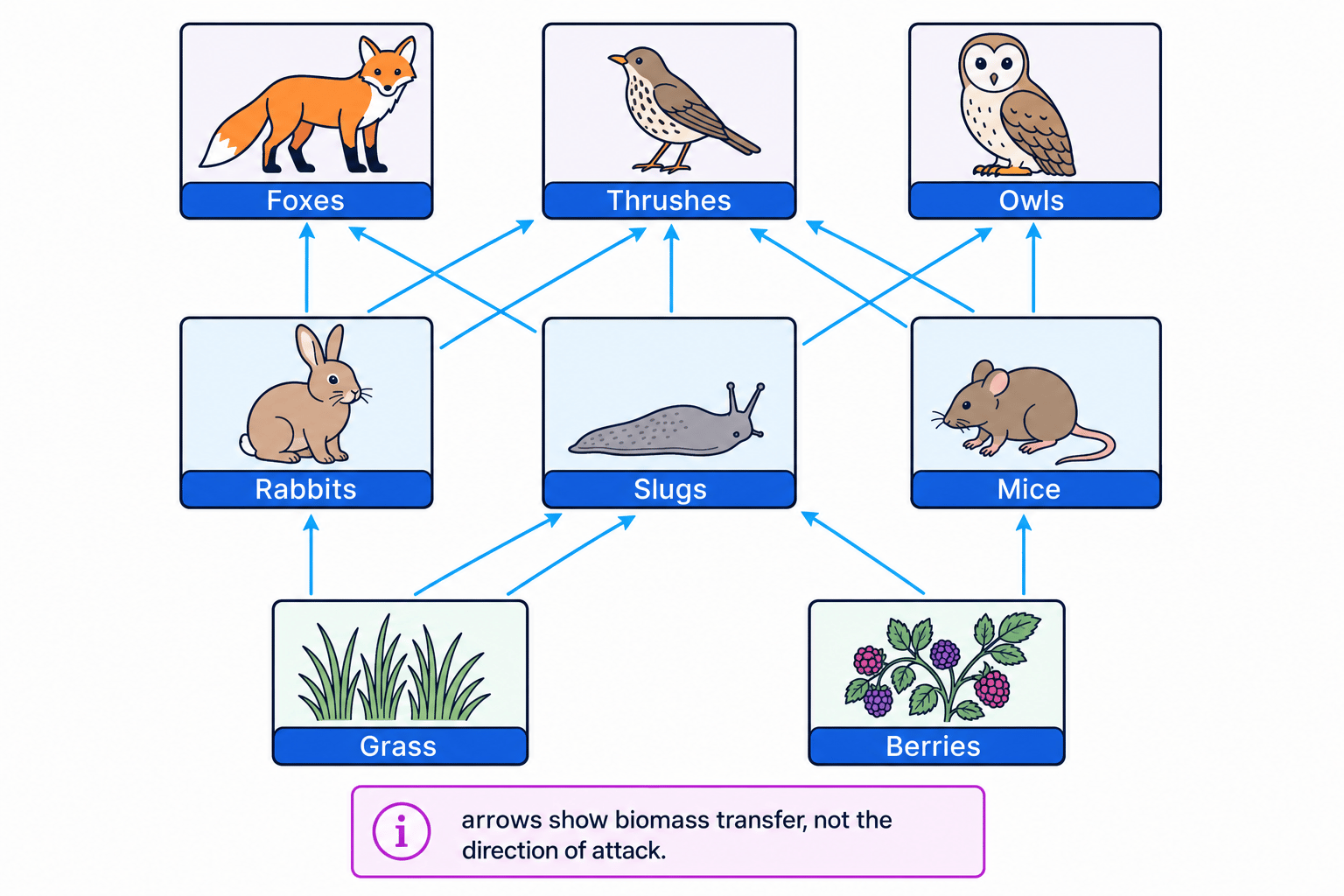
Biomass is the mass of living material. In food chains and food webs, arrows show the direction that biomass is transferred.
Reading food web arrows backwards
The arrow points from the organism being eaten to the organism that eats it. It shows biomass transfer, not the direction the predator moves when attacking.
A stable community has population sizes that stay fairly constant over time. Food webs help stability because organisms may have alternative food sources if one population changes.
Predicting the effect of removing foxes
Use the meadow food web. Suppose foxes are removed from the ecosystem.
- Identify what foxes feed on in the web: arrows point from rabbits and slugs to foxes, so foxes eat rabbits and slugs.
- Predict the direct effect: with fewer foxes, there is less predation on rabbits and slugs, so their populations may increase.
- Predict a knock-on effect: more rabbits would eat more grass, so the grass population may decrease.
- Add a careful limitation: real ecosystems are complex, so the final effect also depends on food supply, disease, competition and other predators.
Calculating percentage mass
You may be asked to calculate the percentage of a total mass. Use:
percentage of total mass=mass of parttotal mass×100\text{percentage of total mass} = \frac{\text{mass of part}}{\text{total mass}} \times 100percentage of total mass=total massmass of part×100Calculating percentage biomass
A quadrat sample contains 90 g of grass, 8 g of slugs and 2 g of other small animals. Calculate the percentage of the total biomass made up by slugs.
- Calculate the total biomass: 90+8+2=100 g90 + 8 + 2 = 100 \text{ g}90+8+2=100 g.
- Substitute the slug biomass into the percentage equation: 8100×100=8\frac{8}{100} \times 100 = 81008×100=8.
- The slugs make up 8% of the total biomass.
Percentage calculations
The part and the total must be in the same unit before you calculate the percentage.
Abiotic and biotic factors
A factor is something that can affect organisms in an ecosystem.
Abiotic factors are non-living conditions, including:
- Temperature.
- Light intensity.
- Moisture level.
- Soil pH.
- Water availability.
- Mineral ion concentration.
Biotic factors are living factors, including:
- Predators.
- Food supply.
- Competition.
- Disease.
- Availability of mates.
These factors affect where organisms live, how well they grow and how successfully they reproduce. For example, low light intensity can reduce photosynthesis in plants, and too little moisture can cause plants to wilt.
Organisms often have adaptations, which are features that help them survive and reproduce in their environment. For example, plants in shady areas may have larger leaves to absorb more light.
Sampling communities
You cannot usually count every organism in a large habitat, so ecologists take samples.
A quadrat is a square frame used to sample organisms in a small area. A transect is a line placed across a habitat, often used to see how organisms change along an environmental gradient, such as from shade to sunlight.
To make results more reliable, samples should be repeated and placed randomly, unless you are deliberately investigating a gradient.
Choosing axes for an ecology graph
A student investigates whether light intensity affects the mean number of daisies per quadrat.
- Decide the independent variable: light intensity is the variable being compared, so it goes on the x-axis.
- Decide the dependent variable: mean number of daisies depends on light intensity, so it goes on the y-axis.
- Choose sensible scales: if light intensity ranges from 0% to 100%, use equal intervals such as 0, 20, 40, 60, 80 and 100 on the x-axis.
- Interpret the trend: if more daisies are found at higher light intensity, light may be one factor limiting daisy growth in that habitat.
Interdependence and competition
Interdependence means organisms in a community depend on each other. This can involve food, shelter, pollination, seed dispersal, gases and recycling nutrients.
Important types of interaction include:
- Predation: one organism, the predator, kills and eats another organism, the prey.
- Mutualism: both organisms benefit.
- Parasitism: one organism benefits while the host is harmed.
Examples:
- Bees and flowering plants show mutualism: bees get nectar, and flowers are pollinated.
- Nitrogen-fixing bacteria in root nodules of leguminous plants, such as clover, can be mutualistic: bacteria gain sugars and shelter, while the plant gains useful nitrogen compounds.
- Leaf miner larvae show parasitism: they live inside leaves and feed on the plant tissue, harming the plant.
Competition happens when organisms need the same limited resource. Plants may compete for light, space, water and mineral ions. Animals may compete for food, territory and mates.
Changes ripple through communities
Because organisms are interdependent, a change in one population can affect many other populations in the food web.
In the exam
- When explaining a food web change, follow the arrows carefully: arrows show biomass moving from food to feeder.
- For “explain” questions, link the factor to the organism: for example, “less light means less photosynthesis, so plants grow more slowly”.
- In graph questions, put the independent variable on the x-axis, use even scales, plot points accurately and describe the overall trend.
Check yourself
- What is the difference between a population, a community and an ecosystem?
- Why are microorganisms important in decomposition and material cycling?
- In a food web, what does the direction of an arrow show?