

What you'll learn
- How the reactivity series decides whether metals are extracted using carbon or electrolysis.
- How to evaluate biological metal extraction, life-cycle assessments and recycling decisions.
- How crude oil is separated into useful fractions by fractional distillation.
- Why cracking turns less useful hydrocarbons into more useful fuels and chemicals.
The big idea: better products, fewer resources
Industry needs materials that perform well, are affordable, and can be made with less damage to the environment. A raw material is a natural starting material, such as metal ore, crude oil or wood. A process is sustainable if it can continue into the future without using resources faster than they can be replaced or causing unacceptable environmental damage.
You already know about materials such as ceramics, polymers and composites. In this topic, you focus on where materials come from, how they are processed, and how we judge their impact.
Assuming reactions always use everything up
In real industrial processes, reactions do not always continue until every reactant is gone. The limiting reactant may run out first, conditions may be changed, or a reversible reaction may reach dynamic equilibrium, where forward and reverse reactions continue at the same rate.
Extracting metals from ores
Reactivity decides the extraction method
An ore is a rock containing enough metal compound to make extraction worthwhile. Most metals are found as compounds, often metal oxides, because they have reacted with oxygen in the Earth’s crust.
The reactivity series ranks metals from most reactive to least reactive. Carbon is important because it can remove oxygen from oxides of metals that are less reactive than carbon.
A non-ferrous metal is a metal that is not iron, such as copper or aluminium.
Reduction
In metal extraction, reduction usually means removing oxygen from a metal oxide. In electrolysis, reduction means a positive metal ion gains electrons.
Carbon is the key dividing line in the reactivity series for metal extraction.
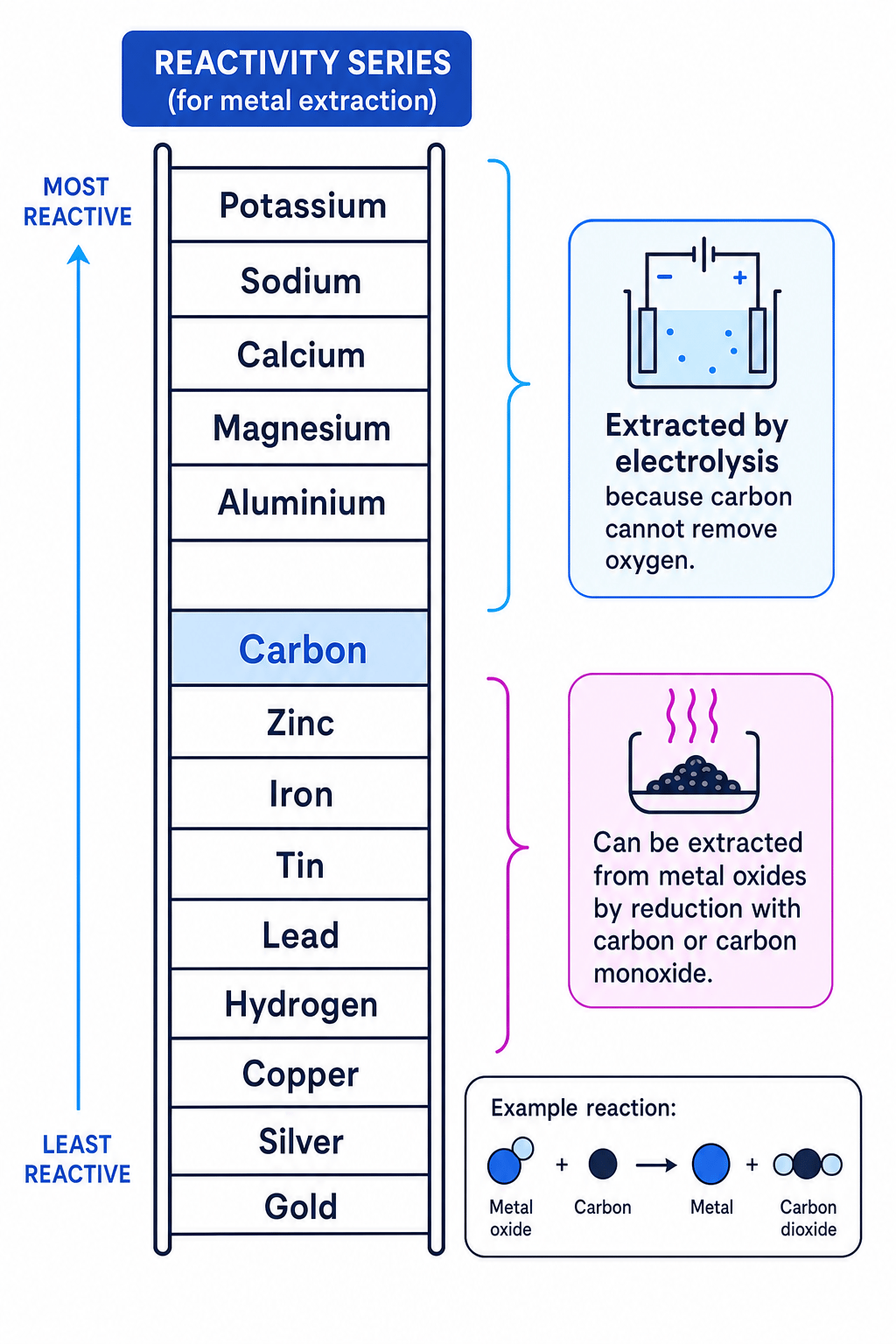
Carbon is the dividing line
Metals below carbon can often be extracted from their oxides by heating with carbon or carbon monoxide. Metals above carbon are too reactive for carbon to extract, so electrolysis is used instead.
Extracting metals using carbon
For less reactive metals, carbon can reduce the metal oxide. For example, copper can be extracted by heating copper(II) oxide with carbon:
2CuO(s)+C(s)→2Cu(s)+CO2(g)2\mathrm{CuO}(s)+\mathrm{C}(s)\to 2\mathrm{Cu}(s)+\mathrm{CO}_2(g)2CuO(s)+C(s)→2Cu(s)+CO2(g)Iron is extracted in a blast furnace mainly by reduction with carbon monoxide:
Fe2O3(s)+3CO(g)→2Fe(l)+3CO2(g)\mathrm{Fe}_2\mathrm{O}_3(s)+3\mathrm{CO}(g)\to 2\mathrm{Fe}(l)+3\mathrm{CO}_2(g)Fe2O3(s)+3CO(g)→2Fe(l)+3CO2(g)Choosing an extraction method
- Compare the metal with carbon in the reactivity series: zinc, iron and copper are below carbon, but aluminium is above carbon.
- A metal below carbon can be extracted from its oxide by reduction with carbon or carbon monoxide, so zinc oxide and copper oxide can use carbon-based extraction.
- Aluminium oxide cannot be reduced by carbon because aluminium is more reactive than carbon, so aluminium must be extracted by electrolysis.
Extracting metals using electrolysis
Electrolysis is the decomposition of an ionic compound using a direct electric current. It is used for very reactive metals, such as aluminium, because carbon cannot remove oxygen from their compounds.
In electrolysis, the compound must be molten or dissolved so the ions can move. The cathode is the negative electrode, where positive metal ions gain electrons. The anode is the positive electrode.
For aluminium extraction:
Al3+(l)+3e−→Al(l)\mathrm{Al}^{3+}(l)+3e^-\to \mathrm{Al}(l)Al3+(l)+3e−→Al(l)At the anode, oxide ions lose electrons to form oxygen:
2O2−(l)→O2(g)+4e−2\mathrm{O}^{2-}(l)\to \mathrm{O}_2(g)+4e^-2O2−(l)→O2(g)+4e−Electrolysis is effective, but it uses a lot of electrical energy, so it is expensive. School practicals such as electrolysis of aqueous copper sulfate or sodium chloride show the same idea of ions moving to electrodes, but industrial extraction of reactive metals often uses molten compounds.
Reversing the carbon rule
Do not write “metals above carbon are extracted by carbon”. It is the opposite: metals above carbon are too reactive, so they need electrolysis.
Biological methods of metal extraction
For Higher Tier, you should be able to evaluate biological methods of extracting metals from low-grade ores. A low-grade ore contains only a small percentage of the desired metal, so traditional mining and heating may be wasteful.
Bioleaching uses bacteria to convert metal compounds into soluble metal compounds. The solution containing the metal is called a leachate. The metal can then be extracted from the leachate, often by electrolysis or displacement.
Phytoextraction uses plants. The plants absorb metal ions from soil through their roots. The plants are harvested and burned, and the metal compounds are extracted from the ash.
Evaluating bioleaching
- If an ore contains only a small concentration of copper, heating huge amounts of rock may use too much energy and produce too much waste.
- Bioleaching may be suitable because bacteria can extract copper compounds from low-grade ore without high-temperature furnaces.
- However, bioleaching is slow and still needs further processing, so it may be less suitable if copper is needed quickly or in very large amounts.
Life-cycle assessment and recycling
What is a life-cycle assessment?
A life-cycle assessment, or LCA, estimates the environmental impact of a product across its whole life, not just when it is being made.
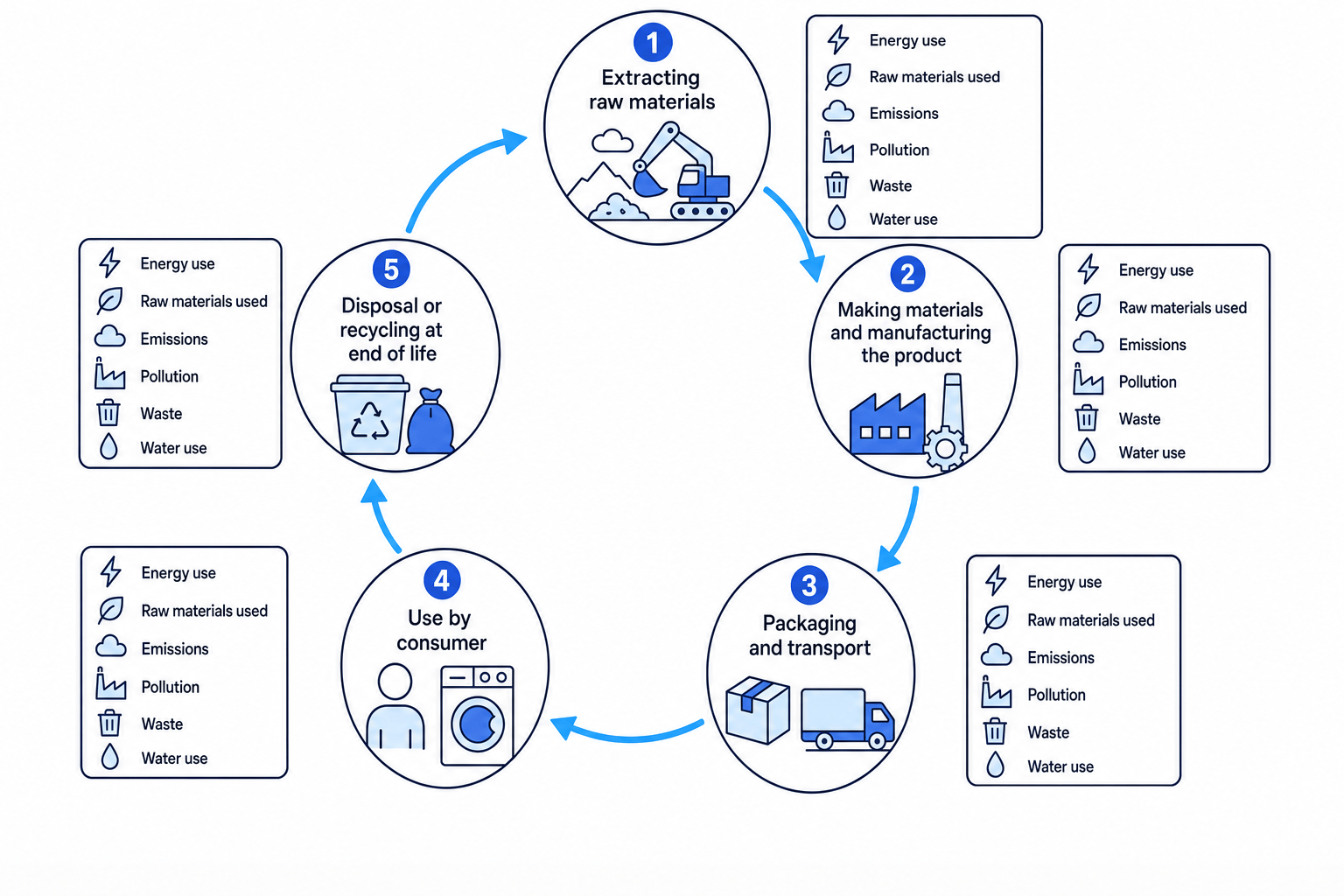
An LCA usually considers:
- extracting raw materials
- making materials and manufacturing the product
- packaging and transport
- using the product
- disposal, reuse or recycling at the end of its life
At each stage, you might compare energy use, water use, waste, pollution, greenhouse gas emissions and use of limited resources.
Whole life, not one moment
A product that looks “green” at one stage may have a larger impact at another stage. Always judge the whole life cycle.
Interpreting life-cycle energy data
A reusable cup needs 4000 kJ to make and 50 kJ per wash. A disposable cup needs 250 kJ to make and is used once.
- Write the energy for nnn uses of the reusable cup as Ereusable=4000+50nE_{\text{reusable}}=4000+50nEreusable=4000+50n kJ.
- Write the energy for nnn disposable cups as Edisposable=250nE_{\text{disposable}}=250nEdisposable=250n kJ.
- Find when the reusable cup uses less energy: 4000+50n<250n4000+50n<250n4000+50n<250n, so 4000<200n4000<200n4000<200n and n>20n>20n>20.
- The reusable cup has lower energy use after 21 uses, but a full LCA would also consider water use, transport and disposal.
Recycling and different uses
Recycling means processing waste materials so they can be used again. Sometimes a material is recycled for a different use, called downcycling. For example, waste glass can be crushed and used as aggregate in road building, or plastic bottles can be turned into fibres for clothing.
This can be viable because it reduces landfill, saves raw materials and may use less energy than making new material from scratch.
Decisions about recycling depend on:
- how easy the material is to collect and separate
- contamination, such as food mixed with plastic
- transport distance to the recycling plant
- energy and water needed for processing
- demand for the recycled product
- whether the recycled material has suitable properties
Deciding whether recycling is viable
- Mixed-colour waste glass may be difficult to turn back into clear glass bottles because it needs careful sorting.
- Crushing it for road aggregate is less demanding because colour does not matter and the glass still has useful hardness.
- If the road project is nearby, recycling is likely to be viable; if transport is very long, the fuel use may reduce the environmental benefit.
Crude oil and useful hydrocarbons
Crude oil as a feedstock
Crude oil is a mixture of many hydrocarbons, which are compounds containing hydrogen and carbon only. It is a major feedstock, meaning a raw material used to make other chemicals in the petrochemical industry.
Crude oil is a finite resource because it forms over millions of years and is being used much faster than it is replaced. Modern life depends on hydrocarbons for fuels, plastics, solvents, lubricants, medicines, detergents and synthetic fibres.
Fractional distillation
A fraction is a mixture of hydrocarbons with similar boiling points. Crude oil is separated by fractional distillation.
The crude oil is heated so most of it vaporises. The vapours enter a fractionating column, which is hot at the bottom and cooler at the top. Hydrocarbons condense when they reach a level below their boiling point.
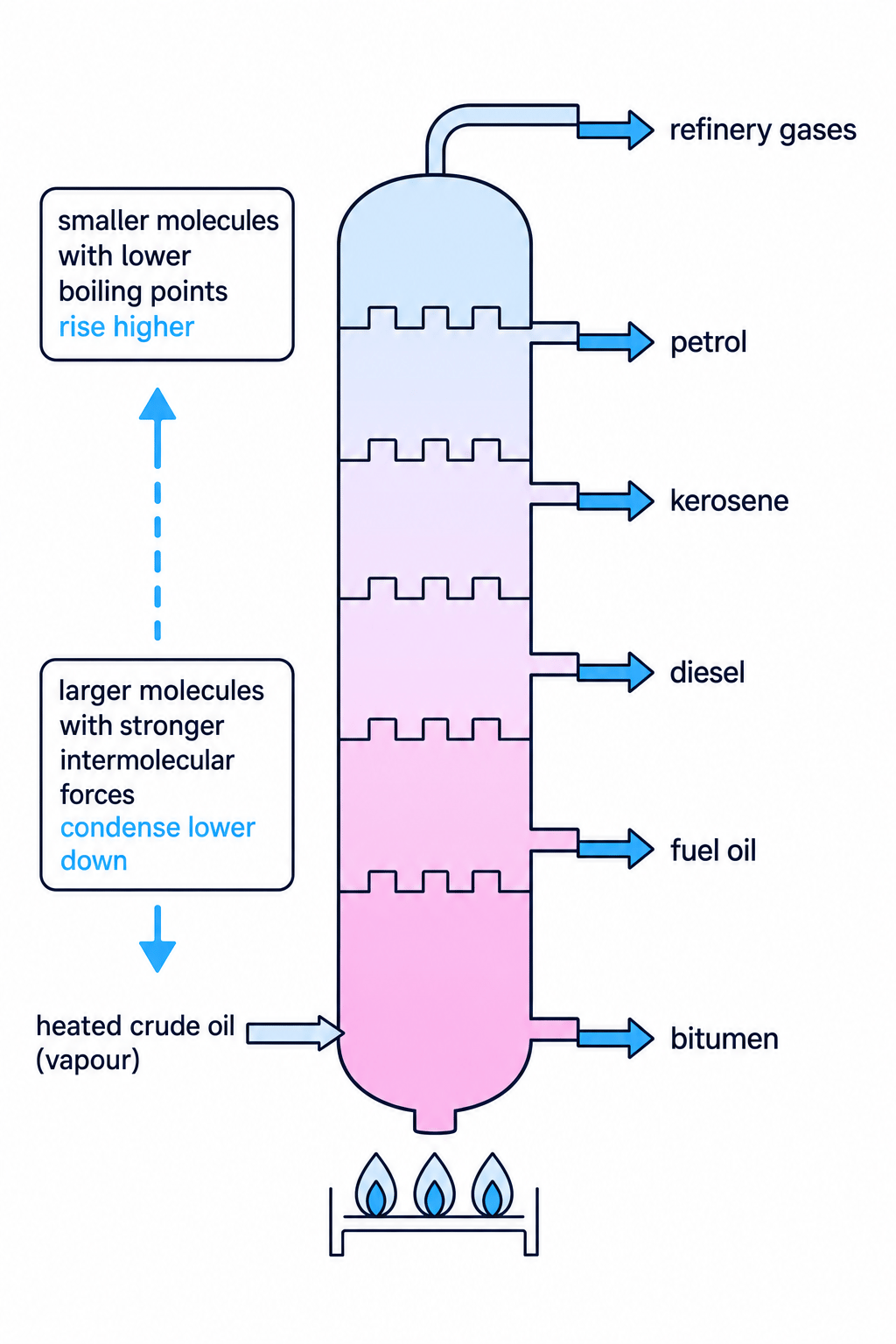
Common fractions include refinery gases, petrol, kerosene, diesel, fuel oil and bitumen.
Why the fractions separate
Smaller hydrocarbon molecules have weaker intermolecular forces between molecules, so they have lower boiling points and rise higher in the column. Larger molecules have stronger intermolecular forces, so they have higher boiling points and condense lower down.
Alkane homologous series
Most compounds in crude oil fractions are alkanes: saturated hydrocarbons with only single carbon-carbon bonds. They have the general formula CnH2n+2\mathrm{C}_n\mathrm{H}_{2n+2}CnH2n+2 and form a homologous series, meaning they have similar chemical properties and a pattern in their formulas.
Predicting where a fraction condenses
- Compare the molecule sizes: C5H12\mathrm{C}_5\mathrm{H}_{12}C5H12 is smaller than C16H34\mathrm{C}_{16}\mathrm{H}_{34}C16H34.
- The larger molecule has stronger intermolecular forces, so it has a higher boiling point.
- Therefore C16H34\mathrm{C}_{16}\mathrm{H}_{34}C16H34 condenses lower down in the hotter part of the column, while C5H12\mathrm{C}_5\mathrm{H}_{12}C5H12 rises higher.
Cracking
Cracking breaks long-chain hydrocarbons into shorter, more useful molecules. This is done because long-chain fractions are often less useful and less in demand than petrol and small alkenes.
The conditions are usually high temperature and either a catalyst, such as silica or alumina, or steam. The long-chain hydrocarbon is vaporised, then split.
For example:
C10H22(g)→C8H18(g)+C2H4(g)\mathrm{C}_{10}\mathrm{H}_{22}(g)\to \mathrm{C}_{8}\mathrm{H}_{18}(g)+\mathrm{C}_{2}\mathrm{H}_4(g)C10H22(g)→C8H18(g)+C2H4(g)The shorter alkane can be used as a fuel. The alkene, such as ethene, contains a carbon-carbon double bond and can be used to make polymers.
Checking a cracking equation
- Count carbon atoms: the reactant has 10 carbon atoms; the products have 8 plus 2, so carbon is balanced.
- Count hydrogen atoms: the reactant has 22 hydrogen atoms; the products have 18 plus 4, so hydrogen is balanced.
- Identify the useful products: C8H18\mathrm{C}_8\mathrm{H}_{18}C8H18 is a shorter fuel molecule, and C2H4\mathrm{C}_2\mathrm{H}_4C2H4 is an alkene used to make polymers.
In the exam
- For metal extraction, always compare the metal with carbon: below carbon means reduction with carbon may work; above carbon means electrolysis.
- For LCAs and recycling questions, use the data given and mention trade-offs instead of claiming one product is always “best”.
- For crude oil questions, link chain length to intermolecular forces, then boiling point, then position in the fractionating column.
Check yourself
- Why can carbon extract copper from copper oxide but not aluminium from aluminium oxide?
- What stages should be included in a life-cycle assessment of a plastic bottle?
- How does cracking make crude oil fractions more useful?
