

What you'll learn
- What a reversible reaction is and how conditions can reverse some reactions.
- What dynamic equilibrium means in a closed system.
- How to interpret equilibrium from concentration-time graphs.
- Higher Tier: how changing concentration, temperature and pressure affects equilibrium position.
Starting point: reactions can be reversible
In many chemical equations, the arrow points one way:
reactants → products
This means the reaction is treated as irreversible: the products are not easily changed back into the original reactants under normal conditions.
Some reactions can go both ways. We show these with the reversible arrow ⇌.
Reversible reaction
A reversible reaction is a reaction where the products can react to reform the original reactants. The forward and reverse reactions are shown using ⇌.
For example:
NH₄Cl(s) ⇌ NH₃(g) + HCl(g)
Heating ammonium chloride can produce ammonia and hydrogen chloride gases. Cooling the gases can make them recombine to form solid ammonium chloride again.
Forward and reverse reactions
For a general reversible reaction:
A(aq) + B(aq) ⇌ C(aq) + D(aq)
- The forward reaction goes from left to right: reactants form products.
- The reverse reaction goes from right to left: products reform reactants.
Changing conditions can reverse some reactions
For reversible reactions, changing conditions such as temperature can make one direction happen more than the other.
Reaction rate: how fast a reaction happens
Before equilibrium makes sense, you need the idea of rate.
Rate of reaction
The rate of reaction is how quickly reactants are used up or products are made.
A common way to calculate an average rate is:
average rate=change in concentrationtime taken\text{average rate} = \frac{\text{change in concentration}}{\text{time taken}}average rate=time takenchange in concentrationThe units could be mol/dm³/s if concentration is measured in mol/dm³ and time in seconds.
Calculating an average rate
A product’s concentration increases from 0.00 mol/dm³ to 0.40 mol/dm³ in 20 s. Calculate the average rate of formation.
-
Work out the change in concentration:
0.40−0.00=0.400.40 - 0.00 = 0.400.40−0.00=0.40 mol/dm³. -
Substitute into the rate equation:
average rate=0.40÷20\text{average rate} = 0.40 \div 20average rate=0.40÷20. -
Calculate the rate:
average rate=0.020\text{average rate} = 0.020average rate=0.020 mol/dm³/s.
Closed systems
A reversible reaction only reaches equilibrium properly if the reaction happens in a closed system.
Closed system
A closed system is one where no reactants or products can enter or leave.
This is especially important for gases. If a gas product escapes, it cannot react backwards, so equilibrium cannot be maintained.
Dynamic equilibrium
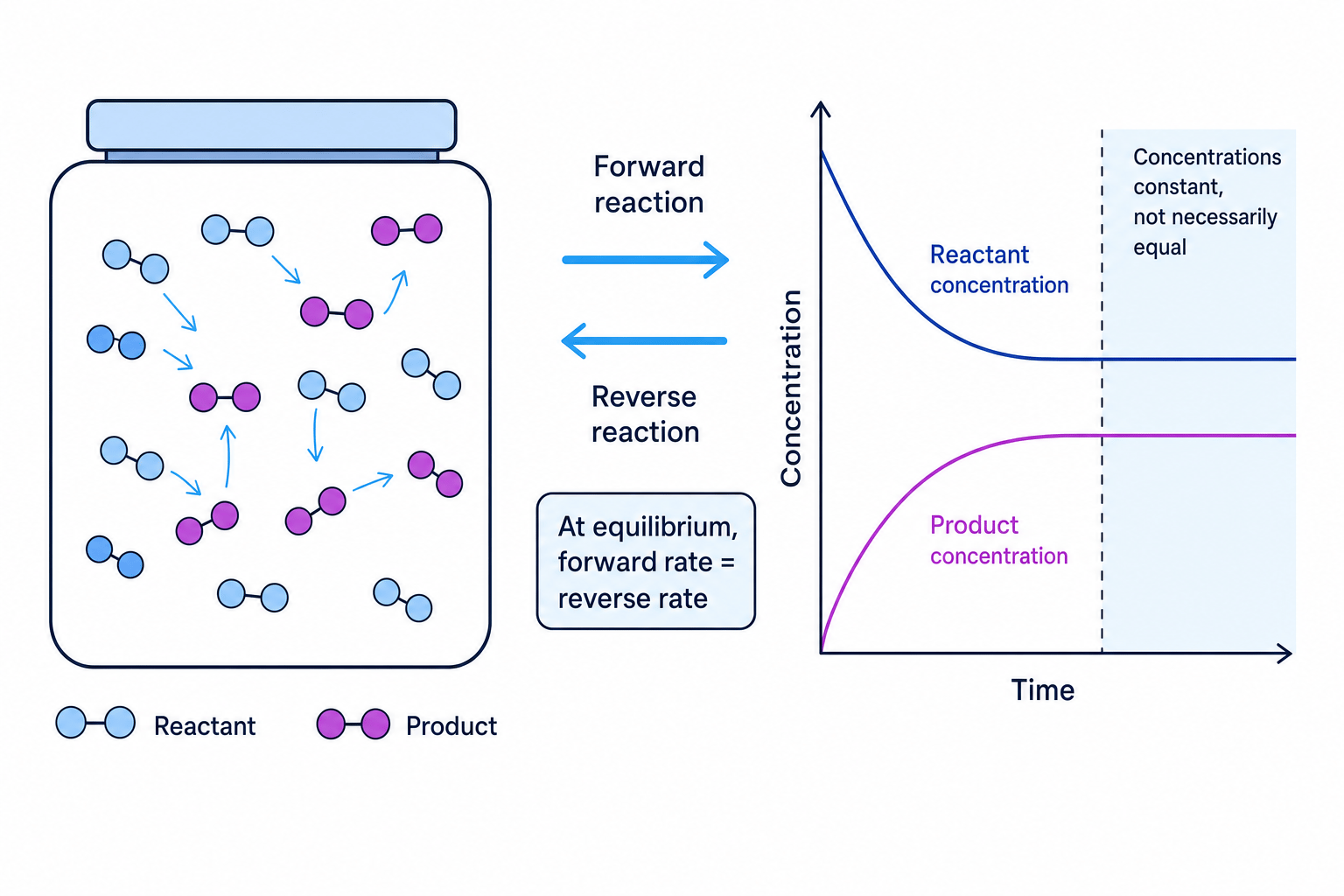
At first in a reversible reaction, the forward reaction may be faster because there are lots of reactants and few products. As products build up, the reverse reaction becomes faster too.
Eventually, in a closed system, the forward and reverse reactions happen at the same rate.
Dynamic equilibrium
Dynamic equilibrium occurs in a closed system when the rate of the forward reaction equals the rate of the reverse reaction.
The word dynamic means “moving”. At equilibrium, the reactions have not stopped — both directions are still happening. But the amounts of reactants and products stay constant because they are being made and used up at equal rates.
The graph below shows the key idea: concentrations become constant, but they do not have to become equal.
Constant does not mean equal
At equilibrium, the concentrations of reactants and products stay constant. They are not necessarily the same concentration.
Interpreting an equilibrium graph
A reversible reaction happens in a sealed flask. The concentration of reactant A decreases then becomes constant at 0.30 mol/dm³. The concentration of product B increases then becomes constant at 0.50 mol/dm³.
-
Because the flask is sealed, no substances can escape, so the reaction is happening in a closed system.
-
Both concentrations become constant, so the overall amounts of A and B are no longer changing.
-
Since the reaction is reversible and the system is closed, constant concentrations mean the forward and reverse reaction rates are equal.
-
The reaction is at dynamic equilibrium, but the concentrations are not equal: B is 0.50 mol/dm³ and A is 0.30 mol/dm³.
Equilibrium position
Chemists often talk about the position of equilibrium.
Equilibrium position
The equilibrium position describes which side of a reversible reaction is favoured at equilibrium. If it lies to the right, there is more product. If it lies to the left, there is more reactant.
For example:
A(g) + B(g) ⇌ C(g)
If there is much more C than A and B at equilibrium, the equilibrium position is to the right.
Equilibrium position and yield
To make as much product as possible, you want the equilibrium position to move towards the product side.
Higher Tier: Le Chatelier’s principle
For Higher Tier, you need to predict how changing reaction conditions affects equilibrium.
Le Chatelier’s principle
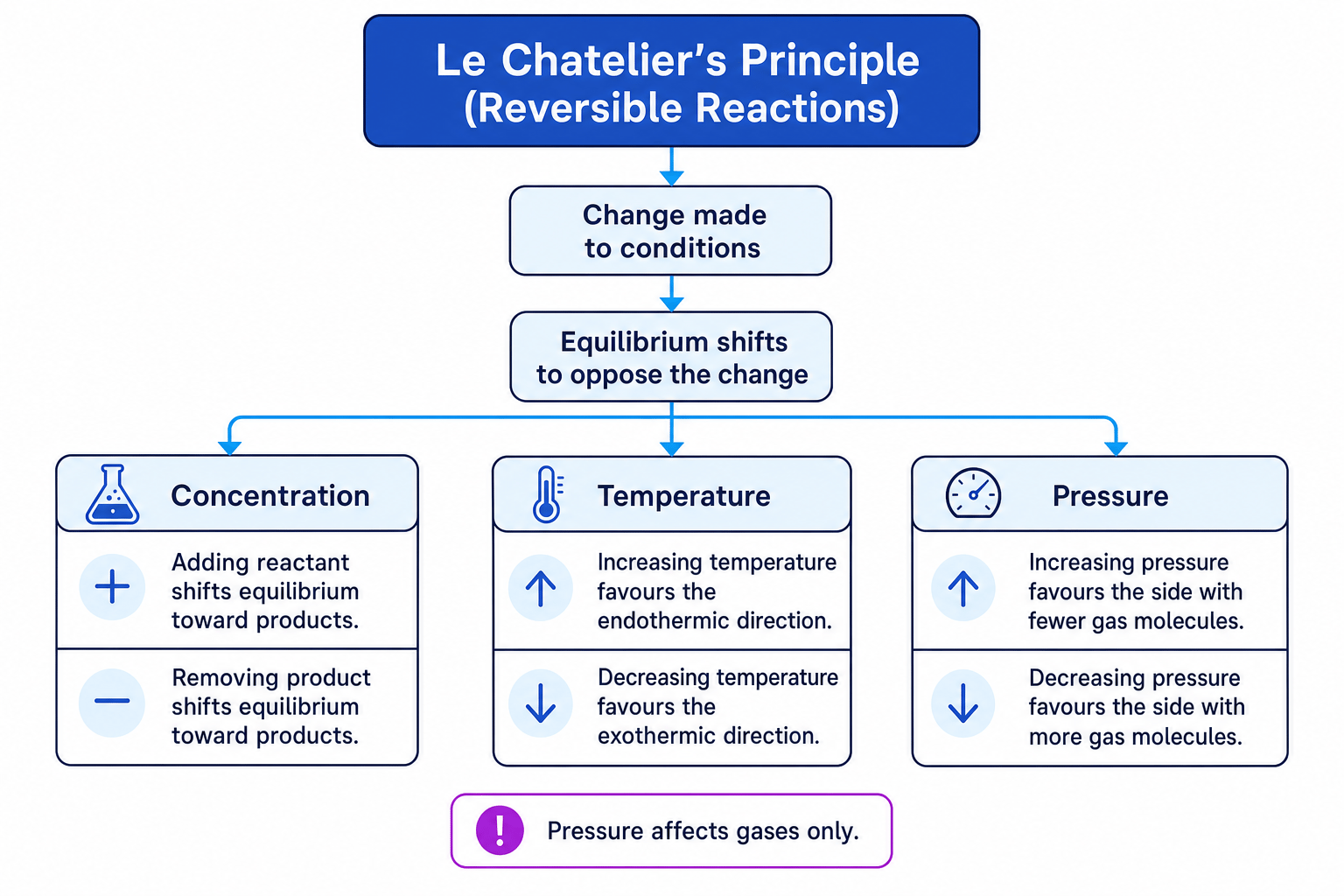
Le Chatelier’s principle says that if a change is made to the conditions of a system at equilibrium, the equilibrium shifts to oppose the change.
“Shifts” means one reaction direction temporarily becomes more important until a new equilibrium is reached.
Changing concentration
If you change the concentration of a reactant or product, the equilibrium shifts to reduce that change.
For:
A(aq) + B(aq) ⇌ C(aq)
- Adding A or B shifts equilibrium to the right, making more C.
- Removing C shifts equilibrium to the right, replacing some C.
- Adding C shifts equilibrium to the left, using up some C.
- Removing A or B shifts equilibrium to the left, replacing the reactant removed.
Predicting the effect of changing concentration
For the reaction:
A(aq) + 2B(aq) ⇌ C(aq)
A chemist wants to make more C. Suggest two concentration changes that would help.
-
C is on the right-hand side, so the equilibrium needs to shift to the right.
-
Adding A or B increases reactant concentration. The equilibrium shifts right to use up some of the added reactant, making more C.
-
Removing C also helps. The equilibrium shifts right to replace some of the product removed.
Changing temperature
Temperature changes depend on whether the forward reaction is exothermic or endothermic.
Exothermic and endothermic
An exothermic reaction transfers energy to the surroundings. An endothermic reaction takes in energy from the surroundings.
For equilibrium:
- Increasing temperature favours the endothermic direction.
- Decreasing temperature favours the exothermic direction.
You can think of heat as something the equilibrium tries to use up or replace.
Predicting the effect of temperature on ammonia yield
Ammonia is made in this reversible reaction:
N₂(g) + 3H₂(g) ⇌ 2NH₃(g)
The forward reaction is exothermic. Predict the effect of increasing temperature on the amount of ammonia at equilibrium.
-
The forward reaction makes ammonia and is exothermic, so the reverse reaction is endothermic.
-
Increasing temperature is opposed by favouring the endothermic direction.
-
The endothermic direction is the reverse reaction, so equilibrium shifts left.
-
Less ammonia is present at equilibrium, so the ammonia yield decreases.
Temperature shortcut
If the product you want is made by an exothermic reaction, a lower temperature gives a higher equilibrium yield. If it is made by an endothermic reaction, a higher temperature gives a higher equilibrium yield.
Changing pressure
Pressure changes only affect equilibria involving gases.
For gases:
- Increasing pressure favours the side with fewer gas molecules.
- Decreasing pressure favours the side with more gas molecules.
- If both sides have the same number of gas molecules, pressure does not change the equilibrium position.
Use the balanced equation to count gas molecules. Only count substances with state symbol (g).
Predicting the effect of pressure
For the reaction:
N₂(g) + 3H₂(g) ⇌ 2NH₃(g)
Predict the effect of increasing pressure on the amount of ammonia at equilibrium.
-
Count gas molecules on the left: 1 molecule of nitrogen plus 3 molecules of hydrogen gives 4 gas molecules.
-
Count gas molecules on the right: 2 molecules of ammonia gives 2 gas molecules.
-
Increasing pressure favours the side with fewer gas molecules.
-
The right-hand side has fewer gas molecules, so equilibrium shifts right and the ammonia yield increases.
Counting solids and liquids for pressure
When deciding the effect of pressure, only count gases. Solids, liquids and aqueous substances are not counted for this GCSE rule.
Choosing conditions to make more product
To choose conditions for a reversible reaction:
- Identify which side contains the product you want.
- Choose concentration changes that shift equilibrium towards that side.
- Use temperature to favour the direction that makes the product.
- Use pressure only if gases are involved, and count gas molecules on each side.
In real industrial processes, chemists may compromise. For example, a low temperature might give a high equilibrium yield for an exothermic product, but it may also make the reaction too slow. Very high pressures can be expensive and dangerous.
Catalysts and equilibrium
A catalyst helps a reaction reach equilibrium faster, but it does not change the equilibrium position or increase the final equilibrium yield.
In the exam
-
For equilibrium definitions, always include closed system and forward rate equals reverse rate.
-
If asked about concentration, temperature or pressure, state the direction of shift and explain how it opposes the change.
-
For pressure questions, count only gas molecules using the balanced equation and state symbols.
Check yourself
- What is the difference between a reversible reaction and dynamic equilibrium?
- Why can concentrations be constant at equilibrium but not equal?
- For an exothermic forward reaction, what happens to product yield when temperature is increased?
