

What you'll learn
- What positive charge, negative charge and neutral mean.
- How rubbing materials can produce static electricity by transferring electrons.
- Why charged objects can attract or repel without touching.
- How current, charge flow and time are linked using Q=ItQ = ItQ=It.
Charge is a property of matter
All matter is made from atoms. Atoms contain protons, which have positive charge, and electrons, which have negative charge. They also contain neutrons, which have no charge.
Most everyday objects do not seem charged because they contain equal amounts of positive and negative charge overall. The effects cancel out, so the object is neutral.
Charge
Charge is a property of matter that can be positive or negative. A neutral object has equal amounts of positive and negative charge overall.
Neutral does not mean no charge
A neutral object still contains charged particles. It is neutral because the positive and negative charges are balanced.
Static electricity
Static electricity is a build-up of charge on an object. It is called “static” because the charge is not flowing continuously around a circuit.
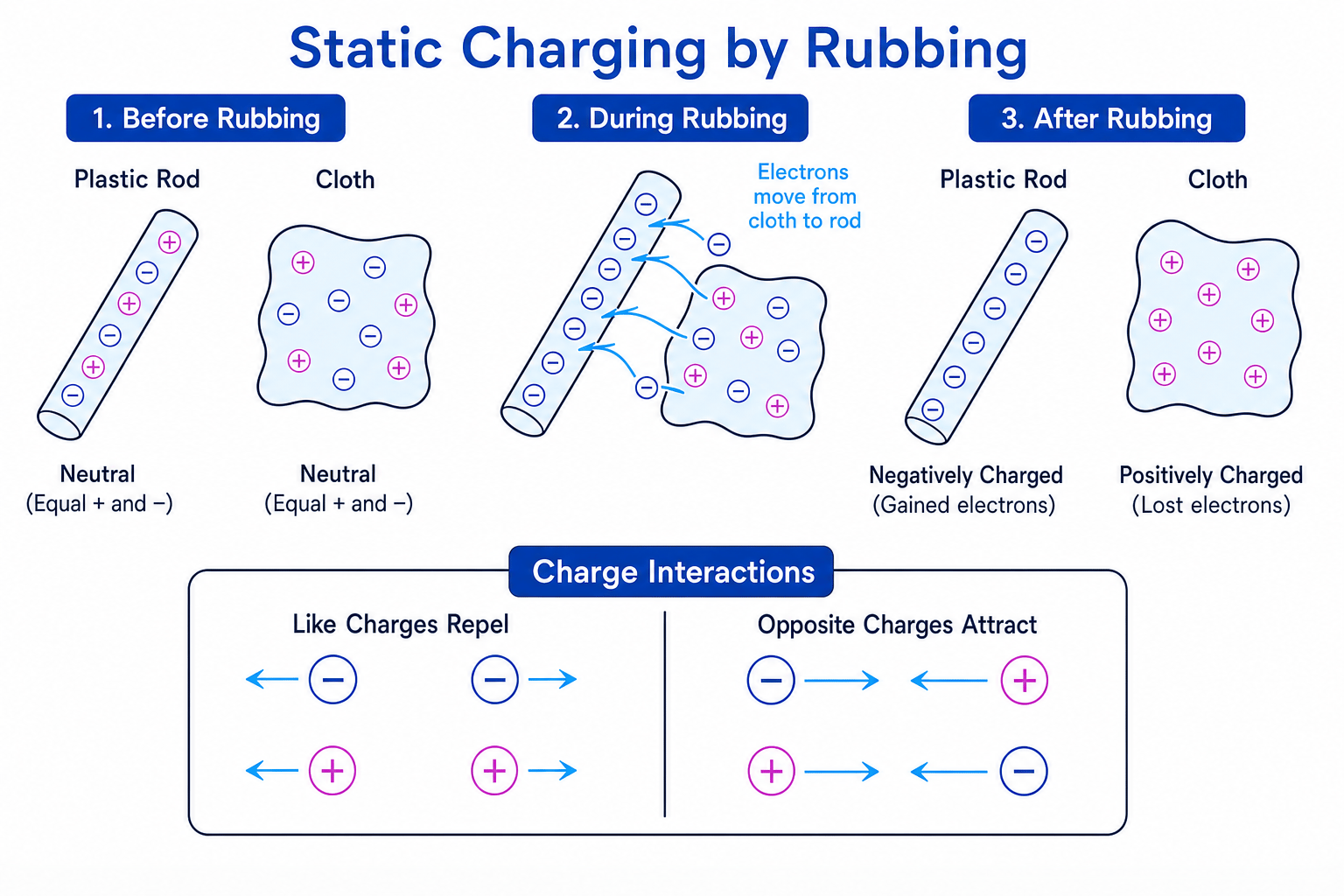
Static charge is often produced when two insulating materials are rubbed together, such as a balloon and hair, or a plastic rod and a cloth. Rubbing does not create charge from nothing. Instead, it causes electrons to transfer from one surface to the other.
The diagram shows the key idea: rubbing transfers electrons, leaving one object negative and the other positive. Charged objects then exert forces on each other.
Gaining and losing electrons
Electrons are negatively charged, so:
- an object that gains electrons becomes negatively charged
- an object that loses electrons becomes positively charged
The total charge is conserved: charge has moved from one object to another, not appeared from nowhere.
Positive charge does not usually move
When an object becomes positive by rubbing, it has lost electrons. It has not gained protons; protons are held inside nuclei and do not transfer between objects in this situation.
Deciding the charge after rubbing
A balloon is rubbed on a jumper. Electrons move from the jumper to the balloon. Decide the charge on each object and the force between them.
- Electrons are negative, so the balloon has gained negative charge and becomes negatively charged.
- The jumper has lost electrons, so it now has more positive charge than negative charge overall and becomes positively charged.
- The balloon and jumper have opposite charges, so they attract each other.
Conductors and insulators
A conductor is a material that allows charge to move through it easily. Metals are good electrical conductors because some electrons can move freely.
An insulator is a material that does not allow charge to move through it easily. Plastic, rubber and dry glass are common insulators. Static charge is easiest to notice on insulators because the charge cannot quickly flow away.
Spotting the material type
Metals are usually conductors. Plastics, rubber and dry glass are usually insulators. If a charged conductor is connected to Earth, charge can flow away, so it may not stay charged for long.
Forces between charged objects
Charged objects can exert forces on each other without touching. This is an example of a non-contact force.
The rules are:
- like charges repel: positive repels positive, and negative repels negative
- opposite charges attract: positive attracts negative
Electric field
An electric field is the region around a charged object where another charged object would experience a force.
This explains observations such as charged rods attracting or repelling each other, a charged rod picking up small pieces of paper, or a charged object deflecting a thin stream of water.
Attracting neutral objects
A charged object can attract a neutral object. This can seem surprising, because the neutral object has no overall charge.
The reason is that charges inside the neutral object shift slightly. The side nearest the charged object becomes more strongly attracted than the far side is repelled, so there is an overall attraction.
Explaining a balloon sticking to a wall
A rubbed balloon becomes negatively charged and sticks to a neutral wall.
- The balloon has extra electrons, so it is negatively charged.
- The negative balloon repels electrons in the wall slightly away from the surface nearest the balloon.
- The surface of the wall nearest the balloon is left slightly more positive, so the negative balloon is attracted to it.
Sparking
If static charge builds up a lot, there can be a large potential difference between two objects. Potential difference is the “push” that can make charge move.
A spark happens when electrons suddenly jump through the air between objects. You may see a flash, hear a crack, or feel a small shock. A Van de Graaff generator can produce this effect strongly: hair can stand up because strands of hair gain the same charge and repel each other.
Air is usually an insulator
Air normally stops charge flowing, but a large enough potential difference can make air conduct briefly. That sudden movement of electrons through air is a spark.
Current: moving charge
Static electricity is about charge building up. Current electricity is about charge flowing continuously.
Current
Current is the rate of flow of electric charge. In metal wires, the moving charges are electrons. A current of 1 ampere (A) means 1 coulomb (C) of charge passes a point each second.
For charge to flow in a circuit, you need:
- a complete conducting path, called a closed loop
- a source of potential difference, such as a cell or battery
- mobile charge carriers, such as electrons in a metal wire
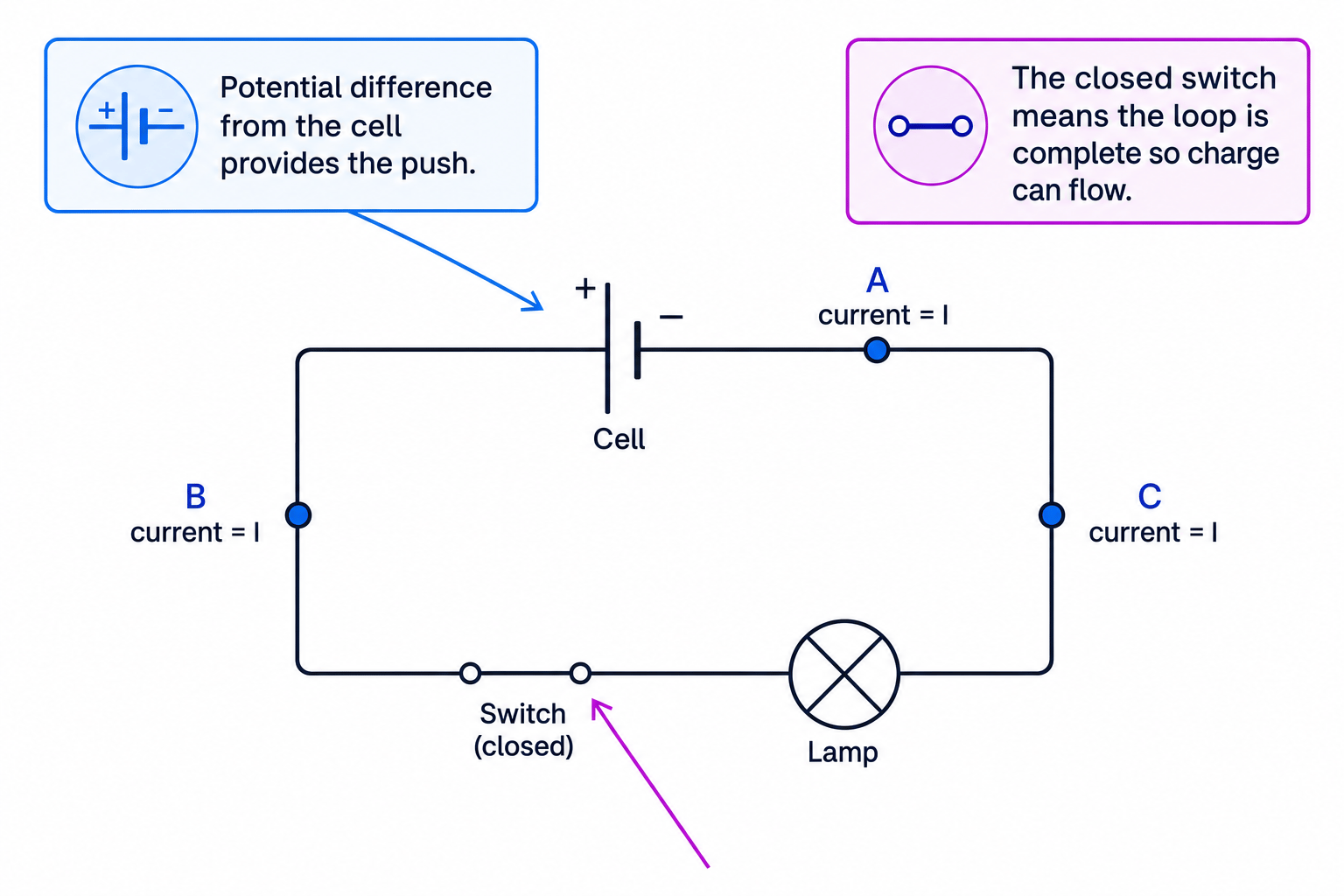
If the circuit is broken, for example by an open switch, the loop is incomplete and there is no continuous current.
In a single closed loop, the current has the same value at every point. Charge does not get “used up” as it travels around the circuit.
Current is not used up
In a single closed loop, a lamp transfers energy from the circuit, but the current does not become smaller after the lamp. The same rate of charge flow passes every point.
Calculating charge flow
For OCR Gateway Combined Science, you need to recall and use this relationship:
Q=ItQ = ItQ=Itwhere:
- QQQ is charge flow in coulombs (C)
- III is current in amperes (A)
- ttt is time in seconds (s)
You can also rearrange it:
I=Qtt=QII = \frac{Q}{t} \qquad t = \frac{Q}{I}I=tQt=IQCalculating charge flow
A current of 0.40 A flows through a lamp for 2.0 minutes. Calculate the charge flow.
-
Convert the time into seconds because the equation uses seconds: 2.0 minutes is 120 s.
-
Choose the charge flow equation and substitute the values:
Q=ItQ=0.40 A×120 s\begin{aligned} Q &= It \\ Q &= 0.40\,\text{A} \times 120\,\text{s} \end{aligned}QQ=It=0.40A×120s -
Calculate the charge flow and include the unit:
Q=48 CQ = 48\,\text{C}Q=48C
Unit check
Because current is coulombs per second, multiplying amperes by seconds gives coulombs. So A multiplied by s gives C.
In the exam
- For static electricity questions, always explain charging in terms of electron transfer, not movement of positive charge.
- If asked about attraction or repulsion, first decide whether the objects have like charges, opposite charges, or whether one object is neutral.
- For Q=ItQ = ItQ=It calculations, convert time into seconds before substituting values, and give the final answer in coulombs.
Check yourself
- If a cloth loses electrons to a plastic rod, what charge does the cloth have?
- Why can a negatively charged balloon attract a neutral wall?
- A current flows for 30 s and transfers 12 C of charge. What equation would you use to find the current?
