A student conducts an experiment to investigate electrostatic charging by friction, as shown in the diagram.
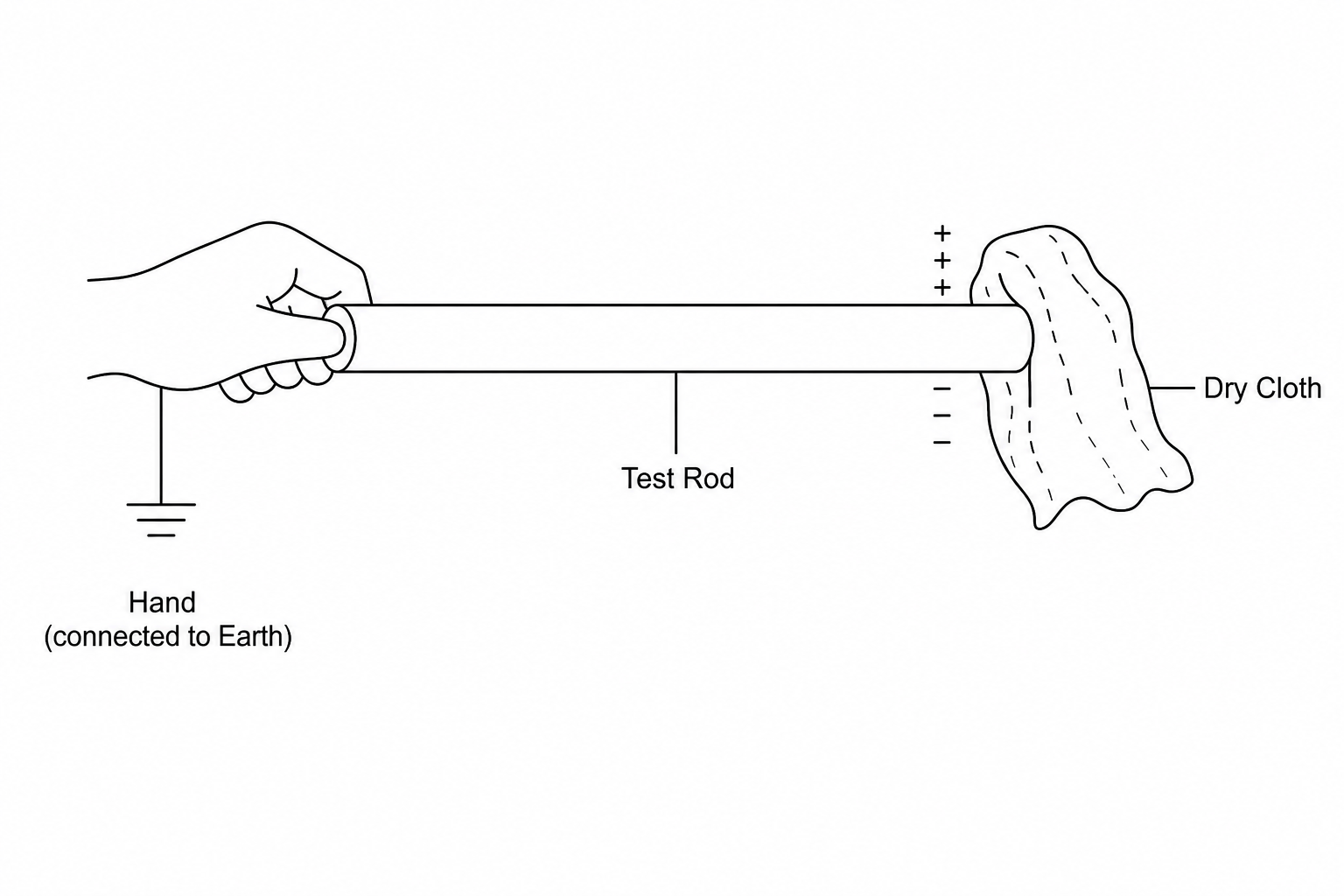
The student holds one end of a test rod with their bare hand (providing a path to Earth) and vigorously rubs the other end with a dry cloth.
Which option correctly identifies a suitable material for the test rod and explains why it successfully retains a static charge on the rubbed end?
A copper rod, because its high concentration of delocalised electrons allows charge to be easily transferred from the cloth and locked in place on the metallic lattice.
A polythene rod, because its high electrical resistivity prevents the transferred charge from migrating through the material to the student's hand and discharging to Earth.
A copper rod, because the high electrical conductivity of the metal ensures that any charge generated is confined purely to the surface at the rubbed end.
A polythene rod, because the insulating material allows charge to flow rapidly towards the hand where it is stored safely by the body's capacitance.